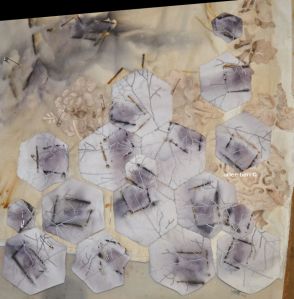
The couple left to be stitched at the bottom will have to be done after the edges are finished (the back covered). Since, as i mentioned before, that “symbol”/shape has shown up before often in my work, i can see these being a focus for awhile in other pieces.
 And the results of the Rumex seed stalk dyepots:
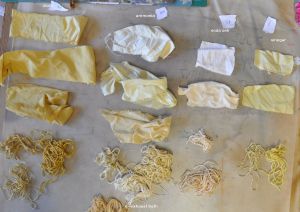 I was quite shocked at how much colour washed out of the soda ash modified one–in the bath, they looked a warm reddish gold, but most of it disappeared. The best was just plain old alum with the dyebath, though i did get a surprise from an immersion of white cotton thread in the exhausted ammonia modified bath, peachy!
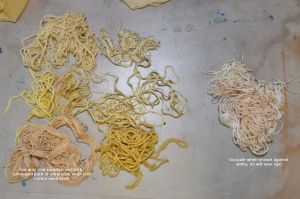
I’m wondering if there was a chemical reaction similar to madder, in that first the yellows are extracted (poured off in madder), and then the redder tones show up? I’ll test that a bit more, as i do like that shade. Other than that, i won’t bother with gathering this plant material again–yellow is basically yellow, after all, and there are a million plants that give that 🙂

 albedo too
I love these hexes so much. There’s something about the way the patchwork is breaking up and the colouring of it that makes me about the end of the book “The Bees” by Laline Paull, where the man who owns the hive is moving and comes in and destroys it in the fall, after the summer harvest, and the chaotic mess that was going on amidst the military order of the bees from within leading up to that point anyway, with the diseased queen laying eggs that spread the destruction from within. It just seemed like such a neat visual interpretation of the breaking up of the hive and honeycomb from within and the bashing up and apocalyptic end from the outside force. Anyway. I know that’s not what you were going for, lol, but there ya go. Hadn’t thought about that book in a couple years until I saw this post. i love the imagery your work ignites- in addition to being beautiful, it always tells the beginning inklings of a story, and becomes curiouser and curiouser.
LikeLiked by 1 person
Thanks Angie! Bees and that honeycomb/hex/cell “symbol show up quite often in my work. I’m a bee rescuer along with my Greyman, and our garden is a haven for them, so despite the destruction mentioned in that book, i appreciate the reference. I’m glad too that you can “see” something in it, without me having to write a lengthy “artist statement”, something i really hate doing, but am going to have to for the exhibit 🙂
LikeLike
I have mixed feelings about artist statements & the little explanation cards that go next to exhibited pieces, and even about titling the art. If I like, love, or am just intrigued about something enough I do like reading whatever info is available about the inspiration and meaning the artist intended, but I always hate seeing any information at all before I really get a chance to consider the art without anything at all, even a simple title, influencing how I feel and think about it. I wish galleries and museums and such would hide all the details of the art behind a little piece of paper you had to flip up to see it or something.
I love that you rescue bees. I’m imagining you tucking them up into individual little hexagon-shaped bee beds with tiny nectar bottles. I totally get being a beekeeper, but how on earth do you rescue bees?! lol
LikeLiked by 1 person