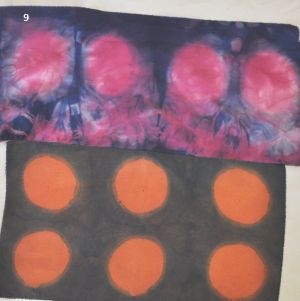
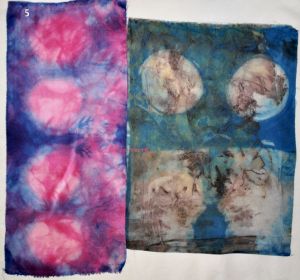
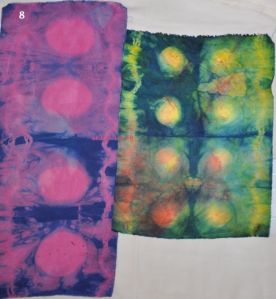
It’s hot, it’s sunny, it’s dry in Calgary, so while that lasts, i’m running a lot of indigo! Some of these babies will be kept for the stash, as i’d like to do an adjunct project with natural dyes this summer, not just the Summer Madder Study! Some will go in the shop***. I have listed only a few to start with, as it takes time to “match up” pieces, so they’re interesting :), and more time to photograph! There are MANY more to list, BUT once the ones in there now are gone, they are GONE, as these are impossible to replicate.
Indigo over madder:
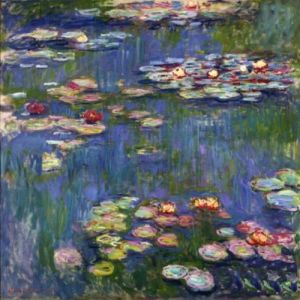
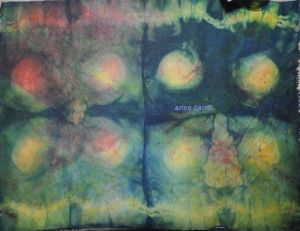 Like a Monet painting!
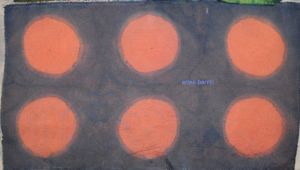
Indigo over tansy and madder:
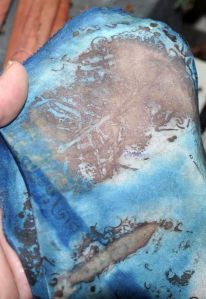
 Indigo over ecoprint:
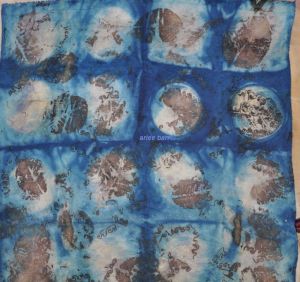 This one above i really love, as the indigo turned the ecoprint almost metallic!
~~~~~~~~~~~~~~~~~~~
I’m still in need of green threads for projects, and remembered i still had some dried privet berries stored away from last February. CRAP, this points up why some materials should be used fresh, rather than dried or frozen……
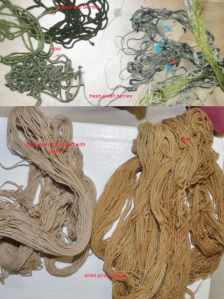 And OMG did the dyepot STINK. A deep dark brown, it immediately got poured out in a spot where nobody goes in the back alley! I want to point out too, that privet (Ligustrum vulgare), while an attractive garden shrub, is also TOXIC. (It’s also invasive, so you might be doing the neighbourhood a favour by grabbing the berries so they don’t turn into baby privets…) One wears gloves, and one does not go all airyfairy breathy goddess and hang one’s head over the pot, inhaling deeply and exclaiming about Mother Nature’s wonderful gifts.
I’ll have to modify those to get greens, or dip in some indigo….
If you forage locally, know what you are gathering, and any potential toxicities. Also, check to see if *your* country has a Biodiversity databank. Canada has an excellent one. They do also mention other areas, in the US. http://www.cbif.gc.ca/…/canadian-poisonous-plants…/…
~~~~~~~~~~~~~~~~~~~~~~~~~~~~
***Please bear with me as i update shop offerings. I know it may be annoying to continually see posts of “GO TO MY SHOP AND BUY BUY BUY”, but as an artist, and a small business owner, this is the way i help keep the groceries on the table, animal food in the pantry for the assorted beasties, and the occasional “luxury” like new socks and underwear 🙂 My hardworking Greyman is very supportive of me, but i still have to pull my own weight, as an even partner in our marriage! I have only 3 avenues to promote my business: here, on my FB “biz” page, and on Instagram, so i have to take advantage of that. I don’t do craft fairs, though i may do the Contextural one this year, haven’t decided yet, so online is where my business is. Yes, it may seem pushy in a way to keep seeing these “ads”, but a Woman Has to Do What a Woman Has to Do, and the Gawdz know i ramble, rant and rite write about other stuff often enough in other posts, that i hope you will understand.

 albedo too
I checked out your link on Canada’s Poisonous plants . It doesn’t seem that supported by science . Some plants make livestock sick if they eat too much.On one page , some kids got sick. Really. That’s proof that a plant is poisonous . Garlic is on the list. Stinging Nettle. I think that they need a grading system. This plant will hurt you if you touch it (Giant Hog Weed) , this plant is bad for horses (Black Walnut )etc. I want to know about fumes.They got nothin’.
LikeLike
I would never stick my nose over ANY pot 🙂 because i don’t know what chemicals are released this way, especially when it becomes a “soup” with mordants, other dye materials, or ecoprint processes. It’s also up to each person who is concerned about safety to thoroughly check toxicity–or not. I’ve seen hands stained with pokeberry and logwood, persons inhaling rhubarb leaf and those who use the same pot for dyeing as they do or cooking. The page is a starting point for those who give a damn about potential hazards. There’s still too common a mindset that if it’s natural, it MUST be safe. Arsenic is natural….
LikeLike
I’m not sure what you mean either by “doesn’t seem supported by science”, as it has plenty of references to check. Also, given that biodiversity *does* affect livestock and wildlife, agriculture, parks and neighbourhoods, it’s necessary to make notes of what affects what animals, *and* humans. And of course they have nothing about the fumes: who cooks these things other than dyers?
LikeLike
I like that metallic effect, too. I just planted privet last year. I’ll have to see if I need to worry about the dog.
LikeLiked by 1 person
Seriously, while you have to be aware of these things, most animals can’t be bothered sampling the garden. I think the problems happen, when someone brings something into the house for a vase, and little bits go on the floor. DogFaced Girl “hoovers up the crumbs” and that’s the only way she would ever get any of these nasties. But, since we know she does this, the floors are swept or vacuumed often!
LikeLiked by 1 person
For different reasons (er um FUR), I have made a second career out of vacuuming.
LikeLiked by 1 person
HAAAAAAAAAAAAA, i’d have to do it twice a DAY for the fur reason 🙂
LikeLike