Like a fancy gerbera, and  i can’t wait to stitch this one!
Like a fancy gerbera, and i can’t wait to stitch this one!
To celebrate my loyal customers who have supported me through this adventure, i am offering 20% off EVERYTHING in the shop–that includes sale items, Art and fabrics! As always too, i refund extra postage paid. The discount code is 8AFS, and because the instructions on the form are a bit confusing, after you add the discount code to the little box, make sure you click on the little black circle too!
According to my old blog, i started “messing with potions” in the form of natural dyes, sometime in July of 2010. From threads that faded in days, kvetching that most dye books mentioned only wool, smelly jars that resulted in copious ick and mold, and wondering how you knew what to mordant with what, i’ve come a long way to piles of naturally dyed fabrics in strong colours that last, a rainbow of threads and a library that is dependable and exciting. Along the way came knowledge about the history, economics, science, geography, arts and culture, and folklore and fact, so much more fascinating that any synthesized dye! (I won’t say “chemical” dye, as it’s ALL chemistry, even/especially the naturals! 🙂 )
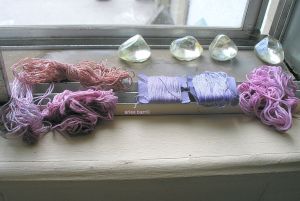
I had hard lessons about the value of mordanting, above (i didn’t at all…), and of learning about fugitive dyes, below:
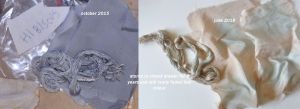
I learned about the quality of dyes:
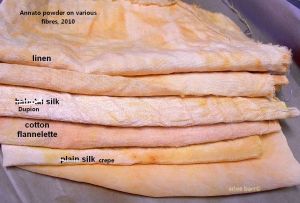
And the correct WOF use:
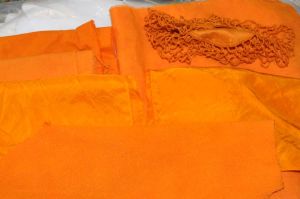
I learned that cheaping out does not give good results–if i bought the dyestuff, obviously i should be using it correctly, but these were scoured improperly, poorly mordanted, and low WOF, madder:
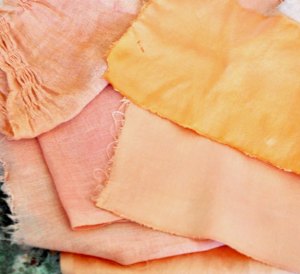
And done correctly below:
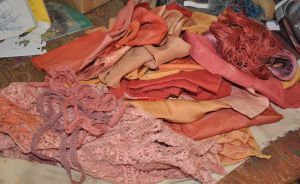
Yes, it *was* fun, playing with whatever was handy, experimenting and mucking about, and it *is* a way to learn about natural colour, BUT all those poor results, fugitive dyes and improper procedures become expensive wastes of time and materials in the end run. “If it’s worth doing, do it right.” “When in doubt, read the instructions.” Because as my mother always says “You buttered your bread: now you have to lay in it.”
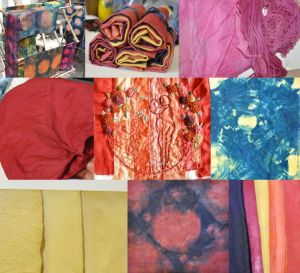
Just doing my bit to keep invasives from taking over 🙂 Tansy, oh Tansy, i love you, but you’re considered “noxious” here in Alberta. And YES, i get that invasive/non-native weeds plants can be a serious problem. I’m a Nature Girl, but the best Nature is, well, Natural, not “introduced”.
Okay, really, to me, a weed is something that grows in my garden that isn’t edible and/or pretty. I let the purslane and amaranthus go crazy, the millet seeded from the bird feeder, the bindweed in the lawn, the dandilions even. Control is maintained by mowing the Back40 often enough, but not MEGA SHORT (cause A that’s ugly and B bad practice), so our little nasties there are never taller than 3″. We have a milkweed growing by the side fence where no other garden is, and guard it jealously, as the bees love it, as do other pollinators, and hope and pray that one day, some day we have visits from Monarch butterflies. I don’t think i’ve seen one since i was a child in mid-western Ontario, many many moons ago.
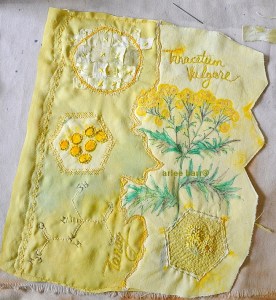 (I should finish this, from 2012…)
BUT, Tansy is really really prevalent here, so i’m ambivalent about the growth, and the destruction of it, as the city and the province would like us to do. On the fence actually, because i cut their pretty little yellow heads off so they can’t set anymore seed, BUT they also reproduce easily from a rhizomatous root. However, because they are so ubiquitous here, i feel no compunction in bringing home bags and bags and bags of decapitated Tanacetum vulgare, to throw in the dyepot fresh, and to dry for future use. The colourfastness is classified as “good””, and with proper mordanting, i don’t worry about its longevity. (Note though, the longest lasting natural yellow is Weld, an ancient–and spendy–dye. Can’t grow my own because it too is a No No here in Alberta.)
Too, yellow is the most scopic of all natural dye plants, from a multitude of sources, some light and wash fast, some not so much. It is however, if you remember your primary mixing of colour, a good base for oranges (think corals and peaches, not pumpkins 🙂 ), greens (teal! emerald!) and browns (chocolate chocolate chocolate!). The photo i showed here is the reason i picked much of this, and plan on stockpiling fibres as bases for overdyeing. I didn’t get *quite* the greens i wanted, but will keep trying.
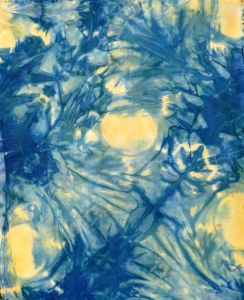
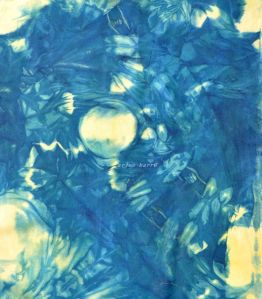
Tansy on bamboo above overdyed (obviously) with indigo. I’m going to try again with cotton (because i’m out of the bamboo) that took up a load of oxidized tannin, as the yellow uptake was quite strong.
There were more greens in the shibori samples below, but the indigo is now weak, and needs reviving. Ah, to find that happy balance. The tansy dyed cotton was post modifed in, top to bottom soda ash, iron and copper before the indigo dip.
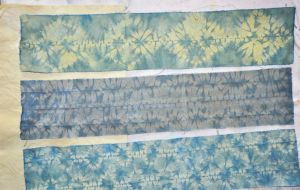
I need to find a disappearing type of marker as well. Even after the “finishing” of these pieces, the pencil i used is still visible, okay for samples, but not for actual work.
And i also want to do this again!
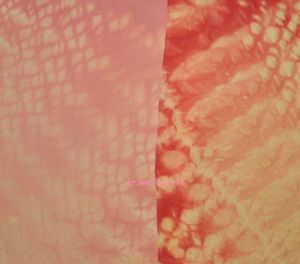
Actually, i could say “re-learning”: i did a bit of shibori during my 2012 residency, and certainly in the 90’s at Capilano College!
This was my first attempt, a bit of “guntai” stitching:
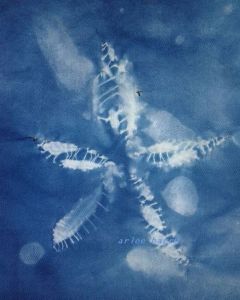 A small piece, i was a bit impatient and didn’t get it far enough into the indigo.
So then i did this one, same design but many more on one piece:
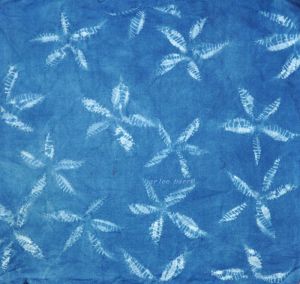 It took me 2 hours to do all the stitching on this–and almost as long to pick it out after dyeing! Note to self: good light, sharp seam ripper, lighter coloured thread, patience.
Then i thought “Hey, why not get the actual shibori BOOK out and try some samples?” *And* the good light, sharp seam ripper and lighter coloured thread. Patience was found, as i realized i was quite enjoying the process.
 Above, trying out different conformations of line.
Below, 2 types of stitch, one motif.
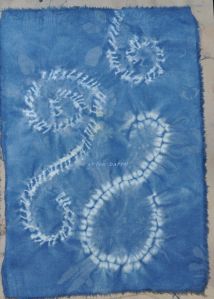
Below, shapes, alone and combined.
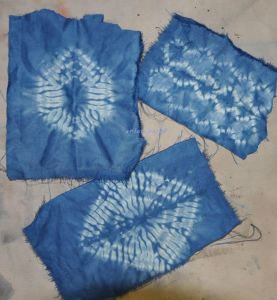
And this rose, which i thought would be wonderful, but could still be, done properly 🙂 Three types of stitch, several of which were not pulled tightly enough, and too square as i learnt to handle the fabric as it stitch. The larger the piece, the more awkward, but it was getting easier!
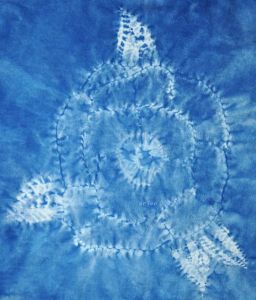 Rose approximately 10×12″.
This morning’s madder mess was easily cleaned up with a bit of a bleachy scrub, something that was still out, as earlier in the week i also had an exploding indigo stock solution on the kitchen counter……… Yes, my kitchen could have been red and blue, naturally 🙂
I quickly scurried the pot out to the patio, and with temps being in the high 20C’s and set on concrete, it stayed hot all day. I hucked some cloth in there, just to see what was left, and am glad i did.
Top, tansy dyed first, then a rusted piece that had been treated with titanium oxalate, an undyed piece, and an indigo over tansy and madder, all previously mordanted with tannin and alum, all cottons:
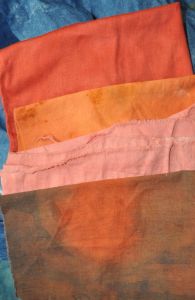 Below, left to right, the TO/rust, the tansy, the undyed:
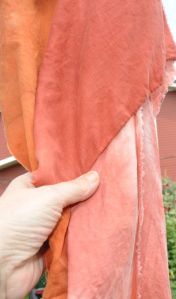 I’d loosely scrunched the undyed–LOVE it.
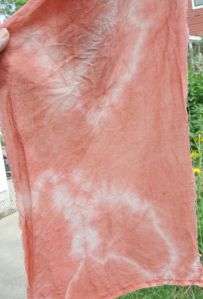 Waste not, want not!
good thing the dye police weren’t here……
i’m off in another room, and i smell the sweetest thing, then realize i accidentally hit the stove knob when moving the madder……….
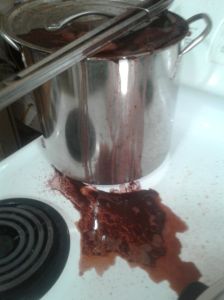
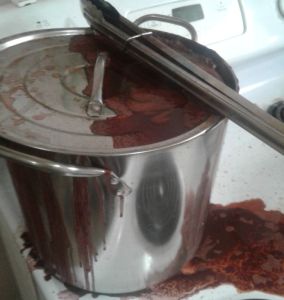
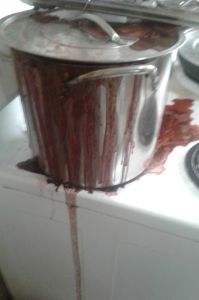 well, it *was* due for a heat up to prevent mold, but.
wonder what colour i’ll get now? (madder isn’t supposed to go above 72C/160F, but this definitely boiled……)
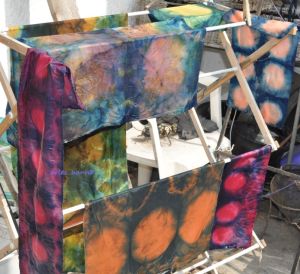
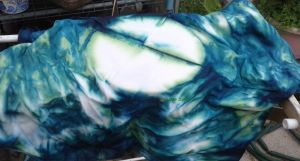
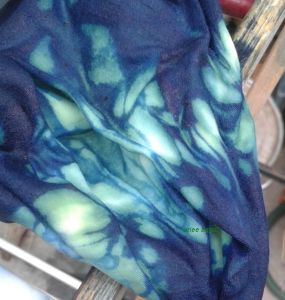
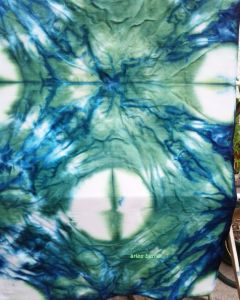
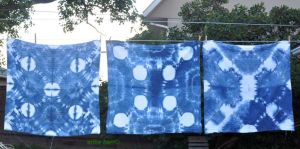
It’s hot, it’s sunny, it’s dry in Calgary, so while that lasts, i’m running a lot of indigo! Some of these babies will be kept for the stash, as i’d like to do an adjunct project with natural dyes this summer, not just the Summer Madder Study! Some will go in the shop***. I have listed only a few to start with, as it takes time to “match up” pieces, so they’re interesting :), and more time to photograph! There are MANY more to list, BUT once the ones in there now are gone, they are GONE, as these are impossible to replicate.
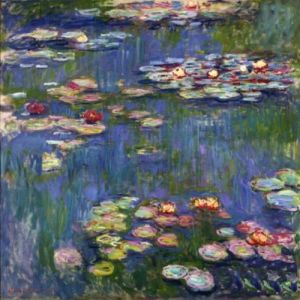
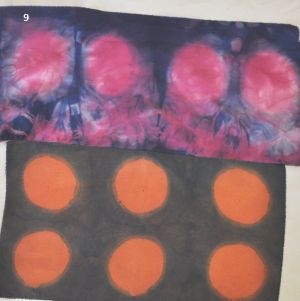
Indigo over madder:
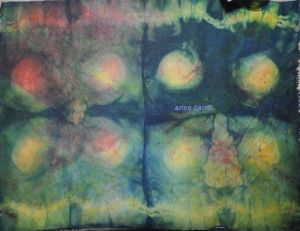 Like a Monet painting!
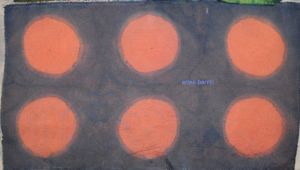
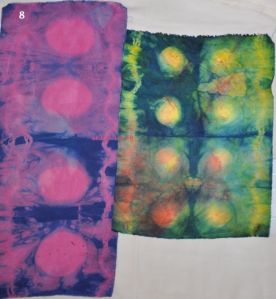
Indigo over tansy and madder:
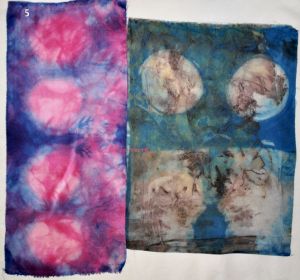
 Indigo over ecoprint:
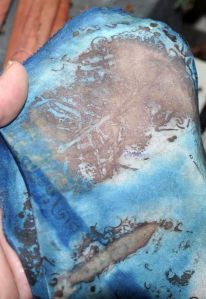
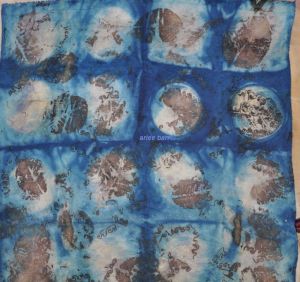 This one above i really love, as the indigo turned the ecoprint almost metallic!
~~~~~~~~~~~~~~~~~~~
I’m still in need of green threads for projects, and remembered i still had some dried privet berries stored away from last February. CRAP, this points up why some materials should be used fresh, rather than dried or frozen……
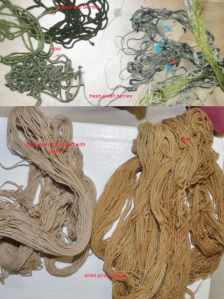 And OMG did the dyepot STINK. A deep dark brown, it immediately got poured out in a spot where nobody goes in the back alley! I want to point out too, that privet (Ligustrum vulgare), while an attractive garden shrub, is also TOXIC. (It’s also invasive, so you might be doing the neighbourhood a favour by grabbing the berries so they don’t turn into baby privets…) One wears gloves, and one does not go all airyfairy breathy goddess and hang one’s head over the pot, inhaling deeply and exclaiming about Mother Nature’s wonderful gifts.
I’ll have to modify those to get greens, or dip in some indigo….
If you forage locally, know what you are gathering, and any potential toxicities. Also, check to see if *your* country has a Biodiversity databank. Canada has an excellent one. They do also mention other areas, in the US. http://www.cbif.gc.ca/…/canadian-poisonous-plants…/…
~~~~~~~~~~~~~~~~~~~~~~~~~~~~
***Please bear with me as i update shop offerings. I know it may be annoying to continually see posts of “GO TO MY SHOP AND BUY BUY BUY”, but as an artist, and a small business owner, this is the way i help keep the groceries on the table, animal food in the pantry for the assorted beasties, and the occasional “luxury” like new socks and underwear 🙂 My hardworking Greyman is very supportive of me, but i still have to pull my own weight, as an even partner in our marriage! I have only 3 avenues to promote my business: here, on my FB “biz” page, and on Instagram, so i have to take advantage of that. I don’t do craft fairs, though i may do the Contextural one this year, haven’t decided yet, so online is where my business is. Yes, it may seem pushy in a way to keep seeing these “ads”, but a Woman Has to Do What a Woman Has to Do, and the Gawdz know i ramble, rant and rite write about other stuff often enough in other posts, that i hope you will understand.
Holding my breath.
 albedo too
You must be logged in to post a comment.