Posted in Probably talking to just myself

animal lovin’

Oh, deer….this morning’s usual let the DogFaced Girl out was interrupted. At 545, in the dark, in my nightgown and bare feet, i am sliding through mushy downed apples and cold wet grass, as i try desperately but calmly to herd two baby deer towards the gate. Momma Deer is on the other side of the fence, glaring at me, the babies are panicking because they’re too little to jump the fence, and now i’m panicking they are going to hurt themselves. Finally, i get them to a point where they can SEE the open gate they came in, and they bolt. *Now* Nessie can go out, and i’ll assess the hoofies everywhere destruction in the garden later. Wouldn’t give up these wildlife experiences for anything though! Oh and wash the applesauce from between my toes!


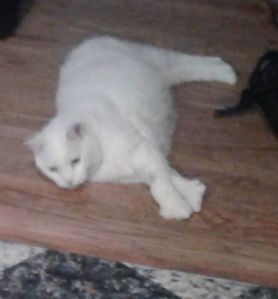
Sigh, part of loving animals is saying goodbye too…Last week it was our old baby boy, Mo, (right) and today, it’s his brother Cosmo (left). The family plot is sadly filling…………..

Truly the end of an “era”. I don’t know about other people, but Greyman and i mark this especially, since when we met, we immediately had a “blended family” of 5 cats… now ALL of those babies are gone.

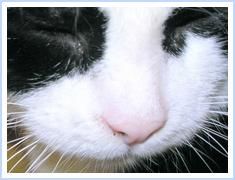
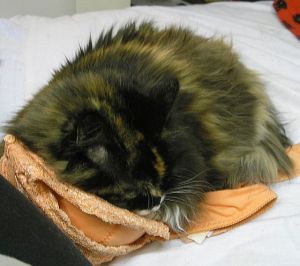
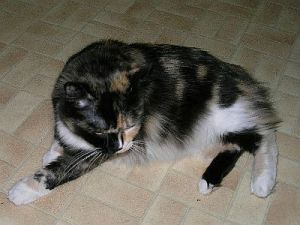
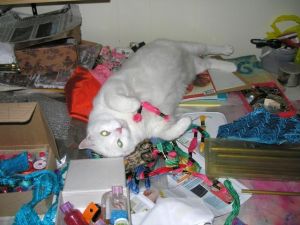
First we lost Slowroll:

Then Doogie:

Then, their Momma, Selena:

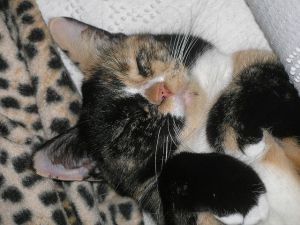
Then, Miss Piggy:

Then Mo:

Now, Cosmo:

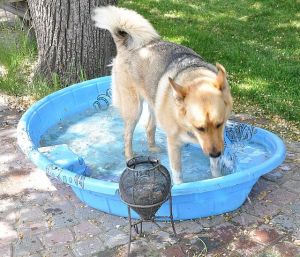
Still loving Nessie, the DogFaced Girl, and Slapshot, the Spastic Elastic:

 We gave them/give them love and spoiling, and they do the same for us. We just can’t have a house empty of animals.
Posted in Dyeing, garden dye plants, hollyhock, Home Cookin' the Cloth, logwood, osage, potassium permanganate

sometimes you just get what you get

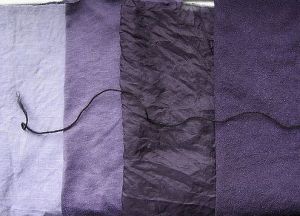
Well, how about that. Acidity, alkalinity, science, weird science, real science. It was mentioned to me that perhaps the soy pre-mordant was too acid? On the advice of a friend, i hucked in some soda ash, to “blue” it up a bit–after all, nothing to lose at this point! Edit: it did change the colour to a more blue-purple, but the bath had already exhausted, so i got minimal colour— so weak that the poor babies shouldn’t have been taken away from their mommies! (Is logwood supposed to exhaust that fast????)

So, the next pot will be using the reverse osmosis filtered water, and NO soy pre-mordanted fabrics (i’ll save them for the indigo).

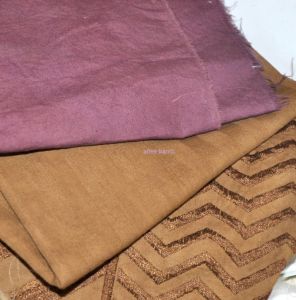
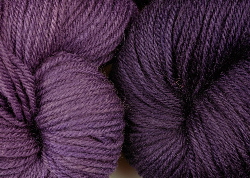
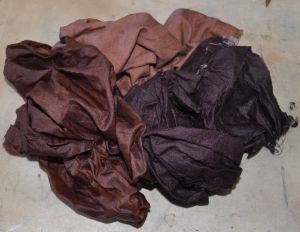
I want to use these colours together, in some new work, logwood top, bottom 2 potassium permanganates:

The logwood in proper light is definitely a red-violet, not a blued shade, but i’m starting to like all the variations. I may not get the results that everyone else gets, but that’s kind of the point for my purposes. I want to follow the tried and true METHODS, but i’m happy to get different colours, as long as they are not weak and namby-pamby!

The Osage dyepot was predictable (WHEW), with no surprises there 🙂 Warm yellows with a hint of orange, like a summer sunrise. I might throw some narrow slices of that too in the mix of fabrics in the above photo.

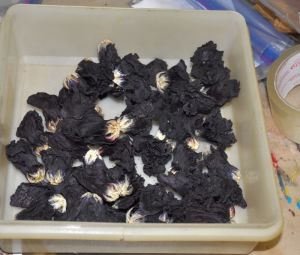
I’ve been collecting the blooms from my “black” Chater’s Double hollyhock all summer, and with only a few more blooms left on the plant, this is the sum total:

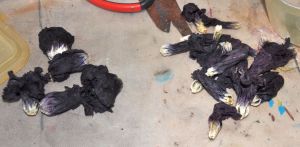
Left below, the Chater’s and right, my single deep red and burgundy–they don’t look that different dried, except for their size, but i’m still hoping the colour will be richer and deeper.

Of course, there’s only enough to do a couple of skeins of thread, but that’s part of the game as well 🙂


Posted in Ecoprints and Natural Dyes, logwood

it must be the water

OH FER &*^%$#^%*(&*^O^&%^%$$#@#$@%&^*^*(!!!!!!!!!!!!!!!!!!!!!!!!!!!

Logwood is supposed to look like this:

Above, on wool, below on cotton and silk:

This is what i got:

Above, wet. Below, dried:

I followed Maiwa’s instructions to the letter, TO THE LETTER. My fabrics were premordanted with left to right silk with soymilk, cotton with alum, and cotton with gallnut and alum. SIGH. And while the colour of the soymilk mordanted cotton is different from anything else, i doubt i’ll be bothering with this mordant again. Nice mottling, i suppose, and the continued surprise of gallnut on the one cotton that does have any purple!


Our tap water does have a lot of mountain minerals in it, but i still expected actual different shades of purple—next dye bath will be done using filtered water from our reverse osmosis system. If that still doesn’t give me the shades it’s supposed to, oh well, WTH, i’ll have myriad colours in the stash. Make hay while the lemonade stand shines… 🙂

AND i will NOT be buying logwood from the ACAD “bookstore” anymore–they do actually charge TWICE the price for the same product (literally) as Maiwa does, not a computer mistake, not human error. I called, and their reasoning was “the shipping”. BULLSHIT. While i agree that a shop needs to make a profit, doubling the retail price to cover shipping is obscene, particularly when they get an “education discount” better price than us, and the shipping could not possibly have been the same amount as the whole shipment of products ordered. &^%$! I could have/should have just ordered directly from Maiwa and even with shipping, would probably have saved 20.00 on the 300 grams i bought……………………………

Posted in Deliberation--do something you don't do--or haven't in awhile, Probably talking to just myself

interim………..

I don’t think i’ve given my studio a good deep clean for more than a year, and certainly some drawers haven’t been touched, or even opened (!) in longer! When the space is so bad you can’t bear to go in there,and don’t want to work on *anything*, in face feel like just giving up period, it’s time for a purge.

Hauled out 2 bags of actual garbage, picked through said drawers and sorted, tossed and “refiled” a few “projects” that went totally out of sight out of mind. Moved the serger and extra sewing machine to the basement, along with the huge plastic bag of plastic bags stored in plastic bags (apparently i have a secret fetish for them…), paints which i rarely use anymore (after sorting the dried up ones out), stuffing materials, and assorted cosmic debris.

My extra chair has room for a person now, instead of piles of books, cloth and EMPTY storage containers. The books are all put away, but easily accessible, the threads are back in their colour drawers, and the dyeable cloth is in one three Rubbermaids, and the dyes are all in one spot along with their tools, bottles, instructions and adjuncts. I have a floor again! And worktable space!

I found some things i haven’t Seen in a long time: a baby bootie pattern i thought i lost 16 years ago (they were ADORABLE, and i may make more), a sheer curtain i was beading with dragonflies (obviously lost the other matching but unstarted one) which needs only ONE wing to finish, and a blanket “fling” i’d really like to complete as well.

All this was because A. the owner of “Tabula Memoria” will be picking up the work in September, B. because i got tired of tripping and sliding on things (think minefield, not obstacle course) C. i could rarely find what i had in mind, and when i did i had no room or gumption to work on it.

And D. i bought new dyes and i want to be able to use them! Because i had a Lightbulb moment at the beginning of the week: get into the ACAD bookstore *before* res ends. They don’t just sell books, but all the art supplies students need for their wonderfully varied programs. And i don’t have to pay for shipping!

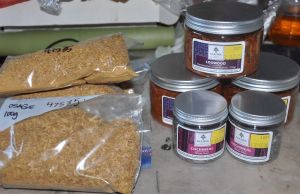
I bought Osage, Logwood and Cochineal, having never worked with the first two, and only minimally with the third. I decided to go the true route, and suss out the real deal from both Maiwa, and Jenny Dean’s books.

I’m realizing too that haste makes waste. I’m sure that stubbornly doing things my way was the reason that my madder dyeing has been less than stellar! Instead of using proper WOF dye material to fabric, i have wasted a LOT of dye materials, thinking there was “enough” being used, and then throwing it out because it gets moldy as i get discouraged and ignore it………………READ THE INSTRUCTIONS: just because the dye bath *looks* rich with colour, doesn’t mean it is.

The logwood and the osage are now soaking, and tomorrow i hope to start dyeing cloth with them. YUM.

Posted in Commission, Tabula Memoria

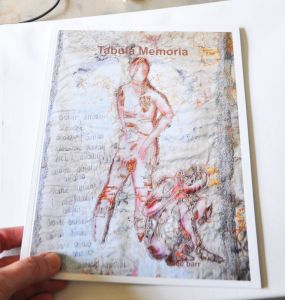
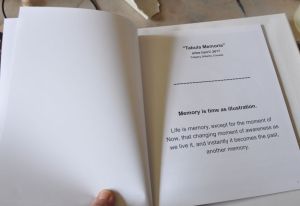
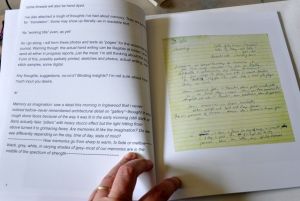
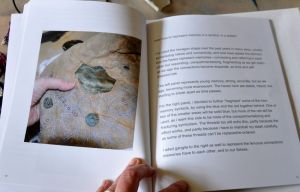
the “Tabula Memoria” journal

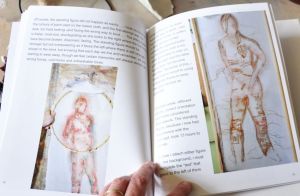
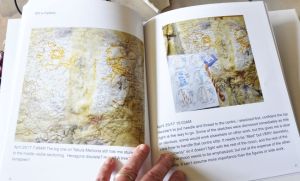
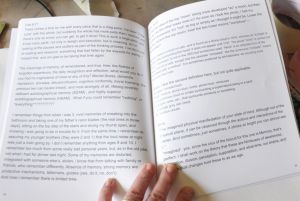
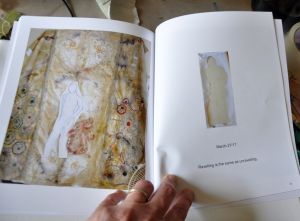
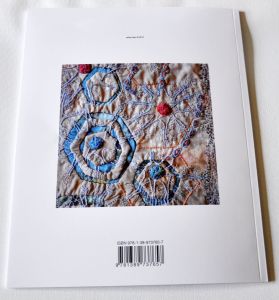
Whoa! It’s a good thing that Blurb has easy to follow parameters and diagrams, and a better thing that i was able to bring into play old layout skills i learned in my teens!

I finished this on Aug 13th, and immediately ordered two copies: one for me, and one for the person who commissioned the work. Had to hold my breath until the 24th of August (Actually arrived on the 21st!) ) to have them in my hands, but OH OH OH, i’m so glad i did this.

Right from the beginning, i had all the digital originals in backed up files, and the physical sampling, writing and sketches in a distinct studio folder. The first time i tried to “make book”, i had no idea what i was doing, and tried to upload small photos with low resolution. (KEEP YOUR ORIGINALS!!!!!!!!!!!!!!!!!! And make sure they are properly edited and presented, none of this “there’s my 3 feet of floor around the 1 foot sized piece…. ) Figuring out the layout, the order, and the relevance of specific things for that endeavour was a nightmare, as i hadn’t documented as i went along. I also didn’t hit “save as” when i should have, and that book is gone, except for a few screenshots!

You *have* to pay attention to details, when self publishing. Unless you have a trusted, erudite, educated and very literate friend to proofread for you, trust the guides they give you!

In my mid teens, i worked for a small Canadian “literary” magazine in Guelph, Ontario, and one of my many jobs was actual layout of photos and text. Those were the days when it was “physical” work, printouts that had to be manually manipulated and then pasted down to a master sheet. While i had naive dreams then of being a poet, i never actually thought i could do my own books, never mind have them printed. The exception is a slim “chapbook” of poetry, published by a small London Ontario press, in 1978. “Tiger of a Different Colour” does have an ISBN though 🙂  (That little magazine converted to Communism, and fired me when i wouldn’t go to Ottawa and participate in a possibly dangerous and illegal protest, risking arrest and jail! I was 16 and incredibly innocent, but i wasn’t STOOPID.) Edit: an hour after, i still have *most* of the work that was to be featured in that first book–i *can* rephotograph!


Now i’m thinking i really want to do a How To book after all, possibly from the FrankenStitch classes i have taught online.


Posted in Dyeing, potassium permanganate

rinsed and dried

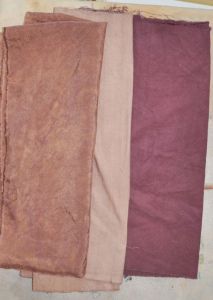
So…..obviously a soymilk mordant does little really for potassium permanganate on these cottons. They *are* nice shades, and the two plain pieces are somewhat mottled as i had hoped they would be, but they obviously weren’t fooled by Mr Smelly SoyMilk:

But alum, and gallnut with alum does. And longer soaks work too.

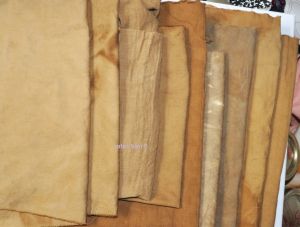
The first four are unmordanted fast dip-and-squishes, the fifth is a unmordanted 10 minute soak, six and seven are respectively, the alum, and the gallnut with alum, the last two are 5 minute unmordanted soaks.

Go figure. Soymilk mordanting is not all the exciting WooWoo treatment it’s cracked up to be after all, at least not here 🙂

I love these various permutations of brown! HA, get that little (VERY little) joke PERMutation, haha PERMutation….

But i want still darker shades. Will pop some of these back in, and see what happens, and do some new batches with the A/G and A pre-mordants i have a stash of. I want CHOCOLATES (don’t we all?): milk chocolate, cocoa with milk chocolate, dark chocolate, bitter chocolate, mud pudding dirt deep soil chocolate—- THOSE browns. Rich, deep, satisfying, sombre, swarthy, earthy, atramentous, important, stately, statement, strong browns.

Posted in Dyeing, journal: lessons to learn, potassium permanganate

first “potperm” results

Though i’ve used the vat at school, this is my first home usage of this scarey dangerous wonderful stuff 🙂 so we’ll just call it the first results. I call it “potperm” simply because potassium permanganate is a mouthful, and one i commonly mangle in pronunciation as well, usually in front of knowledgeable people, resulting in some embarrassment. It’s also referred to as PP in “industry” usage.

Moronic giggle here: “i’m dyeing with PP today”.

And yes, i was apprehensive. Put on my Steel Loin-and-Bosom Girding Big Girl Pants and Bra Set (the beige ones, no sense in calling any more attention than usual) and suited up. I mixed my “vat” in the back alley, wearing an apron, respirator, safety glasses and neoprene gloves, and used a PLASTIC cup to mix in a PLASTIC bucket, with a PLASTIC handle, with NO metal bits. (And carried it by the bucket itself, as i trust no handle ever, given the potentially caustic splash factor.) This stuff is reactive with metals, so i’m not messing with metal lidded glass jars, metal pots, metal spoons, metal bowls, nuttin’ metal PERIOD. The bucket lid is TIGHT as well–apparently this stuff can blow (literally, UP) if it dries out. It *does* exhaust, of course, as it’s used: there’s only so much that can remain in suspension after repeated dips of cloth, something i found out at ACAD. (WHY did i think it would last forever??? Does any other dye? NO, duh, dumdumdum. Sometimes this Mad Textile Scientist can be rather dense….) I also hosed down the area after, thinking any minute particles would be diluted enough to harm neither friend nor foe (local wildlife and plants).

Since i intend to do some fair yardage with this “dye”, obviously i increased the proportions of water and potassium permanganate. (Most home usage i’ve noted is 1/4 to 2tsp per litre of water, whether for dye, garden application, or anti-fungal/antiseptic use.) That means i used 3/4 cup for 15 litres of water. (Not an exact measurement or conversion, but there’s a large margin here for colour depth, so adjust accordingly 🙂 )

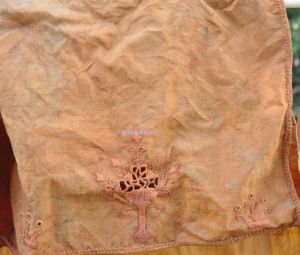
I did the actual dyeing on our concrete back patio, again hosing down after. I used some soymilk, alum, and alum with gallnut premordanted cottons ( 3 premordant solutions), and some unmordanted pieces, and was completely surprised by the results! (These photos below are all as the fabrics oxidize and dry. I’ll show photos of the dried effects and colours later in another entry.)

The soymilk took the least amount of dye, but hopefully once rinsed, the lovely mottling will stay as an effect:
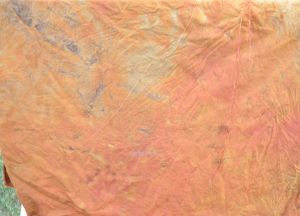
You can see the major differences here in the soy (far right) and the unmordanted, left and middle:
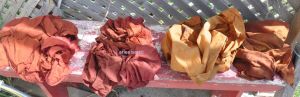
Above, the middle fabrics are top a 5 minute soak, the bottom a 10 minute soak, not sure if this will make a difference either.

Not sure if the different dye absorption, dry rates on the main fabric and the threadwork will make a difference in end colour
The results, still oxidizing and drying:
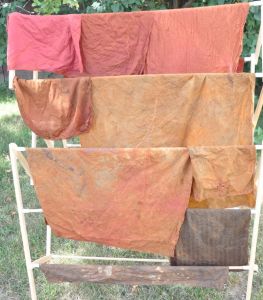
Potperm comes out of the pot in various shades of purple, then oxidizes, like indigo does, but to browns, so don’t get excited by those pinker shades 🙂 See those two bottom ones? The stripey one was mordanted with gallnut, the one  on the bottom rung was mordanted with gallnut and alum—quite a difference from the others! You also can’t see the ones on the other side that had longer soaks, as the light is whack.

Just as obviously, there are a lot of dye techniques to try out, from shibori to over-dye ( i know how it reacts with/to indigo, but how does it affect other dyes?), ecoprint to discharge*****. I think i’m going to have quite a stash. I also momentarily worried about what it would do to silk, but then i remembered that several years ago at the school, i did this one on 8mm habotai silk, a very sheer, delicate weight–it’s still fine, no damage. It appears the vat i used for this was very active also, possibly quite a new mix at the time, as the colour is deeper than i got this year during res.
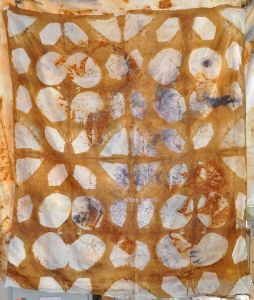


Tip o’ the day: do not mix up with the mid morning break of iced coffee: same colour, different effect.

(YES, THAT IS A JOKE: i never eat or drink around dyes, dry, inert, mixed up or in use.)

***** NEVER DISCHARGE POTPERM WITH BLEACH, use LEMON JUICE

~~~~~~~~~~~~~~~~~~~~~~~~~~~~~~~~~~~~

oh gawdz…………………..i discovered my bucket of soymilk mordant shoved behind a box in the basement by Himself…….actually, it was fine moving it after THREE MONTHS–but OH SHIT THE REEK, as i poured it in the toilet. Oddly, no mold, just festering masses of curdlets…………………no crust even! just a solid mass. Weird Science at it’s best. Or worst.

it didn’t even shiver when i lifted it and carried it upstairs, no smell, no mold, weird, but the minute it was tipped…………. OH LORDY, there are no real descriptors……..

And since this is the bucket i used for the above, it was washed with boiling water and soap, and rinsed really really really really really well, as potperm can also react with other materials, organic and chemical. I dried it in sunshine. (No eclipse here, just some weird light and bent holes through a colander….totally underwhelming.)


Posted in a collusion of ideas, Collision: the work begins, Contextural Fibre Arts Co-operative, in progress, journal: lessons to learn, Residency 2017, Samara

the wings of possibility

Rarely are things set in stone here in the Stately Barr Manor Studio. Evolution, the Baby,  and tossing out part of the bathwater is part of the game as well, to mix several metaphors…….

Samara’s wings aren’t exactly what i’d call problematic, but with a clear vision in mind that somehow isn’t getting to the actual execution, it appears that the plan has to be changed somewhat. When i started her wings, the “feathers” were like this:

Not quite what i wanted, though i like them, so i started these:

Ha, still not quite what i wanted, so i’m going to combine the ideas. I also like both fabrics i used, so redrawing the pattern is also going to have to take into account the placement of both to present an integrated it-makes-sense design.

And no res exhibit for me after all. There is no way human for me to even get enough done to vaguely represent what the whole will be. I can live with that, studio work being the more pleasant result than forcing a deadline.


Posted in Dyeing, Home Cookin' the Cloth, Not so ordinaries, potassium permanganate

making my own rules, potassium permanganate

I really like the effects i get with potassium permanganate, but there’s not a lot of info available, online, or in old books, when it comes to using it with cloth. Most sites tell you how to get rid of the “stains” when you are working with it, in either metal or wood applications, but not how to keep it! I *think* we might have done something with it in the textile arts program in the early 90’s at Capilano College, but if we did, i either took few notes (usually when i wasn’t that interested!), or i threw them out in a long ago purge…….

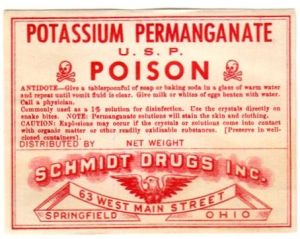
First of all, this stuff is actually Scarey Dangerous. Yes, very, no exaggeration, in application, storage and with other chemicals. It can be explosive, toxic, mutagenic, corrosive. I cringe when i see people sticking their hands in vats with no protection, but this one in particular made me yell at someone during res who did just that. But it’s also used as an anti-fungal, an antiseptic, water purification, in garden applications, for livestock use, and in science labs for staining specimens and slides.

(Ignore the “antidote” notes on the above, and check the MSDS for the real deal.)

It’s not a “natural dye”: it’s a chemical compound. So why use it if it’s so freekybeaky? Because i like the warm browns it can give, i like the way it chases (discharges, technically) indigo, i love the effects with rust and ecoprints. Respect for what we use as dyers, whether chemical or natural, can go a long way though and i have always stressed safety first in any of my own work, and certainly when i have taught classes. So i will use it, and with pleasure! (The few sites that have had any information make me shake my head too, as they blithely swish things around with bare hands……..)

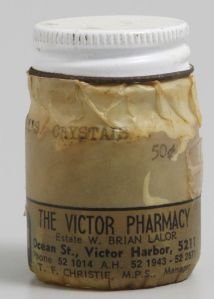
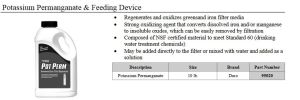
I know brown is not an exciting colour to most people, and most natural dyers are going to use walnuts, chestnut, cutch or sequoia, or combine different dyebaths with various mordants and modifiers to get brown when they do want it 🙂 (And i have, and do that as well. ) You’re not going to find potassium permanganate for sale on any dye house sites though, chemical or natural. I searched through chemical suppliers, university science sites, and finally water purification shops, and bought mine at a local supplier for  “HVAC, Water Treatment, Fluid Handling and Conservation Industries .”  (I’ve heard it also referred to as “Condy’s Crystals”, an archaic name for it, and supposedly available at pharmacies/”chemists”, though i suspect that’s more in the UK than anywhere nearby!) And i asked for and got the 6 page MSDS that should go with ALL chemical use. (See that first link in this post.)

Initially, it’s expensive. I just about had a bird when i called and asked about the size they had on the website (10lbs)–$169.00!!!! The gentleman on the phone said though that they did have smaller 5 lb packages, at slightly less than half of that amount. In use though, it’s cheap, cheap, CHEAP. At 1/4 to 1 TSP per litre of water, it’s going to last a looooooooooooooooooooooooooooong time, great Cost Per Wear!

(HA. When i picked it up, he said someone else had just called and wanted that smaller size too, something he hasn’t sold much of in a good while. Maybe another dyer?)


ALL “mixing” of this will be done outside in a corner of the back40, wearing gloves, respirator and safety glasses. And lest anyone think i am totally looneytunes using this potentially bombwhacko product, a lot of textile program school scenarios have a vat of it in the wet studio, and no one has reported any Incidents. ALL dyeing should be handled with respect, safety and care.

I remember there are a few other things i can do with “potperm” and cloth, so am off to refresh my memory, and make my own (SAFE) rules for use.