Posted in embrilting, Moons, Natural Dyes

this from that

This week is all about stitching. It’s all fine and dandy to dye the fabric and the threads, but if i’m not working with them too, it’s kind of like shopping and stashing :), stuff never seeing the light of day again.

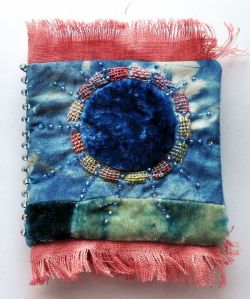
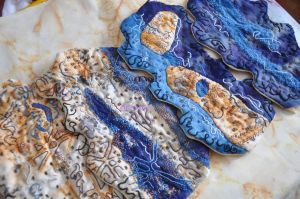
Monday was the beginning of the week of stitch, this:

from that:

Some Lumiere stencilled indigo, a bit of osage and indigo, and beads. A limited colour palette can be as stimulating as one with many colours!


Posted in Madder, natural dye research

on fire in the Dye Dungeon

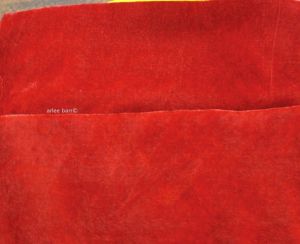
These are the results of my boiled water madder pot. (Note: the water was boiled first, cooled to proper temp, then madder added. Madder does not do well over 180°F/82°C) I’ve never had such deep reds on silk before, but it *might* be because of the rayon blended in. I don’t honestly know if boiling the water made any difference, except for the removal of chlorine, however i’m not going to complain!!!!!!!!!!!

First extraction/use gave me these:

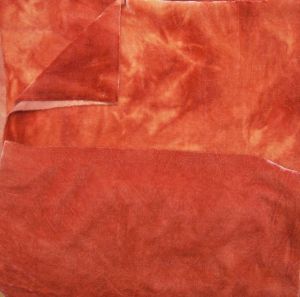
The second was these:

The top one is mottled because it was on top, and because i didn’t add more (boiled) water, it didn’t have as free movement as it should have. Even so, i love the results, a wonderful mottling!

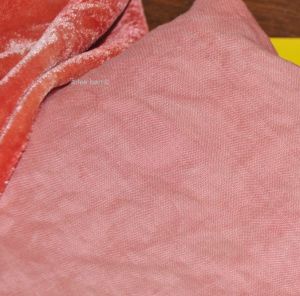
Linen from the second pot at the same time was a bit disappointing, but still good.

Cellulose fibres like cotton, linen, hemp, rayon etc don’t have as much uptake, but linen is the hardest (in my personal experience) to get deep colour on.

I’m doing a third use with cotton eyelet, but i can see already the pot has had most of its red component used, and has more brown tinge too. Kind of reminds me of an antique coral, so that’s okay too 🙂

My dyeing week is almost over, and next week the plan is to get to some stitching again.

Posted in natural dye research, Probably talking to just myself

testing new waters

At the old house (and i mean where we lived before *and* the fact that the house was 100+ years), i knew what the water would do to my natural dyes. Turns out it’s a new ballgame in the new place, a totally different ballgame.

A. There’s a LOT of chlorine in our water in this location. We noticed the smell when we moved in, but stoopidly, i forgot that if i want to use it as hard water (’cause hard water is good for certain natural dyes like madder, weld, logwood and brazilwood, and we get hard water because our water is from the mountains) *and* there’s chlorine, you have to let the water sit for awhile so the chlorine off gases (dissipates). Didn’t have to do that at the old house.

Did you know that if you add ferrous sulphate to water with chlorine in it, that it turns the water PINK? Pretty, but the iron didn’t want to do what it was supposed to because the chlorine was being all busybody and getting in the way.

B. I use our filtered osmosis system for a lot of my dyeing. But it doesn’t work well, when apparently the tank membrane broke and is letting things into the tank, like iron and gawdzknows what else…..this also doesn’t work well for natural dyeing. There are a lot of minerals in our water too, but i’m not sure what else there is that isn’t supposed to be “is”…..

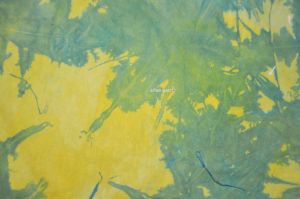
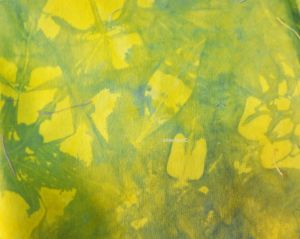
On the 14th and 15th i tested some of the Ugandan marigold my son brought back for me. I was shocked at the amount of green instead of yellow i got. My tannin was green as well, not a good sign, but a sure sign that there was a fair amount of what shouldn’t be in there, in there. I *did* get some pretty colours so that’s okay, but.

This means i now have to test all the dyes i work with, checking the new parameters and verifying my normal practices as still viable. It’s a good thing then that with the rhubarb root and quebracho rojo work i did last week i made lots of notes, and because of that, the marigold was documented as well! BUT it’s also weird that the RR and the QR gave me close to the results i was used to, even though i had used the (broken) filtered water.

Interestingly enough, in several natural dye groups, this was posted. I mean, i KNEW water affects the dyes, but wow, what a lesson in my own space.

So, i begin again.

Posted in natural dye research, quebracho rojo, rhubarb root

warming the vortex

-40C wind chill today, risk of frostbite in 10 minutes. I ain’t goin’ nowhere this week!

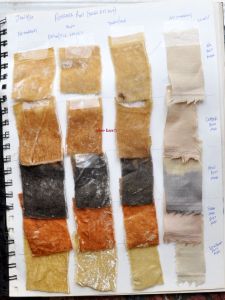
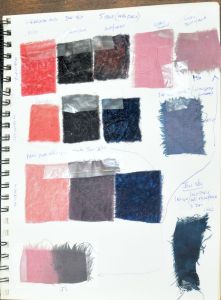
The last week’s results, correctly in dye journal 🙂

I think my soda ash tests needed a fresh mix as well–i adore that orange from the test above, not as apparent in the sample on the bottom of the page below!

Below, the two on the left are linen, quite disappointing! The linen i ordered before Christmas is crappy quality, stiff and feels cheap. I know linen is supposedly harder to dye because of the plant waxes and pectins, but the results were abysmal! I followed all my usual protocols so not sure what the difference was. *Usually* i find rhubarb, whether root or leaves, somewhat inhibits the uptake  of dyes……… For that reason, i never use the leaves anymore. I think it’s the oxalic acid, but also would suspect the roots have more than the leaves, so it’s a mystery!

A mystery because look at the quebracho rojo on the same linen! I was thrilled to see that once rinsed and dry, it was a definite pink, quite the surprise as usually qr is touted to give only pinky tans and browns on cellulose, and paler in range than protein fibres.

I have a different batch of linen from the same supplier that is supposedly the same thing, but the difference is amazing–full handed, thicker, FEELS like linen, so we’ll see what the results are on it.

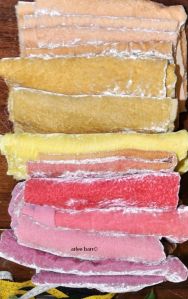
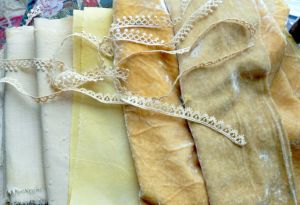
And the rest of the qr tests:

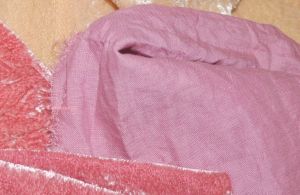
It’s  bit hard to photo these correctly: the velvets on the 2 top left are pinker than here, not as orange. (And OH do i love that lavender from the third extraction with an iron post mod!

I’m also testing Ugandan marigolds! My son brought me some when he came back last week (and YES it was all legal, above board and phyto-sanitarily correct, according to customs regulations! I wouldn’t dream of having anyone smuggle or mail un-regulated product to me!)

Posted in "OPINIONATION", mordants and modifiers, natural dye research, rhubarb root

making it smell like Summer

I can’t pretend Spring is coming with the coming weekend supposed to be in the minus20’s(C), but i can smell Summer right now: I had a pot of rhubarb root simmering, an excellent dye the last time i used some. The fragrance lingers, even to the next day, and always reminds me of alder burning in the old wood stove on Bowen Island. This is a test of sorts too, as the first time was freshly dug and cut up, and this particular bag has been in my cache since October of 2015, so very dry. Some dyes just don’t do well dried! Checking the pot after an hour assured me though: there was LOTS of colour seeping out.

Silly me though! I forgot to weigh the bag and have no idea how much i used. I decided to start a separate note book for my silk work, as it’s a different kettle of canned worms than other fabrics, and the colours are amazing! And guess who didn’t take notes last year when she was doing all this? I mean, i know if i used quebracho rojo, or madder, or osage obviously, but what post mords or post mods did i use? What mixes of dyes did i use to get other colours? How many times did i use that bath? I didn’t even keep swatches!

Rhubarb root has more of an affinity for protein fibres though: all the trials i’ve done on cotton or linen gave at best, a pleasant warm toned pale yellow, and even post modifying doesn’t change much of that. (Except for iron which which pretty much *always” turn any natural dye to shades of charcoal!)

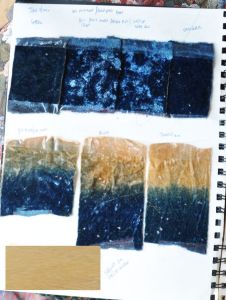
Here’s my array of tests, in order of post-modifier: copper, iron, soda ash and vinegar. (Unfortunately, i threw out the ammonia for some reason, so couldn’t try that…) Again, little change on the linen.
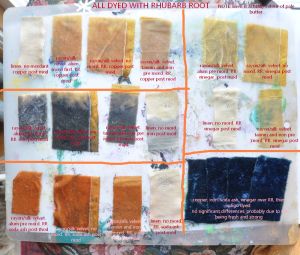
For some reason, there also seems to be little difference in the colour when overdyed with indigo, but my vat may be too strong still. This is the one time i wish for a weaker one! (In *my* experience, a weaker vat gives a better chance for the first colour to influence the outcome.)

So, did i lose you with that highly detailed ireallydon’tgiveashitphotoijustlikecoloursandb? 🙂 (I myself quite like the orangey soda ash results, and the iron.) This is how we roll, us natural dyers!!!! BUT, once we know the general outcome of all those steps, we can play confidently and happily, mixing, mixing more, and mixing again. It’s not just a matter of throwing an avocado in a pot with some pretty muslin 🙂 And more tests will now be done, in overdyeing with *other* dyes: quebracho rojo, cutch, madder, cochineal, etc etc etc.

~~~~~~~~~~~~~~~~~~~~~~~~~~~~~~~~~~~~~~~~~~~

Speaking of misconceptions about dyes……..this article was brought to the attention of several natural dye groups yesterday. Quite an uproar ensued, because while yes we should be more aware of our purchases and the effects mass consumerism has on the world, we should also not have to, as natural dyers, be misrepresented by an uninformed “trend forecaster” belittling us with comments about natural dyes being “Subdued and melancholic…….”, even if she *is* trying to be “on trend”. Except for aforementioned avocados maybe, HA.

The ennui that rises from this article is a palpable stench. I would guess that’s the subdued and melancholic way of saying “i just don’t give a damn”. But then she of course redeems herself with pithiness because “She is given to issuing prophecies such as: “I think we will get very inspired by blouses.” *My* blouses are pretty vivid and lively 🤣(This is as bad an article as one i read by Germaine Greer, who hadn’t a CLUE about textiles, and textile art. I wrote about that on my old blog, here, and here. If you’re going to set yourself as an expert, do some research, for jeebly sakes.)
Posted in a collusion of ideas, cutch, Indigo Dreams, Madder, natural dye research, Natural Dyes, osage

no manual included

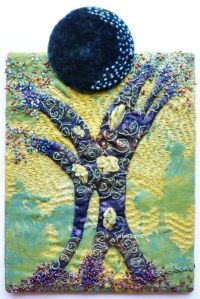
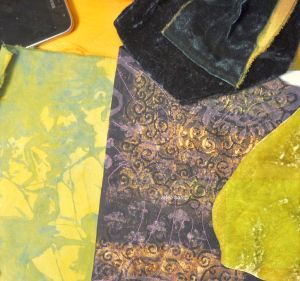
Trees and moons and Spring are on m y mind–though *that* is far away right now, with -21C to -25C projected for this coming weekend. (My son has been in Uganda since the beginning of November–is he gonna get a shock, trying to climatize again to Alberta weather, after almost 2.5 months of African heat!) I’ve picked an indigo overdyed osage cotton, 2 different velvets for another blue moon, a previously screensprinted and then stencilled indigo cotton, and a hunk of the most wonderful chartreuse velvet i only hope i can replicate again! That one is the right side and you may notice a funny bit of photo editing to show the correct colour, a square of green set in the yellow–it ain’t yellow, but the studio is so wrong for photographing colour, and i was too pooped to drag everything upstairs and anyways, it’s a grey snowy day, so bear with me 🙂

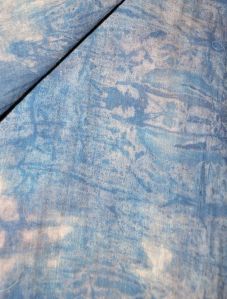
Here’s the indigo over osage:

Above is the piece of cotton i will use as the background (has bluer tones), below is a larger piece (greener tones) that i am drooling on and fondling:

I had revved up my indigo vat again on the weekend past. (Actually i had to start from scratch as the originals had to be dumped for the move…..too little to save, and too much chance of spillage or oxygen overload as it sloshed on a truck!) First results were not encouraging, but after asking in an indigo group what the problem might be, have concluded it might have been the tannin premordant, *and* the cutch, which is *also* a tannin. See the grey around the darker marks of indigo? (All photos in my posts are clickable for larger viewing.) I like the effect, but if it doesn’t “stick” well, it’s not a good practice if i wish to flog my goods later! (It also appears to have stripped the madder…)

Apparently tannin repels the indigo, something a lot have discovered with indigo and ecoprinting. Of course, checking my Boutrup/Ellis book, i should know better anyways and do the indigo first, THEN the mordanting, then the overdyeing. The two osage/indigo pieces mentioned above were done after this debacle, and though of course they were premordanted with tannin and alum, they don’t have as much tannin as the tannin/cutch piece, so the indigo struck properly!

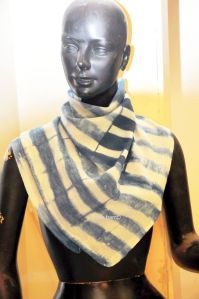
I’ve been meaning to add less expensive, ready to use items to my inventory as well. Here’s the first test piece, a cotton neckscarf, clamp shibori-ed, and modelled by the ever silent Madame LaToussa.

I do like that, if i say so myself! The only problem is that the scarves were obviously hemmed with a polyester thread, but it’s not obtrusive enough to bother me (or probably anyone else) greatly. Barely noticeable.

I also have today clamped a shibori indigo dyed very hairy very scarey very contrary chenille scarf, ready to overdye, and as i mentioned in a previous post, i will do a post about that. I’m pretty sure it’s a failure, a funny one, and probably still wearable, but definitely a failure. You can judge for yourself at the time of showing 🙂

I’d have a nap now, but Greyman will be home in several minutes.

I will have a nap now.


Posted in a collusion of ideas, Probably talking to just myself, Studio Realities

planning the plans to plan

I don’t know how other full time artists handle the tasks associated with making a living in the studio, but i’ve decided i have to treat this like a “job”. I don’t mean cut and dried “you MUST do this today” or “from 211:315AM to 32:3719 PM, you will be weaving gnats hair into celestial robes” kind of job, but being serious about what i want to do, need to do and would like to do. It’s too easy to get side tracked when the studio is “in home”! There’s always a dog to walk, a dish to wash and “Oh look! Cat barf! Goody! Gotta scrub that.”

Hours, how do we manage this? It’s easy to say it could be a 9-5 job (Oops better write this fast as it’s now 10 minutes to 9!), but i think a *little* flexibility could work 🙂  I wrote a post last year (gah, last year seems so far and so close away already…) touching on the subject (3rd paragraph) and parts of it will work, but as i mentioned: tangents! possibilities! potential! As a natural dyer, there *are* certain things that *must* be done; scouring, mordanting, dyeing, the winding of thread skeins (running really low on those to use), the labelling and storage of, and the decision on what to sell and what to use.

On my work blog (private, neener neener neener) i have draft posts with each week’s dates, but not so neurotic that any but the first are lists of what the plans are. Sample, this week Jan 6-10:

  • mordanting! (some are pre-tannined already: linen, chenille scarf, get them in alum)
  • new indigo vat needs starting  DONE ON WEEKEND!
  • dye with indigo, madder and weld: velvet, linen, trims
  • trees for moon pieces–smaller than done before, and larger
  • ORGANIZE studio better…… UN-ENDING JOB!!!
  • wind threads, scour, mordant, dye, combination colours
  • chair cushions-indigo (there has to be personal things made too)
  • finish chenille scarf (a test, post about that later)

I also realized through December that while i can work in front of the tubage, and don’t need to concentrate fully on what i’m doing in the stitching corner, that it *does* slow me down, just enough that i start feeling pressured IF i feel i have set a deadline. I can wind threads, but not embroider with them with “Stumptown” or whatever on  …… Instead, i talk to the DogFaced Girl……

But, not all studio work is Work either. There has to be time to make the art, the pieces that are in our hearts, that are sketched out excitedly and that the stash is culled for. Play it by ear: this week is that list above, but the week after can be the Art Part, because those listed things HAVE to be done or nothing gets done.

I do also stop for lunch, coffee refills, bathroom breaks and skritches for assorted animals. 🙂 I have too, lately, cleaned up the work space every night–not cleared completely of course, but at least organized and tidy for a fresh start the next day. *We’ll see how long that lasts, as i usually end up with “inspiration” and “possibility” piles everywhere! Sometimes there are going to be days when i just go in and “WOWZERS what happened, it was a GREAT DAY” without even noticing what time it was. Sometimes those days are like this:

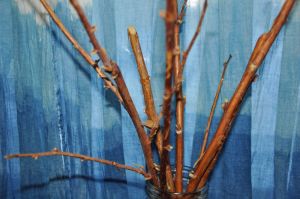
See the teeeeeny little green buds on the stems? I cut these raspberry canes two weeks ago, thinking it was a futile exercise to save some of the raspberry bushes from the old place. (Remember i live in Alberta and it’s ^%$#ing cold and snowy in the winter. I never managed during the move to dig up even a small piece.) Last night, we noticed GREEN. That’s sometimes how things go in the studio, indeed in life also: hopeful, life affirming, chance, luck, caring.


How do you deal with time management? Any tips?


Posted in Crafting, Indigo Dreams, Jam Day, journal: lessons to learn, Moons, Studio Realities

laughing at myself

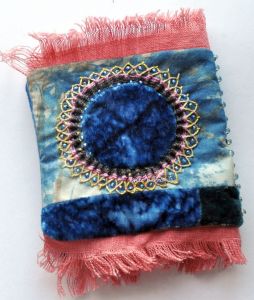
First project of the year, a little test for scale, motifs, use, this needle book is for me.

5×4″, indigo, madder, cochineal, tansy, osage, sandalwood, quebracho rojo, linen, cotton, silk, naturally dyed “*orts”, beads. I won’t show you the inside: apparently some 4 year old snuck into the studio and worked that part! 🙂

I had grand plans for this little work, thinking i could make multiples and offer them in my shop, enticing people with price and portability. HA! If i actually charged what that *should* be, no one would pay the price. A common problem many makers have, either inadvertently, or deliberately, is actually pricing the true value/worth an object has cost in terms of time, skill, design and materials, assembly, and in my case, the dyeing of cloth and threads, and hopefully a small markup for profit. This Thing took the same amount of time and work as one of my larger moon pieces! Would *you* buy a $100 needle book? Nope, me neither.

At least i know my new indigo vat is working though and i *did* cull some ideas for other work from the making and thinking time!

*Orts are the left over short ends of threads (or teeny weeny scraps of fabric) used in other projects.