Posted in a collusion of ideas, in progress, Natural Dyes

new thoughts

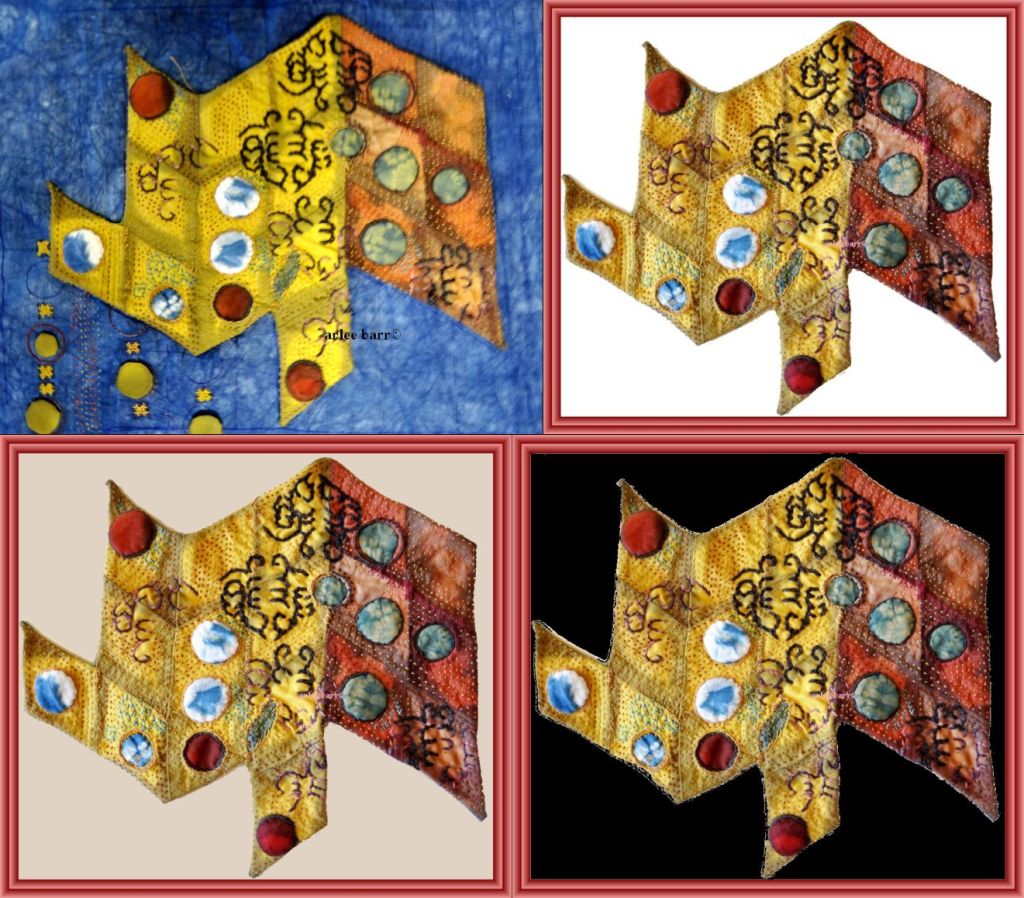
Hmmm, i don’t think this should be on a cloth background, mounted as i usually do on a stretched frame.

I made a start on the background, and i do like it, but i think any colour choice here fights with the shape, but even more with the intent, so, no “background”!

I looked online for mat boards, and wouldn’t you know it, it’s an odd size for conventional mats. I’ll have to now learn to cut my own framing mats, because i really think this would set it off better.

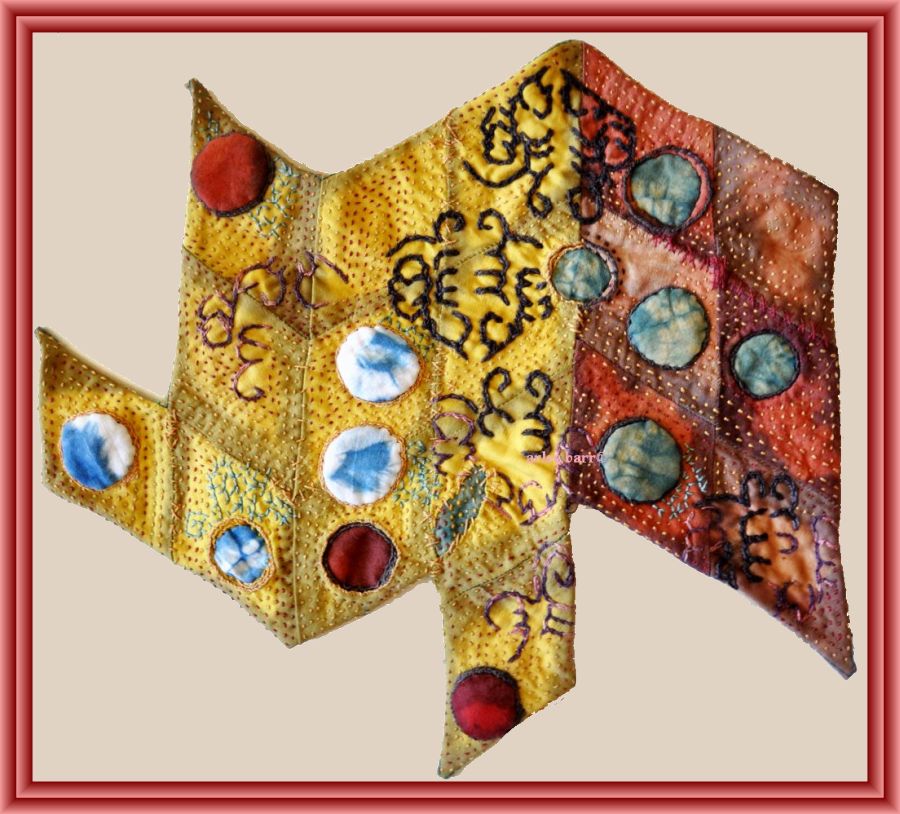
The white background is a bit too stark, so maybe a pale sepia tone would be better:

It still looks a bit “suspended”, but maybe that’s the point, setting it as a fragment?

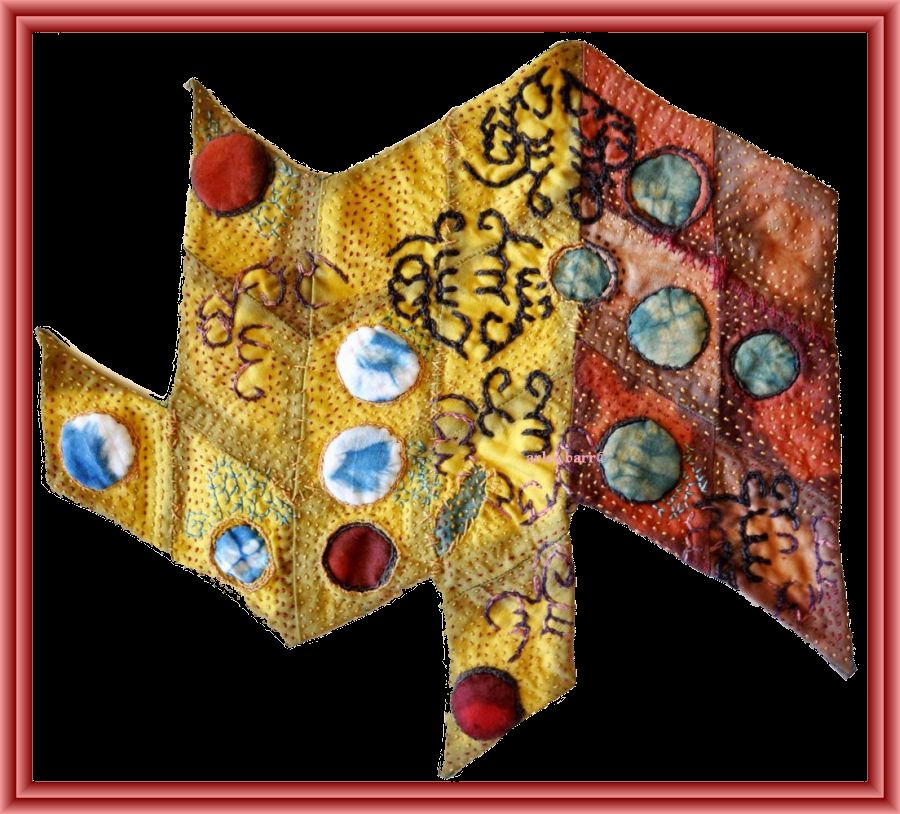
Or really dark?

MM, may be! I don’t want “colour” in a sense, or i might as well go back to the cloth backing. So, neutral or black? (Deep grey washed it out.)

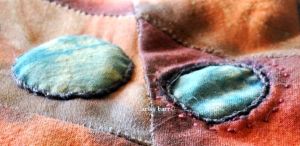
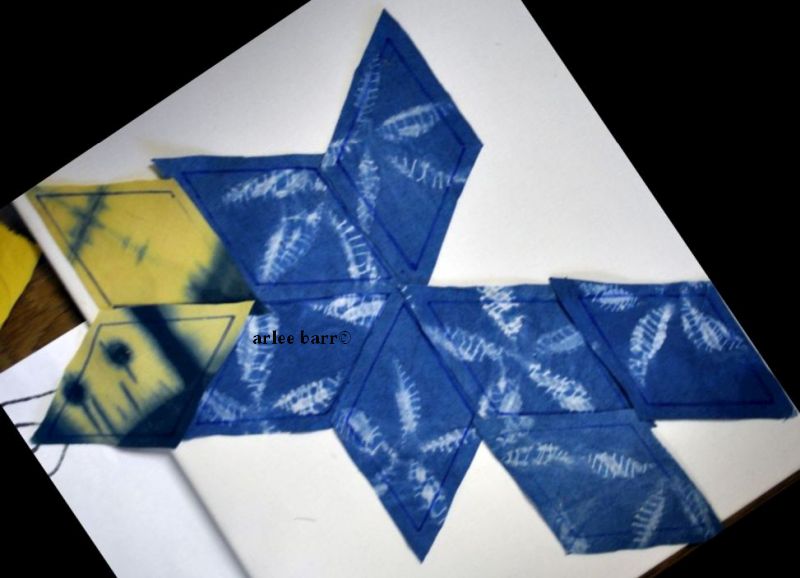
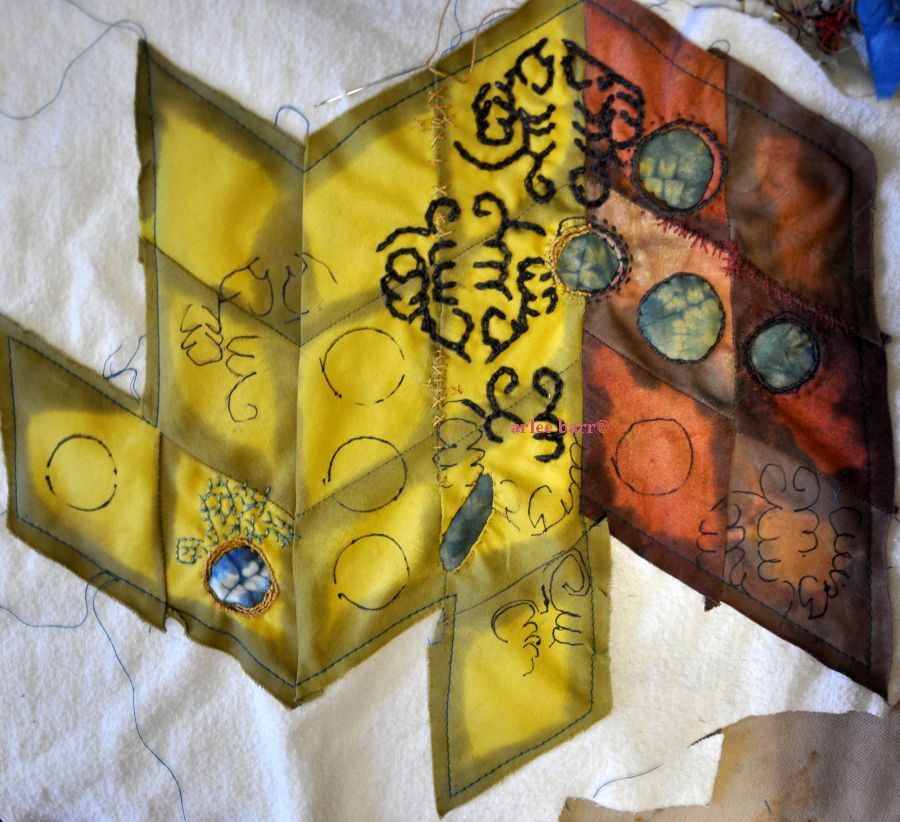
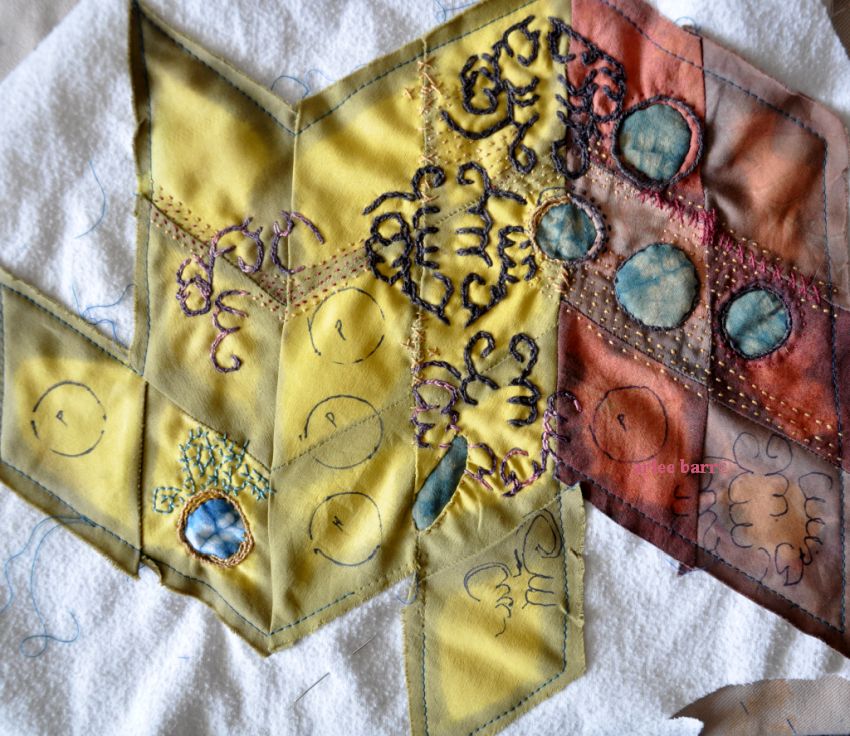
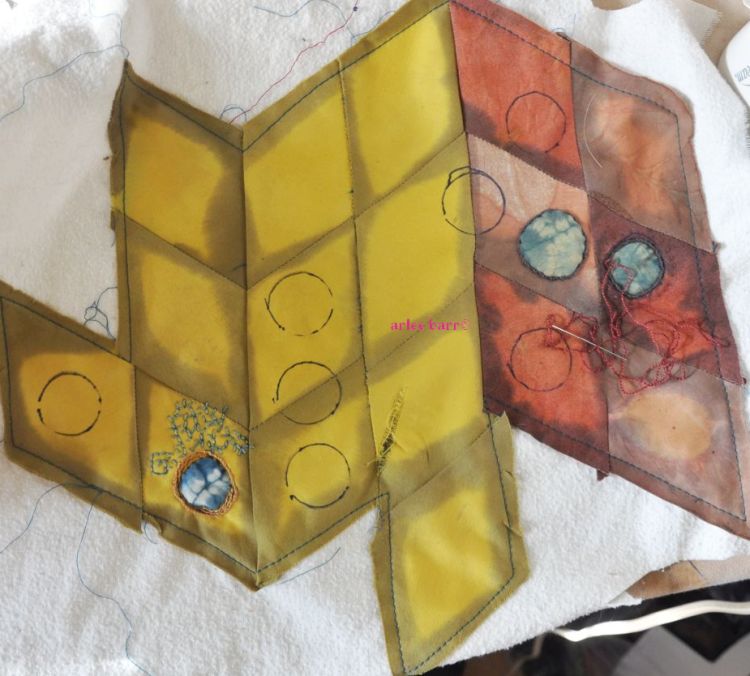
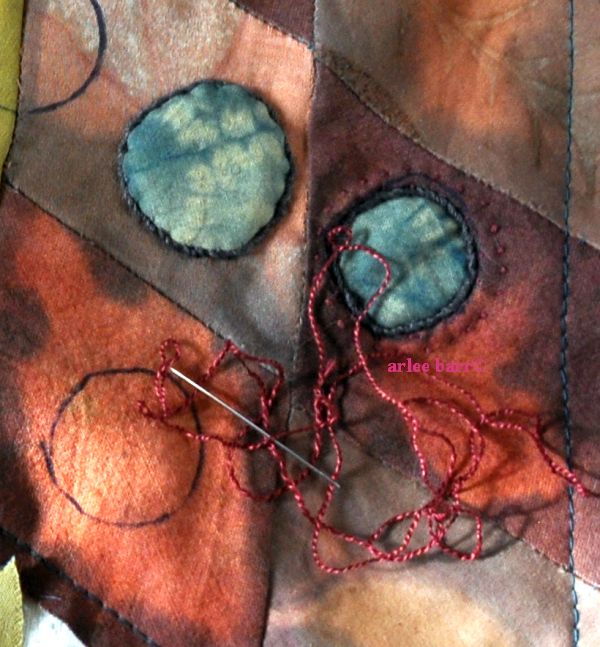
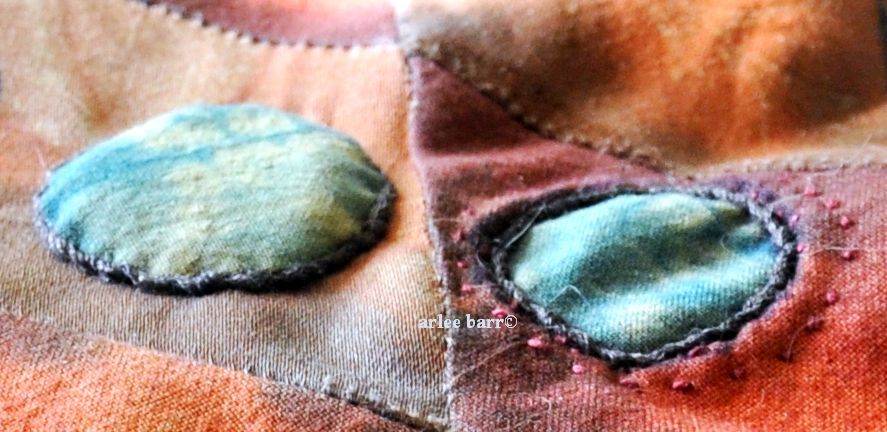
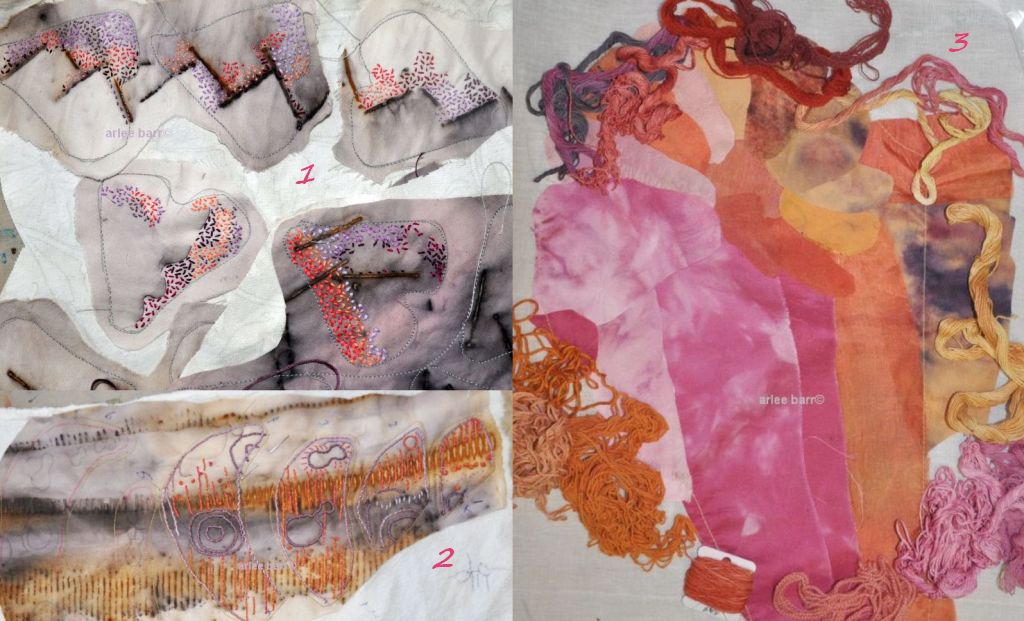
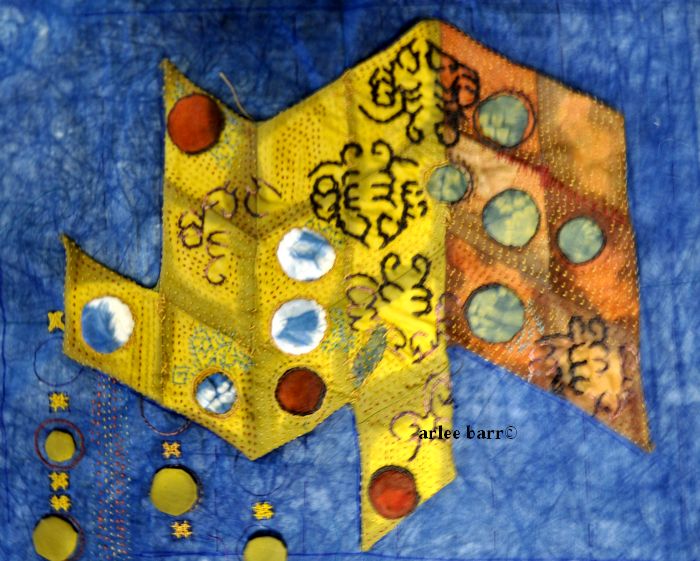
I’ve started working with other pieces too, trying different configurations. These may not be the “final” diamonds i use, but the fragment idea is still strong:

Posted in a collusion of ideas, Collision: the work begins, Self Directed Workshops

“suz, suz, suz, suzani”

To paraphrase Phil Collins……

Progress is slow on this, not because it’s difficult, overwhelming or a slog i feel obligated to get through, but because Life is happening. (Not in a bad way, just a busy way.)

Technically, a “Suzani is a type of embroidered and decorative tribal textile made in Tajikistan, Uzbekistan, Kazakhstan and other Central Asian countries. Suzani is from the Persian سوزن Suzan which means needle. The art of making such textiles in Iran is called سوزن‌دوزی Suzandozi (needlework).”

Though there are elements of Swati and Uzbeki in this, i’m also going for some Sindhi, Kutch–and Me 🙂 For easy reference, by no means comprehensive, but still useful, check out the Wikipedia page “Embroidery of India”, for an overview. I have no desire to emulate any of these exactly: instead i am doing exercises to broaden my use of stitch, and to learn either new stitches, or new ways to use variations of them, an in depth self directed workshop.

While i stitch, i think. I have ideas already for other work, that is less derivative/evocative/reflective. While i know that contemporary work in some of these regions is now done with synthetic dyed threads and fabrics, it’s the naturals again that are making the choices and setting the direction for me. I wouldn’t have tried this if i had dependence still on commercially dyed threads: it just wouldn’t have occurred to me to try this. Research and study of natural dyes leads to the history of them, the use, the end product of thread or cloth, the purpose of these materials geographically and as an art/craft form— it’s a never ending rabbit hole!

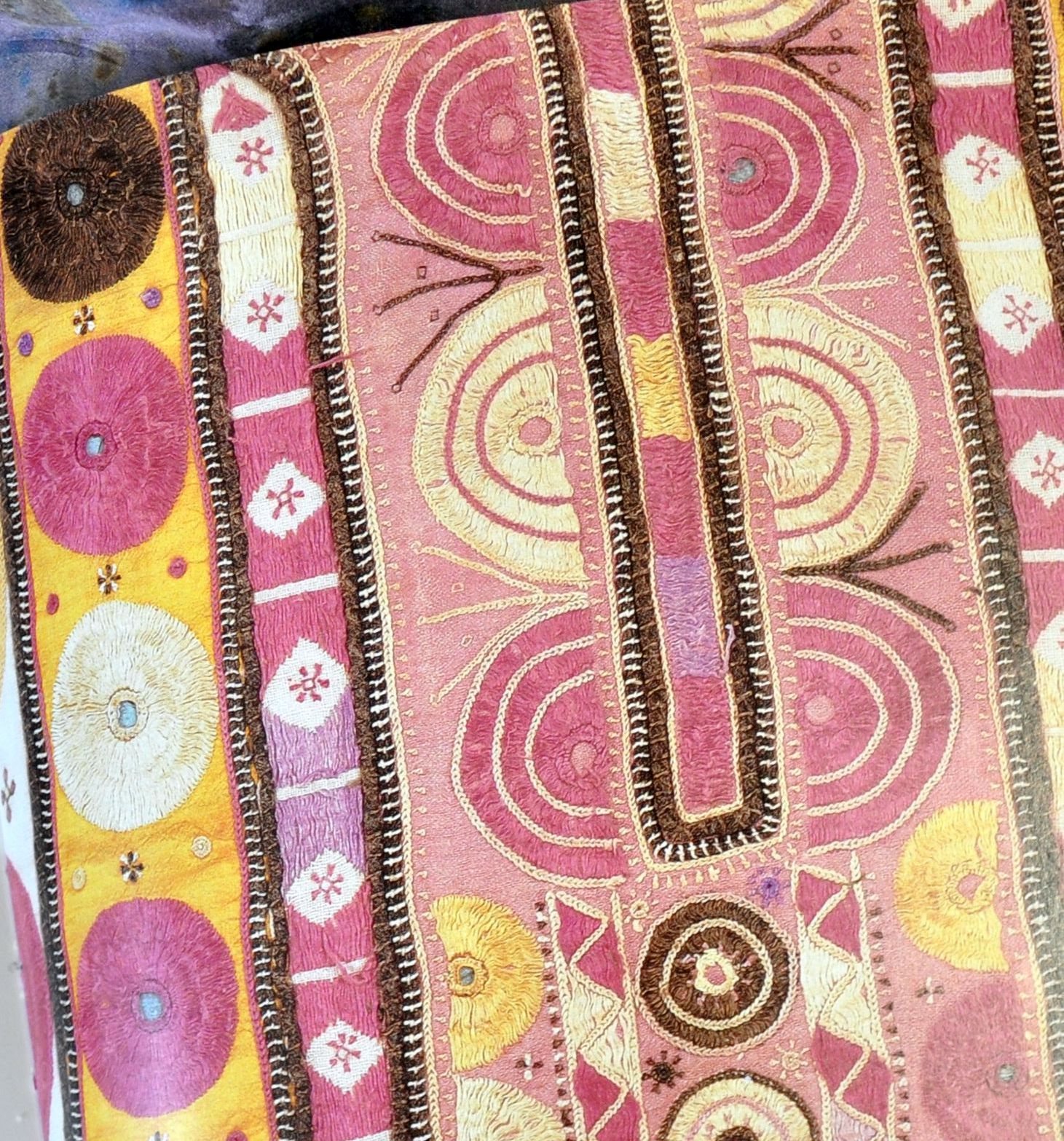
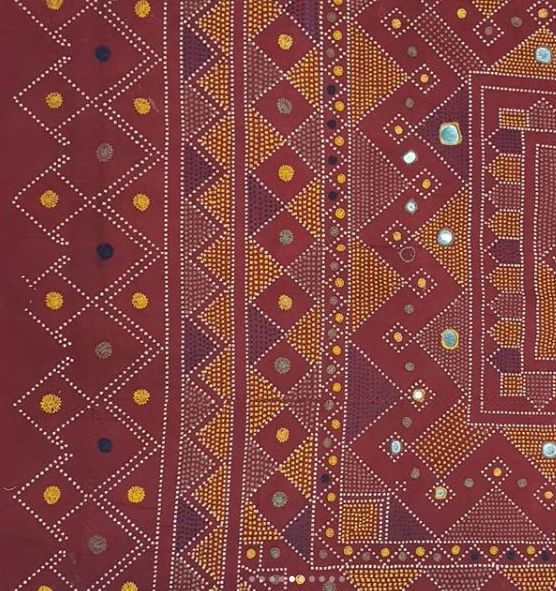
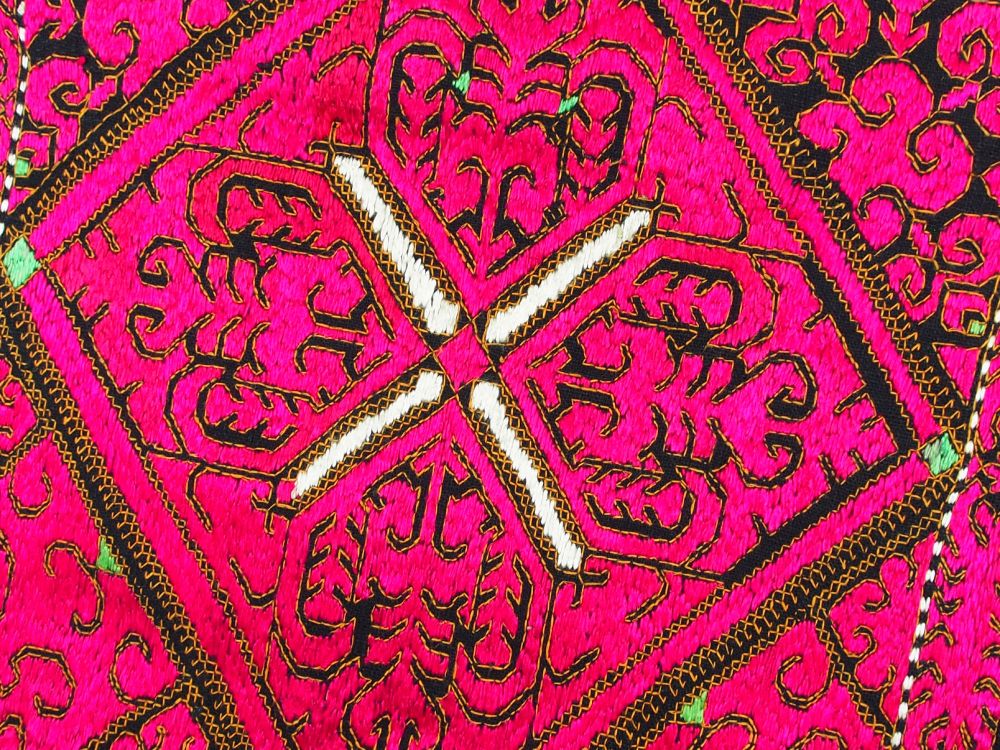
I managed to find TWO books from our local library  that have been helpful. “Embroidery from India and Pakistan” by Sheila Paine is somewhat of a catalogue of items from the British Museum, with gorgeous photos of clothing and household items, some with detail shots, and very basic descriptors of the region, stitch type and aesthetic notes, but no “how to’s”. I *did* learn however that satin stitch as we know it, is not actually used a lot, as it is wasteful of thread. If you think of how much of it is behind the work (on the reverse) as well, you can appreciate that when resources are few and probably quite expensive, you want to use as much as possible on the front. A lot of what looks like satin stitch is actually a surface stitch, akin to darning, but without the crosshatching weaving of another thread. I fell in love with this one, a detail from a Sindhi dress:

I left this as a deliberately large photo, so you can see the details more clearly. You can see though that with the surface stitching(the rounds with “radiating stitch” and the pink and lavender shapes down the sidebars), wear and breakage happens, i would think easily, and quickly.

The second book is “The Techniques of Indian Embroidery” by Anne Morrell. Again, wonderful photos in colour and with details of items, and with illustrative diagrams of the stitches used. The only problem i had was the constant flipping of pages to match “figure 36” stitch diagram with plate 21 to see the stitch in “action”. I’m curious too why the artisans  would work with the reverse side towards them, as stated in this book, as it seems very counter-intuitive.

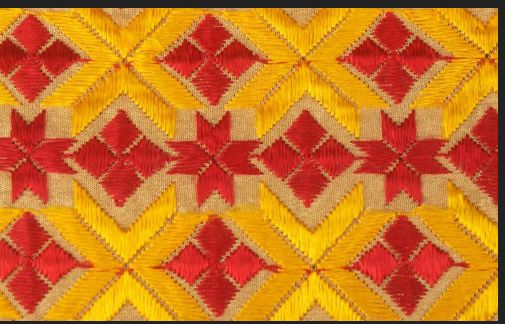
This is also the surface stitch i mentioned, used in this Phulkari piece:

What also blows me away, and a Thing i do not aspire to, is the neatness and regularity of the backs of these! Some are two or three layers of cloth to eke out  what is available, but many are one single layer.

Posted in a collusion of ideas, journal: lessons to learn

brakes on, put it in park!

Oh dear, i just can’t stop looking at these Central Asian embroideries!

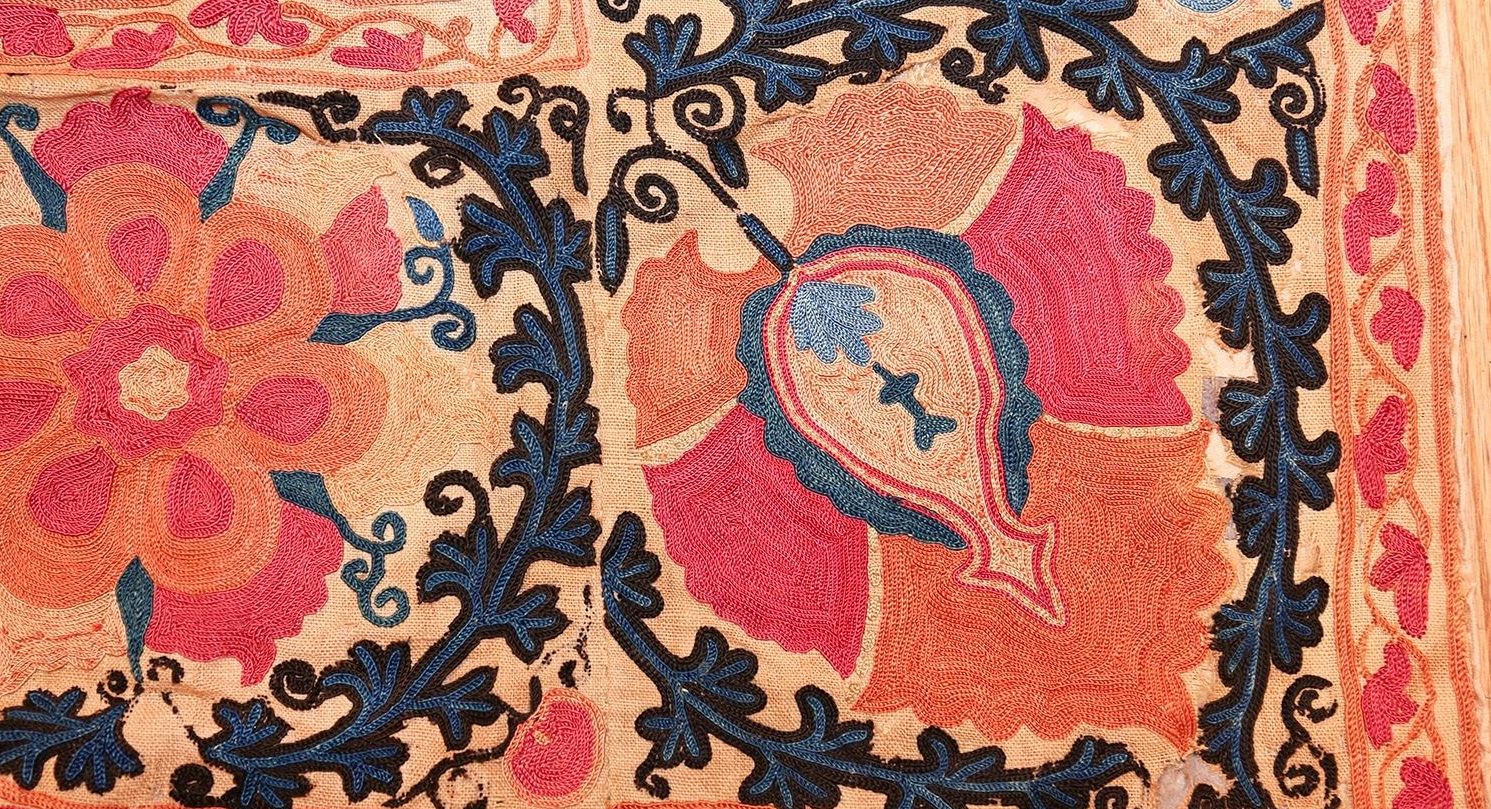
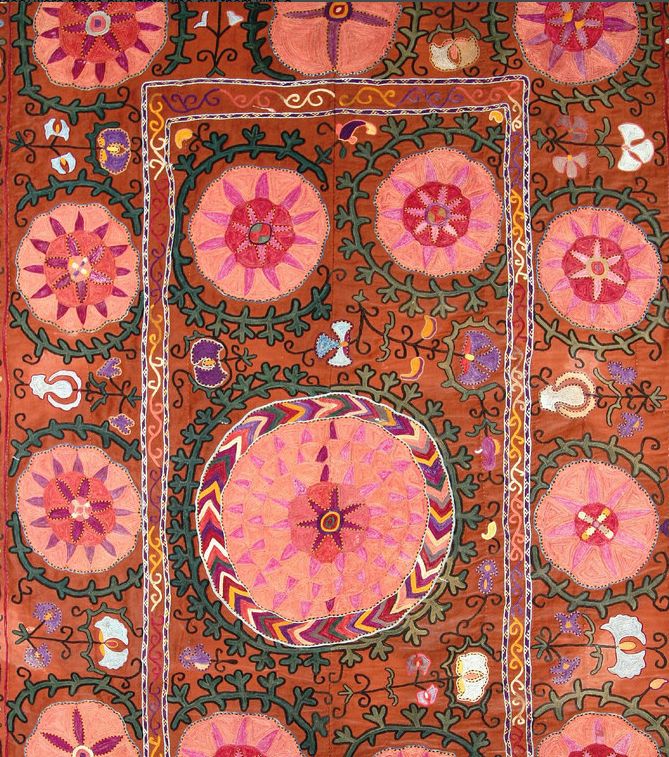
If i win the lottery this week, i AM going to buy this piece 🙂 It’s a steal at 9500US–look at the workmanship and beauty!

PLEASE, click on the photo to see those gorgeous details! I’m reasonably sure the whole thing has been done with ONE type of stitch, “ilmok”, a double buttonhole forming shapes.  From the 1800’s, it’s a good bet too that the colours were created with natural dyes. Though synthetic dyes were first being produced around 1856, these people were highly unlikely to have access to them. I think too that the panels were worked by several embroiderers and then pieced together, as there are mismatched seamlines, different qualities of stitch, and more simplified areas, none of which detracts from the beauty of this. (AHA> i was correct: http://www.marlamallett.com/suzanis.htm )

It’s also huge, given the fact that it’s handwork, a whopping 5foot4 by 8foot4! You can see the whole, and more detail here.

As to the “brakes” and “park”, i am making myself stop looking at photos and sites, and doing the work these inspire. Since i intend to mount the pieced chunk i’ve been working on (previous posts) on a background, i thought this stitch would make a lovely addition and emphasis/accent to that.

HA. Buttonhole stitch is one of the easiest to do, probably one of the first every embroiderer learns in the beginning. To get the effect and look however of that above? Well, firstly, take a look at the size of those stitches in relation to the weave of the fabric used. MIN IS CULE. I mean practically microscopic! I tried to be as tiny as possible with the finest cotton thread i had (one i intend to dye) and still couldn’t get the effect i wanted, with that defined line along the edge of each row. Nope. I *might* be able to do it with a silk thread, but have realized that much effort is not worth my time. I had intended to do only rows, not massed coverage BUT! These extremely skilled artists have a phenomenal talent and infinite patience!

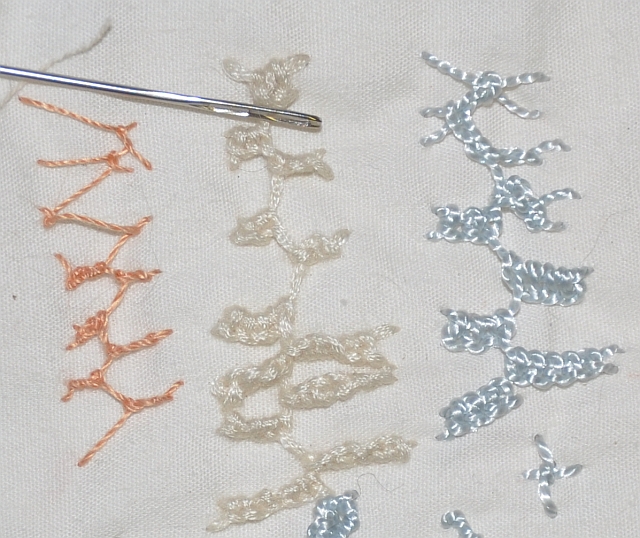
A valuable lesson learned about threads as well: the type, twist and fineness does not guarantee an effect. My cotton thread, while “perfect” was also too rigid to get the fluidity and “spread” i needed; a silk would “fluff” more, even as a fine thread. (Wool of course is the best for that.) I’ll still dye it, as different weights and plies are wonderful for accenting certain stitches or creating different textures, but will be passing on the miles and weeks of trying to cover a large area this way. Using a variety of threads can have very interesting outcomes:

Same stitch above, different weights and fibres, from the first FrankenStitch course i taught online in 2011.

Thinking now that the background will be treated somewhat like i did “Instinct” with the rows of straight stitch:


EDIT: Didn’t win the lottery, so will have to content myself with wiping the drool off the monitor once in awhile…….

Posted in a collusion of ideas, journal: lessons to learn

cultural influences and inspiration

I’m not going to call any of this “cultural appropriation”. I don’t think it is–i’m not about to swathe myself in tribal embroideries, pretend i’m actually an Uzbeki “princess” and swish downtown to pose………..

AHEM. I’m going to stall myself if i’m not careful: I could spend WEEKS looking online at ethnic embroideries, and have in fact, spent probably at least 28 hours doing just that. Calgary not being a hotbed for embroidery of any sort means most of my research has to be online–even the public library has little to offer–i have requested the two books available on the subject!

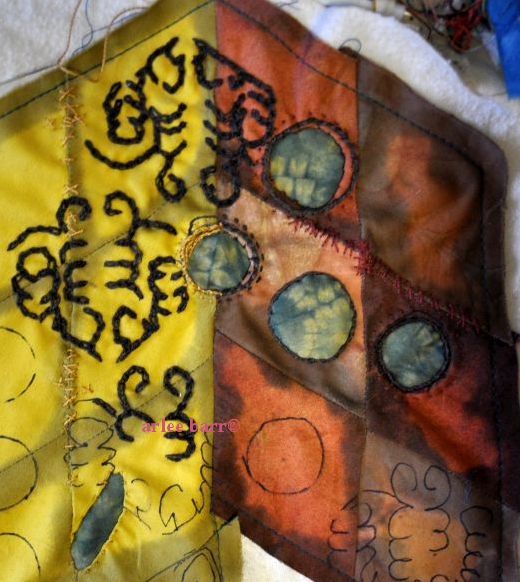
Yesterday it was this far along:

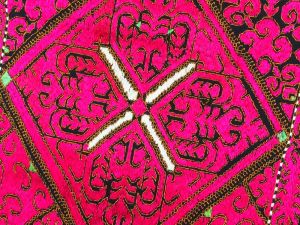
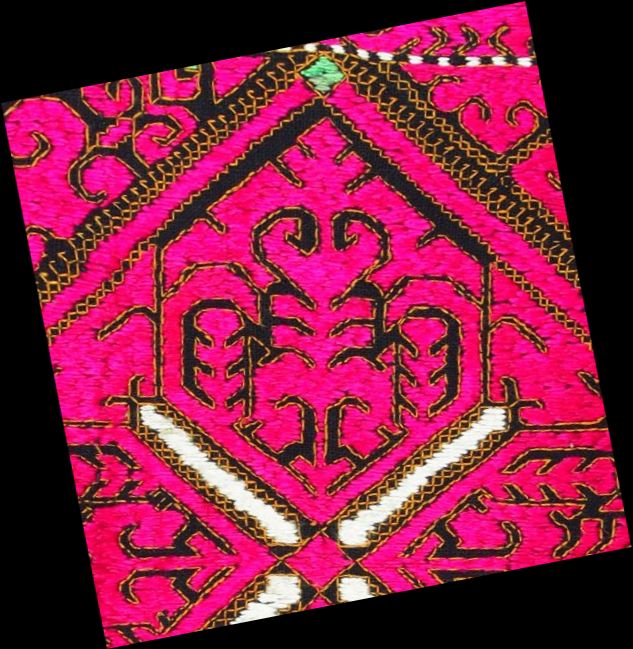
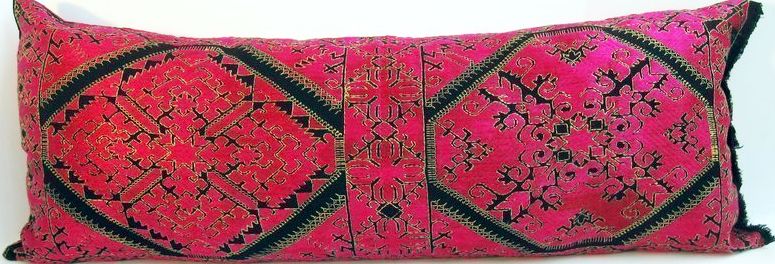
I took the centre motif from this Swati work:

adapting freely, extrapolating and morphing as i went. Upside down, broken, halved, why not?

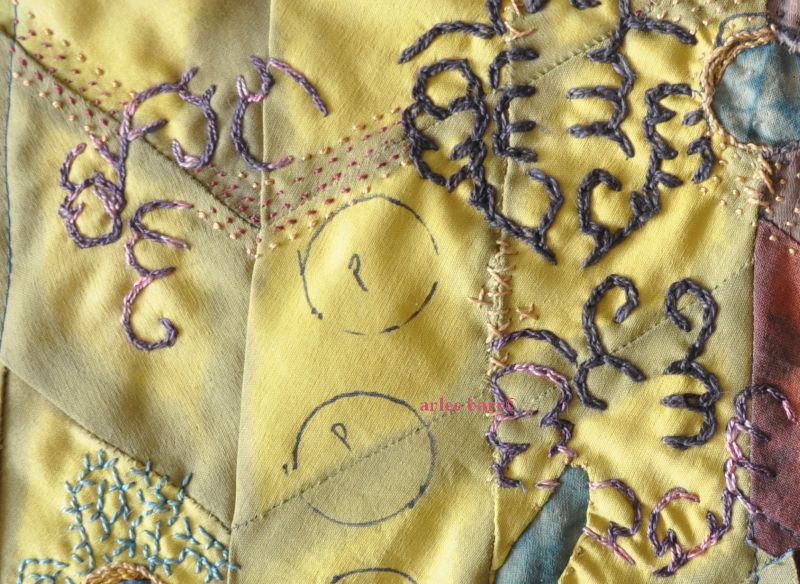
The heavy cochineal and iron modified cotton thread was a pain to get through the seamed areas, so this morning i switched to a cochineal and iron post modified space dyed silk. I like the way it changes colour haphazardly, as if it is fading (it’s not!) or more worn. It’s my thought that this should not be an obviously brand spanking new looking piece, hence the loose stitches along seamlines and the mended hole near the bottom, where i actually tore it when stitching together…..

I’m constantly distracted with this one, thinking of things i can do/add to it. It’s easy to either go overboard, or add things that don’t fit or work.

This morning too was spent looking at other types of tribal embroideries, resulting in a focus on Suzani work……so that is what this is going to be-ish. Though there are also a few tiny elements of Rajasthan in there with the tiny yellow dots….

Hell, it’s a mish mash, but whatever, it’s working for me 🙂 Let’s just say it’s the Everything of these, not one specific thing.

A large, hand-embroidered textile panel; the word comes from the Persian (Farsi language) word suzan, which means needle.  Suzani are more organic than the Swati embroideries, fewer formal repeats though definitely pictorial, and have more colour used. The originals are done with only 4 stitches, a chain (sometimes done with a tambour hook), ilmok (double buttonhole stitch), basma (a form of couching over lines or satin stitch, also known as Bokhara couching) and kanda khayol, a slanted couching stitch like Romanian couching, although i’ve found too many “definitions” of what these are to be sure! Best explanation/source for that was this site.

I already know this will be mounted, but i’m not sure yet what gets added next, letting it go where it wants as the vasty brain trips wires and causes small explosions.

Edit: I’ll be adding this to my side bar as well, as Textile Techniques. https://trc-leiden.nl/trc-needles/techniques/embroidery/embroidery-stitches

Posted in a collusion of ideas, journal: lessons to learn

working with a really good bad idea, and cultural inspiration/”appropriation”

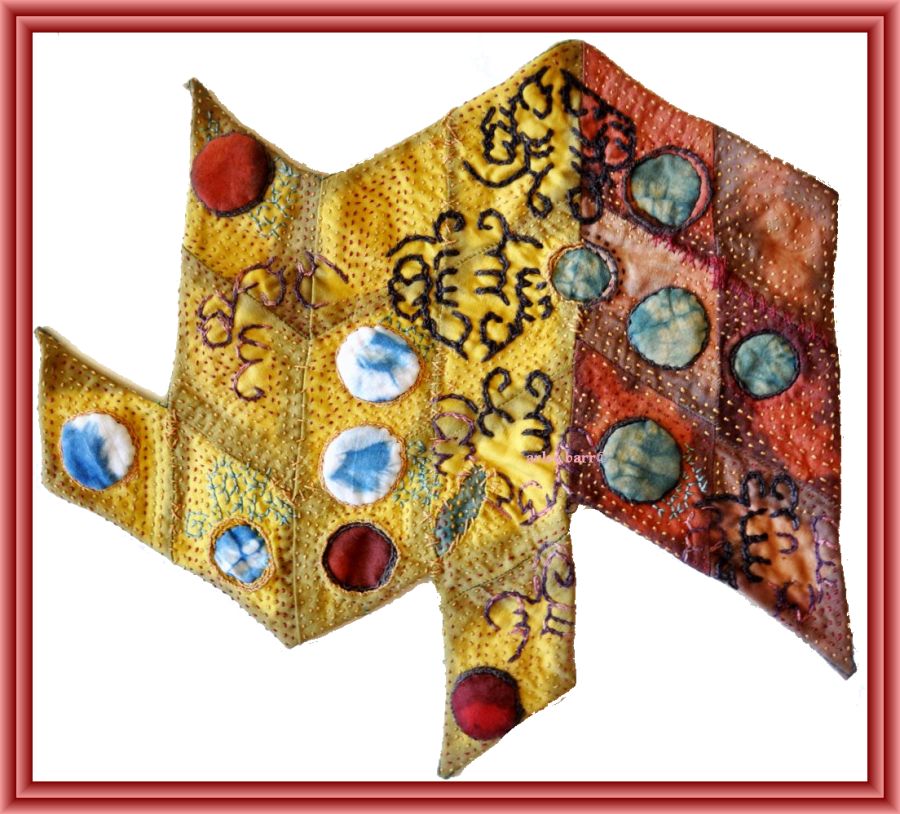
I don’t think i would have enjoyed this as much if it had been stitched together “properly” from the start!

At first too, thinking i would be able to “fix” this, all the holes were going to be lined up and centred, equidistant and regimental, formal. Bah. Life is not that way, and never has ever my art been that way, so why now? Embrace the wonk: there are no straight paths, no flat hills or level valleys, no one way only signs. Journeys shouldn’t be the most direct path between two points. Unless it’s grocery shopping. I hate grocery shopping. (Hell, i hate shopping, period.) And i bet as the crow flies, supposedly a straight line, that there are plenty of diversions along the way too : how do you know they didn’t land in several places? They just get there faster because they’re flying.

See what i just did? I wandered off the path, with the crow…..
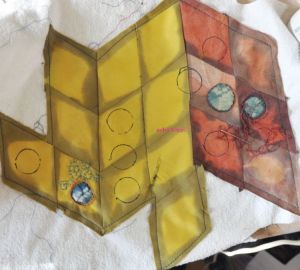
It’s got outies and innies:
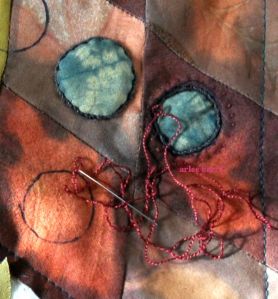
But i want to be a little more adventurous too.

Lately, as i’m learning new stitches and trying new methods, i’ve been looking at a lot of “ethnic” embroideries–and don’t slam me for that term: it generally lumps in everything from Hungarian and Lithuanian,  Aboriginal and Asian to African and Indian, (in other words EVERYBODY) and includes antiquities, primitive, geographical subgroups and historical use examples.

 “pertaining to or characteristic of a people, especially a group (ethnic group) sharing a common and distinctive culture, religion, language, or the like.”

Rather unfortunately though, the word comes from Middle English, meaning “heathen”………. pejorative and condescending to say the least!

Today’s love is the embroideries of Swat Valley, in Pakistan. When i first saw these, i thought they were black lines of embroidery on red cloth.
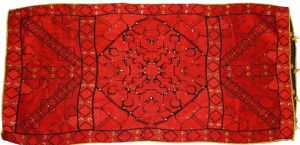
Wowzers, look at all that satin stitch!
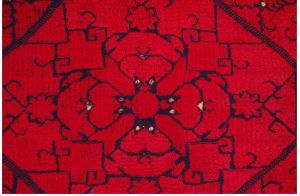
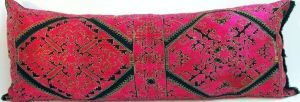
OMG.

Source of images is from commercial sites selling antiquities, found by Mr Google, but there’s specific information here about the Swati embroiderers.

I’m of course, more interested in the black lines, and while i won’t be using a newly learned stitch type (or maybe i will..), i love those motifs. I don’t look at this as “cultural appropriation”, but drawing on the past, the work of skilled artists and a sharing of modern adaptation.

Let’s face it; Canada has a poor history in regards to textile traditions unless it was brought from the Old World by the many immigrant ethnicities, or unless you use more North American “traditional” techniques involving hides, fur, pine needles, grasses, porcupine quills and natural materials. (And i ain’t knockin’ those either, just not my area of expertise.) My family passed on no traditions from Ireland, England or Soviet Ukraine, and the only piece i inherited is a 1930’s hand sewn Dresden plate quilt made from cheap recycled cottons. (I treasure it, made by my Great Grandmother, but it’s neither a work of art, nor stunningly beautiful.)


Posted in a collusion of ideas, Jam Day, Natural Dyes, Naturally dyed threads

no such thing as imperfect

It’s like gardening. You have to think of what will come up from fertile ground. The roots don’t show at all, there’s no movement of leaves, no budding of branches where birds rest, no twining of tendril or bloom tipping to sun. What colours will stay true, which will devolve/evolve/resolve to basic rainbow?

“And don’t think the garden loses its ecstasy in winter.

It’s quiet, but the roots are down there riotous.”

-Rumi

No more tears or tears.

Posted in a collusion of ideas, Deliberation--do something you don't do--or haven't in awhile, journal: lessons to learn

tears and tears, accepting the imperfect

Well, i admit i have never been able to sew or draw a perfectly straight line, but HOW THE HECK DO PEOPLE DO THIS ALL THE TIME????????

I will NEVER be a “Modern Quilter”.

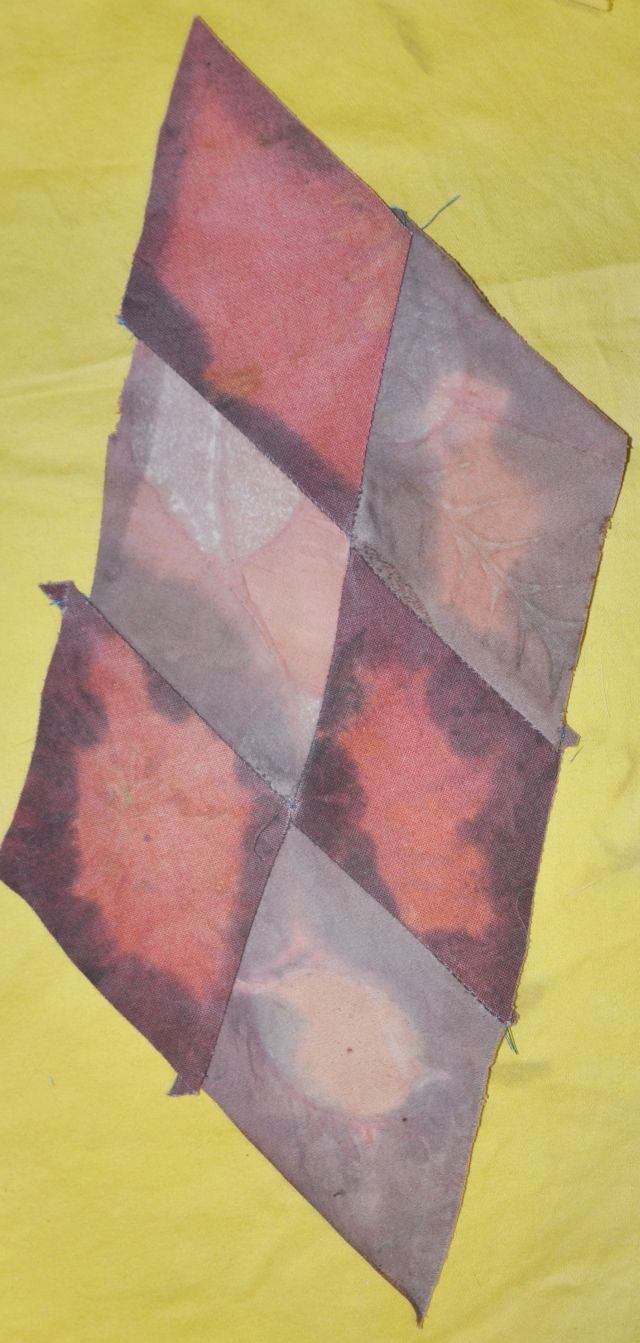
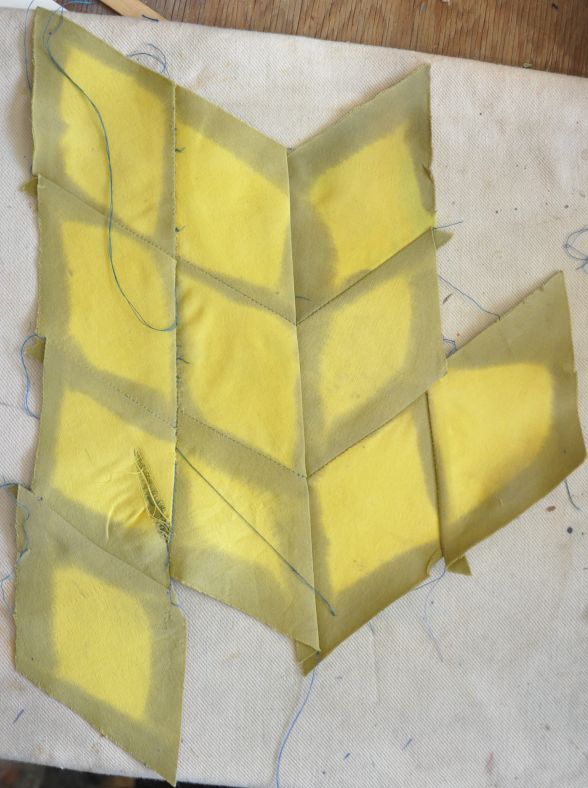
This one sort of worked, except i didn’t cut enough pieces:

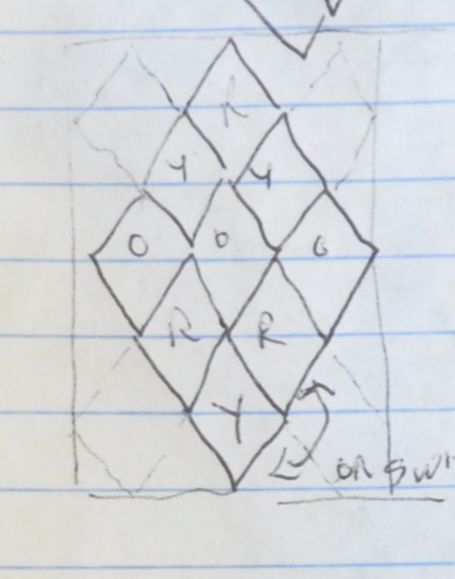
This was the plan:

(Never mind the lettering: i forgot the yellow on the first attempt, and then forgot the red on the second……..) Looks easy. Except when you are seaming. I kept flipping edges to see what it would look like. HA. i didn’t flip correctly on some. Then i just hit a point where i started stitching edges together.
There were angry tears. There were tears (rips 🙂 ) when i pulled on seams to undo. I re-sewed three times. I ended up with an obvious rip, crooked lines, imperfect point matching and the pieces going the wrong way. I cut either too many pieces, or not enough. I blame the template i used 🙂 I swear the marks for the cutting line were off *just* enough on two edges to **** up cutting and seaming. Maybe my blood sugar was low. Maybe i needed another coffee. Perhaps i have too much on my mind. And yes, i used a god-damn blue thread to stitch with because i don’t give a rat’s ass about matching.
Does this even REMOTELY look like the plan??????

Go ahead. Laugh. I can hear you from here.

**** it. I’m not taking it apart again to re-seam it. In fact, i just sewed the *almost” perfect red sample to the left edge of the above.

To hell with the pursuit of perfection. Let’s embrace the organic, the mistakes, the imperfect, the woogles and borgles and blips. Considering i’ve taken mistakes before and made something i’m proud of, i’m just going to let it be what it wants to be. Just wait and see: it WILL be if not “beautiful” when done, it will be defiantly/definitely my work.

Please also refrain from telling me how to do it correctly 🙂

PING!


Posted in a collusion of ideas, Deliberation--do something you don't do--or haven't in awhile, mordants and modifiers, Natural Dyes, osage, quebracho rojo

working up some courage

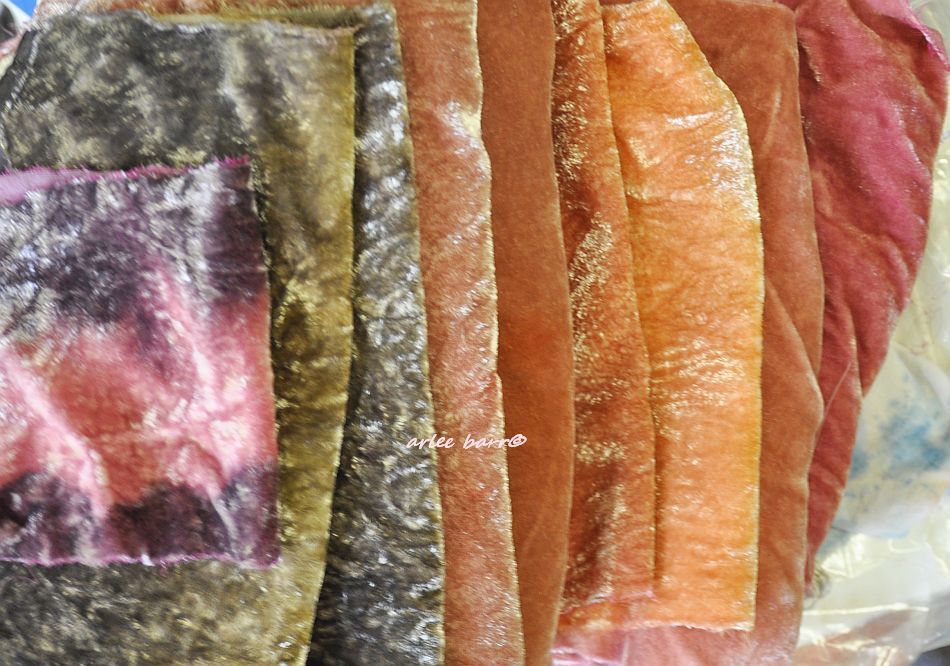
Natural dyes and silk velvet have an affinity for each other, like a love poem whispered into a breeze, like feather soft caresses, cool water on hot naked skin, sensual and earthy, sharing the privacy of deep emotion and quiet solitude.

I’ve always had a secret love affair with velvet, coveting the “lavender panne velvet pant” described in a 1972 Vogue magazine ( i was all of 15 years old and it was certainly not either in my world of farm town, or in my 60cents an hour babysitting budget…) , but never really comfortable wearing any as i got older, feeling slightly fraudulent and as if i was demanding attention i didn’t deserve. But oh the slither of it, the voluptuous animalistic tactility, in the hand, on the back of the neck, under the legs…………

Ahem. Mystery and imagination, in deed, and in thought! Sometimes it’s sexy, too often it’s overblown and tawdry—what’s the expression? “Mutton dressed as lamb”?

Down to earth now. It’s also A BITCH to sew, by hand or by machine, so i’ve stayed far away from it, though once in awhile i pull out a chunk of rayon velvet i dyed some 25 years ago, when all i knew about was Rit. Odd bits of it have shown up in wearable art i made in the 90’s, some Hoodoo work when we first moved to Calgary and i was so enamoured of the spectacular rock formations in and near Drumheller, a few Christmas bits, but nothing really serious.

BUT, these from the last 4 days:

HOW could i not try again?

EDIT: Nov 21, i forgot to mention this is primarily using Quebracho Rojo extract (with the exception of the 2 greys/greygreens which are on osage), and are mordanted and modified with a few different processes. So all these colours from 2 dyes, and 5 mordants/modifiers!!!!!!!!

Now to dig through old sketchbooks.


Posted in a collusion of ideas, embrilting, in progress, Natural Dyes, Samara

small stitches, big ideas

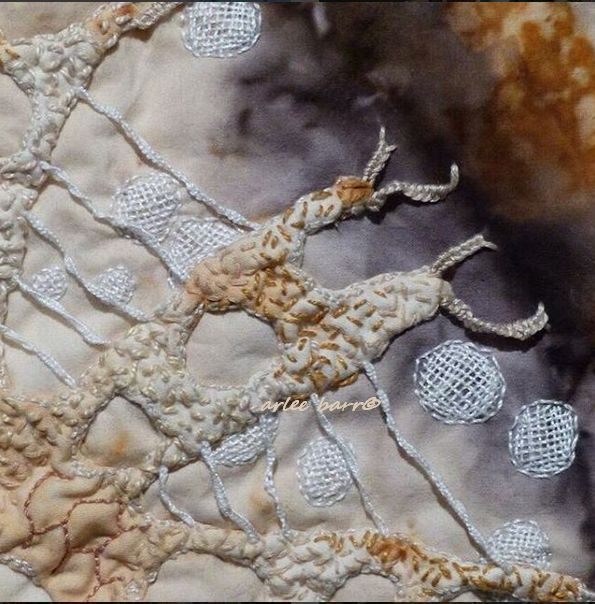
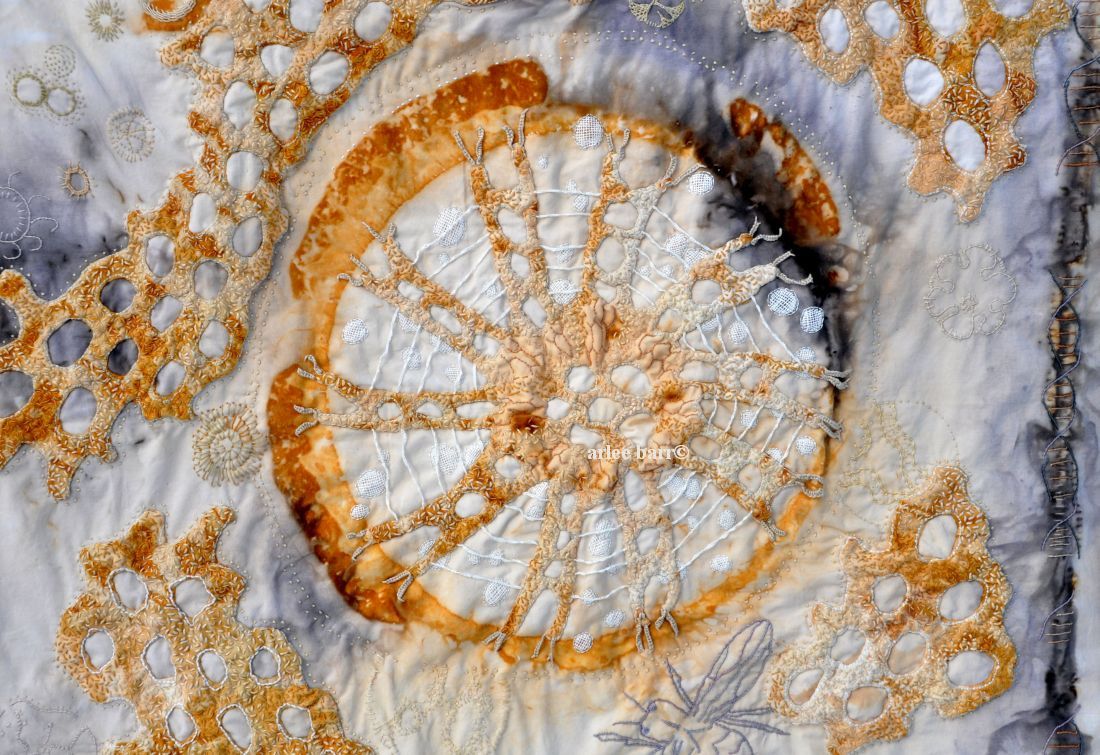
I’ve just completed a small “commission” for someone, and happily noted that a couple of stitches i used on it can feature largely for “Samara”.


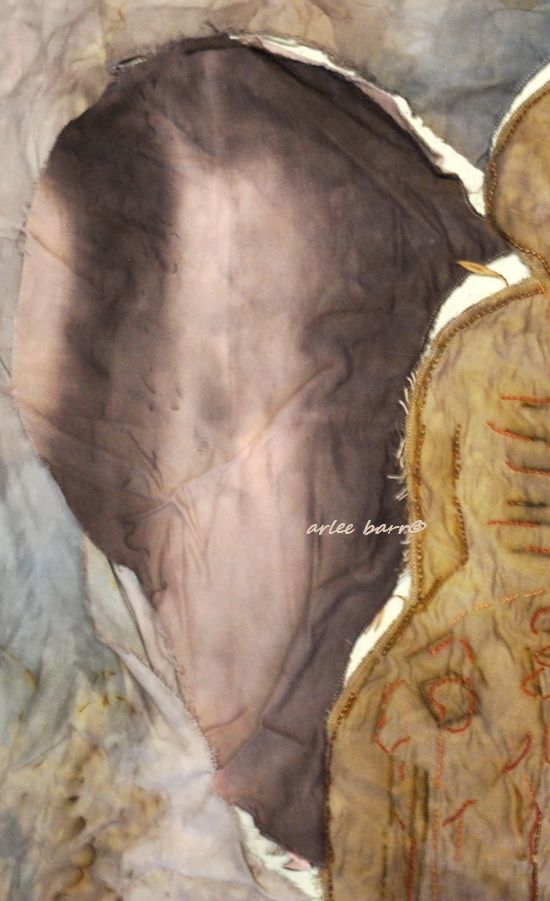
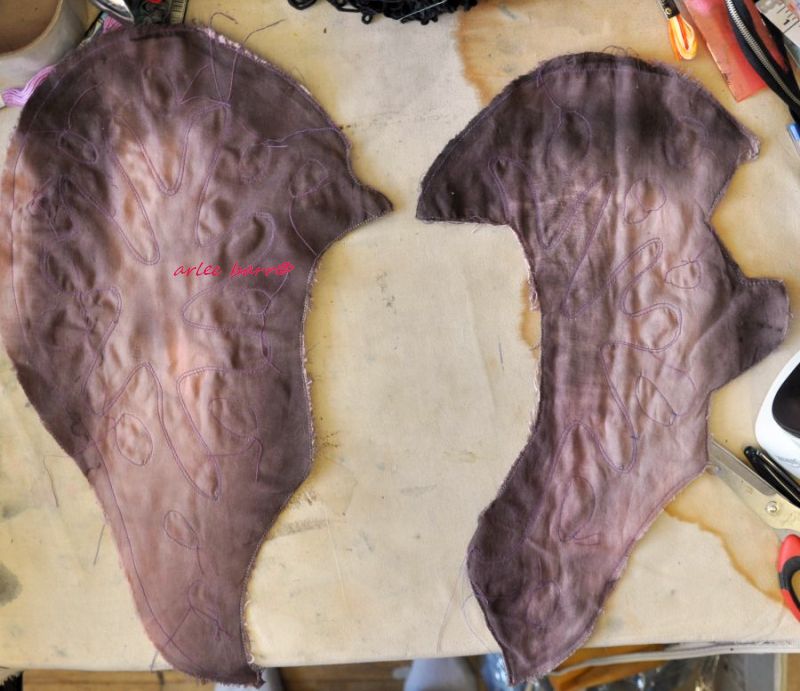
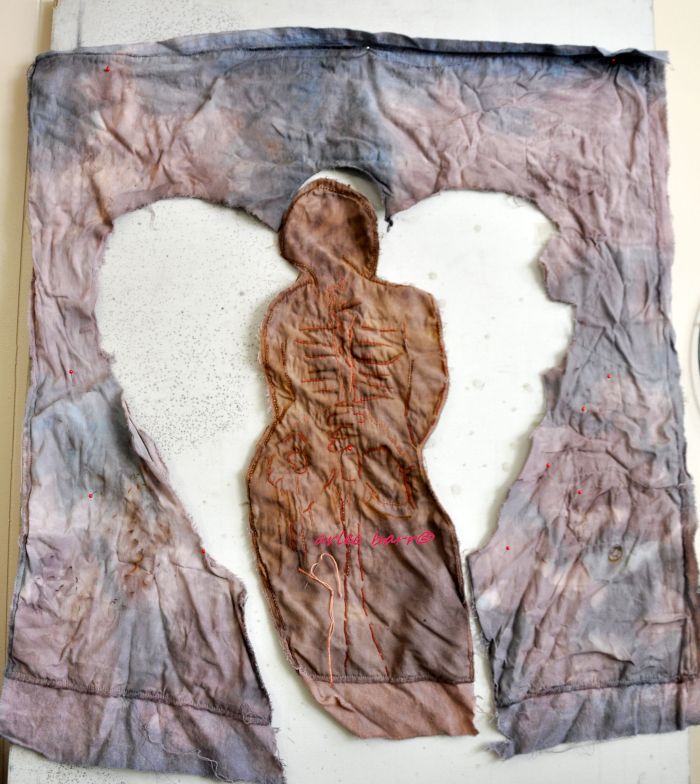
Samara’s wings are (with the figure of course!) the most prominent focus on this piece. I’ve been stumped about how to treat them, and had started three different ways of “illustrating” them, all to no avail. Frustrating. It meant a deadlock, because without knowing how i would work them, i had no idea how to proceed with the background. Hell, it was a gridlock!

The first two were with commercially dyed threads on the rust and natural dye cotton background, the third with all naturally dyed fabrics and threads.

I *do* like all of the ideas–just not for this piece! The first two were a bit predictable: feathers that “look” like feathers, while the third was maybe too much of a good thing with all that colour. (Stack ’em and stash ’em for future work…)

My favourite Thing too, a signature, if you will, is the use of dimension and texture in my embroidery technique. Whether it’s raised areas, or FrankenStitch ( my personal woogly boogly break-the-embroidery-rules-about-neatness-and-even-ness approach), i feel i MUST go back to that. That’s Me, that’s what my work is. The feathers above would have satisfied a bit of that, but nah, too feathery 🙂

I’m looking at this:

in conjunction with ideas from “A Birth of Silence”

and now have these to work on:

I’m hoping that i can do one a week……. the body is almost done, as it needs only minimal stitch, but the background is going to be a bear because it’s so big, and that is why it probably won’t be finished until the new year. (Day Job will be F’n  FRANTIC in December, so very very little time there…) When the first wing is done, i can also start making choices for the fabric that will show underneath at the edges.

I know this work won’t be done until into 2019, my slow pace necessary with hand work. No rush, no deadline, nothing really to add to a “Gallery 2018” page on this blog, because i’m going where i don’t know where i’m going.

Posted in a collusion of ideas, Deliberation--do something you don't do--or haven't in awhile, in progress, Samara

mining

I’ve spent the morning mining deeper and deeper into the archives of old work, old photos, old ideas.

You can’t duplicate things, at least i’ve never been able to. I have no desire to do copies, even of my own work. Series are one thing, adaptations are another, but/and churning out the same thing over and over is an entirely different mindset…… I tried it a couple of times, but other ideas creep in, so obviously that’s my way to go. I’ve bored myelf when i’ve done production work, no real artistic satisfaction in it. Even my “bread and butter” work is all different!

All i’ve done this year, really, is just that: helping putting food in the animal dishes, gas in the car and new underwear for the human residents at the Stately Barr Manor. Six months without a Day Job took a toll, especially psychically, emotionally, and so i am very happy to go back to alternating art for sale, and Art. (Yes, there is a Day Job again, but you’re not going to hear about it, as i’ve decided it’s not my focus anymore, just a way to build things.)

I’m eager to start actual work again on “Samara”. I know it will take time, and much thought, but once i get into the “zone” again, i also know it will be worth it. To that end, the digging has pulled up two three ideas i want to extrapolate from:

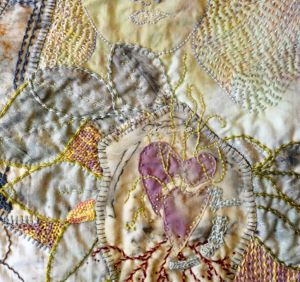
Detail of “Self Portrait: SAD”, 2011. The concentrated areas of stitch, and the looseness of the heart are the appeal here.

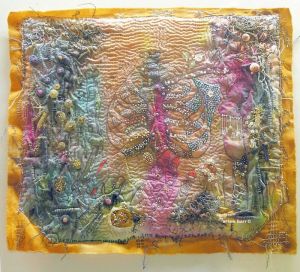
“Beautiful Bones”, 2009, i still love that heavy encrustation of sequins and beads on the ribcage, something i never did again anywhere, but am finding very “catchy”:


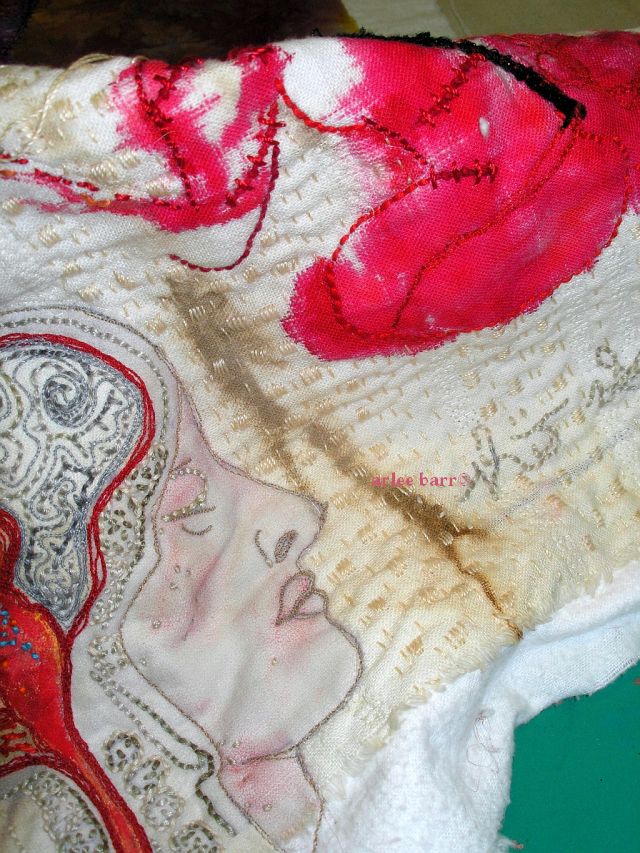
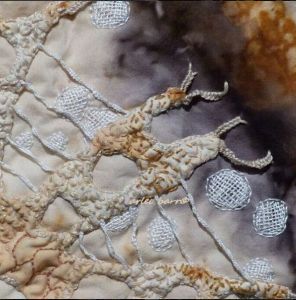
and a detail of “Birth of a Silence”, 2015, the dimension, the combination of flat and raised, of line and texture:

One of the wings will be coming off the board and we’ll see what happens, how things get combined, re-worked, adapted.