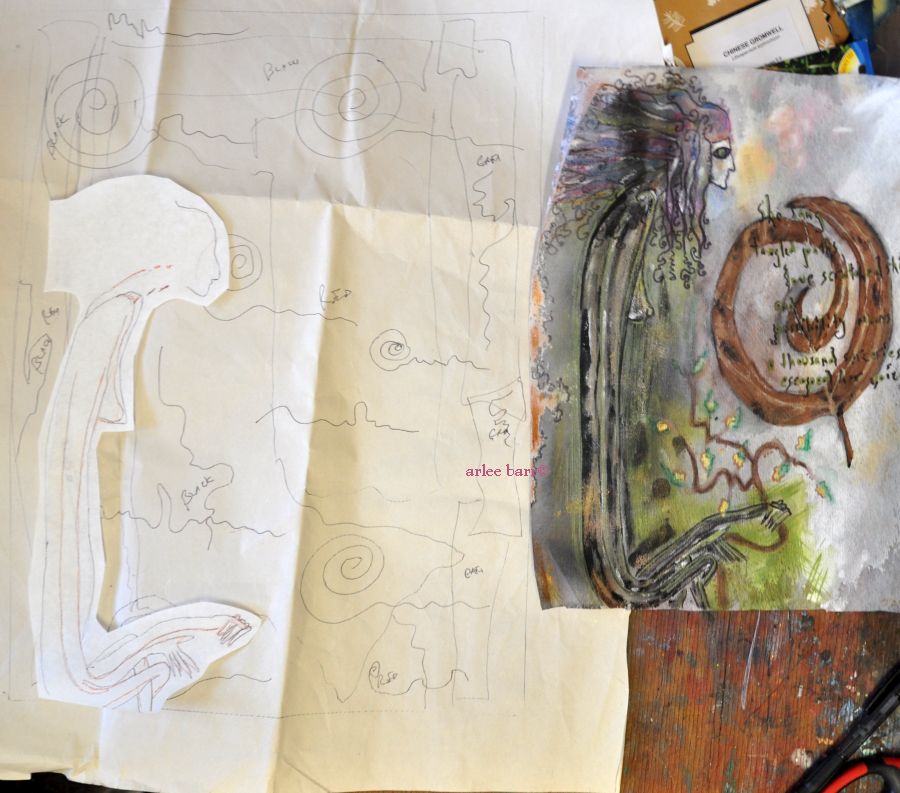
I don’t always plan out this much, or in such detail. I know things will migrate, mute, change, become more subtle or disappear.
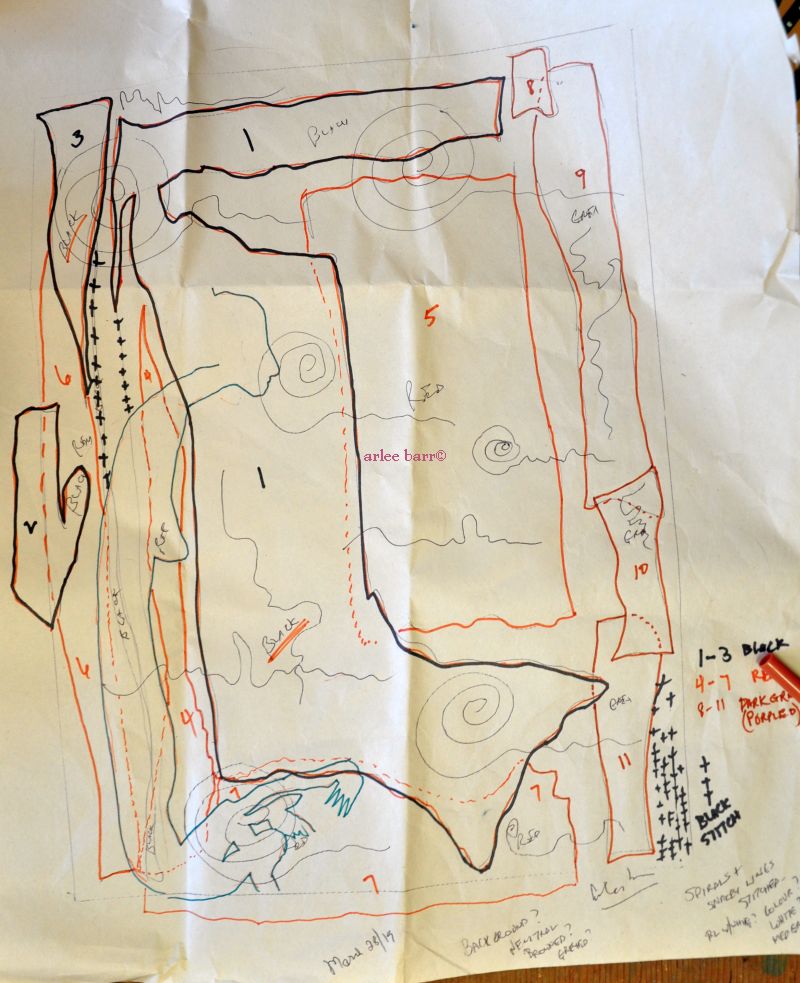
It looks more complicated than it is.
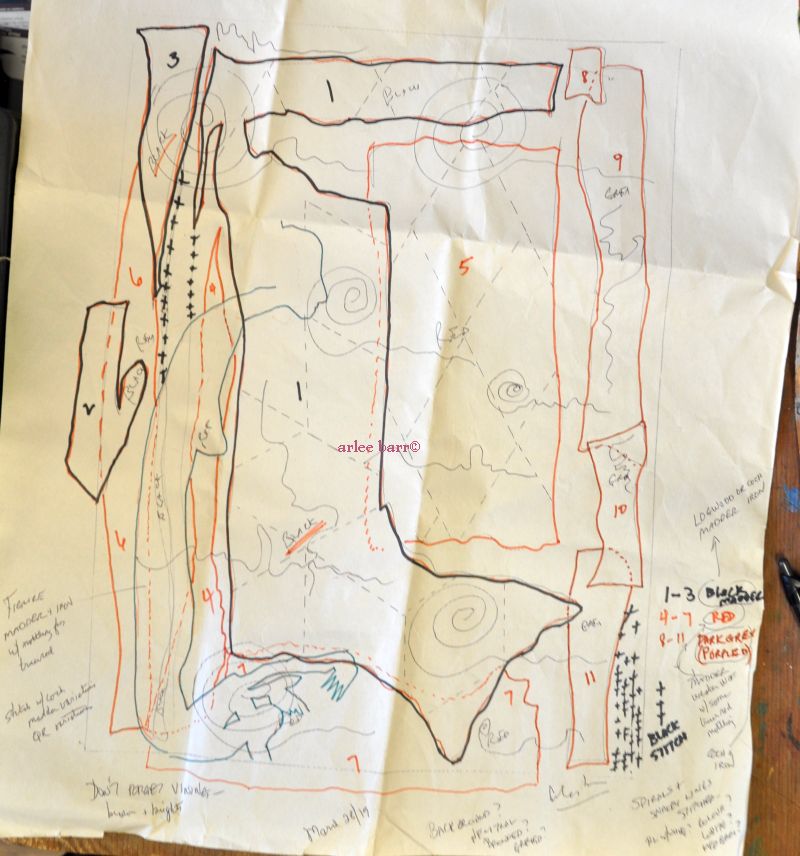 It will be simpler when all the threads and fabrics translate the idea to form.
I don’t always plan out this much, or in such detail. I know things will migrate, mute, change, become more subtle or disappear.
It looks more complicated than it is.
It will be simpler when all the threads and fabrics translate the idea to form.
To paraphrase Phil Collins……
Progress is slow on this, not because it’s difficult, overwhelming or a slog i feel obligated to get through, but because Life is happening. (Not in a bad way, just a busy way.)
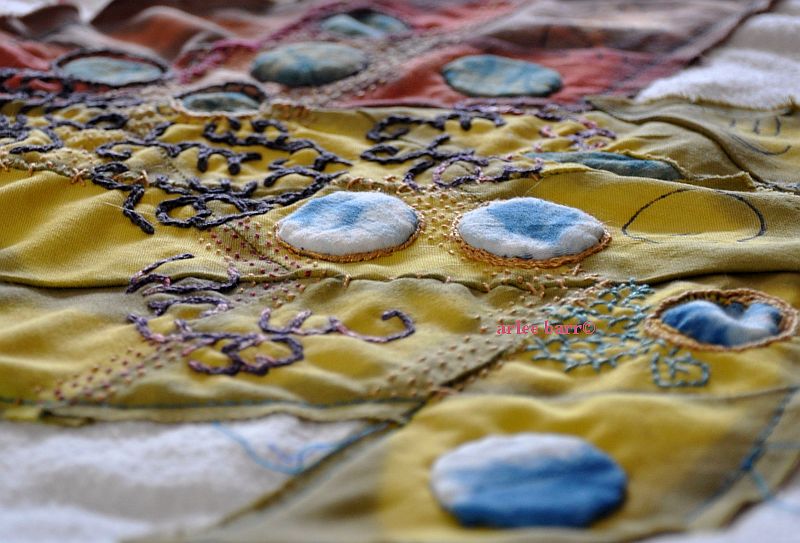
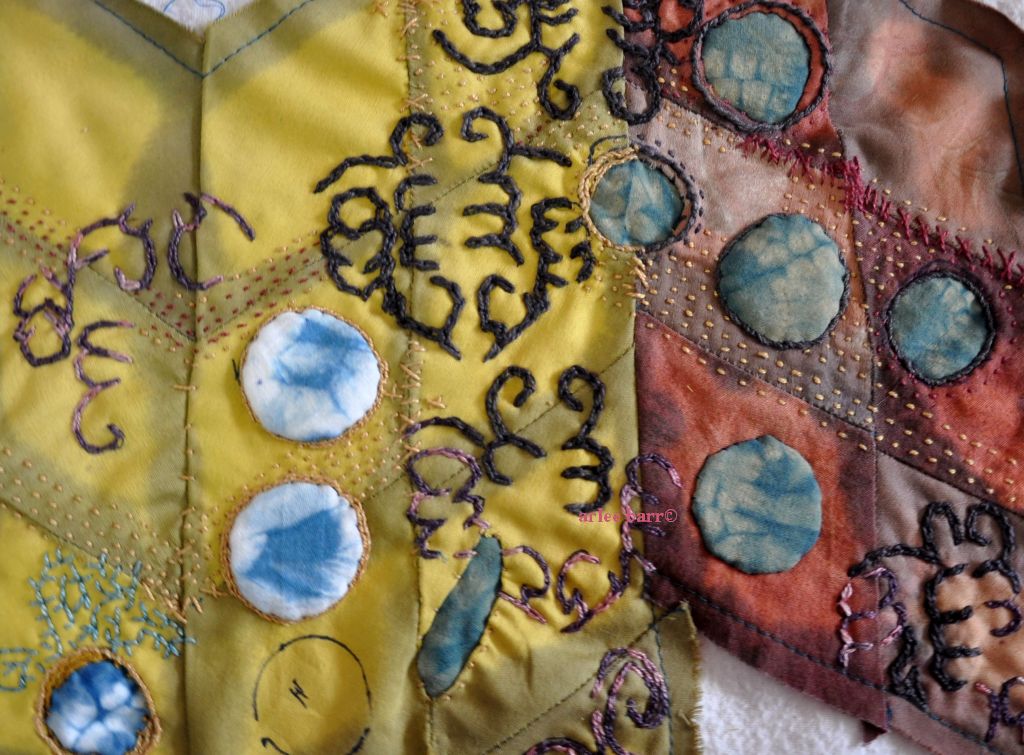 Technically, a “Suzani is a type of embroidered and decorative tribal textile made in Tajikistan, Uzbekistan, Kazakhstan and other Central Asian countries. Suzani is from the Persian سوزن Suzan which means needle. The art of making such textiles in Iran is called سوزندوزی Suzandozi (needlework).”
Though there are elements of Swati and Uzbeki in this, i’m also going for some Sindhi, Kutch–and Me 🙂 For easy reference, by no means comprehensive, but still useful, check out the Wikipedia page “Embroidery of India”, for an overview. I have no desire to emulate any of these exactly: instead i am doing exercises to broaden my use of stitch, and to learn either new stitches, or new ways to use variations of them, an in depth self directed workshop.
While i stitch, i think. I have ideas already for other work, that is less derivative/evocative/reflective. While i know that contemporary work in some of these regions is now done with synthetic dyed threads and fabrics, it’s the naturals again that are making the choices and setting the direction for me. I wouldn’t have tried this if i had dependence still on commercially dyed threads: it just wouldn’t have occurred to me to try this. Research and study of natural dyes leads to the history of them, the use, the end product of thread or cloth, the purpose of these materials geographically and as an art/craft form— it’s a never ending rabbit hole!
I managed to find TWO books from our local library that have been helpful. “Embroidery from India and Pakistan” by Sheila Paine is somewhat of a catalogue of items from the British Museum, with gorgeous photos of clothing and household items, some with detail shots, and very basic descriptors of the region, stitch type and aesthetic notes, but no “how to’s”. I *did* learn however that satin stitch as we know it, is not actually used a lot, as it is wasteful of thread. If you think of how much of it is behind the work (on the reverse) as well, you can appreciate that when resources are few and probably quite expensive, you want to use as much as possible on the front. A lot of what looks like satin stitch is actually a surface stitch, akin to darning, but without the crosshatching weaving of another thread. I fell in love with this one, a detail from a Sindhi dress:
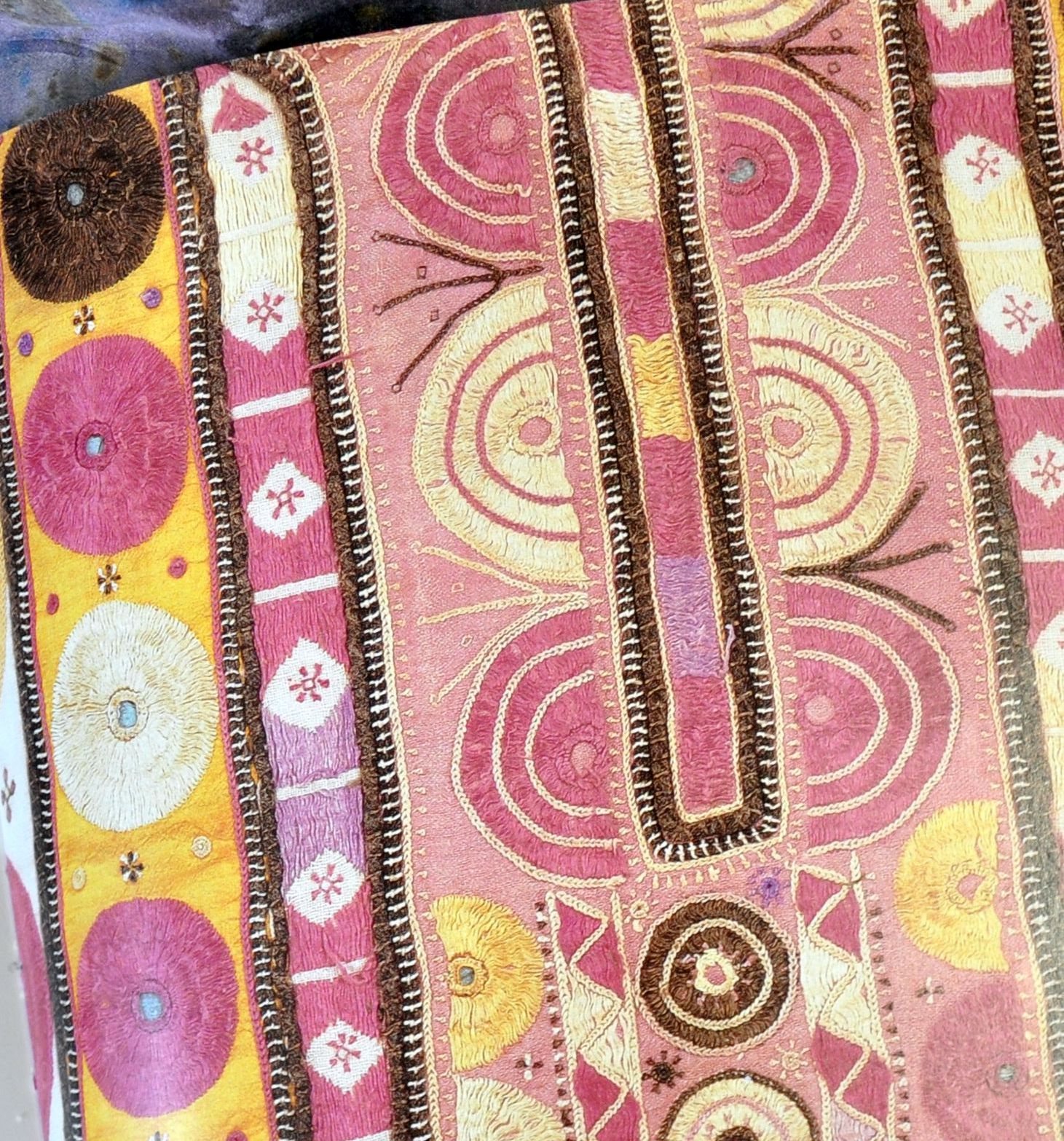
I left this as a deliberately large photo, so you can see the details more clearly. You can see though that with the surface stitching(the rounds with “radiating stitch” and the pink and lavender shapes down the sidebars), wear and breakage happens, i would think easily, and quickly.
The second book is “The Techniques of Indian Embroidery” by Anne Morrell. Again, wonderful photos in colour and with details of items, and with illustrative diagrams of the stitches used. The only problem i had was the constant flipping of pages to match “figure 36” stitch diagram with plate 21 to see the stitch in “action”. I’m curious too why the artisans would work with the reverse side towards them, as stated in this book, as it seems very counter-intuitive.
This is also the surface stitch i mentioned, used in this Phulkari piece:
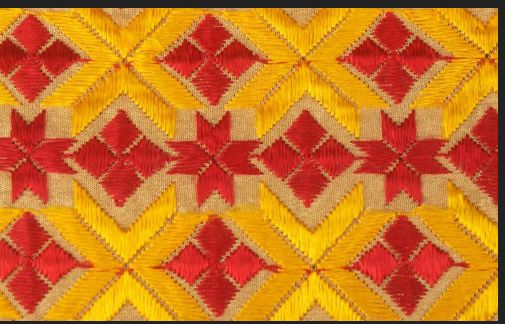
What also blows me away, and a Thing i do not aspire to, is the neatness and regularity of the backs of these! Some are two or three layers of cloth to eke out what is available, but many are one single layer.
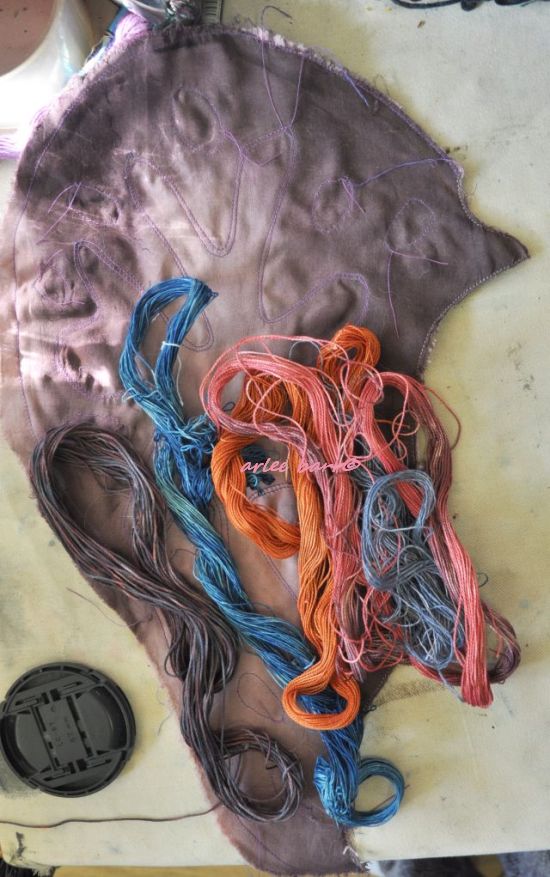
Had a bad moment last night when i suddenly thought the stitching on the wings was too tight, too controlled. Must remember to get out of the small work approach!
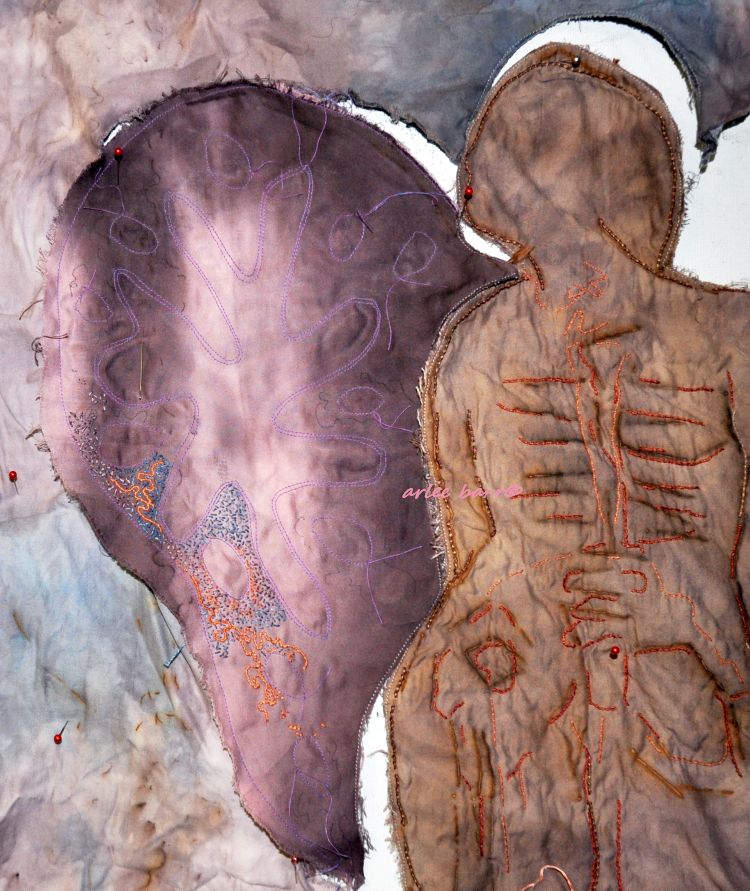
But it’s getting bigger, looser and is not too “precious” after all. The “myopia” that develops as i work small areas of a large piece means i have to literally step back to see the whole. And since i can see in my head what will be happening in the wings and in other areas, it will work.
One disappointing (in a sense) thing is that the result is not the same as the work done this way on “A Birth of Silence”. (See previous post.) The rust on that particular piece stiffened the fabric for more dimension, something that is not featured much on any of this piece. I may have to manipulate it more when the time comes to attach to the background, or maybe it will be fine. I think the backing fabric i used this time too is thinner or flatter than the one used in ABOS as well, but c’est la vie!
There’s nothing wrong with it, it’s just different.
Most women’s garments just don’t have pockets, or real, decent pockets. I’m tired of jeans with fake ones (a cop-out “detail” at its worst–who’s looking at me that cares if it looks like a pocket if it isn’t????????), tired of ones that are too small, or so small and deep that you can’t get anything in, but if you do, you can’t get it back out, ones that don’t lie flat, ones that twist, ones that are placed too high, too low or impossible to find behind your back, and pockets that quickly develop holes.
I have SO many ideas for this Summer Madder Project garment, too many maybe, or maybe enough that there could be a couple of pieces! As things go in, (some delicate vintage lace now! and more threads!) and things come out of the madder pot (hopefully, an even deeper red), i thought one best start somewhere, so pockets, pockets it is. I want capacious, generous baggy pockets, suitable for gathering leaves, stuffing monies in and snacks, carrying lost journals, lost kittens, injured birds, rocks, whatever: pockets should be able to comfortably CARRY things. That’s their function, truly. And if these don’t work as pockets, then they become small bags!
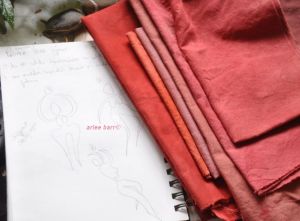
I’ve used similar little figures before, but since i plan on using them scattered around, the above are newly “designed” ones, along with 4 others not shown. Previous incarnation of the originals is here. (There will be other motifs as well, but these are a good start.)
Since this project when done will have to be washed by hand (due to natural dye Ph considerations), i’m not hesitating to mix silk/wool, wool, silk, and cotton threads, and fabrics in silk and cotton. The range of colours is more enticing on all the different fibres than using just cellulose or just protein fabrics and threads. The original plan was to create a “top” from a Tina Givens pattern, and i’m still going to use that (minus the ruffle, and lengthened a bit), but given that most of my embroidery is done with a flannel backing, this is going to have to be lined somehow, to hide the flannel and protect the reverse of the stitches. That means it’s a bit “heavier” than normal summer wear, but given that our nights here in the summer are a lot cooler than elsewhere, due to our altitude, that’s perfectly acceptable. I will however be using a thinner flannel than normal. I *could* use a finer cotton as a backing, but then the effect that stitching on a backing like flannel is lost–and that’s what my work is about, that added little dimension and depth. That’s why, for years, i’ve called it “embrilting” 🙂
As i’ve thought of the stitching itself, i’ve also come to the decision that more dimension will be “needed” as well, to personalize this to me. I might be going overboard, but time and effort will tell!
In the annual purge that takes place in January, i found an old “mark making” journal. A period of mixed media and a lot of colour, it was my antidote to living and working in my MIL’s basement, a horrible place and situation in many ways. “Notes from Mother Nature” was made in October of 2008.
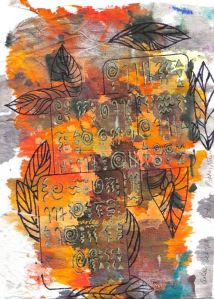
My “epiphany” is gelling, if indeed epiphanies do gel. Reflective searching thought, and research has led back to some ideas, but unless i actually start somewhere, nothing will take form. Simple, right? There are many many parts i wish to use again: the studio worktable is a jumble of sketches, fabrics, notes and paper scraps.
So, start small, because small can become big when the sum of the parts become the whole dance.
Because we’ve all done Stoopid with a Capitol 9 at least once………
“Normally” i would have thrown this in the unfinished pile where it would have sat forever, but the lace is too precious to me to “waste” it. And i *have* gotten much better at (im)patiently pulling or cutting out mistakes, because the initial idea is good. When they lack in interpretation though, cut your losses, or cut the threads!
Firstly, the lace puffed up and made itself look big, trying to scare me. I do believe i forgot to iron the underlayer (Lazy!) and a wrinkle in there resulted in this lofty attempt at escape.
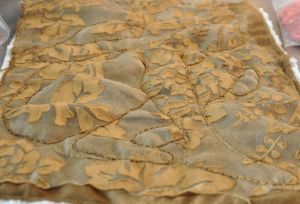 What’s REALLY sad is that though i had a very clear picture in my head of how she would look when worked, i didn’t stop for any consideration on HOW i was going to do that, and just Started. Dear GAWDZ but this is Horridatious, looking as if an inexperienced newbie or a 4 year old got hold of it. I have done trite work, i admit it (we all honestly have) but this? Not only trite, but badly worked–NOTHING to do with what the figure is/says, NO beauty in any of that working, and seriously, i am embarrassing myself horribly by showing this. Is it any wonder she’s holding her head in her hands???? She’s wailing!!! “What have you done to meeeeeeeeeeee???”

I picked out ALL of the interior stitching. I slit the lace and flattened it down–nothing anywhere says that can’t be done, or will detract from the work. I don’t know about you, but there’s nowhere in my contract that says i HAVE to do something ONE way or it’s Wrong! I had to also soak the whole thing to let the resulting holes and pulls Relax. (Relax, Baby: i’ll still respect you in the morning.)
I had this bright idea to use several of my naturally dyed threads, and while the colourway would have worked, it took too much away from the figure, putting focus on the threads instead. I have gone to my commercially dyed threads in rebuttal 🙂 As i’ve always said, colour is colour–yes, brown is too a colour!—and i’m not about to get all precious about just naturally dyed, so all my “bland, boring, beige” browns in all their glorious permutations are being hauled out.
I’m off to appease the Stitching Gawdesses with a cup of fresh coffee, small sweet biscuits and a sacrificial thread loaded needle or two…..i already gave blood, sweat and tears…………
Rarely are things set in stone here in the Stately Barr Manor Studio. Evolution, the Baby, and tossing out part of the bathwater is part of the game as well, to mix several metaphors…….
Samara’s wings aren’t exactly what i’d call problematic, but with a clear vision in mind that somehow isn’t getting to the actual execution, it appears that the plan has to be changed somewhat. When i started her wings, the “feathers” were like this:
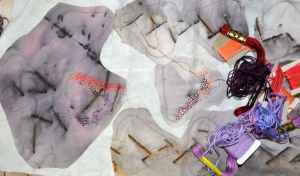
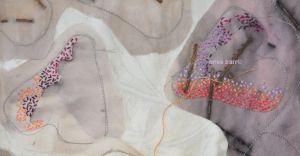
Not quite what i wanted, though i like them, so i started these:
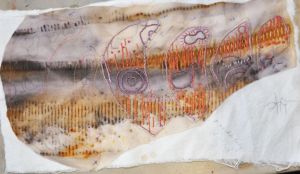
Ha, still not quite what i wanted, so i’m going to combine the ideas. I also like both fabrics i used, so redrawing the pattern is also going to have to take into account the placement of both to present an integrated it-makes-sense design.
And no res exhibit for me after all. There is no way human for me to even get enough done to vaguely represent what the whole will be. I can live with that, studio work being the more pleasant result than forcing a deadline.
I wonder how meaning is created, not what it is. Symbolism, connotation, iconography, denotation, synecdoche: Memory.
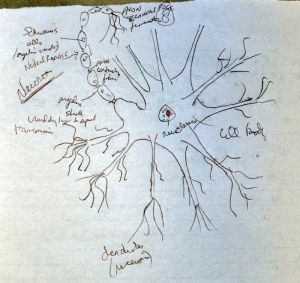
(Sketch of normal neuron from 2011)
A long time ago, i worked a series i called the Artist’s Body. Bones, hearts and brains fascinated, still do fascinate me. How do all these things come together to make a living, breathing entity? Now i’m focusing on one of the more “ephemeral”, unquantifiable aspects of the brain, memory.
Not all of us will fall prey to Alzheimer’s, though most of us as we age, start having faulty memories, the connections becoming disparate, as time and self dissociate. And when you really think about it, all of life is memory, except for the moment of NOW, that changing moment of awareness as we live it, and instantly it becomes the past, another memory.

Memory is time as illustration also. (Even as i write this, i have to refer to my trusty Stitch Journal, for dates…) On the 22nd, i spent 5 hours laying this out and hand stitching.
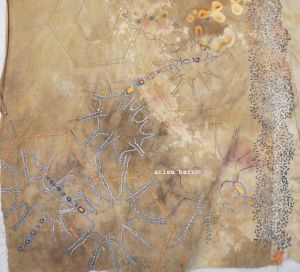 Yesterday, another 5.25 hours:
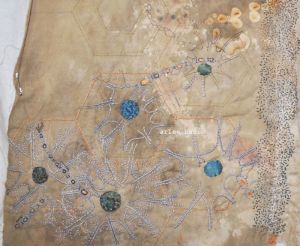 I’m almost where i can start adding the indigo underneath certain pieces.
And can something so drifting and fleeting be so tangible to, and in, physical touch? Palpable, stirring, substantial, as i run my fingers over this.
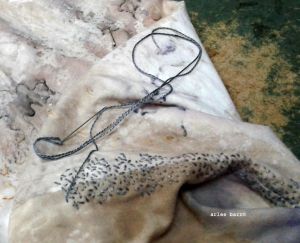 As i work with this large expanse, i’m better appreciating the nuances of colour created by chemical reactions between rust, potassium permanganate and brazilwood. Pinks, purples, teeny bits of blue and charcoal, russets and washed out reds. Amazing how that works, and really wondering how i managed to get such clean whites too!
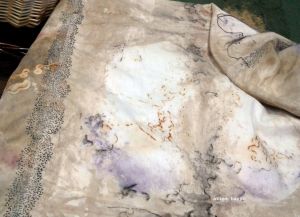
These long lines of seeded backstitch, paths, divisions, separations, they appeal to the memory and sense, for otherness, unpredictable, centering, old consciousness. I’m struggling to express this in words, but words are an important part of this project as well. I’ve been writing a lot of free association exercises on my work blog, and will be condensing them down to make clear what it is i’m making, sharing, experiencing. I think of everything from Jimi Hendrix, to memories of childhood, passed friends and washed away river banks.
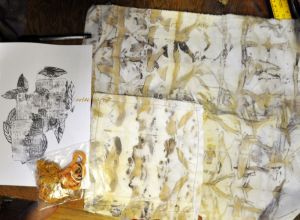
When i created these fabrics during the 2016 Contextural summer residency, i knew i liked them but stashed them away as for use in a Someday project, thinking they would probably just be cut up, and incorporated into other projects.
They are beautiful. They can stand on their own. I hadn’t really really Looked at them. The softness of the colours, the strong yet delicate markings of rust, the motifs that occurred during the process are perfect for a background, while having enough interest to accent in some areas as i move through this piece.
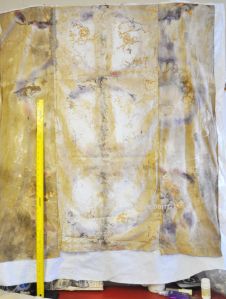
I didn’t want a seam down the middle, so i tore one chunk in half and attached it to either side of the main fabric. This is going to be a large work, as you can see by the yardstick left in there for scale 🙂 (I’ll have to have an appropriately sized stretcher bar set custom built, as i haven’t this size in the stoodio!) The seams aren’t terribly obvious, because of the similar colourings and process, but they are there enough that i wanted to segue them into each other. Immediately, i knew i wanted to use my technique of melding the fabrics into each other with a multitude of seeded back stitch. (I used that technique a lot on “Ebb and Flow” from 2014, on the indigo pieces.)
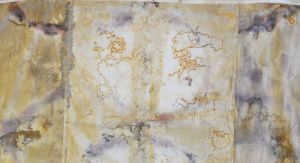
On New Year’s Eve, i watched part of “Expendables” and then all of “Expendables 2” (i deliberately choose “Cheesy B” horror or action films to keep my mind and fingers activated, but not concentrating on the tubage.) and in the space of three hours, managed a section of 12×2″. These seams are 46″ long so i need to update my watch list!!! HA! “You WILL be a-seam-alated!” (I think i’m SO funny….) (Edit: as this post goes live, i have another 13×2″ done—yeah!)
So far, only two variegated colourways have been used there, but a third will pop in as well. One i am going to run out of, hopefully not until the seams are done, because it’s just not available anymore! The other two can be ordered again, and hoofies crossed that the batches aren’t so different as to be noticeable to anyone but Moi. Below, though the differences are not terribly apparent–which is kind of the point of blending—-i’ve used a silk in the centre, edged with a Caron Wildflower Sticks and Stones. Those edges will be edged into also with another Caron Wildflower “Pebbles”.
 Unintentionally, that “strip” echoes the squiggly lines of dye and rust. The subconscious mind at work i suppose, because watching cars blowing up and manly posturing with bazookas sure didn’t influence it.
On the fun side of things, i pulled this out and have started playing with it. A riff on the original Beautiful Bones from 2009, and conceived in 2010, it’s mindless and silly, and an enjoyable change from Serious Art!
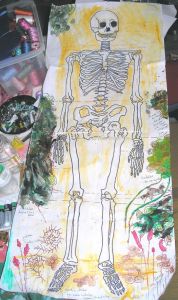
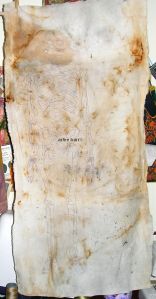
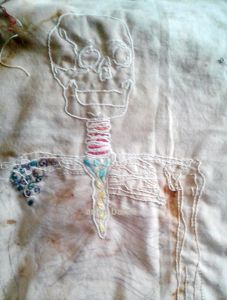
 albedo too
You must be logged in to post a comment.