Posted in Dyeing, journal: lessons to learn, potassium permanganate

first “potperm” results

Though i’ve used the vat at school, this is my first home usage of this scarey dangerous wonderful stuff 🙂 so we’ll just call it the first results. I call it “potperm” simply because potassium permanganate is a mouthful, and one i commonly mangle in pronunciation as well, usually in front of knowledgeable people, resulting in some embarrassment. It’s also referred to as PP in “industry” usage.

Moronic giggle here: “i’m dyeing with PP today”.

And yes, i was apprehensive. Put on my Steel Loin-and-Bosom Girding Big Girl Pants and Bra Set (the beige ones, no sense in calling any more attention than usual) and suited up. I mixed my “vat” in the back alley, wearing an apron, respirator, safety glasses and neoprene gloves, and used a PLASTIC cup to mix in a PLASTIC bucket, with a PLASTIC handle, with NO metal bits. (And carried it by the bucket itself, as i trust no handle ever, given the potentially caustic splash factor.) This stuff is reactive with metals, so i’m not messing with metal lidded glass jars, metal pots, metal spoons, metal bowls, nuttin’ metal PERIOD. The bucket lid is TIGHT as well–apparently this stuff can blow (literally, UP) if it dries out. It *does* exhaust, of course, as it’s used: there’s only so much that can remain in suspension after repeated dips of cloth, something i found out at ACAD. (WHY did i think it would last forever??? Does any other dye? NO, duh, dumdumdum. Sometimes this Mad Textile Scientist can be rather dense….) I also hosed down the area after, thinking any minute particles would be diluted enough to harm neither friend nor foe (local wildlife and plants).

Since i intend to do some fair yardage with this “dye”, obviously i increased the proportions of water and potassium permanganate. (Most home usage i’ve noted is 1/4 to 2tsp per litre of water, whether for dye, garden application, or anti-fungal/antiseptic use.) That means i used 3/4 cup for 15 litres of water. (Not an exact measurement or conversion, but there’s a large margin here for colour depth, so adjust accordingly 🙂 )

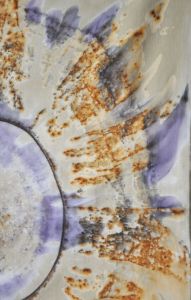
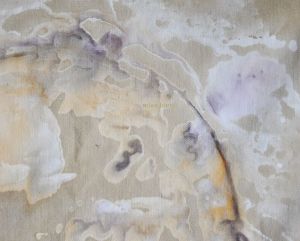
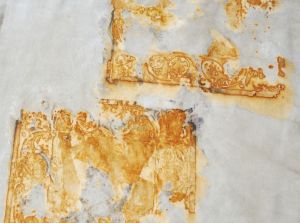
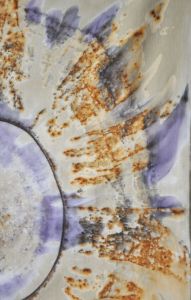
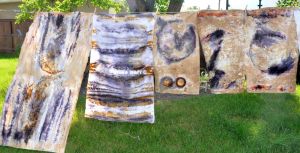
I did the actual dyeing on our concrete back patio, again hosing down after. I used some soymilk, alum, and alum with gallnut premordanted cottons ( 3 premordant solutions), and some unmordanted pieces, and was completely surprised by the results! (These photos below are all as the fabrics oxidize and dry. I’ll show photos of the dried effects and colours later in another entry.)

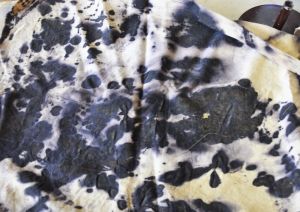
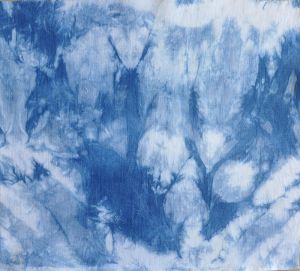
The soymilk took the least amount of dye, but hopefully once rinsed, the lovely mottling will stay as an effect:
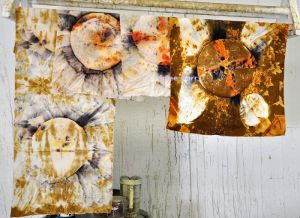
You can see the major differences here in the soy (far right) and the unmordanted, left and middle:
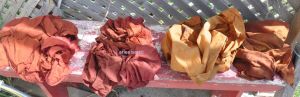
Above, the middle fabrics are top a 5 minute soak, the bottom a 10 minute soak, not sure if this will make a difference either.

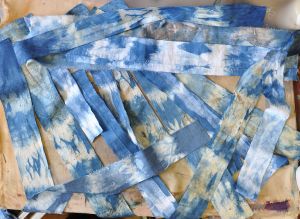
Not sure if the different dye absorption, dry rates on the main fabric and the threadwork will make a difference in end colour
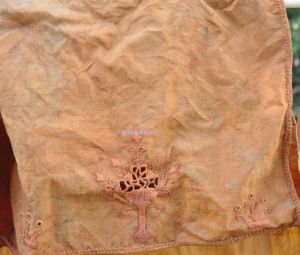
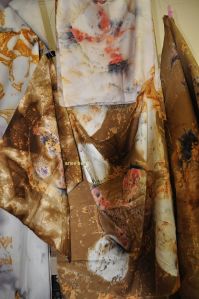
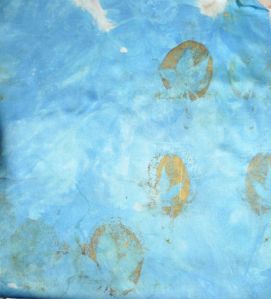
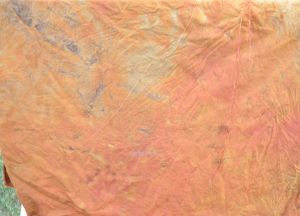
The results, still oxidizing and drying:
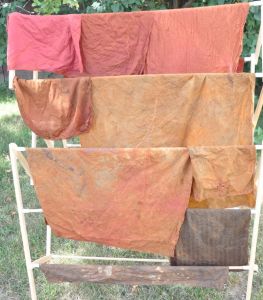
Potperm comes out of the pot in various shades of purple, then oxidizes, like indigo does, but to browns, so don’t get excited by those pinker shades 🙂 See those two bottom ones? The stripey one was mordanted with gallnut, the one  on the bottom rung was mordanted with gallnut and alum—quite a difference from the others! You also can’t see the ones on the other side that had longer soaks, as the light is whack.

Just as obviously, there are a lot of dye techniques to try out, from shibori to over-dye ( i know how it reacts with/to indigo, but how does it affect other dyes?), ecoprint to discharge*****. I think i’m going to have quite a stash. I also momentarily worried about what it would do to silk, but then i remembered that several years ago at the school, i did this one on 8mm habotai silk, a very sheer, delicate weight–it’s still fine, no damage. It appears the vat i used for this was very active also, possibly quite a new mix at the time, as the colour is deeper than i got this year during res.
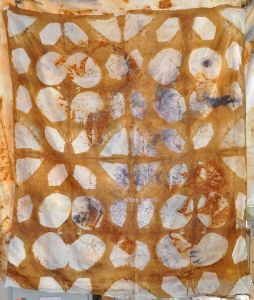


Tip o’ the day: do not mix up with the mid morning break of iced coffee: same colour, different effect.

(YES, THAT IS A JOKE: i never eat or drink around dyes, dry, inert, mixed up or in use.)

***** NEVER DISCHARGE POTPERM WITH BLEACH, use LEMON JUICE

~~~~~~~~~~~~~~~~~~~~~~~~~~~~~~~~~~~~

oh gawdz…………………..i discovered my bucket of soymilk mordant shoved behind a box in the basement by Himself…….actually, it was fine moving it after THREE MONTHS–but OH SHIT THE REEK, as i poured it in the toilet. Oddly, no mold, just festering masses of curdlets…………………no crust even! just a solid mass. Weird Science at it’s best. Or worst.

it didn’t even shiver when i lifted it and carried it upstairs, no smell, no mold, weird, but the minute it was tipped…………. OH LORDY, there are no real descriptors……..

And since this is the bucket i used for the above, it was washed with boiling water and soap, and rinsed really really really really really well, as potperm can also react with other materials, organic and chemical. I dried it in sunshine. (No eclipse here, just some weird light and bent holes through a colander….totally underwhelming.)


Posted in Dyeing, Home Cookin' the Cloth, Not so ordinaries, potassium permanganate

making my own rules, potassium permanganate

I really like the effects i get with potassium permanganate, but there’s not a lot of info available, online, or in old books, when it comes to using it with cloth. Most sites tell you how to get rid of the “stains” when you are working with it, in either metal or wood applications, but not how to keep it! I *think* we might have done something with it in the textile arts program in the early 90’s at Capilano College, but if we did, i either took few notes (usually when i wasn’t that interested!), or i threw them out in a long ago purge…….

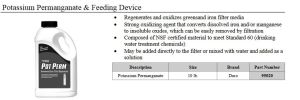
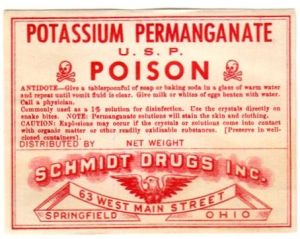
First of all, this stuff is actually Scarey Dangerous. Yes, very, no exaggeration, in application, storage and with other chemicals. It can be explosive, toxic, mutagenic, corrosive. I cringe when i see people sticking their hands in vats with no protection, but this one in particular made me yell at someone during res who did just that. But it’s also used as an anti-fungal, an antiseptic, water purification, in garden applications, for livestock use, and in science labs for staining specimens and slides.

(Ignore the “antidote” notes on the above, and check the MSDS for the real deal.)

It’s not a “natural dye”: it’s a chemical compound. So why use it if it’s so freekybeaky? Because i like the warm browns it can give, i like the way it chases (discharges, technically) indigo, i love the effects with rust and ecoprints. Respect for what we use as dyers, whether chemical or natural, can go a long way though and i have always stressed safety first in any of my own work, and certainly when i have taught classes. So i will use it, and with pleasure! (The few sites that have had any information make me shake my head too, as they blithely swish things around with bare hands……..)

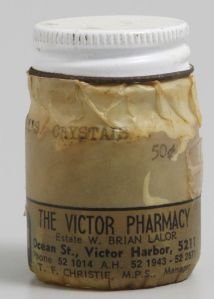
I know brown is not an exciting colour to most people, and most natural dyers are going to use walnuts, chestnut, cutch or sequoia, or combine different dyebaths with various mordants and modifiers to get brown when they do want it 🙂 (And i have, and do that as well. ) You’re not going to find potassium permanganate for sale on any dye house sites though, chemical or natural. I searched through chemical suppliers, university science sites, and finally water purification shops, and bought mine at a local supplier for  “HVAC, Water Treatment, Fluid Handling and Conservation Industries .”  (I’ve heard it also referred to as “Condy’s Crystals”, an archaic name for it, and supposedly available at pharmacies/”chemists”, though i suspect that’s more in the UK than anywhere nearby!) And i asked for and got the 6 page MSDS that should go with ALL chemical use. (See that first link in this post.)

Initially, it’s expensive. I just about had a bird when i called and asked about the size they had on the website (10lbs)–$169.00!!!! The gentleman on the phone said though that they did have smaller 5 lb packages, at slightly less than half of that amount. In use though, it’s cheap, cheap, CHEAP. At 1/4 to 1 TSP per litre of water, it’s going to last a looooooooooooooooooooooooooooong time, great Cost Per Wear!

(HA. When i picked it up, he said someone else had just called and wanted that smaller size too, something he hasn’t sold much of in a good while. Maybe another dyer?)


ALL “mixing” of this will be done outside in a corner of the back40, wearing gloves, respirator and safety glasses. And lest anyone think i am totally looneytunes using this potentially bombwhacko product, a lot of textile program school scenarios have a vat of it in the wet studio, and no one has reported any Incidents. ALL dyeing should be handled with respect, safety and care.

I remember there are a few other things i can do with “potperm” and cloth, so am off to refresh my memory, and make my own (SAFE) rules for use.


Posted in "OPINIONATION", Days of Honey, Dyeing, Ecoprints and Natural Dyes, journal: lessons to learn

becoming a purple thread

Certainly a vanity, thinking one knows everything, but i’ve always subscribed to “Learn something new everyday, and you know you’re not dead” — i *don’t* know everything, but i do my research and i’m happy to not only do the correct thing, but to riff on that once the lesson is learned. If i need an affirmation of something i’ve done or a puzzlement needs solving, i’ll ask, but i don’t JUST ask and expect the whole answer “with 8×10 glossies and paragraphs and arrows on the back” to be handed to me on a silver platter.

I remember asking a Contextural member a long time ago how she achieved a certain shade in her natural dyeing/ecoprinting, and she sweetly and truthfully replied “Every dyer has her secrets” with no smugness, and in all honesty. I took that to heart, learning what i could and often failing because i didn’t follow the basics first.

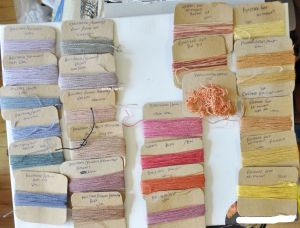
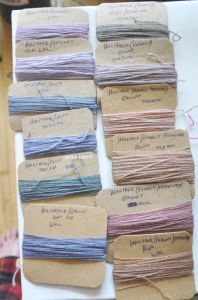
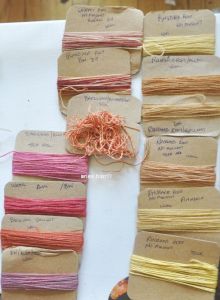
I’ve got that part well sussed now, and am quietly thrilled with the tried and true, and the experimenting. All of this past week’s naturally dyed threads here have notes on each as to what it is, but you’ll have to figure out certain parts for yourself 🙂

And the details in close-up:

Where these threads go next will be “the long white gown”,  metaphorically speaking.

Posted in a collusion of ideas, Dyeing, Ecoprints and Natural Dyes, Residency 2017

keeping the ball rolling

Definitely a different weight, lovely, looks like #5 perle when relaxed, but with tension in stitch will be equivalent to a #3–perfect!!

And i’ll be rolling it into balls–no desire to fight the twangles otherwise!

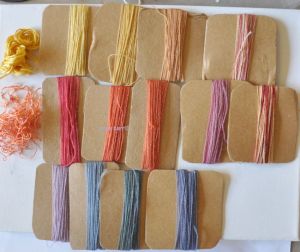
I had to resort to card bobbins after all for the previously dyed batch—the skeins are too fine to keep unsnarled otherwise, even in little zippies. (The silk i will leave as is ( :O ) as it actually is easier to unravel as i work!)

I’ll be doing all these colours again, as this new one is a silk/wool blend (previous was all wool), but am going to add some other colours as well, and some fermentation dyeing as well. I have a lovely vat of bubbling hollyhock…………….. I’m premordanting today, and tonight will pop them into their sweaty little baths.

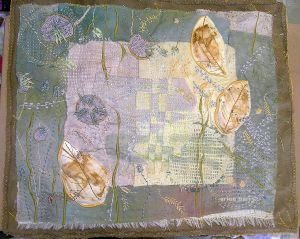
I’ve been busy fondling and admiring these and figuring out what to stitch next. I think some will be on this fabric:

Tired yet of seeing that one languish in a heap!  I’ve never before experienced such vacillation in choosing to do something! The residency exhibit is going to be hung Aug 27th, and i still haven’t started anything for it, going back and forth with so many, too many ideas that just aren’t inspiring, or gelling. I *do* usually have a fallow period after completing a big work, but months long is just not going to cut it.

I might look to this for inspiration:

Haystack, 2010, hand and machine embroidery, naturally dyed cotton. In private collection.


Posted in Dyeing, Ecoprints and Natural Dyes, Probably talking to just myself, Residency 2017

slow slow summer

All i’m doing is experimenting, and adding knowledge, no stitching since finishing “Tabula Memoria”.

In all honesty too, time at ACAD for the residency has slipped away and i am left with a little more than a month to go, with very very little to show for it. Most of my ideas though are being utilized at home though so no loss really!


As much as i love all my commercially dyed threads, especially all the permutations of the variegated ones, i also want more naturally dyed choices, so i’m doing it myself. I can’t/won’t be doing huge batches, but enough to keep me happy at least. I’ll still use the “boughten” threads, and hopefully if all goes well with the pre-mordanting, will have a range of natural dye colours to supplement the arsenal.

I’ve gone through all my dyes and have enough of everything to get a BIG collection of colours, after different mordants and modifiers. This is more manageable in terms of space, time and effort also, as the batches can be quite small for threads.

Hoofies crossed.


Posted in Contextural Fibre Arts Co-operative, Dyeing, Ecoprints and Natural Dyes, Residency 2017

day three res

Of course, usually by the time i post, it’s another day, in fact two days past, but………. This is part of the game, of what i do, hurry up and wait, no instant gratification, nightmares (yes!), anticipation and hoofies crossed SO tight.

(These are a mix of the two day’s results.)

Most are detail shots as that’s where the devil beauty is.

I have to start thinking about what will come of all this for the end of residency exhibition. This is Contextural’s 10th anniversary, but the theme is open this time, as we all work so differently. And i also realized that this is my 6th residency! (Although my very first one in 2009 was a self induced bust….i signed up for 3 months then too, all excited and drooling, and showed up TWO days, because i had NO idea what i wanted to do!!!!!!)

EDIT: got my idea/s last night as i was falling asleep 🙂

On Monday, i’ll be firing up an indigo vat there (two at home already, but impossible for me to transport by bus and train ), because, because, believe it or not, OMG, there are some participants who have never done indigo!

PS The rabbit showed up again, and was offended because i had nothing Rabbity to share, and YAWNED at me! Henceforth, he shall be Paul Bunyawn, ’cause he is a big rabbit 🙂


Posted in Dyeing, FybreSpace the shop, Indigo Dreams

hurried up and waited, and a shop hint

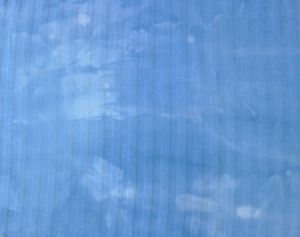
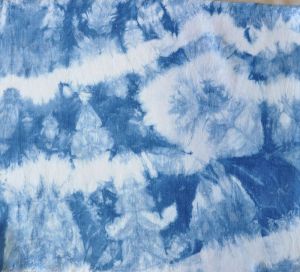
More results from the chemical (aka regular vat/indigo vat/vat, ’cause i’m tired of explaining the difference…)


And it was worth it. The 123 vat IS WORKING. The colour *is* paler, but repeated dips i’m sure, will add depth to the shades. I had expected the greeny-turquoise tone from my first experience with it in a Wada workshop, but am still thrilled. (Though once this vat is used up, i won’t repeat the effort 😉 )

On silk:

On cotton:

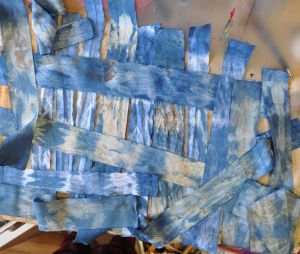
And for your delectation and discerning taste, i’m offering small “Boro Strapping Packs” again in the shop. Letting you know too, these are all from the chemical vat (so as not to offend the purists)!