Posted in mordants and modifiers, Natural Dyes, The Summer of Madder (Study)

madder stash—and more “boring” madder notes :)

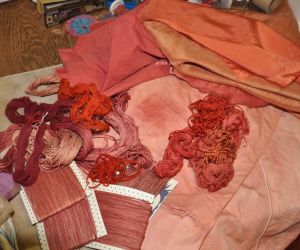
The pile so far for the Summer Madder Project project:
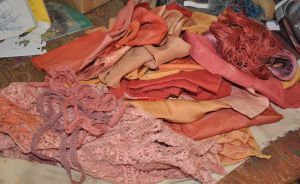
Cottons, silks, threads, and trims in wool, silk and cotton, these are the grist for the garment i am creating from this summer of study.

I’m glad i started with a small “canvas” in choosing one of the pockets to start with, as it has led to a lot of note taking and sketching for other components of the garment. I decided too that some areas can be pieced together first, and then “worked”, and others will be worked independently, with “cross-overs” to integrate the whole. I’m also thinking this could become quite an ornate piece of wearable art, and that it may extend past the summer, because of the amount of handwork. That’s okay though: i didn’t set myself a deadline, just a strategy to both keep myself busy after what i consider to be a long dry spell creatively speaking, and to learn more about natural dyes and all the science and mysteries of them.


Even though madder is a substantive dye, meaning it doesn’t have to have mordants, i’ve been experimenting with different premordants with it: celluloses need tannin and alum, or the dye just doesn’t attach properly,   Proteins accept dyes much easier but with other dyes that aren’t substantive, usually they require at least alum. In my experience though, mordants are crucial to getting deeper colours: one can only use so many pale peaches and pinks! I premordant everything now, as it not only influences the colour, it also helps more in lightfastness.

Though we do have hard water from our taps, when i use madder, i always add a Tums (calcium carbonate), and a 1/2 tsp of soda ash to shift it to more reds than yellows/oranges/browns. It doesn’t always work, though my track record says most of the time it does 🙂 (Madder, weld, logwood and brazilwood need hard water, all other dyes do best in soft.)

Next up is some tests with rhubarb leaf mordant. The one we have in the Back40 is massive this year, so it’s perfectly willing to give up some material. I’ve used rhubarb *root* before as a dye, and had a gorgeous, rich, glowing green gold from it, but haven’t tried it as a mordant, because i have so little of it. Unless some house in the neighbourhood with a patch of it is sold and slated to be torn down, i can’t get more either!

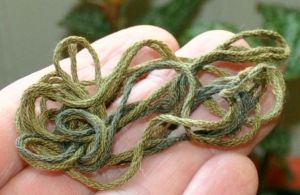
And now i need to make some good greens for leaves and vines! I tested some of the rhubarb root dyed cotton embroidery thread i have, and love the rich greens i got with an iron mordant:
I’m going to try comfrey, also from in my garden, but will have to do some lightfast tests, as i can’t find much info online. It gets a page in Jenny Dean’s “Wild Color” book, but alas, no real mention of lightfastness, so i’d rather be safe than sorry. If it doesn’t work, well, at least it becomes a fab compost/fertilizer for the tomato plants!


~~~~~~~~~~~~~~~

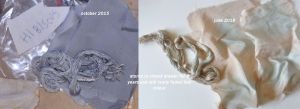
As i was digging through drawers yesterday, i found one labelled “hibiscus”. OMG. I was SO thrilled when i did this waaay back,, but now look at it! I have since learned that most plant materials that are composed chemically with anthocyanins are NOT lightfast, which is why the damn beets, black beans, red cabbage and berries that so many wax ecstatic about DO NOT LAST. (In that link, scroll down to the “Anthocyanins” notes.)
Posted in in progress, Madder, mordants and modifiers, privet, The Summer of Madder (Study)

pocketing the difference

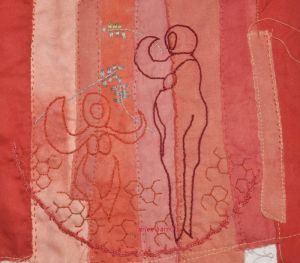
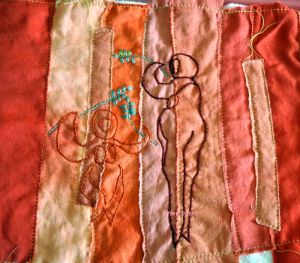
A happy start on the first pocket. To see how it’s progressing, scroll down!!!

Ahhhh, the different shades of madder! These are all cotton, and reasoning that pockets should be strong and capacious, i chose not to add silk to this, though i suppose with the method of construction, it would have been supported by the interlining. (The yellow “anchoring” machine stitch will be removed.)

The threads are silk, and wool. (The greens are from privet berries, on silk.) Because this, as i mentioned before, will have to be hand washed due to natural dye Ph sensitivity, i’m not being shy about using different fibre types together.

(Colours are truer in first photo–another reason i *usually* shoot in my sunny south facing studio between 2 and 4 PM, rather than the AM, like today 🙂 )

The figures looked kind of floaty, so i added a curve below, a cupping earth if you will, and my favourite hexes/honeycombs/cells. And beads are coming, because, well, beads, and for awhile now i have wanted to add a bit of bling with naturals 🙂

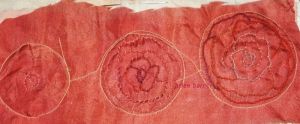
I thought this was still kind of flat looking, so dimensional roses will added at the edges, another motif i can carry across the whole garment.

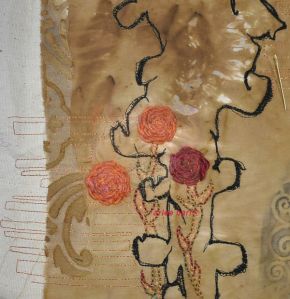
At first i thought i would do my usual embroidered, then appliqued pieces above, (maybe too much dimension for this???) but stumbled across this from 2012:

Never finished, but certainly an inspiration for this project! I do have some chunkier wool to dye, along with some already done, so maybe i will have enough.

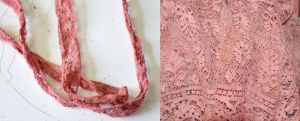
There’s a finely worked narrow band of antique lace  and a chunk of vintage as well, and i’m hoping i can integrate those as well.

I don’t want anything saccharine sweet, but it might work. I’m going to have to add a solid band across the top also, as i forgot that gathering it a bit is going to distort the figures! The second pocket will be similar, but not identical–nothing says they have to match.


Posted in Madder, mordants and modifiers, Natural Dyes, The Summer of Madder (Study)

seeing red

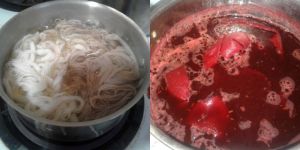
Oh so close to disaster! My brain must have done a fancy flip of some sort, because on Saturday i was bemoaning to Greyman, that i couldn’t seem to get the madder pot to 140C. He most emphatically with gestures and other well chosen words reminded me that boiling point of water is 120C, and WHY WOULD I WANT IT THAT HOT????? Oh BUGGER…that’s the Fahrenheit temp, the Celsius should be 60!!!!!!!!!!!! I whipped the pot off the burner just as it reached 70C, and fortunately the short time at that temp doesn’t seem to have hurt the results too much. (Too high a temp with madder, and you destroy the reds, and get browns only.)

On a side note,  the Greyman puts up with a lot in the dye department–after all, he *almost* accepts when he comes home at suppertime that this is spaghetti and sauce……   🙂

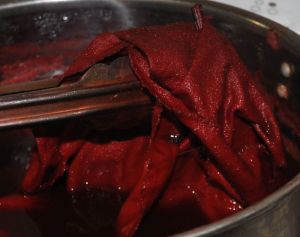
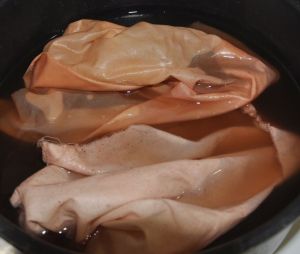
I greatly increased the WOF this time, reasoning that hoarding the darn stuff is pointless–ya bought it for using: USE IT!!!!! Recommended WOF for madder is 35-100% after all. It’s not worth cheaping out: you can’t add another egg to a cake after it’s already baked. (Yeah yeah, one can overdye, but why add another step and more dye material?)

And of course, while the above photo makes it look EXACTLY like what i desire most in madder, fabrics always dry lighter, whether a synthetic dye or a natural.

Wet:

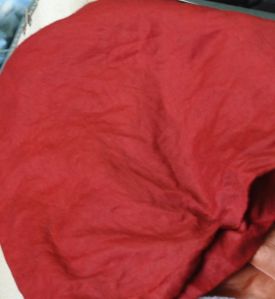
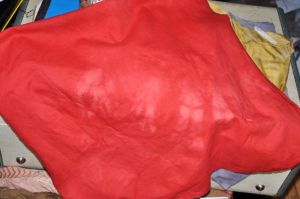
Dry:

The resultant colour is much better, though still not quite as deep as i’d like–and note too, while it’s almost impossible to get even results on large pieces(above, actually folded in half, and around  20×34″), i obviously need a much larger pot for movement so i don’t have such conspicuous squish marks 🙂 Still, i kind of like the effect! I’m pretty much sticking to cotton too, as getting madder red on silk is a LOT of different steps and chemicals, some of which i’m not sure i’d like to do/use at this time. Getting this depth of red though on cellulose is rather special too so, though i want the red that Kate Bowles got on hers, and have informed her via Instagram that from now on that coveted shade is “Kate Bowles Red”, i’m quite sure i’m on the way to what i want!

I’ll try some post mordanting/modifying on small bits of this to see if i can get closer to that wet-in-the-pot shade.


I’ll be throwing some threads and lace in there next, as additions to the Summer Madder Project garment. They’re stewing in the first part of the mordanting process, so won’t be in until tomorrow night at the earliest.


~~~~~~~~~~~~~~~~~

I’ve also been playing with a “new” mordant, something is becoming quite popular with ecoprinting, a fine powder called Titanium Oxalate. I was abbreviating it to Titox, but Greyman thought that was hilarious, so have gone to the accredited TO appellation 🙂 On weaker madder shades however, it seems to strip out the colour.

Won’t be using it as a madder adderitive then!

BUT, i also found another use for it besides it’s usual for creating orange-r yellows:

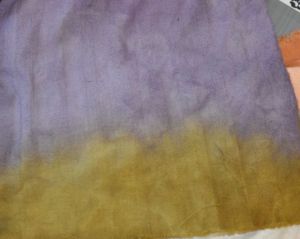
and strange colour/chemical reactions like this green on logwood purple:

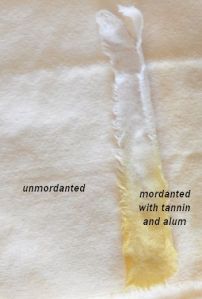
A funny little tip for you, if you A. properly mordant your fabrics (but forget if they’re finished when you pack them away) and B. keep a wee tiny jar of Titanium oxalate, then you’ve got a handy dandy little tester for mordants. Tear off a tiny strip of the fabric, dip the end in the TO, and if it turns bright yellow, it’s mordanted with alum (silk) or alum and tannin (cotton). If it’s pale pale cream, it’s unmordanted!

~~~~~~~~~~~~~~~~

And now i REALLY need to start actual STITCHING on this Summer Madder Project. I’ve decided to start with pockets–cause i’m tired of not having any! I had to revise my plan a wee bit due to the way i do my “embrilting”, so instead of a “top”, it’s going to be more of a jacket/wrap/coatlet of some sort.


Posted in a collusion of ideas, Deliberation--do something you don't do--or haven't in awhile, Madder, mordants and modifiers, The Summer of Madder (Study)

summer madder project Project

For a couple of years now, i’ve had an idea in my head for a special garment, after seeing something in a trendy boutique window that fired some desire for a similar “Objay Dart” (aka Objet d’art). It was in reds, all patchy and flowing, bohemian though unadorned with any embellishments, simply cut and extremely Spendy. I filed the idea away, as i haven’t made even a pair of pyjama pants in the last 7 years.

But what’s this? There seems to be a plethora of chunks of fabric, all dyed recently, in the madder summer experiment pot. And threads in various shades as well. EUREKA.

I do have more fabrics, but have to dig through some serious piles first! I’m picking up a package from Maiwa today too, which includes more madder, because even though i intend to use up the 33 year old madder currently in the pot, and the tons still left in that bag, i think the best red was from Maiwa. Two madder pots then!

I used to make wearable art, even had a moderately successful small business for 6 years, selling through local boutiques and “Craft fairs”, so i’m experienced enough a designer and construction-ist (i hate the word seamstress…), that i know the cut of this is going to be important. Cotton, at least most of the cotton i have, is not terribly drapey. They’re not stiff slices either, but with not a lot of movement in them, the design has to accommodate that fact and the silk additions, which are drapey. I might go on the bias with some of them though, as that helps a bit with flow.

I could of course just draft my own design, but i pulled out my only Tina Givens pattern, and had a look at that.

Hmm, slip “too” biasy, pants too much fabric. The crop top however might work, but i may forgo the ruffled detail at the bottom, and just lengthen it a bit. Actually, there could be enough silk to do the slip too! OOOOO, wouldn’t that be decandenty-bohemianish-artful-artistry-Artist-y? I tend to live in either leggings and a shirt for work and out-and-about, and a tank and pyjama pants at home! My body has settled into a 60 year old shape (though a “few” pounds could be lost) and i really don’t care to “dress to impress” anyone anymore, but it’s always nice to have something for “good” 🙂

So, though i may have chunks of fabric, and hanks of thread to share in the shop, depending on amounts and time, i will also have something to really show what i’ve been up to. It’s not a daunting project either, as i have no deadline, no rules to follow, and no one to account to. I can do whatever treatment i like to the “patches”, take my time with those as well, enjoy the process (and maybe make learn new skills or at least, new applications of older skills), and go easier on myself in my studio. Perhaps the Muse will return somewhere along the line here, and if not, well, i’ll have some new duds at the least.

***EDIT: For those of us with that 60 year old body, you might want to read this review, with its tips. (Please be aware though that the writer of the post, Lorraine from Calgary, has passed on since…i sure would have liked to have met her in person.)


Posted in Madder, mordants and modifiers, Natural Dyes, The Summer of Madder (Study)

33 year old madder

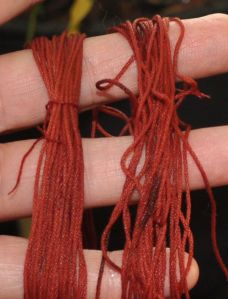
This madder *could* be older actually. I’m going by the date of dissolution of the company that sold it, so who knows when this was actually packaged??!!! I doubt that it has “expired”, though i’m sure at some point, even madder roots lose their potency. From yesterday’s start, things looked mighty promising.

All skeins were premordanted with tannin (gallnut) and alum acetate, as is recommended for cellulose fibres. The thread is a 4 stranded embroidery floss Galler product, “Parisian cotton”, sadly no longer in production. The company is still in business, but doesn’t manufacture this particular commodity anymore. I didn’t do a bran bath however as the last step, a better way of “dunging” than actual dung….  That will happen on the next batch of threads to see if it really does make a difference–i know people who swear by this, and it is emphasized with the use of alum acetate, but haven’t tried it myself yet.

The first skein was in the dyebath for 8 hours. Wet:

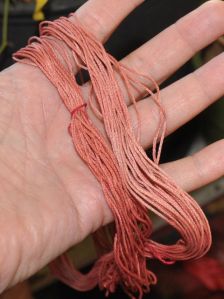
And dry. I was quite surprised to see how much the first skein lightened when dry, though i know that dyed items, whether chemical or natural dyes, always dry lighter. Well, nothing wrong with “terracotta rose” 🙂

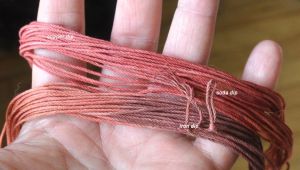
An iron dip on one section of the 16 hour second skein browned it, copper sort of pinked it, some soda ash made it slightly redder.

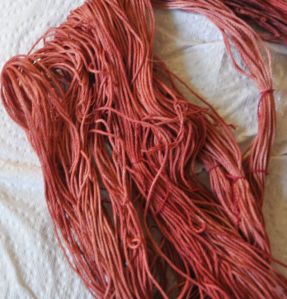
I still had 4 skeins in the pot at this point and left each for a day longer, progressively, though there’s not much difference in absorption. From now on though, i’ll be leaving the threads (or fabrics if used) in the pot for at least 2-3 days for maximum absorption and depth of colour.

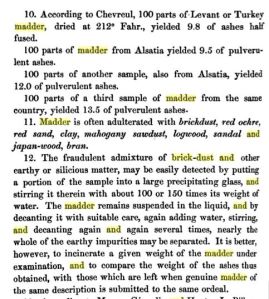
Not knowing the provenance of this bag of ground madder root, i’m not even sure it hasn’t been doctored with red brick-dust or gawdz-know-what, a common practice to pad the bill in the old days! For the amount i put in the stocking, it swelled a LOT, from filling a good two inches to puffing up and making itself look big at 6 so round so firm so fully packed inches.

Though not “true” TURKEY RED, this range of shades are wonderful, because each time i do the dye pots, i get something unique to me. Madder is also more work on cellulose fibres though, with those deep rich radical raunchy reds best showing on wool (a protein fibre). BUT, that’s still a good thing for the personal stash and usage. *And* i can say now with some truth, that i have some “vintage” threads. And yes, i know the terminology: 25+ years is “classic”, 50-100 is “vintage” and 100+ is “antique”. “Vintage” also refers to a specific YEAR, so my threads are done with vintage madder 🙂 I do love this range of shades i got, and look forward to incorporating them into my work, should the Muse return……

I’ve poured off the first extraction, saving it, and will now see what colours result from a second soaking.

Posted in Ecoprints and Natural Dyes, gallium, garden dye plants, Garden Hard, mordants and modifiers, Natural Dyes

Galium results

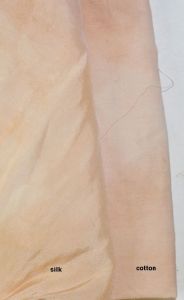
Well, there *is* colour, but it’s weak, probably because of the amount of root i had, maybe 40 scant grams, dirt included. I used Jenny Dean’s method of soaking the roots overnight, pouring off the first water, then slow simmering with a Tums tablet (calcium carbonate) for two subsequent baths that were saved and combined. (A third simmer had no colour at all, and was discarded with the roots, in the garden as no adjunct chemicals were added.) Both fibre types were properly scoured and pre-mordanted also, according to their requirements.

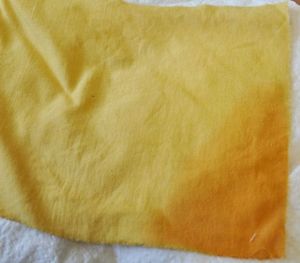
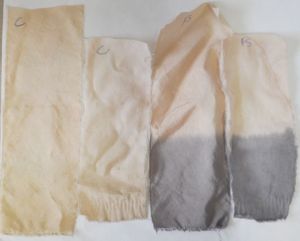
Wet, silk top, cotton bottom, after 24 hour soak in dyepot:

Technically, i should have decanted into two pots, and dyed separately, as cotton (cellulose) and silk (protein) have different uptakes.

Dry:

Soft, but not terribly exciting, again most likely due to the amount of root gathered.

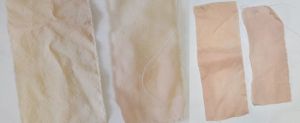
Some modifying/post mordanting on small strips:

Pretty much insignificant changes with (L to R) above, vinegar no change/possible “bleaching effect”, soda ash marginal pink activation

and above (L to R) copper minimal change and possible miniscule yellowing, ferrous sulphate the most dramatic change (might just do this to the remaining pieces and use that way!). (This could also be due to any residual tannins. I used an incredibly SMALL amount of ferrous sulphate, as the stuff is quite strong, maybe a few grains.)

I’m also thinking that because there is so little colour on these, that they are NOT going to be terribly light OR wash fast……BIG sigh of “WhatEVER” 🙂 Still goes in the dye annals though 🙂 I’m sticking to actual madder from now on.


So, was it worth the effort? Yes, in a way, because i learned it is possible to grow, harvest and use a plant material that can and does grow here. And no, because i learned the amount of time to grow (3 years to wait to harvest), time to harvest (ridiculously small amount for the work it took) and use (weak, because time and harvest took too much and amount gathered was too small) was not worth the experiment. Then again, maybe ***this variety of Galium has very little dye material in it. BUT, obviously someone with patience, a larger pot/plot might want to try this so they could say they use “local”, if that’s their Thing.

I’m rather sure too, that if i had just ecoprinted with these, instead of using as a dye material, the results would have been negligible, as there’s little alizarin/purpurin in these roots, probably due more to their size, than the quantity gathered. (Again, or the variety is pathetic in the dye substance department.) I highly doubt that the roots get very big at all, even after years, as that’s not their nature. It would also take masses and masses of them to get a decent quantity, a problematic exercise, also due to the way they grow.

So, have on, some brave soul: i’ve lived and learned, and the lesson is filed! (If you are interested in how i got to this point, this will take you to all of the Galium posts previous.) (And yes, i misspelled it in the archives–gallium with 2 l’s is actually a chemical element.)

Erratum: The Galium species most prevalent here is Galium boreale, which is what i used, not Galium verum as previously stated. There are ***6oo species of Galium, and some have no alizarin at all, but do have pur purin and pseudopurpurin. I’m also certain that some have little to no use whatsoever as a dye plant. I found this article, and they do mention that some of these plants have little to no madder-like characteristics.