Some “new” colours because of the different water (which is a good thing), but i want some of my “old” colours back as well! But i CAN live with this, if i can have both 🙂
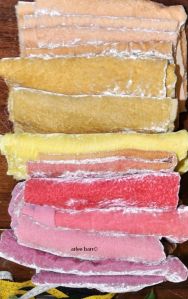 (Click on the photo–as all of mine are–for tactility close-up.) SCRUMMY.
Some “new” colours because of the different water (which is a good thing), but i want some of my “old” colours back as well! But i CAN live with this, if i can have both 🙂
(Click on the photo–as all of mine are–for tactility close-up.) SCRUMMY.
At the old house (and i mean where we lived before *and* the fact that the house was 100+ years), i knew what the water would do to my natural dyes. Turns out it’s a new ballgame in the new place, a totally different ballgame.
A. There’s a LOT of chlorine in our water in this location. We noticed the smell when we moved in, but stoopidly, i forgot that if i want to use it as hard water (’cause hard water is good for certain natural dyes like madder, weld, logwood and brazilwood, and we get hard water because our water is from the mountains) *and* there’s chlorine, you have to let the water sit for awhile so the chlorine off gases (dissipates). Didn’t have to do that at the old house.
Did you know that if you add ferrous sulphate to water with chlorine in it, that it turns the water PINK? Pretty, but the iron didn’t want to do what it was supposed to because the chlorine was being all busybody and getting in the way.
B. I use our filtered osmosis system for a lot of my dyeing. But it doesn’t work well, when apparently the tank membrane broke and is letting things into the tank, like iron and gawdzknows what else…..this also doesn’t work well for natural dyeing. There are a lot of minerals in our water too, but i’m not sure what else there is that isn’t supposed to be “is”…..

On the 14th and 15th i tested some of the Ugandan marigold my son brought back for me. I was shocked at the amount of green instead of yellow i got. My tannin was green as well, not a good sign, but a sure sign that there was a fair amount of what shouldn’t be in there, in there. I *did* get some pretty colours so that’s okay, but.
This means i now have to test all the dyes i work with, checking the new parameters and verifying my normal practices as still viable. It’s a good thing then that with the rhubarb root and quebracho rojo work i did last week i made lots of notes, and because of that, the marigold was documented as well! BUT it’s also weird that the RR and the QR gave me close to the results i was used to, even though i had used the (broken) filtered water.
Interestingly enough, in several natural dye groups, this was posted. I mean, i KNEW water affects the dyes, but wow, what a lesson in my own space.
So, i begin again.
-40C wind chill today, risk of frostbite in 10 minutes. I ain’t goin’ nowhere this week!
The last week’s results, correctly in dye journal 🙂
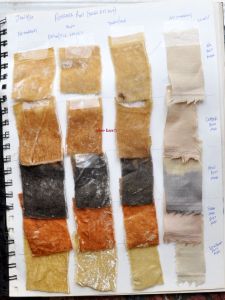
I think my soda ash tests needed a fresh mix as well–i adore that orange from the test above, not as apparent in the sample on the bottom of the page below!
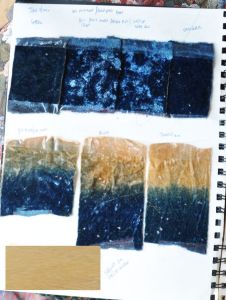
Below, the two on the left are linen, quite disappointing! The linen i ordered before Christmas is crappy quality, stiff and feels cheap. I know linen is supposedly harder to dye because of the plant waxes and pectins, but the results were abysmal! I followed all my usual protocols so not sure what the difference was. *Usually* i find rhubarb, whether root or leaves, somewhat inhibits the uptake of dyes……… For that reason, i never use the leaves anymore. I think it’s the oxalic acid, but also would suspect the roots have more than the leaves, so it’s a mystery!
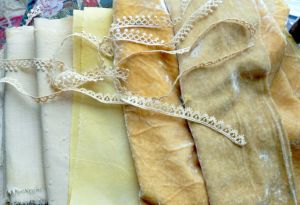
A mystery because look at the quebracho rojo on the same linen! I was thrilled to see that once rinsed and dry, it was a definite pink, quite the surprise as usually qr is touted to give only pinky tans and browns on cellulose, and paler in range than protein fibres.
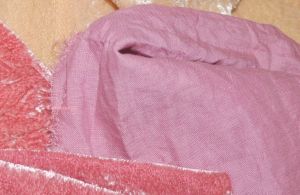 I have a different batch of linen from the same supplier that is supposedly the same thing, but the difference is amazing–full handed, thicker, FEELS like linen, so we’ll see what the results are on it.
And the rest of the qr tests:
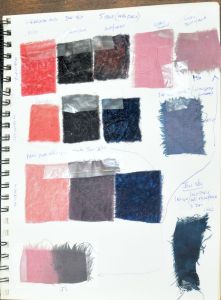 It’s bit hard to photo these correctly: the velvets on the 2 top left are pinker than here, not as orange. (And OH do i love that lavender from the third extraction with an iron post mod!
I’m also testing Ugandan marigolds! My son brought me some when he came back last week (and YES it was all legal, above board and phyto-sanitarily correct, according to customs regulations! I wouldn’t dream of having anyone smuggle or mail un-regulated product to me!)
I can’t pretend Spring is coming with the coming weekend supposed to be in the minus20’s(C), but i can smell Summer right now: I had a pot of rhubarb root simmering, an excellent dye the last time i used some. The fragrance lingers, even to the next day, and always reminds me of alder burning in the old wood stove on Bowen Island. This is a test of sorts too, as the first time was freshly dug and cut up, and this particular bag has been in my cache since October of 2015, so very dry. Some dyes just don’t do well dried! Checking the pot after an hour assured me though: there was LOTS of colour seeping out.
Silly me though! I forgot to weigh the bag and have no idea how much i used. I decided to start a separate note book for my silk work, as it’s a different kettle of canned worms than other fabrics, and the colours are amazing! And guess who didn’t take notes last year when she was doing all this? I mean, i know if i used quebracho rojo, or madder, or osage obviously, but what post mords or post mods did i use? What mixes of dyes did i use to get other colours? How many times did i use that bath? I didn’t even keep swatches!
Rhubarb root has more of an affinity for protein fibres though: all the trials i’ve done on cotton or linen gave at best, a pleasant warm toned pale yellow, and even post modifying doesn’t change much of that. (Except for iron which which pretty much *always” turn any natural dye to shades of charcoal!)
Here’s my array of tests, in order of post-modifier: copper, iron, soda ash and vinegar. (Unfortunately, i threw out the ammonia for some reason, so couldn’t try that…) Again, little change on the linen.
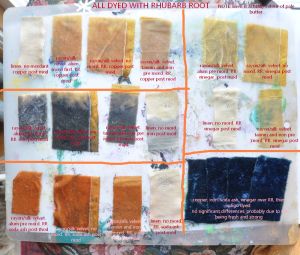
For some reason, there also seems to be little difference in the colour when overdyed with indigo, but my vat may be too strong still. This is the one time i wish for a weaker one! (In *my* experience, a weaker vat gives a better chance for the first colour to influence the outcome.)
So, did i lose you with that highly detailed ireallydon’tgiveashitphotoijustlikecoloursandb? 🙂 (I myself quite like the orangey soda ash results, and the iron.) This is how we roll, us natural dyers!!!! BUT, once we know the general outcome of all those steps, we can play confidently and happily, mixing, mixing more, and mixing again. It’s not just a matter of throwing an avocado in a pot with some pretty muslin 🙂 And more tests will now be done, in overdyeing with *other* dyes: quebracho rojo, cutch, madder, cochineal, etc etc etc.

~~~~~~~~~~~~~~~~~~~~~~~~~~~~~~~~~~~~~~~~~~~
Speaking of misconceptions about dyes……..this article was brought to the attention of several natural dye groups yesterday. Quite an uproar ensued, because while yes we should be more aware of our purchases and the effects mass consumerism has on the world, we should also not have to, as natural dyers, be misrepresented by an uninformed “trend forecaster” belittling us with comments about natural dyes being “Subdued and melancholic…….”, even if she *is* trying to be “on trend”. Except for aforementioned avocados maybe, HA.
The ennui that rises from this article is a palpable stench. I would guess that’s the subdued and melancholic way of saying “i just don’t give a damn”. But then she of course redeems herself with pithiness because “She is given to issuing prophecies such as: “I think we will get very inspired by blouses.” *My* blouses are pretty vivid and lively 🤣(This is as bad an article as one i read by Germaine Greer, who hadn’t a CLUE about textiles, and textile art. I wrote about that on my old blog, here, and here. If you’re going to set yourself as an expert, do some research, for jeebly sakes.)
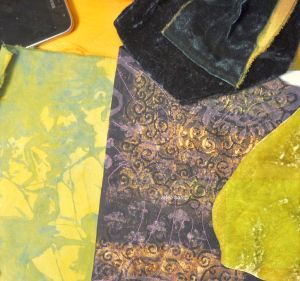 Trees and moons and Spring are on m y mind–though *that* is far away right now, with -21C to -25C projected for this coming weekend. (My son has been in Uganda since the beginning of November–is he gonna get a shock, trying to climatize again to Alberta weather, after almost 2.5 months of African heat!) I’ve picked an indigo overdyed osage cotton, 2 different velvets for another blue moon, a previously screensprinted and then stencilled indigo cotton, and a hunk of the most wonderful chartreuse velvet i only hope i can replicate again! That one is the right side and you may notice a funny bit of photo editing to show the correct colour, a square of green set in the yellow–it ain’t yellow, but the studio is so wrong for photographing colour, and i was too pooped to drag everything upstairs and anyways, it’s a grey snowy day, so bear with me 🙂
Here’s the indigo over osage:
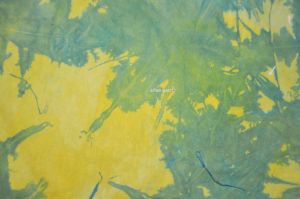
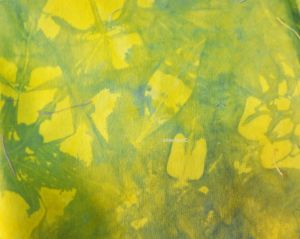
Above is the piece of cotton i will use as the background (has bluer tones), below is a larger piece (greener tones) that i am drooling on and fondling:
I had revved up my indigo vat again on the weekend past. (Actually i had to start from scratch as the originals had to be dumped for the move…..too little to save, and too much chance of spillage or oxygen overload as it sloshed on a truck!) First results were not encouraging, but after asking in an indigo group what the problem might be, have concluded it might have been the tannin premordant, *and* the cutch, which is *also* a tannin. See the grey around the darker marks of indigo? (All photos in my posts are clickable for larger viewing.) I like the effect, but if it doesn’t “stick” well, it’s not a good practice if i wish to flog my goods later! (It also appears to have stripped the madder…)
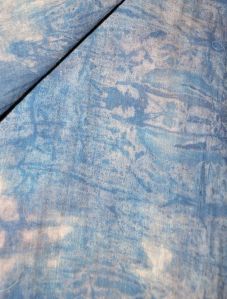
Apparently tannin repels the indigo, something a lot have discovered with indigo and ecoprinting. Of course, checking my Boutrup/Ellis book, i should know better anyways and do the indigo first, THEN the mordanting, then the overdyeing. The two osage/indigo pieces mentioned above were done after this debacle, and though of course they were premordanted with tannin and alum, they don’t have as much tannin as the tannin/cutch piece, so the indigo struck properly!
I’ve been meaning to add less expensive, ready to use items to my inventory as well. Here’s the first test piece, a cotton neckscarf, clamp shibori-ed, and modelled by the ever silent Madame LaToussa.
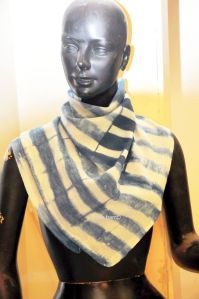 I do like that, if i say so myself! The only problem is that the scarves were obviously hemmed with a polyester thread, but it’s not obtrusive enough to bother me (or probably anyone else) greatly. Barely noticeable.
I also have today clamped a shibori indigo dyed very hairy very scarey very contrary chenille scarf, ready to overdye, and as i mentioned in a previous post, i will do a post about that. I’m pretty sure it’s a failure, a funny one, and probably still wearable, but definitely a failure. You can judge for yourself at the time of showing 🙂
I’d have a nap now, but Greyman will be home in several minutes.
I will have a nap now.
Nope. Not even going to bother with light fastness tests with these!
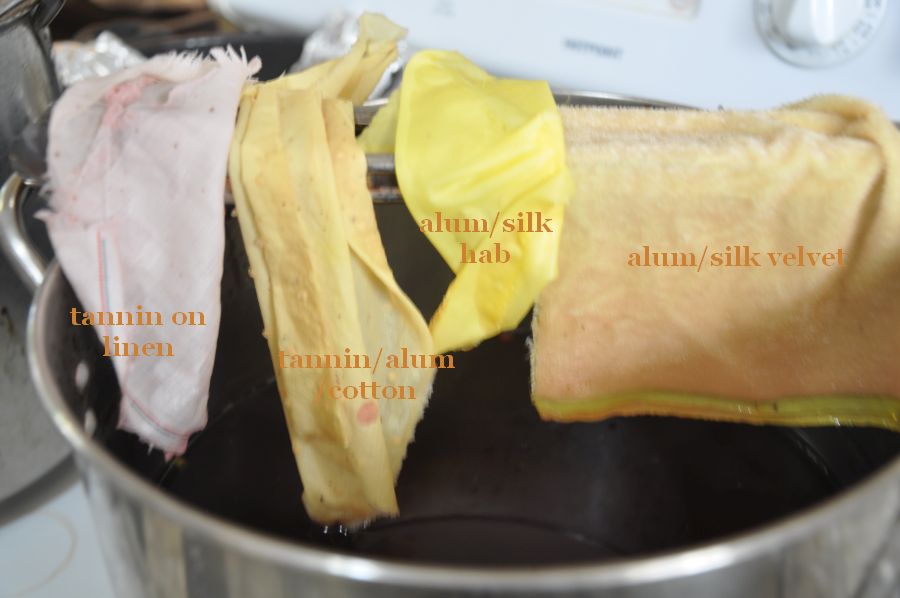
Funny that after half an hour, a test pull had strong colours (strong being relative, as these are not exactly strong 🙂 ):
 After 34 hours:
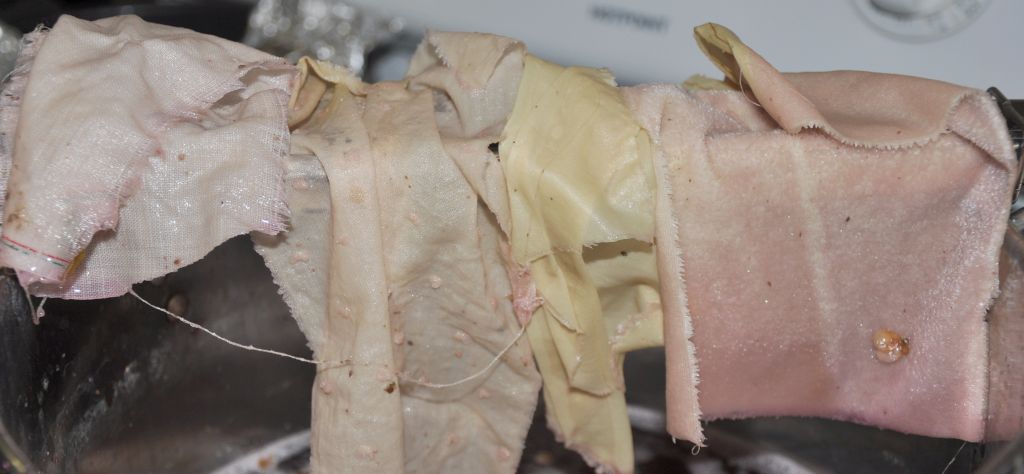
And rinsed:
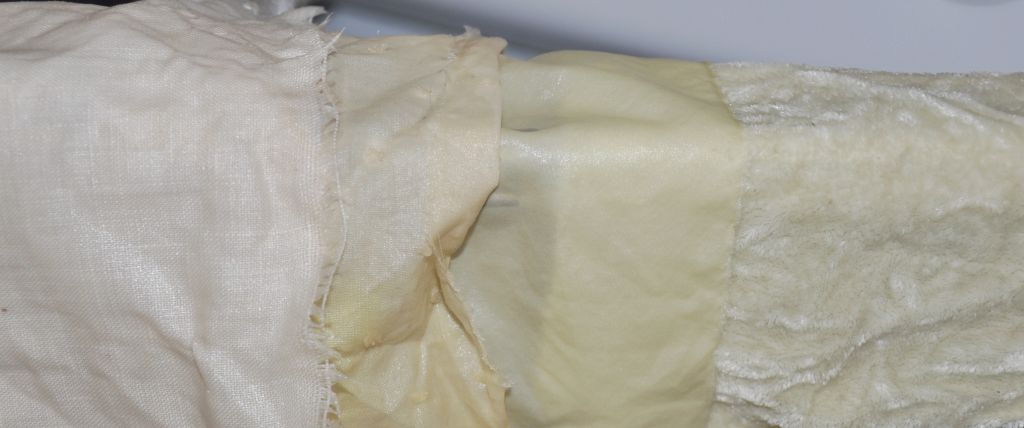
HA.
I wanted do an iron dip to see if there was any tannin, always a useful thing to know,but could do that only on the silks, as the cotton and linen pieces of course had been premordanted with tannin.
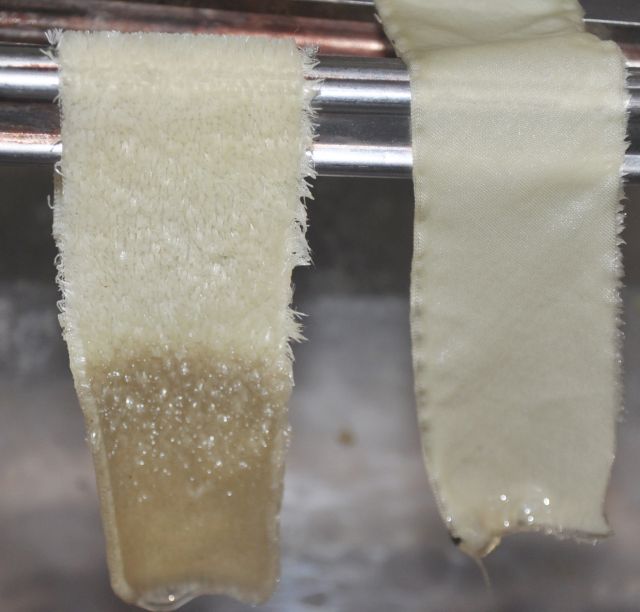
Though these are still wet, i can tell you the tannin in this plant is negligible. There are much better local plants if i do want tannin, like oak!
The dyepot also started fermenting after 24 hours, probably due to the freshness and any alien life forms that live on these. Because there are no other elements in these but orach and water though, i’m going to dump in my garden. (Edit: My neighbour was intensely curious what i was watering my patio pots with after–ALL of the deep pink was still in the water!)
I’ve realized too that many posts about local plants are going to bore you, even if a Die Hard Dyer, so will limit those to the end results, multiple plants per post. I know a lot of you have wandered off in the last year anyways!
I’m taking several approaches here with foraged plants, so what works for me might not work for you, depending on where your plant material is growing, and it’s growth habits/requirements. There are many variables in natural dyeing, from that fact of plant biome, to water factors such as Ph, soft vs hard, city tap vs well, seasonal factors like heat, rain and soil composition and hell, just plain “luck of the draw” and magic. (Despite my crusty, abrupt, oft irked attitude, i DO love Nature and believe there IS magic afoot there.) There *are* actual credited dye plants in my area, but i’m also experimenting with either lesser known, or new to me possibilities.
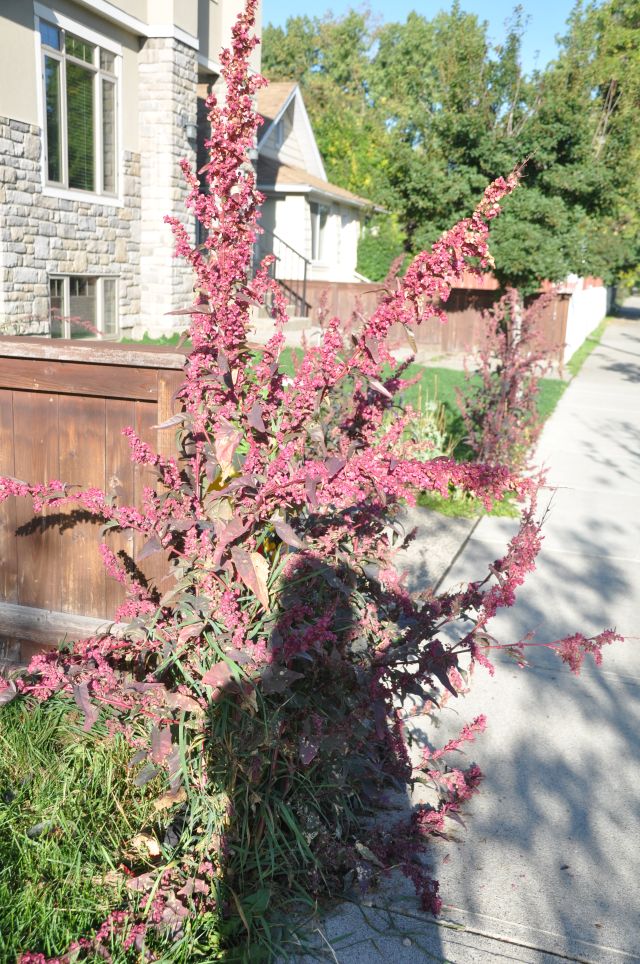
Red Orach, introduced to the neighbourhood as a garden “green” by my immediate neighbour, is prolifically self seeding and will grow ANYWHERE, as i’ve found it everywhere from our lush back meadow, to the neighbour’s sterile little golf green lawn, the rough berm across the road, and down on the riverbank. (Our soil here is river sediment/clay based.) I initially thought it was in the Rumex family, but it is in fact Atriplex hortensis, part of the Amaranthaceae classification. And yes, i AM drawn to it by the very fact too that it is red–i *know* plants like this are full of anthocyanins, a fugitive colourant that neither lasts in light (or dark, and why would you keep beet/bean/berry/red cabbage stained cloth/es in the dark if the dye is that bad????) or through washing. But, maybe i’ll get a different yellow than the other mostly yellow colouring plants i intend to try? BWAHAHAHA. As i’ve said before, most “local” plants give a range of yellow, yellow, yellow or yellow……. But i *might* get pink, peach, coral with the right post mordant/modifier treatments, on different fibres. (This worked well, back in the day, with rhubarb root.)
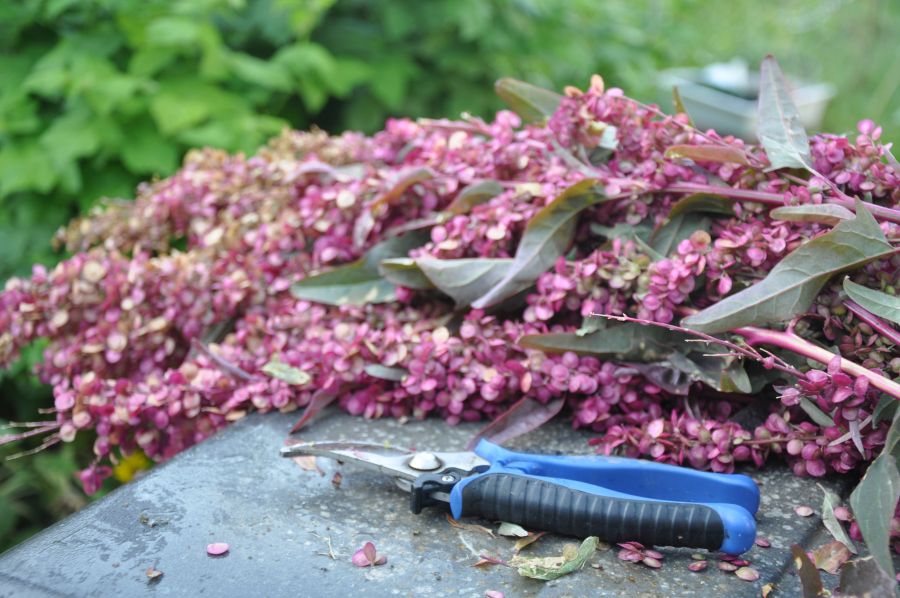
I thought i’d do the first test with our filtered water, as our tap water is very very hard, and loaded with iron as well, and truthfully there are few dyes that do well in hard water. I’m also simmering, not boiling, as most dyes shouldn’t go above 180 degrees F/80 degrees C. A total of maybe 600grams?
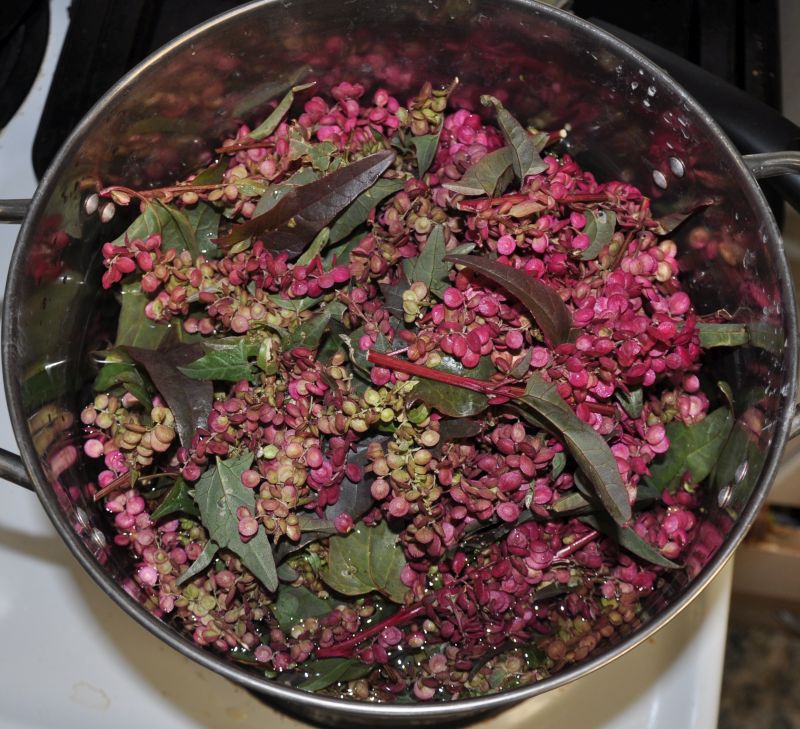
After 20 minutes, the water did start turning pink, no surprise actually, because this plant is used also for food colouring, and the neighbours noted their kids wouldn’t eat an omelette after the addition of the leaves turned the eggs pink…… 🙂 Reminds me of when i was a kid and the family was camping. Late one night, supper, only food left eggs and strawberries. Dad threw them together, result pink puke that no one would touch. Ah, memories.
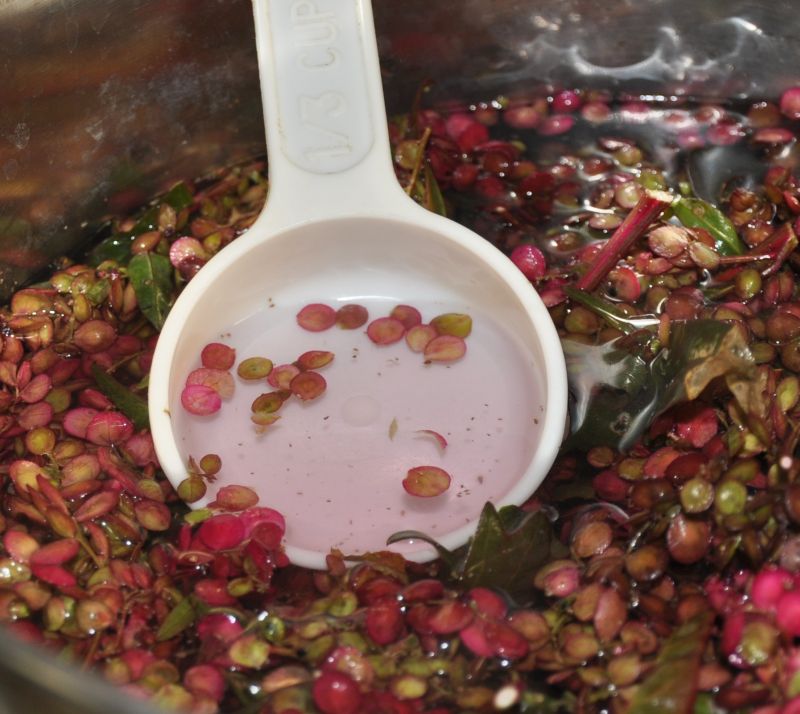
At 40 minutes:
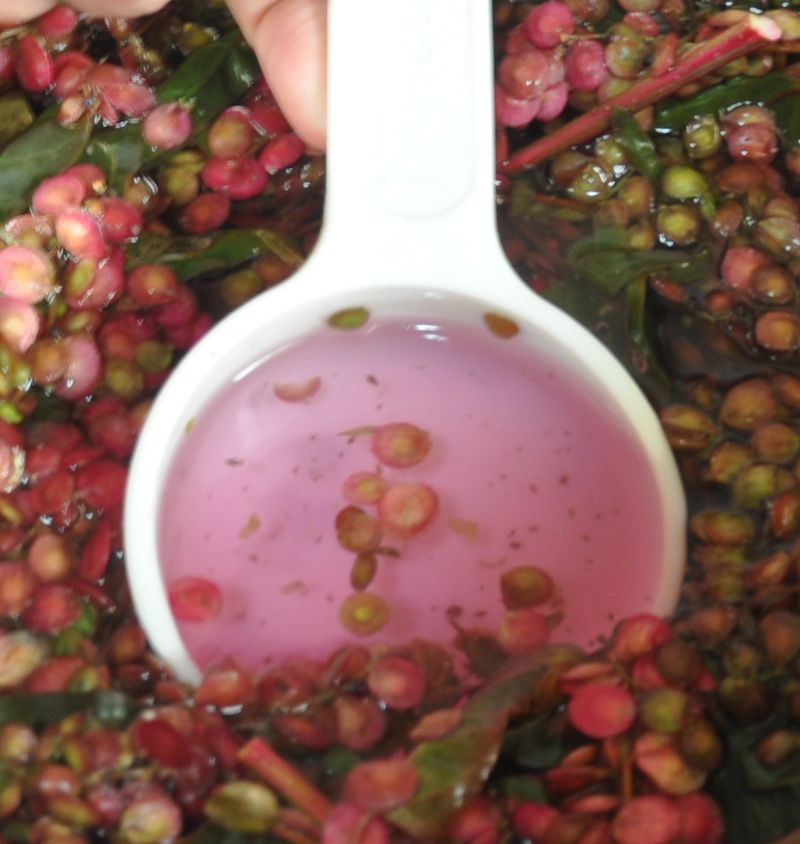
Simmered for an hour, then cooled for another hour, i then strained all the plant material out (and the bugs…..i did rinse everything first, but there were Klingons apparently.) Because these are an edible, they will go right into the compost bin in the back40.
I leave the whole bath letting it cool on the burner, my usual method. In it, i threw premordanted according to fibre type pieces of silk velvet, silk habotai, cotton swiss dot and a tannined, but not yet alum treated linen. (I can post mordant that one.) There is a BIG caveat here: the colour you see in a dye pot, is not always what you get on the fibre! (That’s why too many artily staged IG photos are just plain fraudulent.) I will leave all of these chunks in the pot for 2 days, occasionally raising the temp to prevent mold and alien lifeforms, as normally this is how i dye, leaving the fibres in anywhere from 8-36 hours, depending on how busy i am or if i forget!). Too, protein and cellulose fibres should actually be dyed separately as protein is greedier and grabs more of the dye, so cellulose results may be weaker. Whatever. It’s a test.
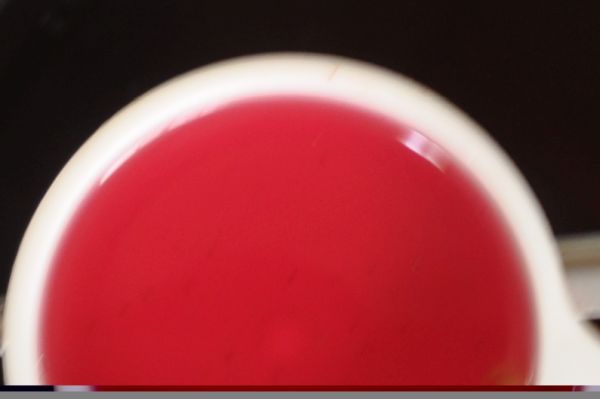
This is half an hour in the pot, again not very indicative of what the end results will be, but interesting in terms of chemistry, just a pull to see if anything is happening. These are unsqueezed, unrinsed, so keep that in mind!
On the weekend, i will do some post mods and mords, then start lightfast tests. I don’t expect miracles, but the hoofies are crossed anyways, in the spirit of admiring Nature’s magic.
I am drying another 600 grams or so. If the above test doesn’t really work as a dye, well, the dried may be added to something else as a weak tannin, or slightly acid something or other. Or tossed 🙂
EDIT: AS you will see from my next post, Orach is NOT a good textile grade dye!
Though i love my “Grand teints” ( classically proven dyes like madder, indigo, etc) natural dyes very much, and disdain the current trend of throwing any and all “food waste” materials in a pot to use as a “dye”, there are also the lesser known dyes foraged locally by many cultures . (“Petit teints” are the non fast/fugitive dyes such as red cabbage, most red/purple/pink/blue berries, most red/purple/pink/blue flowers, black beans, beets, etc.)
Yes, some *will* fade, some are rather anecdotal and some are still being promoted but are folklore with no actual extant or provable results, and there are some that while they may not last as long as the classics, they are still viable dyes.
To that end, i bought a copy of the much vaunted “Spectrum: Dye Plants of Ontario”, reasoning that much of what grows in Ontario, grows also where i am (Alberta), so that it’s worth exploring. I *do* want to use local plants, whether grown in my garden, or foraged on walks and day trips. I have an older book that is dedicated to Canadian dye plants, written in ’78, and at best a good laugh, and at worst very confusing if you don’t have any experience at all, but i’ve heard much good spoken of this Ontario volume. There’s also a classic book, out of print now, “Dyes from Lichens and Plants: A Canadian Dyer’s Guide” by Judy Waldner McGrath, 1977, which is more geocentric as it covers mostly plant materials above the 55th parallel! Even though Canada is so large and we do have some vastly different grow zones, many “weeds” flourish in all or most of our varied climes 🙂 Indeed, many of these plants may be in most of North America, at least the northern zones of the US.
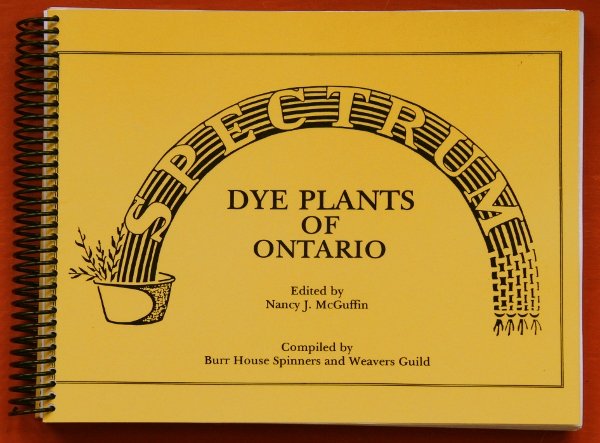
There are 300 plants identified. I question some of them, though helpfully, some are referred to in other dye books, included in the bibliography for cross checking. (Again though, some still questionable….) I highly recommend again using a good clearly photographed plant ID book, as all illustrations are pen and ink drawings, better than the ’78 book mentioned above, but still, not drawn by qualified botanists…. (Forget the damn “plant app” nonsense–most of the results with those are too vague, and possibly dangerous if a poisonous hemlock is identified as Queen Anne’s Lace!)
Being so late in the year at this time, i will have to either immediately use what i find, or chance drying it and using it through the winter. Some dye stuffs locally foraged will not give as good results when dried : solidago is notorious for poor colour when stored, for instance, though tansy is just as good in my books dried as fresh. Too, let’s face it, most dye plants give yellow, yellow, yellow or yellow 🙂 Different mordants and/or modifiers may give different hues, and sometimes there’s a real difference between “commercial” dyes like osage overdyed with indigo as opposed to tansy overdyed with indigo, so it is still a valuable colour library.
There are no colour photos in this book, so though the results are described, perceptions may vary on the difference between “old gold” and “brassy gold”! Obviously if you’re interested enough in the potential of each plant, you’d do your own tests and quantify those descriptors with photos 🙂 Results are described with alum, chrome (A BIG BIG NO NON NO, mentioned IN the book now as a black hand (literally) over each entry), tin, copper and iron. CAVEAT: ALL FIBRES USED WERE WOOL.
So, my dried materials gathered this fall will be chosen firstly because i *know* people have had reasonable outcome with them , and secondly because they are in my immediate environs (few day trips left in the year now due to weather, season and work schedules).
PS There are also “stand by’s” in this book: coreopsis, dahlia, eupatorium, solidago, tansy, and more.
I have dried already some tansy, artemisia and yarrow. With the recent e-garbage run (old electronics), there’s plenty of room down in the Dye Dungeon now for storing dried materials in bags and boxes. All tests, information, results will be in the “Alberta dye plants” category, though as i mentioned, many of these are not as geocentric as just Alberta.
Off now to gather what from a distance looks a huge expanse of Rumex!
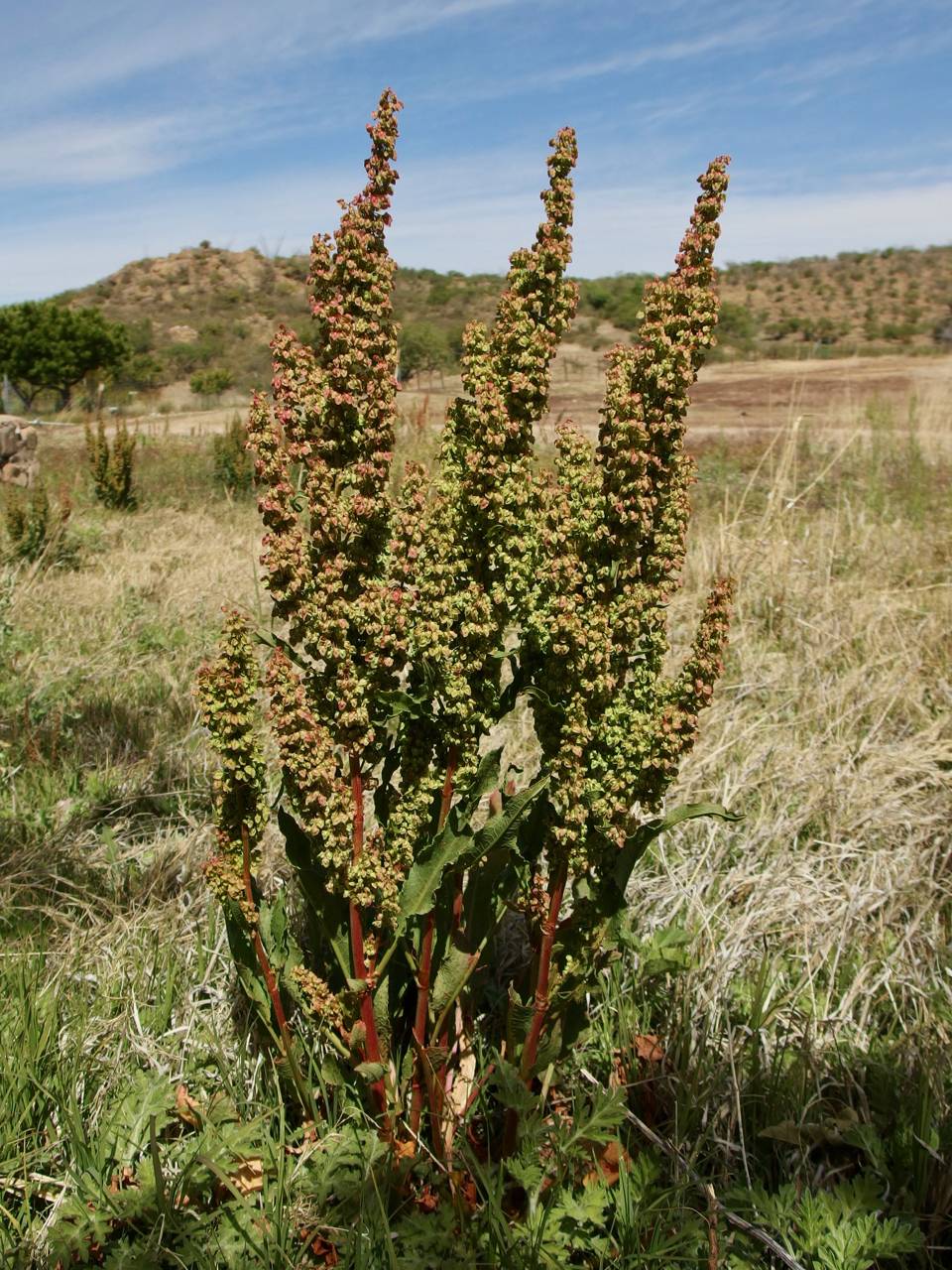
DogFaced Girl loves these expeditions, so no complaint there 🙂
Firstly, i’m ambivalent, PERIOD, about posting this review. I realize it may have been a deeply personal choice of the editor/writer to make these particular inclusions in the book. I’m also rather curious how some have been given the title of “World Master” as well. But honestly? I wouldn’t recommend buying unless you’re one of those people who has to have *EVERY* book on a subject: borrow from the library when it gets there. (Petition your library: they are always open to reasonable requests for aquisitions, and it’s still a sale for the writer/publisher.) It’s not that it’s expensive (it isn’t by a long shot) but you’d be better off with other more historically “slanted” books, like Dominique Cardon’s epistle, any of Yoshiko Wada’s beautiful offerings, Jenny Balfour-Paul’s indigo histories, and many museum guides online and sometimes available as catalogues.
So.
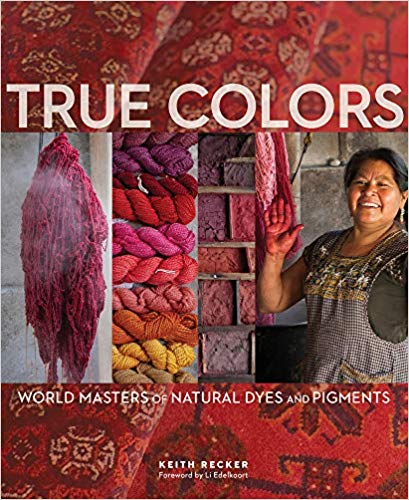
This is the first natural dye book i’ve ever been ambivalent about. On one hand, it’s exciting visually, a cornucopia of natural colour use around the world, illustrated gorgeously with close-ups and atmospheric scenes. Spotlights are on cultural meaning and history, empowerment of indigenous people, and the uses of ethno/geo-centric dye materials, in traditional and in cutting edge directions. The many facets of indigo are intriguing, and in some cases jaw dropping in the dedication to preservation of a skill, and in the use of aeons old techniques and materials for contemporary art applications in other media. The indigo sections in particular opened my heart to appreciate *all* the permutations of blue possible and to embrace the vagaries of the vat, finding beauty in the palest to darkest, no “wrong” blue as a result. The book should have been edited then and there, to be finished.
The reverse side of the coin however is the inclusion of erroneously labelled “sustainable” branded “dyers” who promote the use of food waste, fugitive dyes and the instant gratification element of DIY, with no actual historical data. This isn’t a recipe book by a long shot, but i would have expected a disclaimer by some, (even one!) of these currently Popular Girls, about dyes that last, are done correctly with proper mordanting, with light and wash fast tests, instead of “seasonal colour” that essentially wastes more resources by the very fact that they have to be redyed over and over to have colour. I feel that these chapters are puff pieces only, designed to fill the book, with no actual value added, but since there are only a couple of these artistes included, there is a small blessing in that.
As i said, this isn’t a recipe book by a long shot, and was never intended to be, but in giving the title “World Masters” to some of the included artists, it cheapens the whole field, promotes bad practice, and encourages questionable business models. It’s unfortunate that the classic dyers, innovative artists and contemporary uses will be glossed over by many in favour of the easy to do fugitive. A coffee table book, and it may pique some interest in those who intend to get serious, but in the end, not a reference book, not destined to become a classic, and not very useful for the most part, except perhaps as a “Digest”.
Unfortunately, or funnily, or strangely even, i cannot post this review on Amazon, because the book hasn’t been “released” yet. Really? I got my copy 2 days ago!
You’ll note too that i actually was rather mild in my condemnation for fugitive dyes, and mentioned no names 🙂 These ARE *MY* personal opinions, and whilst many think i’m a Know It All, i have never steered anyone wrong, deliberately or otherwise, with information i have shared. “The facts, Ma’am, just the facts.”
UPDATED Oct 7/20
Oh, but it’s a pretty colour anyways.
Well, i can always overdye it.
But it was/looked clean when i bought it to dye.
It doesn’t matter, my clients like this colour.
But Famous Author *always* does this.
I don’t wash these anyways.
Did too scour: I washed this with my socks, before i dyed it.
Vinegar is too a mordant, you freak.
You’re just jealous i got dye from strawberries, ______, _______ and _____. (Insert appropriate inappropriate plant material here.) (This is usually said when said player has it explained to them, that even mordanting will not “fix” fugitive dyes.)
Here’s why you should scour, and pre mordant. Left to right: unwashed cotton, dye didn’t penetrate completely, many white spots visible, stiff as a f*****g board. Next, scoured only (soft as a baby’s butt!!!), no mordant, some colour uptake. Last, scoured and premordanted, deeper colour uptake. All were dyed in same pot of quebracho rojo, at the same time.
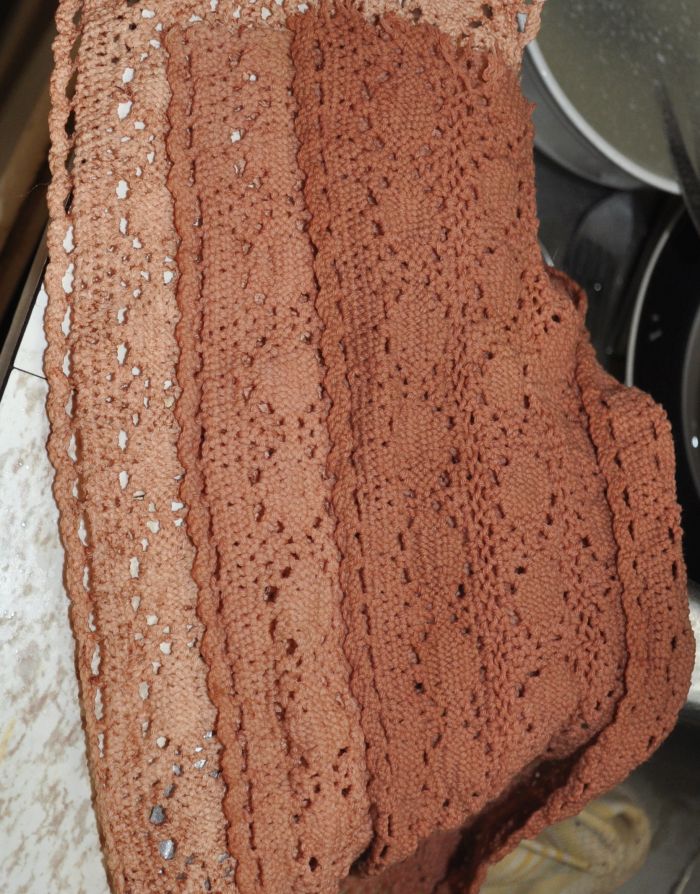 And please “but the colour is so pretty anyways” is not a good way to dye: the colours on the unscoured and unmordanted especially will/did wash out and will continue to do so, the scoured only will lose most of its colour with each subsequent wash, while the scoured and mordanted piece will keep its colour. And even “new” fibres that look clean need scouring.
Below cotton also, left scoured and mordanted, right scoured but no mordant.
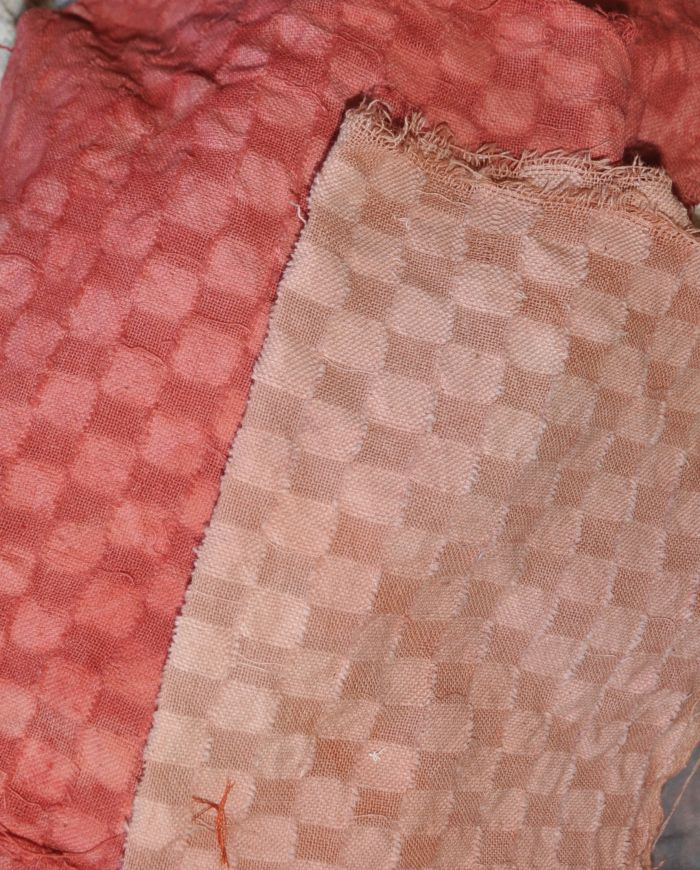
A perfect example of what happens if you don’t scour properly, lesson learned in June last year:
I thought i had done enough on a new thread, but when i put them in tannin, this happened:
GREEN?????? I contacted Maiwa, my trusted supplier, and asked if perhaps it had been the soda ash in the initial scouring that had reacted (maybe not rinsed enough), as gallnut is a clear tannin, and stays to the “browner” tones after being used and stored. Nope.
Hi Arlee,
This is rare but it does happen, but it is not from the soda ash. Fabrics are often pretreated and contain substances which can leach out or react with the mordant. When used on it’s own Maiwa’s gallnut extract is usually a clear/colourless tannin. I would suggest trying other cotton fibres from different sources and comparing the results.
Best,
Danielle
I had to REALLY scour again, properly, to get the green out of the threads! And it’s not that these were second hand or cheap threads–they were brand new, brand name, tightly plastic packaged and tightly boxed for shipment. Subsequent threads scouring has given baths of brown, yellow and absurdly, PINK. SCOUR YOUR THREADS TOO! Don’t skimp on this step. Even “PFD” (prepared for dyeing) fabric in MY opinion should be scoured—a. it’s been “prepared” for synthetic dyes, and b. you don’t know how much it’s been dragged over warehouse floors, handled, packed or shipped. (MMM, someone had tacos for lunch and wiped their fingers on the silk. SHARESIES!)
After scouring, I mordant EVERYTHING, according to fibre type. I *know* substantive dyes like indigo and walnut don’t require mordanting, but given that i use a lot of dyes that do need it, i’d rather have everything pre-done in case i grab the wrong chunk. Pre mordanting will not hurt substantive dyes. Some may be stripped out by a chemical indigo vat, but you should mordant again after indigo if you are going to overdye with another natural dye.
EDIT: Oct 7/20 Here’s another object lesson from my Dye Dungeon. I bought brand new white cotton velveteen, and lazily scoured it only once, and for only 45 minutes. I hung it to dry, and in the morning, THIS was on the floor:
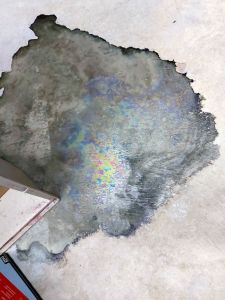
I don’t know what textile additive this was, but i suspect because of the oil like iridiscent sheen it was a solvent, or other petroleum based product, something that is definitely not coming out easily, and that would certainly inhibit the uptake of mordants and dyes. I had wondered why the fabric took up very little dye:
 This “should” have been a deep rich colour, as it had been properly premordanted according to fibretype.
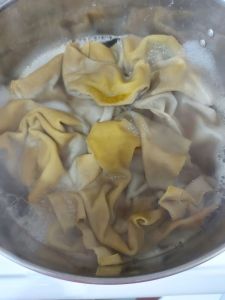
So i threw it back in a big pot, and as soon as it started boiling (above photo), i knew there was still a lot of crud in it. At the end of the first hour long boil up, it looked like i was using a walnut dyebath–it was that dark and disgusting! It took 2 more boils at 45 minutes each, each successive pot with 2 heaping tablespoons of Borax, 2 of soda ash and some neutral soap, to get the water clear. (J.Liles recommends some fabrics be boiled up to 4 hours!)
There must have been a hell of a lot of fibre additives, because the snow white fabric i initially started with is now a lovely CREAM. That’s okay though, still a good base colour, and significantly, the plushness is softer and thicker feeling, probably due to shrinkage. (Be aware that scouring can shrink things as well, and better to know *before* you make plans than after and have lost 2-15% length or width!) Note too, the cleaning aspect i used is for CELLULOSE only. Soda ash will destroy proteins, and i doubt Borax is good for them either.
While we all know (or should if you do a little research) is that textile manufacturing is loaded with chemicals, whether it’s naturals or synthetics. Not all are done in one dedicated plant that does “only” synthetics, “only” naturals, and i suspect few that are “ONLY” “organic”. (Fact in case, that cotton lace in the first photo, had some suspiciously plastic filaments stuck in it, meaning the factory had produced synthetic laces as well, either on the same machine before, or near by on another run.) Some of the chemicals are cleaners, some are part OF the fabric, some are added after to give weight, sheen, dyeability and effect, and a lot of them ARE in our natural fibres, whether you think them clean or not. LINK> This will tell you how many additives and processes are used, most of the time. I remember when i was a young teenager, some fabrics *smelled REALLY weird”—turns out it was formaldehyde! I have friends who still can’t go in fabric stores because of their health conditions and all these chemicals.
HOW to scour? Maiwa: https://cdn.shopify.com/s/files/1/1086/6542/files/natural_dyeing.pdf?2077475857497476456 NOTE: different scour methods for cellulose vs protein fibres. I use neutral soap and soda ash, or neutral soap and borax, or just neutral soap, depending on what i have handy, and depending on the fibre type.
HOW to mordant? Maiwa: https://cdn.shopify.com/s/files/1/1086/6542/files/natural_dyeing.pdf?2077475857497476456 I sometimes add a tannin step to protein fibres, not because they need it, but because they will extend the colour possibilities.
Yes, they are the same link. Maiwa has the BEST, FREE information available that is accurate, researched and trustworthy. Save the link, print it, share it, USE it.
 albedo too
You must be logged in to post a comment.