Posted in natural dye research, Natural Dyes

how to do a lightfast test for natural dyes

There’s nothing complicated about a lightfast test, so either people don’t know about it, or they choose to ignore it. All it requires is some cardboard or heavy paper, a couple of clips, and your yarn/thread/fabric, a window, and some patience.

A couple winds of thread or yarn, or a 4×4″ piece of fabric is all that’s needed to do this. Cover half with the cardboard or paper so it’s enclosed and clip it so it’s tight. Put in a very bright window. Wait. Wait some more. Leave it for at LEAST a month. Go do whatever else it is you do, but DON’T commit that larger stretch of yarn/thread, or cloth to any project, or sell it.

After a month, unclip it. What’s happened? Here’s hollyhock bloom dyed yarn after a month :
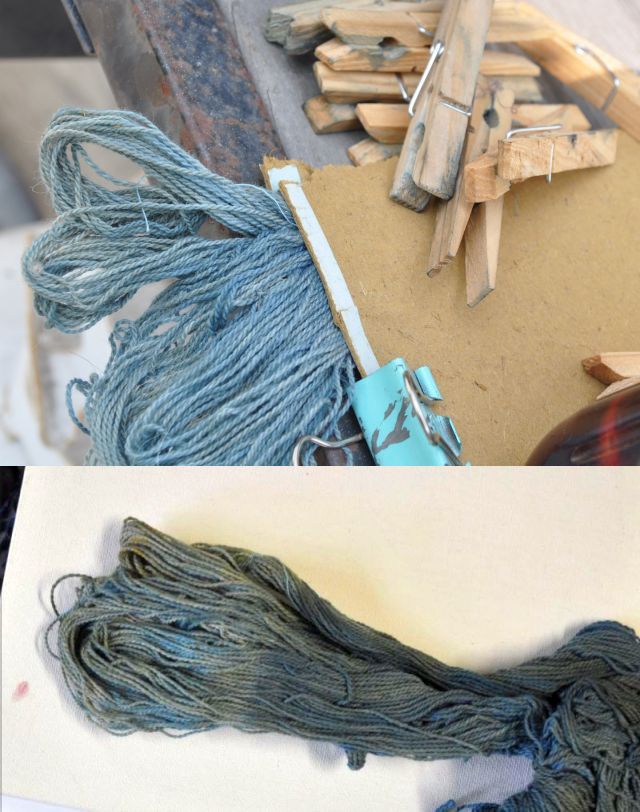
There’s a VERY distinct line where the cardboard covered it. All of my blooms went into the compost. I overdyed this in indigo and while the shade may eventually change *because* of the underlying hollyhock hue, i’m okay with that in work i keep for myself, or to use as stitch samples.

I have a big thick natural dye journal that i started in 2010 at the beginning of this journey. Yesterday i was looking through it and found the photo on the left taken at the time of the tests of alum mordanted fibres and hollyhock, hibiscus and marigold, and compared it to a 9 year stint in the journal, completely covered, and look at the difference. Even the vaunted marigold flower has faded.
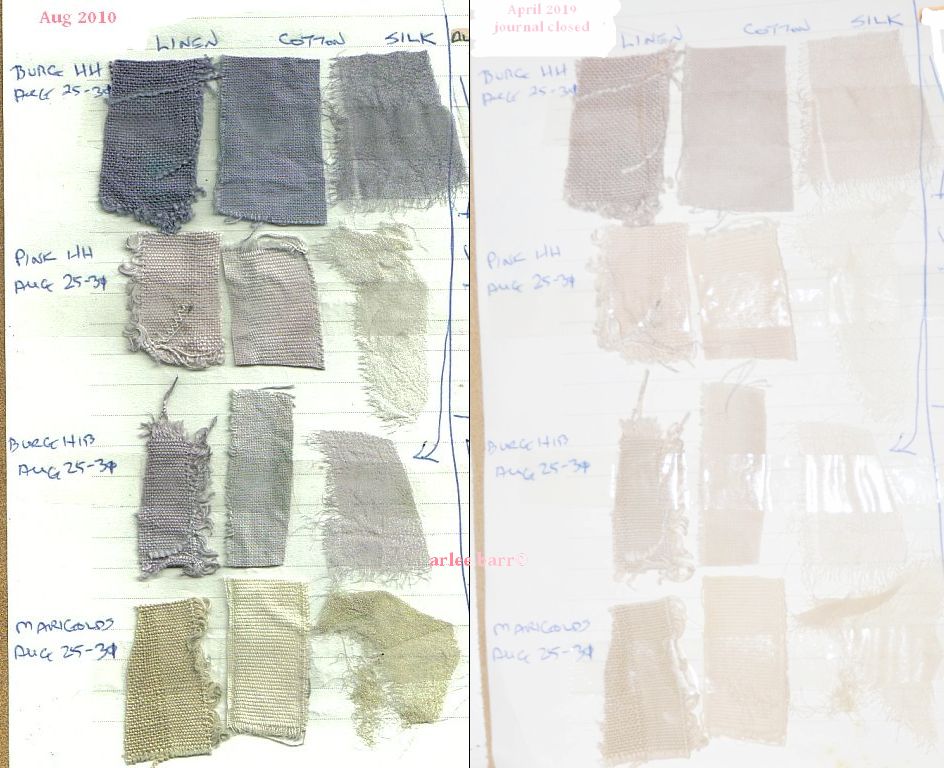
Though i am happy to use marigold, dyer’s chamomile and coreopsis, they will stay in my studio, as this proves to *me* that flowers just don’t have enough strong dye compounds to be useful for long term work. I will never again use flowers like hibiscus, hollyhock or any others that have anthocyanins in them, as the beautiful reds, blues and purples they share, are shared only briefly. EDIT: Since people are getting argumentative about the hollyhock (!!!), see the expert’s opinion here, last paragraph.

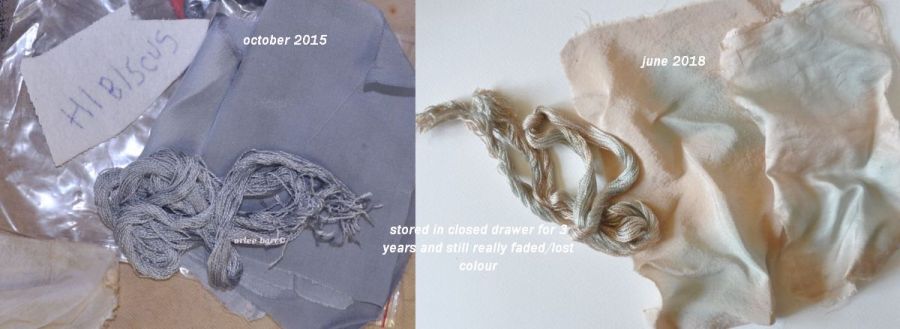
Another hibiscus sample below, stored in a drawer for 3 years:
Below, annatto, the folded over top section the area that was exposed to light for a month:
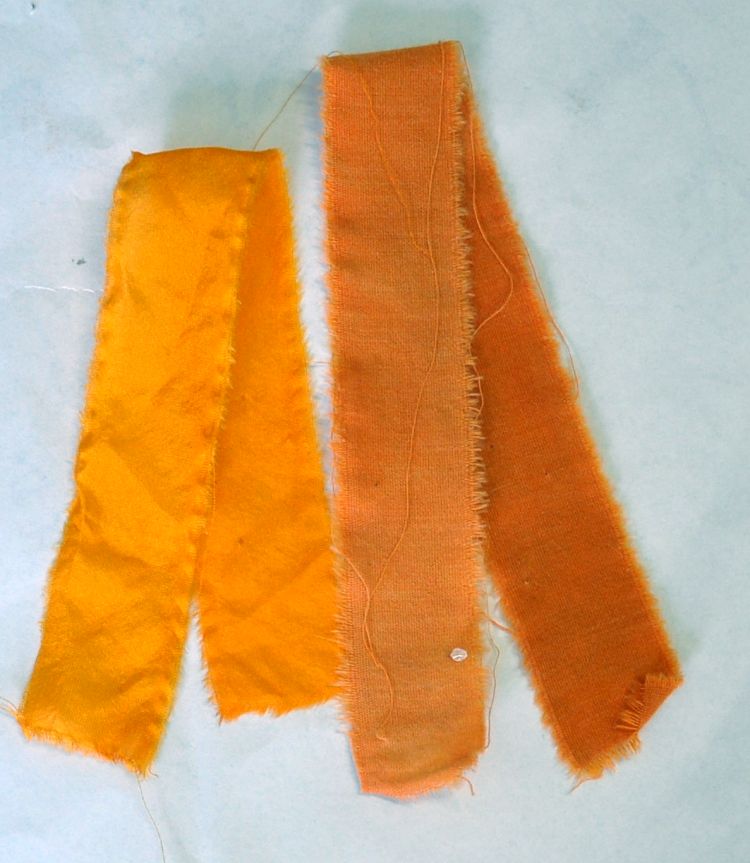
Not as bad a change, but still obvious. Again, i’ll use as a base, or keep in the studio for personal use.

Some natural dyes last better than others, notably madder, indigo and weld, the “grand teint” dyes. Lesser (still very good results in most cases) dyes are most of the others including brazilwood, logwood, fustic, cochineal, sandalwood, cutch, lac etc, ie dyes that are sold by reputable dealers. Tannin rich dyes will eventually oxidize–and that includes avocado–to browns, beiges and mud. Iron will *improve* lightfastness, but does not make anything truly permanent.

Below, a FB friend’s results of lightfastness of avocado:
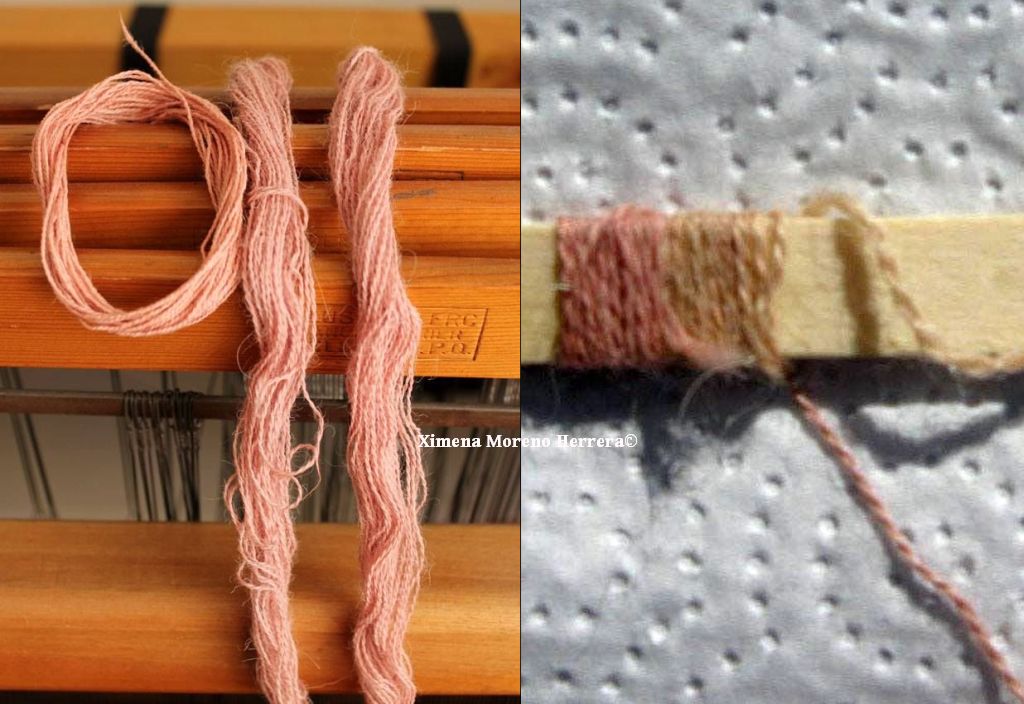
Left, the first result of avocado dyeing, right is after a lightfastness test.  You can see the darkening of the tannin as it “ages”, even after covering, and to the right in the right photo 🙂 , the lightening of the colour as it is exposed to sun. Ximena lives in South America, and has access to local lore and plant materials that are indigenous to the continent. We’re shared much information about avocados, tannin use, and “true” dyes, with both of us pointing the way to more scholarly papers, something that either people don’t know about, or don’t care enough about to go so far with research, which is sad because we live in such an information rich world now!

Note: Carol Lee, the one who got deep reds from avocado, has said that even after storage for 10 years, her reds turned to brown, proving avocado colours are tannin only, not a true dye for reds and pinks. The tannin oxidized even away from light.

NOTHING FIXES FUGITIVE, so forget the flowers, and food waste unless you’re happy with “play silks” for the kids, or things for personal use that you can re-dye. Please, don’t sell these. All of this is not to say don’t play, BUT please be aware of longevity and the final use of the finished “product”. Again, i say don’t sell fugitive dyed fabrics and yarns.

I still intend to continue experimenting (playing? 🙂 ) with locally foraged dyes, but now armed with a section from the Boutrup/Ellis book, i know what to look for in these forays. Admittedly, early peoples, and settlers to this continent discovered certain plants dyed well enough for their end use, so we’ll go with that. Accurate scouring, mordanting, possible post mordanting and/or modifying, light fast and wash fast tests DO make things last better.

What it all boils down to is: whenever you are trying a plant material for a natural dye, and can find no information on it as to whether or not it works, do a lightfast test.
Posted in "OPINIONATION", Book reviews, mordants and modifiers, natural dye research, Natural Dyes

my drawers will never be empty (book review):The Art and Science of Natural Dyes

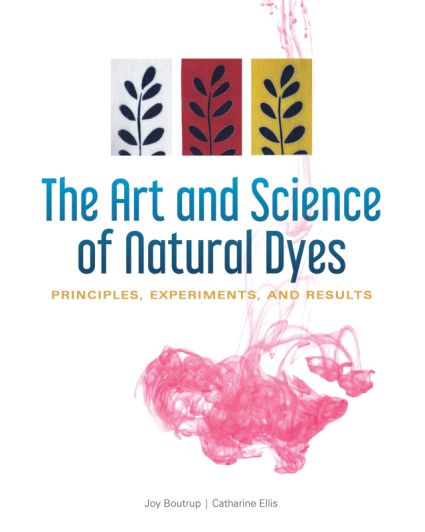
JUST when i had got all my dye stuff and tools and pots back down to the Dye Dungeon, this arrived in the mail 🙂 I pre-ordered this last July, the moment i heard it was finished, and have been anxiously waiting for it. I pretty much snatched it out of the postman’s hands!

The Art and Science of Natural Dyes: Principles, Experiments and Results  – Catherine Ellis and Joy Boutrup

I’ve already had 3 “AHA” moments, and i’m only half way through. It’s not a book you read once and then sporadically refer to, so fortunately, it’s also spiral bound so it stays open to the page you want. (Terrific, now i have to dig my book/magazine holder back out of the “donate” box….)

It’s not so sciencey that it can’t be understood, but it’s also not a skim it and do it manual. It covers the “classic” dyes, none of the usual beets, beans and berries nonsense, so don’t bother if you’re interested only in sauteing up some food waste, throwing in a cute baby onesie and staging artful photos for IG. If you’re serious about natural dyeing, and i don’t mean Total Scientist Mode but are a dedicated hobbyist/artist/small business owner, this is the book to explain WHY things work/don’t/happen. I still recommend Jenny Dean for basic, accurate dye recipes and processes, but this one will give you insights into the many variations that can and are encouraged to happen with skillful, knowledgeable hands.

There’s a small section on testing the dye potential of local foraged plants, minimal though helpful, but not the focus of the book. That being said, those tests could lead to work with those plants, following the advice for the classics. It’s all grist for the colour mill!

I’m not about to dissect any “recipe” in this reference manual: A.  buy the book, i don’t like spreading out the photos of pages i find interesting, as i’d rather you support the authors, and their research and B. the recipes are classic anyways, BUT with much new information that can be digested fully with the book in front of you 🙂

There’s a LOT of excitement about this book in the natural dye groups, and rightly so: it also supports all the things i, and others, have said about what constitutes solid, legitimate dyes and the techniques used to create these wondrous rainbows. I have to laugh though in one sense, because i just know that the new catchphrase is going to be “Welllll, Boutrup Ellis says……..” This book should be MANDATORY reading for anyone who goes near a natural dye pot.

It’s not a cheap book, but then it’s not a cheap book, like so many of the Popular girls are publishing right now. I’m about to settle in with another cup of coffee and a pack of stickit thingies to mark pages, and do a little dreaming and planning.

Edit: After 1000’s of hits to this blog post, it occurred to me that there really should be a link here to the book! Beware though–already some are claiming it in their “used but good condition” racks at two and three times the price!!!!!!!!!!!!!!!!!!!!!!!!!!!!!!!!!!!!!

EDIT: Feb 9/18WHOA! “#1 best seller” in dyes at Amazon, sold out of a lot of places, and the bloodsuckers have moved in with their jacked up prices because they bought several copies deliberately to re-sell. Good for the authors, not so much for the buyers!

Posted in "OPINIONATION", natural dye research, Natural Dyes

transparency in natural dyeing


#Plantdyes. #Naturaldyes. #Botanicaldyes. #Vegetabledyes (????????????????????)

These hashtags drive me up the wall. Use them, sure, but QUALIFY them.

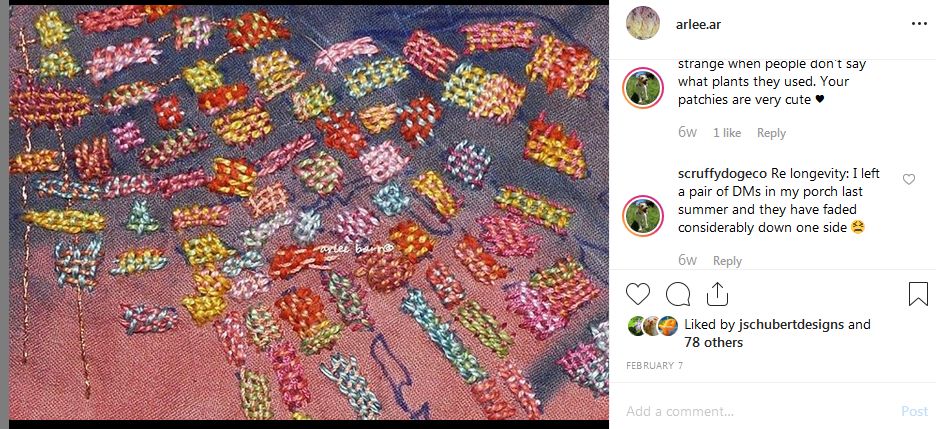
Natural dyes patchies, work in progress. You may have noticed that when I post, I hashtag  (edit:or ID) ALL of the dyes i use: when people say “plant dyes”, it doesn’t always mean it’s light or wash fast; in fact it could be fugitive. I pride myself on doing these colours and the subsequent art work made from them correctly, from the start. I make sure my efforts are going to last! The “Beets, Beans and Berries Brigade” can go suck on a turnip 😜 #naturaldyes #plantdyes #cochineal #sandalwood #indigo #logwood #osage #madder #quebrachorojo #naturaldyersofinstagram #yycartist #calgaryarts

I’ve asked people what “natural dye” they used. They don’t answer. I’ve asked to see their lightfast tests. They don’t answer. Or they do answer,  huffy because “it’s not going to be washed anyways”. I’ve asked what mordant they’ve used. “What’s a mordant?” or “Vinegar.” Sigh………… I ask precisely because i DO want to know–there are dyes out there that are not Old World, European, Asian, that we know nothing or little about at present. Maybe i could learn something new, but not with these attitudes.

Raspberries, grapes, beets, strawberries, black beans, mint, spinach, daylilies, passionfruit, cherries, rose petals, hibiscus and hollyhock blooms: when we start out, we try these. It’s fun, it’s fast, it’s colourful, pretty, sweet.  BUT THEY ARE NOT DYES. I admit it, i used 2 of these things, but only because they were in a book by a dyer i trust. (That dyer has subsequently revised her opinion on them as NOT true dyes. And i threw in the compost the blooms i’d saved.)

I strongly believe that natural dyeing has become such a burgeoning industry, that anyone who has ever seen beet juice stain a tablecloth, suddenly is a natural dyer, writes a book, and sells the product to increasing numbers of gaga followers. Hell, *i* could write a book, and it would be accurate, but since there are already more than enough GOOD, WELL RESEARCHED, RESPECTED authors and books out there, i wouldn’t presume. I don’t have all the answers (yet 🙂 ), but someday i will (have all the answers, not write a book), because i DO the research: i don’t trust anyone who doesn’t address or demonstrate anything about lightfastness, i don’t trust “seasonal colours” when half of them are not real dyes, i don’t trust just because something makes a wonderful ink means it also dyes cloth or threads, i don’t trust anyone who won’t be clear about what they are doing if they are selling it, i will never trust someone who advocates the use of kitchen waste without discerning and explaining the difference between a stain and a dye. I’ve *seen* the beet juice dyed yarn on Etsy, the packages of coloured fabrics on Instagram that have no identifiers. How do i know they are “plant dyes” , not food colouring, or watered paint, or procion, ’cause i ain’t never seen THAT green or deep fuschia from plant materials???? Yeah yeah, i know about mordants and modifiers, but some of the colours i’ve seen do not occur in natural dyestuffs! I just wish more buyers too would call out the frauds, identify problems plainly, and stop the “oh but it’s pretty anyways” crap.

No one wants to bake or buy a cake that looks gorgeous, but is really just icing bewitchingly swirled onto a cardboard base……………

I think what i’m asking for is honesty here. If you take pride in your work, and you know that you know what you are doing, share that. Don’t make people guess, don’t defraud them, don’t lie, cheat, obfuscate. If you write a book, aren’t you supposed to be sharing the real true information, or are you just promoting your own agenda with the artfully staged photos, the vague instructions, the “projects” that take up half the book? Holding the information close to your chest is selfish; if you’re doing it wrong, you will be found out i guess, if you’re doing it right, well, so can someone else. And yeah people copy, of course they copy but with natural dyeing, there are so many factors, that their projects are not going to be copies of your projects no matter how hard they try. If you’re hiding that information so you can sell your books, or your fabrics, and you’ve done it wrong, you will be found out, and there goes not only your bank account, but your reputation and the reputation of natural dyers WHO DO IT RIGHT.

I have been asked for instance, “how did you get that colour from madder?” I’ve answered, “by using it correctly, as per a madder recipe”. I can’t be more specific because there are water, mordant, modifier, fibre type, age of dye stuff, original source of dye stuff, length of time, temperature and Magical Fairy Moon Breathless Goddess factors–and that last one is no artsy fartsy obfuscation, because sometimes there is such a confluence of events to create a colour, that it HAS to be magic. Even this pragmatic skeptic has to admit this.

Don’t skimp on the research yourself, personally. Don’t take at face value one blog post that has a colour you like. Don’t EVER take at face value the most popular as the final word on a subject. (Popularity has nothing to do with actual knowledge.) Compare notes with each source, find the original source. Was it all done correctly from the start? Scouring, mordanting, actual dye material, possible post mordanting and/or modifying, light fast and wash fast tests? (These last two are my biggest peeves–i RARELY see any indication these have been done.)

Ah, i could go on and on.

Maybe most people are more interested in popularity and money, than pride of place, of ethics and honesty, of quality work/art. I’d like to sell more too, because i sure as hell  get frustrated when i see those big numbers of sales on stuff that just isn’t made correctly, done poorly, weak. There’s no “sustainability, eco-consciousness, mindfulness” to any of it. I have however found natural dyers who give a damn, who share the info, who are constantly learning, who are nice or snarky (because they too are frustrated) and know their stuff, who will troubleshoot with you. Those are the ones who have the art of transparency in spades (to mix a metaphor).

As usual, i’m probably just pissing into the wind.

I wrote about this before too, in less polite terms 🙂
Posted in mordants and modifiers, natural dye research, Natural Dyes, Naturally dyed threads, Probably talking to just myself, quebracho rojo

feeling in the pink….and purple

Now that i have a good stock of green threads from the osage and indigo work, it’s time to add some pinks and purples! Not talking about wishy washy, not talking about raspberries, beets, beans or any other silliness i see on too many blogs who haven’t the sense of a sack of potatoes 🙂

I did get a wonderful hot pink from madder by accidentally boiling over a pot of madder (considered a VERY VERY BAD BAD as madder shouldn’t go above a certain temp or you just get browns), some useful colour variations from cochineal in the pink to purple range, and a very deep purple with logwood. Cochineal however kind of puts me off now because i worry about Ph shifts–and some Ph shifts WASH OUT with an ordinary tap water rinse!!!!!!!!!!!– and i fret too about the lightfastness of logwood, because unless it’s got a lot of iron in the mix (which can damage fibres…), i’ve seen a noticeable change in the depth of colour within months of dyeing. (I do wonder too about the current craze for it in ecoprinting: are these people going to have a shock somewhere in the next few months/year with dramatic colour shifting or fade??) So………………. my next experiments/tests/results are from a type of tannin in the “catechic” range, more red-browns that the clear “gallic” or yellow “elegic” types. Tannins are an important part of premordanting fibres, especially cellulose which doesn’t work well with just alum, but very well with a tannin first, then the alum. Some tannins are also used as dyes by themselves, notably in the elegic and catechic types.

This tannin/dye IS more expensive, but i now am comfortable spending the money to get the best results. There’s no point in cheaping out with some things: it’s a waste of time, effort and resources, from water to electricity to containers and materials used, something i am very conscious off, having been raised quite frugally and with much common sense 🙂

When i threw the Quebracho Rojo in the pot, i first screamed (silently, as Greyman was napping). The colour was PHENOMENAL. However, that silent scream was from my excitable take it at face value 9 year old child self: my rational XX+ self reminded me that what you see in a dye pot is NOT necessarily what you get from a dye pot, as  i swear they deliberately skull xxxk with you. Ahem.

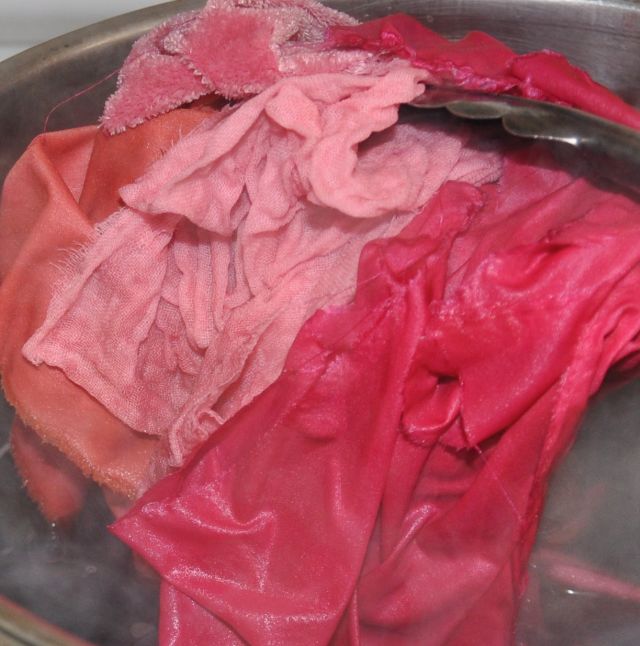
Looks fab, ay?

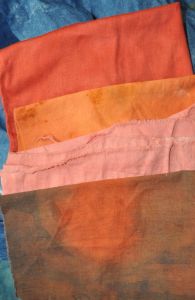
Wet, ooo ooo oooo:

Above, rinsed, barely any wash out!

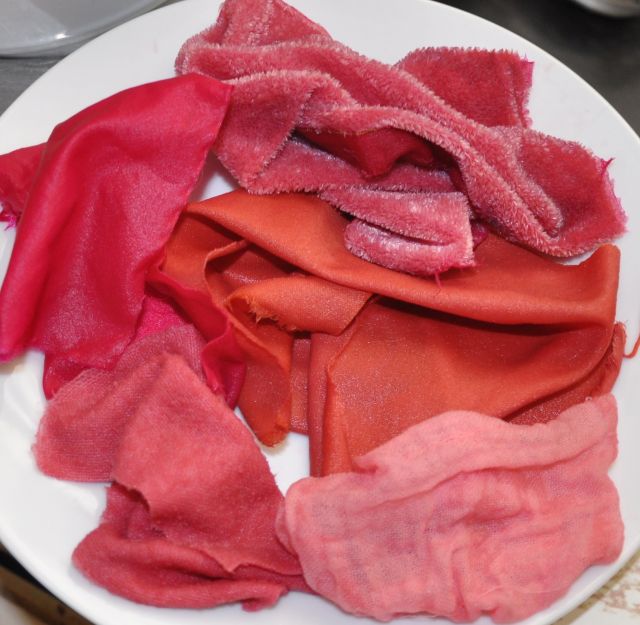
Dry, bearing in mind that colours can dry 20-70% lighter with ANY colourant, natural OR synthetic:

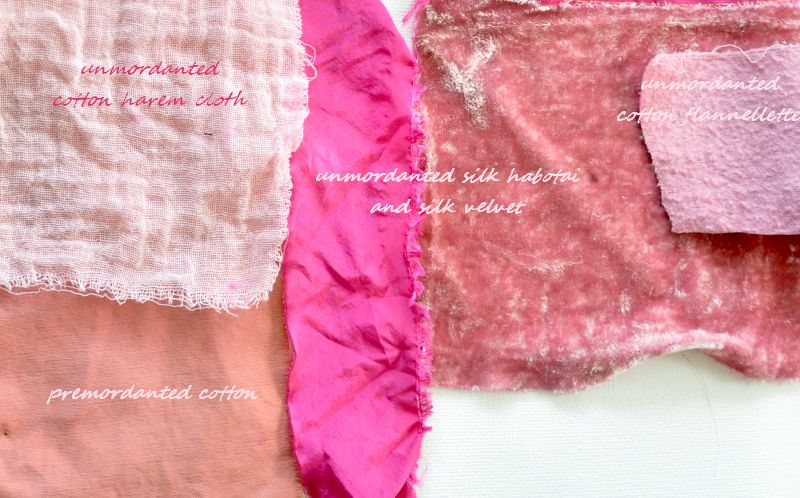
See what i mean by dye pot deception? Respectable colour, but not terribly excitingly scream worthy. Now mind you, the cottons that are paler pink were unmordanted, the darker cotton premordanted with tannin and alum. The silk habotai and silk velvet were also unmordanted, but because QR is a tannin as i mentioned, i figured “let’s try it as a tannin first”. Interesting too that most sources says it’s best on cellulose, “but performs well on silk and wool”, since obviously both silks did better……………………

The next phase of natural dye colour work is post mordant/post modify (though you can do these first, i don’t because i don’t want that active stew in the mix all in one pot.) Now this a is a nice range of colours!!!

Guess what though? I forgot to put any threads in, so now i have to go wind some skeins, scour ’em, then premordant some…………..

Olé!

PS you can still click on the photos for enlargement, but you can no longer comment on them–i had to shut that off due to the number of STOOPID ASSHAT SPAMMERS.

Posted in journal: lessons to learn, mordants and modifiers, natural dye research, oak

foraging, part 2

Mysterious chemistry 🙂 These are the oak leaf results.

Quite chocolate coloured on its own!!! I’m sure the first extraction, the first thread in the photo below, proves that more WOF is needed, as i’d love to get that ON fabric or threads! Even though the pot was positively solid with the leaves, i’ll do extraction by soaking/simmering for two days, then remove and add new/more leaves and repeat the process.

Oddly the UNmordanted silk took the colour better, whereas the uptake on previously mordanted cotton was expected.

I have also discovered that my thread skeins from this batch were looped too tightly to either be scoured properly, or mordanted thoroughly, hence the “variegation”–even though i loop quite loosely, it still had an effect. (lesson learned there: DON’T loop)

The colours are softly pretty but not terribly exciting, however they are good base colours for overdyeing, and are obviously *all* mordanted now, as that’s what oak does 🙂 I still have to do post mods to see what colour changes i can get (nothing earth shattering expected), but it *is* good to see what colours one can forage locally.

I’ll still collect more of the oak leaves as they are plentiful and falling anyways. And no one else uses them, just bags them up and sends them to the city compost facility! Also on the list is Cottonwood (a poplar species), very prevalent in my neighbourhood.

Posted in "OPINIONATION", Book reviews, Natural Dyes, Probably talking to just myself

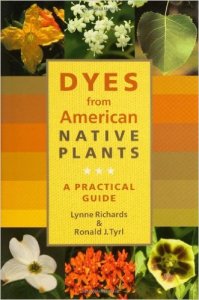
Book review: Dyes from Native American Plants

(I reviewed this on my old blog, but thought it worth repeating here, with a few edits.)

You know what the best thing about this book is? It gives a detailed list of plant materials that give little or no colour!!! That means less wasted time, fabric, heat and gathering 🙂 Though it’s a bit more geocentric than i thought it would be, given the slightly misleading title (covering mostly what grows in south-central US), a lot of the wild plants mentioned are widespread in North America, even up to Alberta. It does miss out on a few plants in the same species, but given again that it is geo-specific, that may be why–one variety in the species grows there, but not others. It’s also decidedly not a “kitchen scrap” book with claims of blue from elecampene, magenta from dandilion roots, green from spinach and lasting effects from turmeric!!!

No vinegar or salt “fixes” either–really, just go, run down to the corner convenience store, buy a bag of potato chips fer jeebly sakes, if you’ve got a hankering for salt and vinegar, and stop mushing on about how they make berries last longer and stops rust from rusting…….

The only true problem with this book, is that it doesn’t give any indication of what is light or wash fast. It does tell you *how* to do that, but there are no notes with plants what is worth the effort, and what is a waste of time, effort and resources. I truly believe too, that testing for these should be an INTEGRAL part of the dyeing process. Maybe then we’d see less of the Beet and Berry Brigade posting their results for the GaGa newbies…………… There’s also no mention of post modifying, an important and often surprising process that brings unexpected colour out.

So what else is in it?

It’s laid out with plant materials grouped by colour results, it has a comprehensive index with the Latin and common name (though the common nomenclature may be regional), there are photos of the plants mentioned. I would also recommend investing in a good geo-centric plant guide, like those published by Lone Pine Publishing, so that you know what you are looking at, and hoping to gather. The author speaks of responsible gathering and safe dye practices and it’s not dumbed down or too technical. My only complaint is the prevalent use of tin as mordant in a lot of the dye baths. Even in 2005 (the date this book was published), we knew this type of mordant was dangerous for the dyer, and best not used in the home. There are no “recipes” per se, for the novice, but the more experienced dyer will already know that as with most plant materials, your plant chunks ratio should be at least of the same weight as your fabrics/threads.

There were a few surprises with some of the flora mentioned. Certain plants abound here, and while i’m not going to get too excited about the possibility of using them, it does give me new hope for local colour. Many of them are also though, while “plentiful”, are in our National Parks–and i am never going to scavenge great quantities, because of that, and because they belong where they belong, period. If i find them in a ditch however and if it’s in my immediate environs, and i know it’s considered invasive or noxious, it’s fair game. I recognized a few varieties i had no idea would give any colour at all, but because of my frequent walks with the DogFaced Girl, i know that locally these are very very small ecosystems, and i would feel incredibly guilty if i denuded the area. I am passionately interested in using what i can find, but not at the expense of the primary reason why i do these walks and that is to appreciate what is there, not what can be taken away! You’ll note i did not mention any of these by name—–i don’t want to be blamed by the Cosmos for encouraging somebody sneaky to go and strip their area!

Of course, the preponderance of colour mentioned is yellows and browns, as few native North American plants have the tinctoria classification 🙂

Posted in Madder, mordants and modifiers, natural dye research, Natural Dyes, tansy, The Summer of Madder (Study)

gimme the ticket, i’m guilty as hell

This morning’s madder mess was easily cleaned up with a bit of a bleachy scrub, something that was still out, as earlier in the week i also had an exploding indigo stock solution on the kitchen counter……… Yes, my kitchen could have been red and blue, naturally 🙂

I quickly scurried the pot out to the patio, and with temps being in the high 20C’s and set on concrete, it stayed hot all day. I hucked some cloth in there, just to see what was left, and am glad i did.

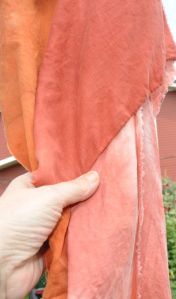
Top, tansy dyed first, then a rusted piece that had been treated with titanium oxalate, an undyed piece, and an indigo over tansy and madder, all previously mordanted with tannin and alum, all cottons:

Below, left to right, the TO/rust, the tansy, the undyed:

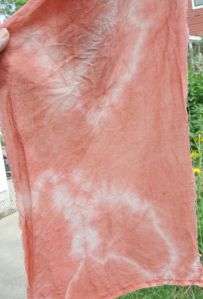
I’d loosely scrunched the undyed–LOVE it.

Waste not, want not!


Posted in "OPINIONATION", Book reviews, natural dye research, Natural Dyes

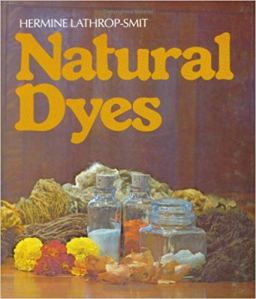
Book review: Natural Dyes (1978)

One doesn’t really need another dye book for the library, but i couldn’t resist, as this one was written by an Albertan, Hermine Lathrop-Smit, and is touted as “specific” to Canada.

Actually, it’s pretty much North American–most of the plants are available throughout a number of climes, and are not particularly geo-centric. It’s a funny little book, given when it was written, and some of the plant materials are specious in one way or another–beets don’t give red (i was QUITE shocked to see that entry, though she does mention that it’s not colourfast….), berries used are rarely light or washfast,  and no mention that lily of the valley and bloodroot are poisonous.

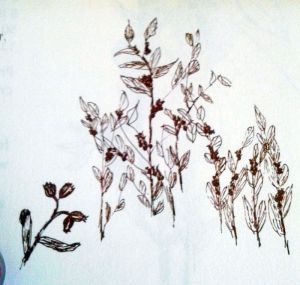
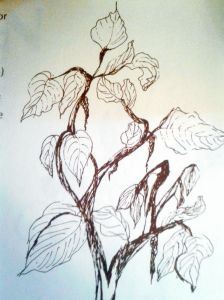
Illustrated with black and white drawings, i would recommend referencing an actual plant guide with colour photographs and full descriptors of leaf, stem, flower and seed, and growth habit (is it a bush, a vine, a flowering plant, field, mountain or water sited? These guides always mention toxicity as well, very important in the wild. Wouldn’t want a bear to eat Poisoned Forager (sub-species, varietal) 🙂 .  I use field guides for Alberta, and the Rocky Mountains, from Lone Pine Publishing which can be found in most garden centres, Walmart (!) and sometimes National Park gift shops. Some entries in these books will mention whether or not the plant has been used “historically” as a dye material, but don’t take that as a rule of thumb, as some of that is based only on hearsay and old wives tales! Lone Pine has a number of geo-specific books, so look for your area. You can also order online, if you can’t find them locally.

These drawings are rather vague, though she does give Latin names. I wouldn’t however have been able to determine WHAT these were from the drawing.

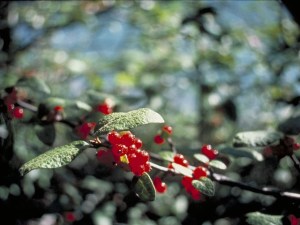
Buffalo berry/Shepherdia canadensis

actual photo:

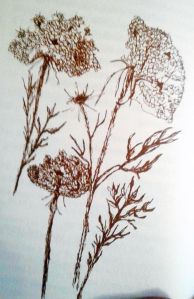
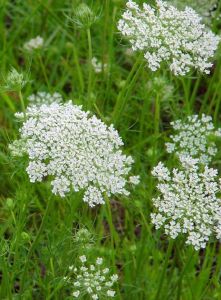
Queen Anne’s Lace:

This plant is particular is dangerous to identify from a drawing only, as there are many similar plants that are HIGHLY toxic. *I* know what QA is but that’s because i grew up with it. (Even it can bother some people, though NOT as much as the others!)

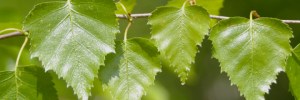
Birch. Seriously? While some know that birch is “peelable” bark wise (DON’T, unless it’s a dead tree or a broken branch!), most don’t know the difference between birch and aspen. And no one is really going to be able to positively identify this:

Heck, you might even think it’s alder. Below, the real thing:

You also need to watch out for common/colloquial/local names–one person’s bluebell is another’s Polemonium. Latin is the same EVERYWHERE.

I realize too, the cost of colour photographs was probably rather spendy as all was film in those days, but don’t depend on these for proper identification! The drawings especially of Queen Anne’s Lace can be very misleading, as there are a number of very similar plants, in the same family and in others, and some are extremely dangerous to human and animal. (I can’t reiterate that enough. Too many associate natural with “safe”– arsenic is natural too….

The use of alum is rather heavy-handed as well: 50gr to 200gr of wool, since most modern recipes recommend 12-20% WOF for “regular” alum (aluminum potassium sulfate ), and 5-8% WOF for aluminum acetate (THE recommended alum for cellulose fibres). Mention is also made of mordants we now try to avoid, like tin, chrome and copper sulphate. Note though, that some dyers with caution, expertise and experience still use these. Rarely do we use Glauber’s salt either–though maybe we should!

This book could also be confusing for the novice! There’s a chapter on mordanting that precedes the actual dye plants, but in many of the recipes, she adds the mordant to the dye bath, or no mordant at all, giving the impression that some don’t need it. Since none of the plants mentioned, except for walnut, are substantive (meaning needing no mordant), this gives the impression that these plants will give colour that stays, and that will be strong from the “get go”. Honestly, i mordant EVERYTHING, even for indigo, madder and walnut, not because they need it, but because having a stash of premordanted fabrics on hand means i can dye with anything, when i feel like it, and have it take the colour. Mordanting doesn’t hurt substantive dyes, so rather than take the chance of accidentally getting something unmordanted and going in a dye material that needs it, i figure it’s best to be prepared.  I do keep bags labelled with each type of mordant however, as mordants react differently to dye materials. Post mordanting *is* possible, but in my experience, the colour is not as strong. Overdyeing of substantive colours is also possible, but then they must be mordanted for the dye type being added over the substantive dye.

There’s a list of suppliers in the back too–when i searched, most of them are of course gone. Funny that one of them was Wide World of Herbs Ltd, in Montreal, the place where my 33 year old madder came from! Also included in a ONE page appendice of dyeing with lichens, very uninformative and vague.

So, in the end, this one stays in my library anyways, as a bit of history, a bit of useful information and a bit of a laugh.


PS DO NOT click on ANY of the “free PDF downloads” if you search for Ms Lathrop-Smit, as they are probably toxic malware sites!!!!!!!!!! I could find NO actual information about her, or any mention by anyone in article, blog, research site or history of the area.

Posted in "OPINIONATION", Ecoprints and Natural Dyes, Home Cookin' the Cloth, natural dye research

going deep, back to ecoprints

I stopped doing ecoprints a few years back. Honestly, it had started to bore me, as i *did* get “predictable” results, knowing what local plants did print, and the effects i could get. Then i was quite frankly, COWED by all the splendid, wonderful experimenting and marvellous, amazing results that others were getting! I couldn’t figure out how people were doing what they were doing, and at the time, it seemed to me that only people with a lot of discretionary cash could afford the goods, dye materials, travelling to classes and workshops, and free time, perhaps a sour grape reflection, but “valid” at the time, for me…

Methods and materials were being closely guarded–and i DO understand the point that teachers make a living from teaching these with their years of experience and skill level, and should be recompensed, so don’t think i’m kvetching because the process was only being taught in paid for classes. (I would KILL, i WOULD kill,  to take a class with premier ecoprint teacher Irit Dulman.) I too have been in that position, as a student, and as a teacher. I never asked anyone who had done the classes to break the chain by giving me for free what the teacher had been paid for, so tried to puzzle it out.

I tried a few things that i thought were the process, but didn’t have a lot of success. It wasn’t that i was stupid, or unwilling to experiment: things just didn’t WORK. But i was “sloppy” in a sense. Now that i’ve learned properly how to prepare fabrics and threads and then dye with natural materials, that knowledge, based on historically accurate, well researched and proven methods, can be applied to ecoprints. (I’m still not a perfect dyer/mad textile scientist, but i’m improving every day 🙂 ) If however, i see ONE more post about vinegar or soymilk as “MORDANT”, i will puke a twice iron dipped catalpa leaf, with a nice frothy TO chaser…………….

Recently i joined a group that is big on sharing method, without spilling teacher secrets, or fighting about who “owns” the process, something that was nastily prevalent in the beginning. (I’ve never seen such an insidiously/assiduously “policed”–sometimes quite maliciously– practice before, as ecoprinting, contact printing, leaf printing, whatever term makes your boat float without “offending” anyone…) The people in this group share generously, indeed that is the POINT of the group, to SHARE the knowledge, the experimenting, processes, thoughts, ethics etc. Oh sure, there are still divisors between the purists, and the “anything that works” camps, but it’s reasonably civil, as the admins do a fantastic job. (It also helps that you can turn off commenting as an admin, or on your own posts 🙂 ) (I tend to do that when people go waaay off topic, or give me the same answer over and over, or just didn’t read the actual post and are tossing in two cents that makes no sense…)

I have a few ideas i explored before and want to return to them with the ecoprinting. They were successes at the time, and nope, i didn’t share the process at the time, and won’t now either 🙂 because as a talented friend once said when i asked something specific about her work : “Every dyer has her secrets”. THAT is valid too.

I have bags of premordanted fabrics ready, from the basic tannin/alum, to rhubarb leaf, titanium oxalate, iron, soda ash, alum alone, combinations thereof of whatever, all suited to the type of fibre (cellulose vs protein) and on the stove is a batch of pomegranate readying for use.  I’m still doing the Summer of Madder (Study) and its adjunct project, but the ecoprinting will be incorporated into that as well.

And since DogFaced Girl and i have got so lazy and so fat over the last year, it’s a perfect time for walks to gather materials, relish the summer, and enjoy the short Calgary summer as best we can. Exercise, fresh air, science and joy at their finest!

And here’s a funny little one, tossed into the current almost exhausted madder pot:

Iron turned the colours pink and purple!


Posted in avocado, natural dye research, Natural Dyes

pity, ’cause it’s pretty, but pits are the pits

Nope, ain’t gonna bother anymore. I suspect you do have to use the Hass avocados, reputedly the best for natural dyeing, but at 2-4 bucks each, that’s much more expensive than my grocery/natural dye budget allows for! WOF is 2:1, so that’s a LOT of pits that have to be saved…   I buy bags of the smaller whateverthevariety is for 3 bucks on sale, usually getting 4-6, because i do like eating them, but all this effort is a waste of time for me. I envy the deep pinks and russet corals others get, but nope, nope, nope.

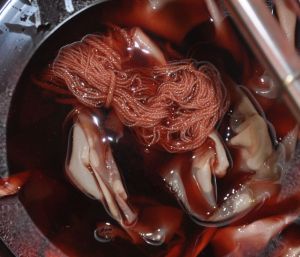
See how beautiful it looks in the pot?

All the fibres were correctly premordanted according to type (cellulose and protein). They were done according to Carol Lee’s clear instructions from“Dyeing with Avocados, Food for my Dyepot”, Fall 2002 Spin-Off Magazine, but they are not Hass avocados, so blah blah blah.

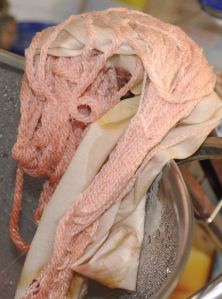
The minute they were lifted to check on uptake, the colour started draining out:

Pathetic, even the silk. EDIT 15 minutes after posting: the cotton is definitely pink, deeper than the wool, and the silk has turned a hideous yellowy piss green……. The cotton has NO uptake (Carol does mention not such good results on cellulose, though Rebecca Desnos seems to make it work, possible because of the hideous soy milk “premordanting… which soy is not …. whatever………… not going there again to explain or to show the results *i* got when i subjected fabrics to it……)

Squeezed:I know what’s going to  happen when they are rinsed and dried: minimal nugatory insipid weak vapid ghost of an insignificant feeble pale negligibly pink colour. Nope.

To all the other intrepid dyers out there, good luck. Your dye bath will look F*&^ing FABulous, but unless it’s a Hass, it’s too much of a HASSle!


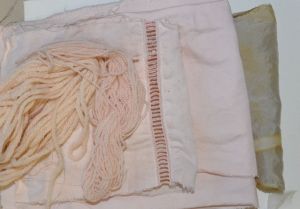
Edit June 20/18: how pink it isn’t……….

EDIT APRIL 30/19: subsequent discussions in a natural textile dye group, and my own lightfast tests, have concluded that avocado’s lovely pinks will gradually oxidize to browns, because they are more a tannin, than a dye.