Posted in avocado, mordants and modifiers, natural dye research, Natural Dyes

addendum to avocado “failure”

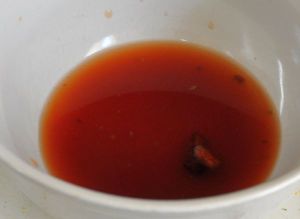
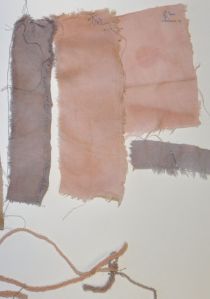
Since these are from a second extraction of the avocado peels, i didn’t expect much, but thought i’d give it a shot anyways. Well, lo and behold, a shorter time in the pot (because after the first batch/reveal i thought “Cut yer losses, Girlie” and pulled them out after 5 hours….) and more colour. Still not terribly exciting and admittedly they were dyed (badly) in the first extraction, so essentially now over dyed, but but but. I think the ammonia worked its magic in the second extraction, while the soda ash from/in the first didn’t. I just about cried though when i poured the bath down the drain, as it looked a rich blood red………..
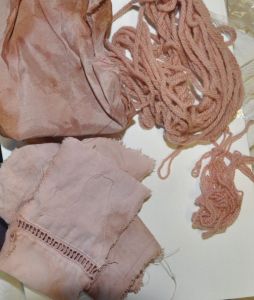
What i don’t understand is that the cottons had better uptake than the silks, as usually it’s stunningly opposite. The rhubarb leaf mordant did a better job than the usual tannin/alum also.

I still intend on collecting both peels and pits as they are consumed on a regular basis here, but the next experiment with the still soaking pits is perhaps going to prove that conceivably both should be used, as a WOF enhancement (2:1) and for the colour. And when i do it PROPERLY with correct WOF, i ain’t pouring out anything until it’s as exhausted as the DogFaced Girl and i after a loooonnng walk πŸ™‚ The pits will continue soaking for another week or two, unless they start getting jiggy with bacteria.

(Interestingly enough–or stupidly—-my fingers were stained by the avocado bath, as i didn’t put my gloves on to pull things out.)

I did do some post mordanting/modifying with the previous samples though, as that adds to the “library”, at least as research, if not usable samples. No striking differences, except for the iron! These will now be tested for lightfastness, though they may not be entirely indicative because of the low uptake.
Soooooooooooo, i’m just being done with this batch and turning it purple πŸ™‚

Time to return to the Summer Madder Project!

EDIT APRIL 30/19: subsequent discussions in a natural textile dye group, and my own lightfast tests, have concluded that avocado’s lovely pinks will gradually oxidize to browns, because they are more a tannin, than a dye.
Posted in avocado, journal: lessons to learn, mordants and modifiers, natural dye research, Natural Dyes

deception/disappointment/disavowal in the avocado pot

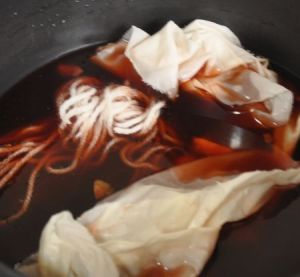
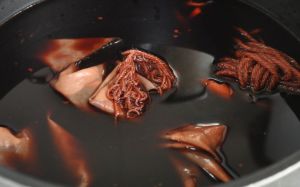
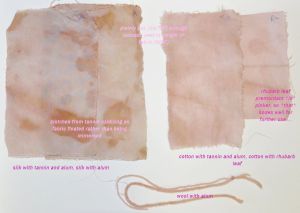
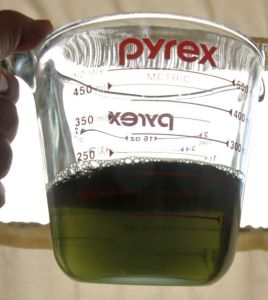
Though i was intending to leave much of the test fabrics and threads in the dyepot longer, i couldn’t resist cutting a few pieces from them, and pulling them out. You’d think with the appearance of that pot above, that the colours would be a HELL of a lot deeper. I could have totally conveniently “forgotten” to post all this, lessening the chance of public embarrassment, but hey, it doesn’t work all the time, and usually because we don’t follow the instructions, so live, learn, laugh and take the lumps πŸ™‚

CRAP, these are undeniably CRAP. Definitely not enough plant material in comparison to the fabics (WOF in other words)!Β  Admittedly, i had maybe a scant 50 grams of the peels………. I’ve been told the best ratio here is 2:1, so i was waaaaaaaaaay off base with that, duh duh duh. Strangely, the cottons seem to have better uptake than the silk and the wool this time.Β  The blotches are because they floated up during the night, and were exposed to air, the tannin then oxidizing. I think too, my pot is a bit too alkaline though, and that’s why i have browner tones. HOWEVER, there IS colour uptake, but undoubtedly, irrevocably, clearly, not enough peels.

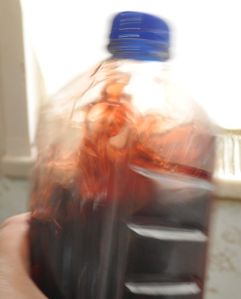
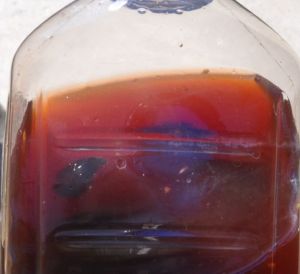
The remaining stewing peels had a glug of ammonia added yesterday, and holy crap, there’s more colour left! I shook the bottle to show the colour splash πŸ™‚

I’m assuming these then are Hass avocados, reputedly the best for colouring. So, i’ll combine the two extractions, and the first dyed pieces, trusting that the strange chemical mix will give me something πŸ™‚Β  (If i don’t blow up the house.) I’m calling this experiment not quite a failure, but a learning experience: DON’T CHEAP OUT ON THE DYE MATERIALS. If it’s worth doing, do it right, otherwise all i can chalk this up to is a waste of water, time and effort.

The pits that are soaking are more weightwise, but need to stew longer.

Note: buy more avocados for lunch.

EDIT APRIL 30/19: subsequent discussions in a natural textile dye group, and my own lightfast tests, have concluded that avocado’s lovely pinks will gradually oxidize to browns, because they are more a tannin, than a dye.


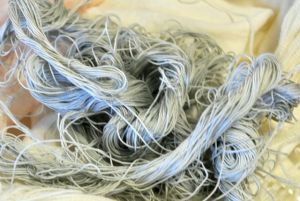
As a side note about the importance of scouring, i thought i had done enough on a new thread, but when i put them in tannin, this happened:

GREEN?????? I contacted Maiwa, my trusted supplier, and asked if perhaps it had been the soda ash in the initial scouring that had reacted (maybe not rinsed enough), as gallnut is a clear tannin, and stays to the “browner” tones after being used and stored. Nope.

Hi Arlee,

This is rare but it does happen, but it is not from the soda ash. Fabrics are often pretreated and contain substances which can leach out or react with the mordant. When used on it’s own Maiwa’s gallnut extract is usually a clear/colourless tannin. I would suggest trying other cotton fibres from different sources and comparing the results.

Best,
Danielle

So, obviously, i did NOT scour as well as i should have, and am thinking this could also be the problem with some fabrics i’ve had problems with, particularly new ones (not second hand, recycled, etc). I don’t generally use new fabrics, but maybe some of the stuff i’ve purchased second hand were new enough that these chemicals were still in them. Something to think about! I had noticed there was more “colour”/precipitate in the wash pot after, but thought all had been removed from the threads. I’ll be doing all the scouring from now on with fabrics/threads that appear in better condition then (ie “newer”) for 2-4 hours, as per J. Liles recommendation. (I scour PFD fabrics as well, as i don’t trust that everything has been removed!)

The green didn’t rinse out of the threads either!


EDIT: i decided NOT to mix the two extractions of the avocado peels. I’ve dumped the first “batch”, rinsed the fabric and threads, and put together in cleaned pot with the second extraction.


Posted in avocado, natural dye research, Natural Dyes

more avocado science

AHA! There is tannin (catchetin, a non water soluble tannin) in the pits: “The seeds could also be used as a source of natural dye. Colour of the extract is supposedly connected to the procyanidins, the oligomeric compounds, formed from catechin and epicatechin molecules . Currently no reported research was performed in dyeing of textiles with avocado seed extract.” Tannins help alum bond tighter/better/stronger/Superman to cellulose fibres. But there are also anthocyanins, which are notoriously UNlightfast )—-remember those damn beets and hibiscus???).

There’s still no definitive evidence though that this tannin is strong enough on its own, though apparently it is used in South America as a tannin. I’ll do my usual prepping then on cellulose using a tannin (gallnut, which imparts little colour) and alum after, just to be sure that things “stick” πŸ™‚

I decided to use the peels first (no tannin as far as i know), as the “extraction” is now turning a wee bit murky, signifying that other life forms could be spontaneously generating in there! There does appear to be a lot of dye colourant, though who knows how much of it is actually viable?

I threw in some wool yarn with alum, cotton with tannin and alum, cotton with rhubarb leaf, silk with alum, and silk with tannin and alum. ( I am aware that silk requires only alum, but adding the tannin may give different colours/shades, depending on the dyestuff.) I gently raised the temperature until it BARELY started to steam, then turned it off. NO boiling as it forces the browns. It will be left in the pot for a number of days, gently reheating once a day to reduce the possibility of mold and other potential ickies.

One thing i didn’t think about initially when i “potted” it in the narrow necked recycled juice bottle: everything swelled, and because i didn’t break into teeny pieces, they are a pain in the bazotski to get out! So, what the hell, filled it up again, threw in a glug of ammonia, and we’ll see if there’s more colour to come.

The pits are still stewing, with no sign of alien activity, so will leave that for a later time.

I’ll leave these in the bath for a couple of days, and see how much it deepens, then the lightfast tests commence. One good thing about summer in Calgary is the intensity of our sun in the summer due to our higher altitude, so tests will be easy–and relatively speedy!

EDIT APRIL 30/19: subsequent discussions in a natural textile dye group, and my own lightfast tests, have concluded that avocado’s lovely pinks will gradually oxidize to browns, because they are more a tannin, than a dye.
 

Posted in avocado, natural dye research, Natural Dyes

oh, do i want to use the translation of avocados as this post’s title :)

I’ve been trying to find research papers on the use of avocado as a textile dye, and have found little, though i have found a bit. The first link is a badly translated hoot, especially “The word avocado comes from nahuatl ahuacatl, which also siginifica testicles” or probably properly translated as “means testicles”. (Not sure how accurate that is either, as it may have been a joke on the Spanish invaders…)Β  Second linkΒ  is more “scholarly” though only a photo of the seeds is shown, no actual information on their use, and no actual listing, Latin or otherwise in the tables of plants used. Obviously this is a MesoAmerican dye, as avocados are only found in the “New World”. ( Central and South America).Β  (Somewhere down the rabbithole, i found a brief mention of deep purple blacks also, but i’ll be damned if i can find that again……although i did notice deeper purple splotches on one failed attempt, so who knows. Of course, i can’t find *that* either, but at the time it was the pits only that i had used.) I do wonder too about the popularity of avocado dye having such a bandwagon–who “re-discovered” it, had a “happy accident”, did any research?

The pits are reportedly high in tannins–though i’m not sure how to qualify that. I suspect too that the skins are going to be less permanent, but i could be wrong, as i haven’t any scientific information to back any of this up. The only other research paper i could find mentioned an orange colour from the pit, but no mention as a textile dye, just as a food additive. I’m therefore going to keep the pits and peels separate in dye baths also, when it comes time to use the extractions. I’m allowed to have avocados in my diet luckily (in moderation) , after recent heart issues, diet being one item of speculation, so still plan on saving more bits!

I fortunately have stumbled into a Chilean dyer on a FB group, and she offered to share any historically accurate info she finds in her own search for these geo-centric dyes.

Meantime, the brews deepen in colour, while i work on other parts of the Summer Madder Project!


EDIT APRIL 30/19: subsequent discussions in a natural textile dye group, and my own lightfast tests, have concluded that avocado’s lovely pinks will gradually oxidize to browns, because they are more a tannin, than a dye.
Posted in avocado, natural dye research, Natural Dyes

avocado bandwagon

I’m willing to try some dyes that are not in the classic dye histories, at least not in “western” use, but i never assume they are going to work, or last. Avocado peels and pits are the newest trend/fashion it seems, and i admire some of the gorgeous pinks people are getting. I’m not normally a fan of pink, but it *is* in the red family, so why not a little experiment?

I’ve tried avocados before, and the first time, i got NADA, the second time, an insipid languishing Victorian heroine pink. I did the time-tested huck-it-in-a-pot-and-simmer method, and used premordanted fabrics, but. Didn’t bode well for further experimentation!

I decided to really search online for information but take very little on faith, particularly from some sites i’ve visited. When most of them are written by blackbean/turmeric/beetjuice/raspberry aficionados, there’s a large grain of salt attached to the “results”. There is however, Rebecca Desnos, a person who has done research and much experimentation and has had marvellous results. The only problem i personally have is that she only “mordants” with soy milk. (Soy milk is NOT a mordant, it is a binder…. and yes, i know it is a valid method of treating fabrics, as the Japanese have done for millennia for indigo usage, but still not a mordant as indigo does not require one, being substantive.) I will never use soy milk again, as the results i had with it were ABYSMAL, stripping colour from logwood and even wreaking havoc on potassium permanganate (an inorganic compound), though i have friends who swear by it. Also, she never shows or talks about lightfastness!

Further research on my part has found that an alkaline soaking first will result in more colour being pulled from the plant materials, though i have also read that the colour is an anthocyanin, notoriously short on lightfastness. I’m not sure how long to leave it though in the solution, as it seems some are doing a couple of days, and others, several months.

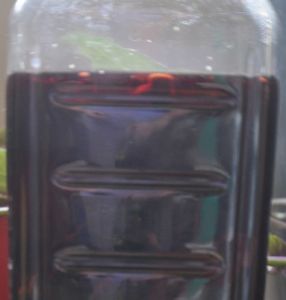
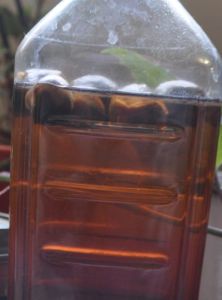
I separated the skins from the pits, and these are the results after 2 days:

Above, peels, below, pits.

I didn’t chop the pits, so obviously it will take longer to extract any colour. The peels practically exploded after an hour, however. I’ll leave them until i think they are ready (how scientific is that? πŸ™‚ ) , or until it looks like they might just be about to go funky.

And when i do use them, they will be on the correct cellulose/protein appropriately premordanted fibres, and lightfast tests will be conducted.

EDIT APRIL 30/19: subsequent discussions in a natural textile dye group, and my own lightfast tests, have concluded that avocado’s lovely pinks will gradually oxidize to browns, because they are more a tannin, than a dye.
Posted in "OPINIONATION", Book reviews, Natural Dyes

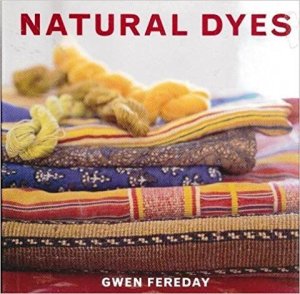
Book Review: Natural Dyes by Gwen Fereday

Note to self: this is the last natural dye book that will be bought for the Stately Barr Manor Studio!

On the advice of someone on the FB Natural Textile Dyeing group (someone i trust πŸ™‚ ),Β  i ordered a copy of Gwen Fereday’s “Natural Dyes”.

It’s available through used book sellers, but i bypassed Amazon as it was rather expensive ($55-158!!!!!) , just in case it was garbage. I bought mine from Abe books, from theΒ  seller Broad Street Book Centre (an actual bricks and mortar store in NJ Hereford, an actual real live book store!!!),Β  and was happy to pay slightly less than 30US including the shipping from the US. EDIT: This seller is in the UK! And them sending on the 18th of December, to arrive here on the 27th was impressive also.

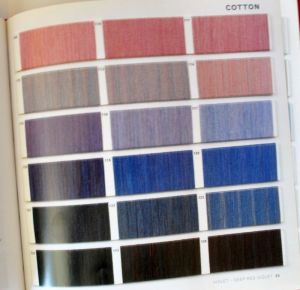
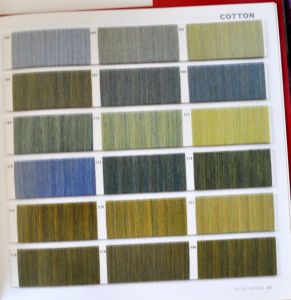
And it IS worth the money. Very clear, as the author is also a well respected teacher at the Surrey Institute of Art and Design at University College in the UK, it explains everything from proper pre-treatment of fabrics, both protein and cellulose, to specific dye types, and through to the most wonderful colour plates with “recipes” for achieving the colours. Best of all, as much information is presented for the cellulose as for proteins–while i like wool, and am happy with my results, i prefer to work with cellulose, specifically cotton, and let’s face it, most natural dye books barely give a passing mention to anything but wool!

For the longest time, my cotton results were frankly, lousy, because there was little clear information. I did hunt around and eventually found the tannin/alum method for cellulose (Turkey Red Journal), and that made a world of difference. I still felt there had to be more out there–let’s face it, the average dyer of yore would have been working with linen, cotton or local indigenous fibres, not silk, and possibly not even wool, depending on the geographics.

Even more specifically, and exciting, is that decent mention is made of Turkey Red Oil, a type of sulphated Castor oil, often used historically to deepen reds from madder, hence the “Turkey Red” (not the bird, the locale!) I found a near by supplier–REALLY near by, as in 20 blocks away!!!! It can be used with other colours/dye materials, so i want to play with it, and buying a SMALL bottle of it will mean that effort/expense/extra steps are not wasted or being committed to.

But i digress πŸ™‚ The only point i don’t like about the book is the extremely heavy WOF of cochineal used: 60%!!!!!! as opposed to the usual 3-10%WOF!!!!!!!!!!! (EDIT: JAN 10/17 Actually a lot of her recipes are really heavy WOF’s (500% madder????)—i’d say overkill in some respects, as fibres can still only uptake so much before it’s wasted effort, materials and EXPENSE. And if it crocks after, well, big problems.) And yes, a lot of the info contained is also in other respected books in my library, but the extras i needed are what’s made it worth adding to the shelf. If i *didn’t have any of the others, it would be a fantastic start to the library too. And best of all, no wasted pages on “projects”: really, i’ve said it before, if you didn’t know you could actually MAKE things out of what you dyed, WTF are you doing it for then?

Anyhoo. The next step is to figure some time management so i am not obsessing about one thing, as i am wont to do :), but dividing my efforts between this, and some serious stiching again, so that both are “sustainable”, i.e. they get DONE, not just blethered about.