Posted in FybreSpace the shop, Indigo Dreams, journal: lessons to learn, Natural Dyes

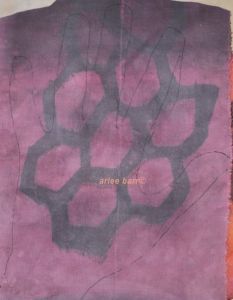
“shopfull” indigo revival

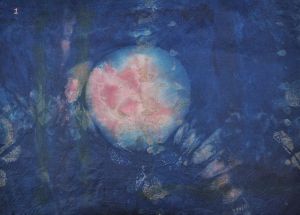
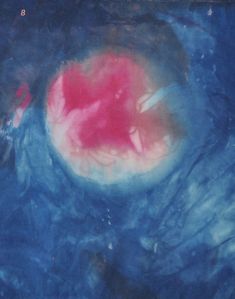
I had to make a new indigo vat, as the old one while having been successfully revived last year (after going through 3 frozen outside Calgary winters!), is now defunct, kaput, gone to the Great Blue in the Sky Vat. The 123 vat, well, we just won’t go there again…….i took the lid off and i’m sure the neighbours three doors down heard my horrified gasp. It’s definitely a note to throw out when it’s GREY, molded and has a suspicious pancake of solid yellow schmutz in the bottom that won’t break up……

As i was going through drawers and boxes, looking not only for dyes and chemicals, but fabrics as well, i realized too that it’s almost an anniversary, 8 years of natural dye, sometime around the beginning of August, and wow have i come a long way! In the beginning, i played and got lovely colours that didn’t last (no mordants!), used things that didn’t really qualify as a dye (lilac flowers, anyone?), but i learned from this what would give colour, a bit about post modifying, and got quite excited about indulging a childhood passion for “potions” and finally that actual RESEARCH means you can do it right, right from the start. I really knew nothing about natural dyeing, in respect to process, though i did know the basic history. Along the way, i also learned to ecoprint/contact print/botanical print, whatever you want to call it 🙂

Subsequently, in the shop are some wonderful combinations of natural dye, ecoprint and indigo. The prices are low, considering the processes, and the size, so please, do indulge yourself:) As always, any extra postage you paid will be refunded!


Posted in a collusion of ideas, Ecoprints and Natural Dyes, embrilting, in progress, Redux projects, The Summer of Madder (Study)

mining the past again

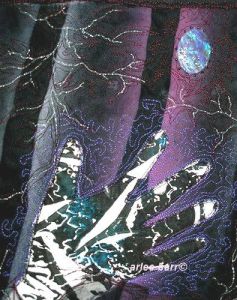
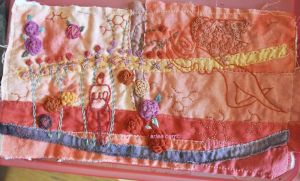
That’s a page from a 2007 “fabric art journal”, a time for me of experimenting and heavy machine embroidery. “Kirlian Hand” is a portrayal of the so-called phenomena of a person’s “aura”. Named after Semyon Kirlian’s accidentally discovered observation in 1939, that if an object on a photographic plate is connected to a high-voltage source, an image is produced on the photographic plate—- and touted in the 70’s as captures of the human spirit! (My ex was heavily into this, Hollow Earth theory, pyramid power, Chariots of the Gods alien conspiracy, and the whole “new age” crapola of the time….used to drive me nuts…but then *he* was/is.)

Anyhoo, i did like the design possibilities of this, so wth. The hand was cut from screen printed fabric, all of the embroidery is by free motion and the abalone shell piece was attached with glue and beads (i think..the page is somewhere in a box with other relics of the time, in a little room at the back of the house so stuffed i can’t get into it. Note to self: do something about that this weekend, there’s some Good Stuff in there too…)

It’s interesting to look at old work and not only remember how and why it was done, but to go forward with it as well, in a new direction. Yeah, some of the results from the way back machine are either embarrassing or weak, but some of it is still valid, good, intriguing, and touches a chord. Let’s roll with it!

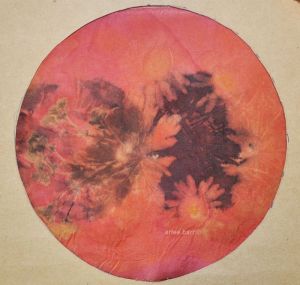
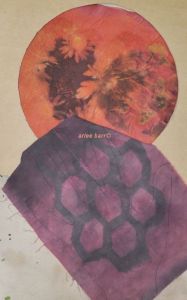
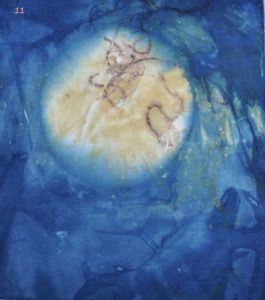
As i mentioned in a previous post, i’m working on improving my ecoprinting skills, and while my little tests are very quite promising, i’m not completely satisfied yet, BUT, i can still use some of the bits in the Summer of Madder Study project 🙂 I’m going to “condense” the above layout a bit, due to the size of the moon i want to use, because the original layout would make too big a section to work on comfortably, considering the scale.

I’ll have to be tender with the moon too: a silk, i always have problems with stitching on this fabric, by hand or machine, as the threads of the fabric tend to “pull” when the needle goes through. I’ve tried finer threads, and smaller eye bulbed needles, but haven’t solved the mystery yet, so minimal stitching on the moon. Given though that the details are so fine and so delicious, less is more anyways: not everything has to be encrusted!

And the potential layout–just pretend/imagine the fingers are separate so the moon shines through 🙂

It’s now time then to set up the outside stitching corner!


Posted in in progress, Madder, Natural Dyes, The Summer of Madder (Study)

while the water’s away, arlee will stitch play….

Some idiot at the major BRT construction site last night hit the water main feeder that supplies our two blocks. We’ve had no water since 7PM last evening, and nothing was done until about 10 this morning, because of course first priority was a fight between the city and the construction company about who was responsible for fixing it. ASSHATS. An emergency water services thingie showed up sometime in the night, and we have to lug big bottles in to flush, wash and water the animals. No word either as to when it will actually be DONE. Better i suppose than having to lug a bucket down to the river——which is impossible at the moment anyways, as the riverbank is unreachable now due to the construction of a new bus bridge and remediation of the banks after the 2013 flood………………..probably a good thing also because i have a hard time keeping a DogFaced Girl on a leash out of the river and balancing a bucket on my head at the same time. Things slosh.

SIGH. So, dyeing requires water. Ain’t got none. Pause in the dyeing escapades then, perhaps a good thing, as i am capable of other things in the studio.

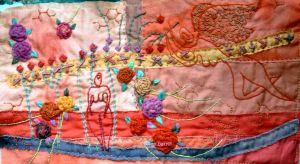
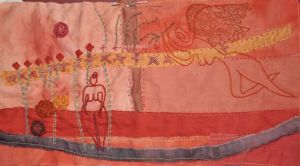
I pulled out the threads again, and have almost finished the first section of the garment for the Summer of Madder (Study) project.

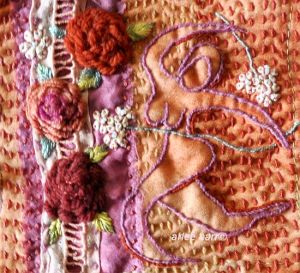
I have a few leaves left to do, a bit on the yellow strip, and have decided that the big floaty roses that worked as big floaty roses on the pocket, need to be “grounded” on this section.

I love these little figures!

Posted in "OPINIONATION", Ecoprints and Natural Dyes, Home Cookin' the Cloth, natural dye research

going deep, back to ecoprints

I stopped doing ecoprints a few years back. Honestly, it had started to bore me, as i *did* get “predictable” results, knowing what local plants did print, and the effects i could get. Then i was quite frankly, COWED by all the splendid, wonderful experimenting and marvellous, amazing results that others were getting! I couldn’t figure out how people were doing what they were doing, and at the time, it seemed to me that only people with a lot of discretionary cash could afford the goods, dye materials, travelling to classes and workshops, and free time, perhaps a sour grape reflection, but “valid” at the time, for me…

Methods and materials were being closely guarded–and i DO understand the point that teachers make a living from teaching these with their years of experience and skill level, and should be recompensed, so don’t think i’m kvetching because the process was only being taught in paid for classes. (I would KILL, i WOULD kill,  to take a class with premier ecoprint teacher Irit Dulman.) I too have been in that position, as a student, and as a teacher. I never asked anyone who had done the classes to break the chain by giving me for free what the teacher had been paid for, so tried to puzzle it out.

I tried a few things that i thought were the process, but didn’t have a lot of success. It wasn’t that i was stupid, or unwilling to experiment: things just didn’t WORK. But i was “sloppy” in a sense. Now that i’ve learned properly how to prepare fabrics and threads and then dye with natural materials, that knowledge, based on historically accurate, well researched and proven methods, can be applied to ecoprints. (I’m still not a perfect dyer/mad textile scientist, but i’m improving every day 🙂 ) If however, i see ONE more post about vinegar or soymilk as “MORDANT”, i will puke a twice iron dipped catalpa leaf, with a nice frothy TO chaser…………….

Recently i joined a group that is big on sharing method, without spilling teacher secrets, or fighting about who “owns” the process, something that was nastily prevalent in the beginning. (I’ve never seen such an insidiously/assiduously “policed”–sometimes quite maliciously– practice before, as ecoprinting, contact printing, leaf printing, whatever term makes your boat float without “offending” anyone…) The people in this group share generously, indeed that is the POINT of the group, to SHARE the knowledge, the experimenting, processes, thoughts, ethics etc. Oh sure, there are still divisors between the purists, and the “anything that works” camps, but it’s reasonably civil, as the admins do a fantastic job. (It also helps that you can turn off commenting as an admin, or on your own posts 🙂 ) (I tend to do that when people go waaay off topic, or give me the same answer over and over, or just didn’t read the actual post and are tossing in two cents that makes no sense…)

I have a few ideas i explored before and want to return to them with the ecoprinting. They were successes at the time, and nope, i didn’t share the process at the time, and won’t now either 🙂 because as a talented friend once said when i asked something specific about her work : “Every dyer has her secrets”. THAT is valid too.

I have bags of premordanted fabrics ready, from the basic tannin/alum, to rhubarb leaf, titanium oxalate, iron, soda ash, alum alone, combinations thereof of whatever, all suited to the type of fibre (cellulose vs protein) and on the stove is a batch of pomegranate readying for use.  I’m still doing the Summer of Madder (Study) and its adjunct project, but the ecoprinting will be incorporated into that as well.

And since DogFaced Girl and i have got so lazy and so fat over the last year, it’s a perfect time for walks to gather materials, relish the summer, and enjoy the short Calgary summer as best we can. Exercise, fresh air, science and joy at their finest!

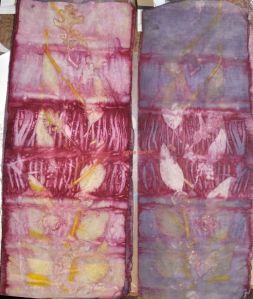
And here’s a funny little one, tossed into the current almost exhausted madder pot:

Iron turned the colours pink and purple!


Posted in mordants and modifiers, Natural Dyes, pomegranate (as dye and as mordant)

dyeing with poms

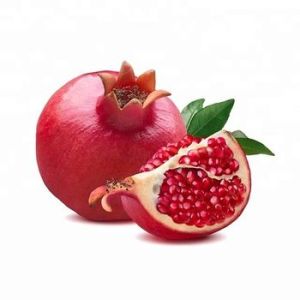
I’ve wanted to try pomegranate for a long time, as it’s both mordant and dye material. I had been saving the peels given to me, until i figured i had enough to make it worthwhile. This isn’t an experiment by the way: it works, and is historically used in India as both a tannin rich mordant, and a greenish-yellow dye. Note: it is the peels that give colour, *not* the arils (the part you eat), not the juice either, just the peels/skin.

I don’t eat pomegranates, as they are expensive, and to my mind a waste of time as an edible 🙂 You can buy an extract from Maiwa, if you don’t have someone saving the skins for you, and can’t be bothered picking out all those seeds for consumption. The price is a bit spendy, BUT at the same time, the WOF because it’s an extract, not just powdered peels, is low, so a little jar goes a long way.

Since the season here for pomegranates in the grocery stores is Autumn, i simply picked off the labels, put in an OPEN plastic bag and set them near a heat vent to dry out, and saved them as i got them, over the month and a half they are available. No mold or ick resulted, just crunchy red bits, that i then stomped to break up more. The weight came to 625 grams, so i just filled my biggest pot with filtered water (not sure what our hard tap water would do), threw the skins in, brought it to a low just starting to boil temp, then immediately turned it off, and let it sit overnight. I threw in 2 skeins of cotton threads on a whim, leaving them overnight also.
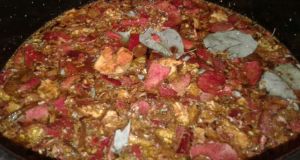
Yup, a few errant eucalyptus leaves, nothing to worry about.
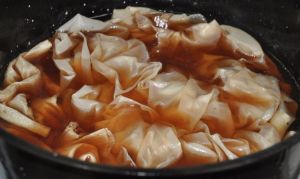
Good colour as soon as the heat hit.

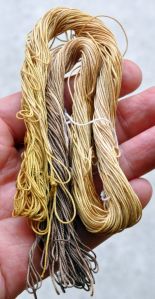
The threads seem a *wee* but stiff, maybe due to the high tannin level, but i can live with that, especially as the cotton embroidery floss is an almost metallic gold! (SO hard to photograph!)  (OOPS, just remembered both threads had been previously tannined in gallnut, but never made it to alum.) I post modified the left cotton thread.
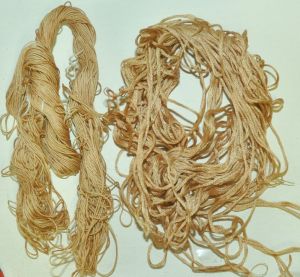
 

Below on the left skein, colour changes are left copper, middle iron and right ammonia. Biggest surprise was the iron, as i assumed i would get green!
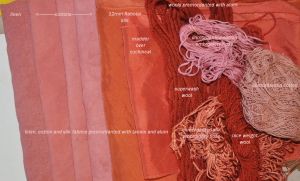
In the morning, i strained out as much of the skins as i could, because leaving them in can result in spotting fabrics, due to contact. The pot is a huge canner, so i tossed in 3 kinds of unmordanted silk (habotai, dupioni and a light charmeuse), several unmordanted cottons, one cotton with a previous tannin/alum mordant  pale madder dyed and one premordanted with tannin/alum no dye, and 2 skeins of wool (a superwash and a lace weight both premordanted with alum), total weight about the same as the peels. Technically, i should have had 2 pots, one for cellulose, one for proteins, as uptake is different, but since i’m more concerned with it as a mordant than a colour, i’m not too fussed about this. The previously mordanted and dyed cotton almost immediately changed colour, a warm goldy yellow. The beauty too of pomegranate is that it’s not fussy with temperature regulation and doesn’t take more than an hour after it’s being used, to get results.

DogFaced Girl and i went for our morning walk, so the whole stew was left a little longer than an hour, probably closer to two and a half 🙂
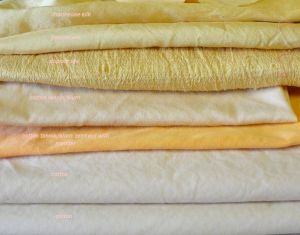
Above, hard to photograph, the cottons are closer to a creamy yellow, with a noticeable difference between the previously unmordanted and the tannin/alum premodanted. The silks are almost metallic as well!
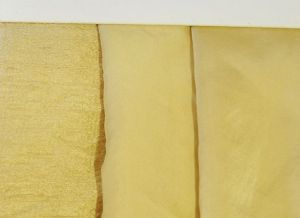
The two skeins of wool are a pale cream, no surprise or big surprise, can’t decide 🙂

I’ll keep sections of the silks and the two darker cottons as they are right now, and play with their other bits in different dyes (and ecoprints) now. The cottons showing little colour will be used for other dyes/ecoprints and more tests.

And i’m pretty sure, i can add the saved used peels back to the pot and get more colour,  after i’ve exhausted this “extraction”. I don’t know either if the use of hard water would have greened the dye more, but i suspect it would have, as we have iron and minerals, especially calcium, in our tap water. Adding an alkali or an acid would change that as well, but doing a few little tests first in smaller decantings.

If the results with dyes and second extractions are deemed worthy, i may buy some of the extract from Maiwa in the future!
Posted in cochineal, Natural Dyes, The Summer of Madder (Study)

FIRE IN THE STUDIO!!!!!!!!!!

Well, hell, i mean *i’m* on fire, at least in the dye department 🙂

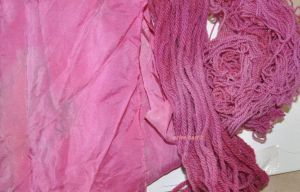
Cochineal on silk, and on wool threads:

OOPSIE, i’m not sure why there are areas of gradation in those, as they were all mordanted properly and dyed by swishing around regularly, but it does make the colours more interesting to use.  (I think though that the greyed areas in the silk are oxidization that occurred during the night, when the fabric probably bubbled up.) And i realized with the cotton results–that i won’t show :)–that most of my cellulose results, barring threads, have been rather weak, so need to play a bit with that still. Strange, since cochineal LOVES cotton, as witnessed by Central and South American dyeing……


I’ve been doing a lot of exploration with madder this summer, my “study” for the year. This week, i (accidentally!) discovered softer pink toned fabrics and threads by using soft (filtered) water, instead of our regular hard tap water I had still dropped in the ol’ Tum’s tablet, recommended to add that “hardness” of calcium (carbonate) to the bath, but for whatever reason, i used the filtered water this time………… (Too much on my mind lately…)

I’m making green threads today, not something i ever dyed a lot of, deliberately or accidentally. The current project demands them, for leaves and vines. Time to fire up the osage, privet berries and logwood.

And maybe (gasp), the indigo that has been hiding in the Dye Dungeon for 2 years at least…

Posted in a collusion of ideas, embrilting, in progress, Natural Dyes, The Summer of Madder (Study)

wings

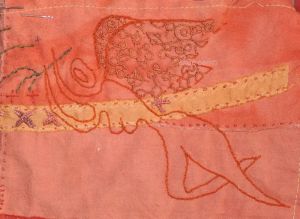
Admittedly, i overthought this section, but i’m happy anyways with the results (still in progress). The idea/execution however is getting a bit *too* “figurative”! It’s time to think of texture and effect as well as the “embrilting”.

As soon as i finished the wing on the upper right figure, i flashed back to 2014, when i was working on “The Weight She Carries”. At the time, though i wanted redder madders than i was getting, i used synthetic dyes (Procion/Rit/Dylon, whatever was in the drawer) to get a range of reds. (The coral/peach “puffs” in the photo are the madder results i was getting at that time.) The feathers on this wing are a textural smorgasbord, and perhaps i can draw from these, literally, in shape, and figuratively, in feel.

I could see wings on the back of this garment,  but that might be a bit much! I can’t/don’t want to make them smaller to fit in a section either, as they would be too fiddly to work, and would lose the point and effect. Perhaps a few scattered?

Posted in Ecoprints and Natural Dyes, lac, logwood, Madder, Natural Dyes, osage

taken to task….

From the PM i got, someone (some many?) thinks my bad avocado results are because i don’t know what i’m doing………

I beg to differ. Cotton is one of the hardest fibres to get good results on, with natural dyes. I follow Maiwa’s insightful, clear, well researched methods, from scouring to mordanting to dye procedures for each dye. (Don’t lump all together, as each one usually requires a different set of parameters!) My results before this were lousy, but these instructions became my “go to”. (My other trusted source is anything by Jenny Dean.)

You’ve seen these before, but for the person/s who have taken me to task, eat your words please.

My ecoprints on cotton are rather spectacular too, if i do say so myself.

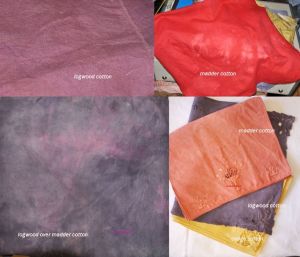
Lac and logwood on cotton, with eucalyptus leaves, oak leaves and osage strips.

So, let’s see *your* results then, Miss/’s.