Posted in Ecoprints and Natural Dyes, gallium, garden dye plants, Garden Hard, mordants and modifiers, Natural Dyes

Galium results

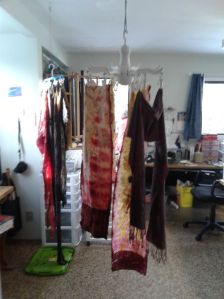
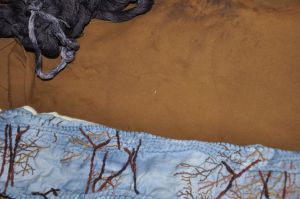
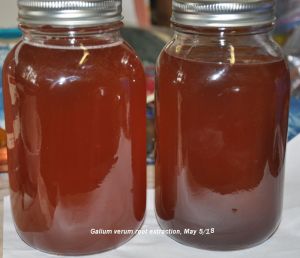
Well, there *is* colour, but it’s weak, probably because of the amount of root i had, maybe 40 scant grams, dirt included. I used Jenny Dean’s method of soaking the roots overnight, pouring off the first water, then slow simmering with a Tums tablet (calcium carbonate) for two subsequent baths that were saved and combined. (A third simmer had no colour at all, and was discarded with the roots, in the garden as no adjunct chemicals were added.) Both fibre types were properly scoured and pre-mordanted also, according to their requirements.

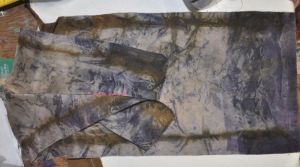
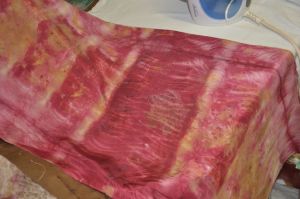
Wet, silk top, cotton bottom, after 24 hour soak in dyepot:
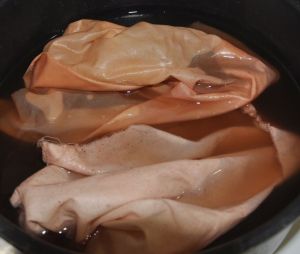
Technically, i should have decanted into two pots, and dyed separately, as cotton (cellulose) and silk (protein) have different uptakes.

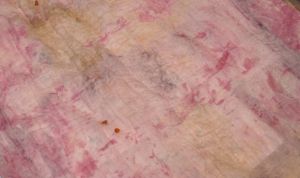
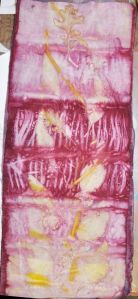
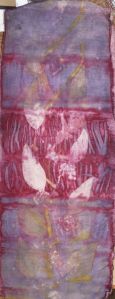
Dry:
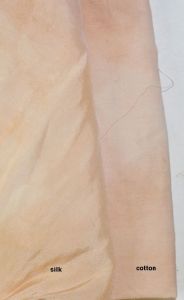
Soft, but not terribly exciting, again most likely due to the amount of root gathered.

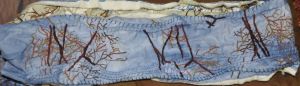
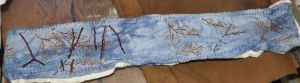
Some modifying/post mordanting on small strips:
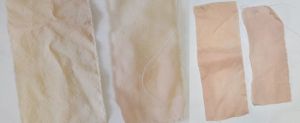
Pretty much insignificant changes with (L to R) above, vinegar no change/possible “bleaching effect”, soda ash marginal pink activation
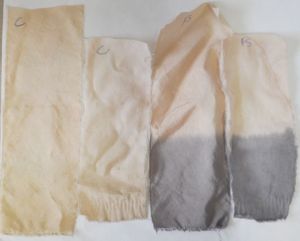
and above (L to R) copper minimal change and possible miniscule yellowing, ferrous sulphate the most dramatic change (might just do this to the remaining pieces and use that way!). (This could also be due to any residual tannins. I used an incredibly SMALL amount of ferrous sulphate, as the stuff is quite strong, maybe a few grains.)

I’m also thinking that because there is so little colour on these, that they are NOT going to be terribly light OR wash fast……BIG sigh of “WhatEVER” 🙂 Still goes in the dye annals though 🙂 I’m sticking to actual madder from now on.


So, was it worth the effort? Yes, in a way, because i learned it is possible to grow, harvest and use a plant material that can and does grow here. And no, because i learned the amount of time to grow (3 years to wait to harvest), time to harvest (ridiculously small amount for the work it took) and use (weak, because time and harvest took too much and amount gathered was too small) was not worth the experiment. Then again, maybe ***this variety of Galium has very little dye material in it. BUT, obviously someone with patience, a larger pot/plot might want to try this so they could say they use “local”, if that’s their Thing.

I’m rather sure too, that if i had just ecoprinted with these, instead of using as a dye material, the results would have been negligible, as there’s little alizarin/purpurin in these roots, probably due more to their size, than the quantity gathered. (Again, or the variety is pathetic in the dye substance department.) I highly doubt that the roots get very big at all, even after years, as that’s not their nature. It would also take masses and masses of them to get a decent quantity, a problematic exercise, also due to the way they grow.

So, have on, some brave soul: i’ve lived and learned, and the lesson is filed! (If you are interested in how i got to this point, this will take you to all of the Galium posts previous.) (And yes, i misspelled it in the archives–gallium with 2 l’s is actually a chemical element.)

Erratum: The Galium species most prevalent here is Galium boreale, which is what i used, not Galium verum as previously stated. There are ***6oo species of Galium, and some have no alizarin at all, but do have pur purin and pseudopurpurin. I’m also certain that some have little to no use whatsoever as a dye plant. I found this article, and they do mention that some of these plants have little to no madder-like characteristics.
Posted in gallium, garden dye plants, journal: lessons to learn, Natural Dyes

galium, part two

Sad, very  very sad.

Granted, i had a really small amount of roots, but i’m not sure (yet) that this was worth it! This “red” has a quite brown tone to it, but of course, the proof will be in using it. I’m still waiting for pre-mordanted fabrics to be finished 🙂

I’m thinking however, that whatever results i get, this was a valuable experiment in growing my own dye, processing it, and using it. You don’t know if you don’t try!

Posted in gallium, garden dye plants, Garden Hard, madder, Natural Dyes

it might “madder” that i grow my own :)

We gardeners in harder zones have a tough time growing certain things. If you’re a gardener who wants to grow your own dye plants, it’s even tougher! If you’re a Calgary gardener who wants these, it’s even more more tougher! Our growing season is shorter, and while we get intensely sunny days, due to our altitude, we also get much cooler nights–no steamy evenings here (at least, not in the garden 🙂 )

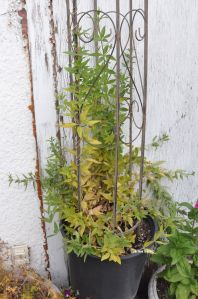
Last spring i planted madder seeds in a big black pot, containing it because madder is notorious for sneaking everywhere with the root system, and this makes it easier to harvest when the time comes (usually after 3 years), but also because my Zone 3 garden is clay based, due to being only a few 100 yards from an old (still quite active) river. I used a mix of “garden soil” i’d had delivered, some actual garden soil from the extant garden, a bit of sand and then amended it weakly with some lime.

It grew to about 3.5 feet last year, and survived the first 3 frosts, before i heeled it into the garden in October. That means, i dug a hole deep enough for the pot, sank it to its rim, then mulched with newspaper, garden debris and it’s own stalks. (I also removed the trellis obelisk, as metal conducts cold and i didn’t want the roots “injected” with -20 to -40 temperatures!)

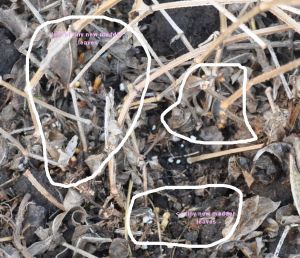
I pulled it out of its hole on  the 27th of April, and was about to PULL all the old growth off, when i realized i didn’t know if it would grow new branches, or start from the old ones. Good thing i stopped and really looked, because the old growth base is precisely where the new growth starts! If you click on the photo below, you can see the new growth.

While it may not look terribly exciting to some, it IS. IT’S VERY VERY VERY EXCITING, because that means at the end of next year, i can be using my own home grown madder for dyeing with! Madder roots are best used in year 3, or 4 if you can wait that long 🙂 The big deal also is the fact that we had one of our harshest winters in a long time, and it still survived being buried under 3 feet of ****ing cold and snow for 5 and a half months. It was also a LONG winter, with snow still happening until mid April…………..

It didn’t flower last year, though that again is not that much of a disappointment, but i’m hoping because it has a much earlier “start” this year IN it’s growing conditions (ie no indoor starting, coddling and having to harden off), that it will—–because it also occurred to me this morning, that if it does flower, seeds from it would already be on their start to being a Zone 3 hardy dye plant!

I’ll continue to use “commercial” madder until then, but i can’t wait to see the results of true “slow dyeing” 🙂

Which reminds me…….last year i harvested the third year roots of gallium, a more “local” dye plant that gives red from the root also. (Gallium grows almost everywhere in the world so i call it “local” because *i* *can* harvest it locally if i had the patience. I grew mine from locally sourced seeds though, as the wild areas are too dense with roots to find any easy to dig out. And Conservation Officers would nail me, if i got caught. And i’m not about to dig in a wild area like that, to that extent, because ya just DON’T!) I did wrap it in silk at the time, ready to throw in a pot and use as an ecoprint material, but never got to it, and just added it back to the pile collected. Today i will try using it!

Posted in FybreSpace the shop, Natural Dyes, Naturally dyed threads

Naturally dyed thread sale, shop update

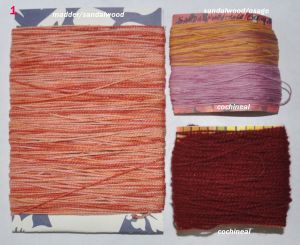
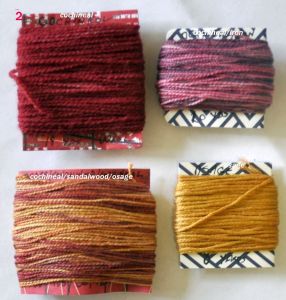
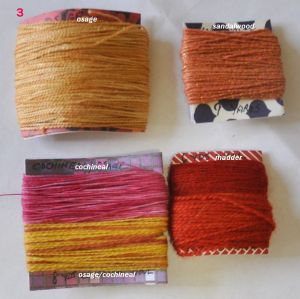
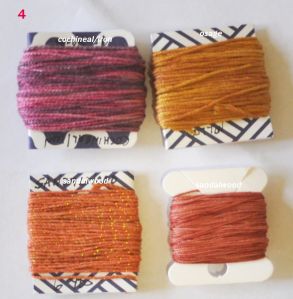
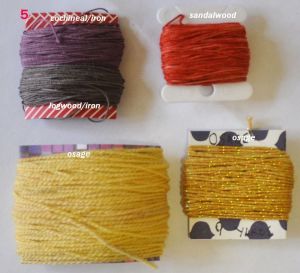
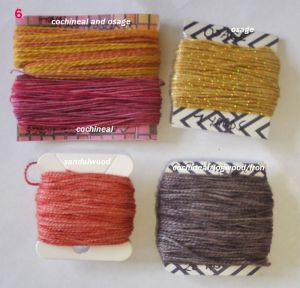
Clearing out the naturally dyed threads! <—LINK.  SOLD OUT It seems most people are/were not as excited by them as i am, but those of you who are, can experience packs of different colours, great for your Boro or Kantha style stitching. Mother Nature provides a bounty of beautiful colours for us and what better way to add mindfulness to your work? EDIT April 27, only 3 packs left.

Above, 3 packs. EDIT: 2 1 available  ALL SOLD

~~~~~~~~~~~~

Below, all only 1 pack of each:

SOLD

~~~~~~~~~~~~~~~

SOLD

~~~~~~~~~~~~~~~~~~~~~~~~~~~~~~

SOLD

~~~~~~~~~~

SOLD

~~~~~~~~~~~~~~~~~~

SOLD


As always, i will refund extra postage paid, and remember, my prices are in Canadian dollars, so use your currency converter

Posted in Ecoprints and Natural Dyes, Jam Day, Natural Dyes

Jam Day Ecoprintingpalooza

Friends and i have been planning and hoping to get together for literally months to have a play day! All of us of course have busy lives, but finally on the 27th, we were able to commit all at the same time, to the 29th of January.

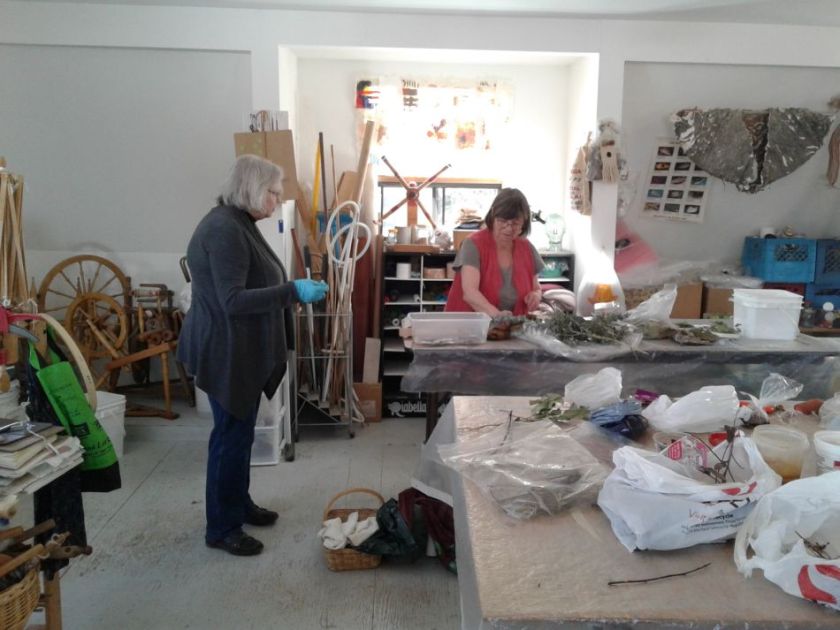
Lyn has a wonderful second story studio set up, waaaaaaaaaaay out by the mountains!

With oodles of materials to work with from rose to cherry, sumac and grevillea, onion and maple, marigold flowers, rose petals, turmeric, something like sliced betel nut, privet berries and oak, eucalyptus, osage curlings, well, you name it–if it was scavenged locally, buyable or shared, we had a plethora of materials to choose from. Almost overwhelmingly so! We also shared pre-mordanted fabrics, and lots of discussion and tips about various methods and techniques.
We had a pot of onion skins going for one bath, and a pot of superstrong Lac as well.

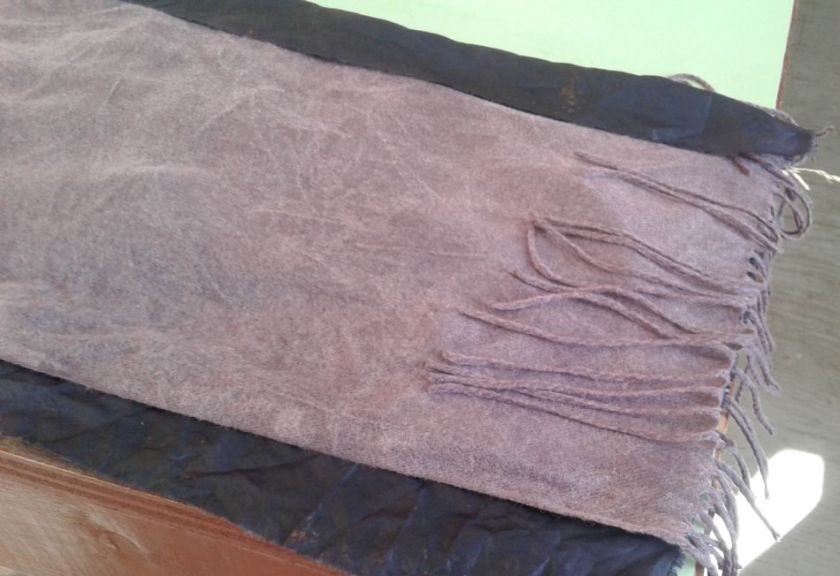
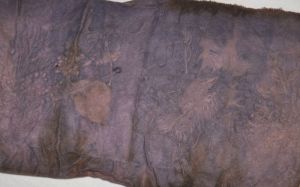
I had a difficult time choosing, so  i stuck to the “tried and true’s” of maple, oak, grevillea, euc and osage, with experimental hints of privet berry, rose petal, the almost betel nut, amaryllis and rowan. (Note, the privet berries give a nice green dye, but do NOT print at all….) Lyn generously shared a long strip of viscose (?) scarf (commercially dyed, and un-mordanted) that we first soaked in vinegar (NOT A MORDANT, but a modifier/Ph adjuster), and then layered with plant materials, with me adding a strip of previously logwood dyed silk in between. I had gone out for a bit of fresh air at one point and picked some fresh fir, tearing it into little pieces and putting that between the layers, with a bit of euc also.

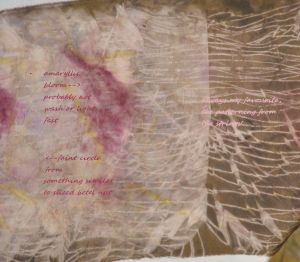
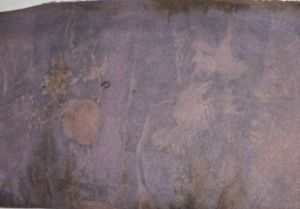
!!!! When this was wet, we couldn’t decide if there was a definite imprint, thinking perhaps it was just an “embossing” effect as the viscose was thicker than most cottons and silks, but yup, fir and euc did the job and discharged just enough to make it interesting. First photo below, un-pressed, second pressed:

(To see more details, all photos can be enlarged by clicking on them.) Part of the effect i think is that some of the logwood “transferred” to the viscose, as evidenced by the darker colour. Even so, i think i’m going to discharge this whole piece, and try again. I might even add a crocheted or needlelace edging after so i can wear it as a scarf.

And look what it did to the logwood silk!!!


We tried some of the haremcloth as well. Lyn got crisp results, mine not so much, but i think mine was too loose a bundle.

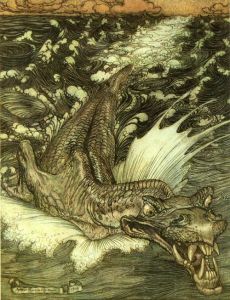
I love this green from the onion bath, very atmospheric and reminding me of an old Arthur Rackham illustration.

Great colour on this one from the lac, but the maple, euc and osage is barely visible, except as a contrasting yellow:


Blah, but i like the string patterning, always my favourite part, and usually strong even on failed pieces:


I wish i had a shot of one of Susan’s pieces–she has used alum acetate with a chalking after (mordanting procedure for cellulose fibres) , something i have pooh-poohed as a step i didn’t “need” to do 🙂  However, it definitely made the colours from the leaves and dyes bond better, with maple leaves showing such incredible detail and colour range that you would believe it had been painted by a VERY skilled artist.

These two pieces are the ones though that really made me SQUEAL.

Above, euc, oak and osage on cotton, with lac. Below, euc, oak and osage on previously logwood dyed cotton, in lac.

Obvious to me is that pre-mordanting properly can make a major difference. Click on the photos to see the full glory 🙂

I still have one bundle cooking right now, as it missed getting into either pot, so maybe another surprise or two.

(And alas i don’t have a lot of in situ shots, or pics of Susan and Lyn’s results–oh some were to die for!!– as i forgot to put the chip in the big camera, and had to use my phone. And most of those were blurry ’cause i was so excited 🙂 )

I do believe i could get excited about ecoprinting again. I’m still in “Epiphany” mode though, so taking more time for reflection and doing, rather than showing and sharing here.

~~~~~~~~~~~~~~~~~~~~~~~~~~~~~~~~

You may, or may not(!),  notice that i have disabled the “like” button on posts, starting with Jan 21st of this year. It’s starting to feel like FB where people “react”, but never actually say anything. Blogging is about interaction, and as guilty as i myself am sometimes for doing that, i’m feeling if i *do* “like” something, it might be is helpful, encouraging or validating to someone to actually SAY what i mean. Trying to change that habit myself!
Posted in Collusion: sampling, Natural Dyes, Sketchwork, Work 2018

fool me once…….

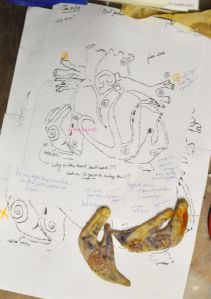
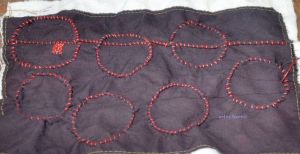
HA! It took me TWELVE YEARS to figure out here was something wrong with this sketch. At the time, i was quite concerned that i get the valves and tubes all facing the right way, (there was an actual, real life cardiac surgeon on the QuiltArt list in those days, who helped a lot), but what about the hands???? Who holds a heart like that (pre-supposing one could, and not as part of some nasty ritual 🙂 ) ?

It’s not the intended Next Big Thing, but a smaller part of the whole, perhaps a new “series”. Either that or a very intense sampling 🙂 The hands are done on a potassium permanganate/rust/brazilwood cotton from a residency, with naturally dyed threads used for the embroidery.

I’ve done some dyeing now for this particular design, both “potperm’ and cochineal with iron (I want deep purple, not fuschia), and have some logwood dyed cotton as well for bits. I’m torn between using an indigo with potperm background, or just potperm–or something else entirely different!— and have to decide reasonably soon so i can commence the rest of the work.

Posted in "OPINIONATION", Book reviews, Natural Dyes

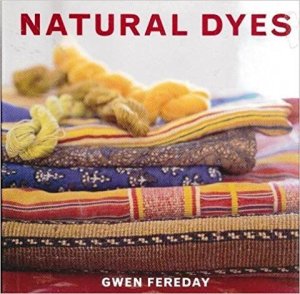
Book Review: Natural Dyes by Gwen Fereday

Note to self: this is the last natural dye book that will be bought for the Stately Barr Manor Studio!

On the advice of someone on the FB Natural Textile Dyeing group (someone i trust 🙂 ),  i ordered a copy of Gwen Fereday’s “Natural Dyes”.

It’s available through used book sellers, but i bypassed Amazon as it was rather expensive ($55-158!!!!!) , just in case it was garbage. I bought mine from Abe books, from the  seller Broad Street Book Centre (an actual bricks and mortar store in NJ Hereford, an actual real live book store!!!),  and was happy to pay slightly less than 30US including the shipping from the US. EDIT: This seller is in the UK! And them sending on the 18th of December, to arrive here on the 27th was impressive also.

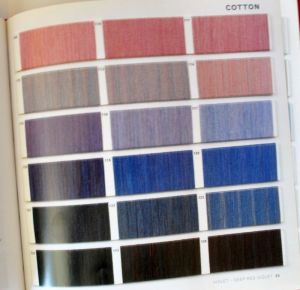
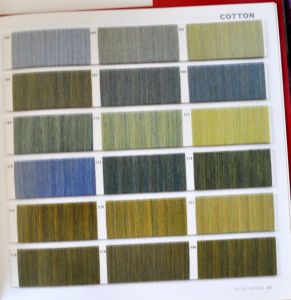
And it IS worth the money. Very clear, as the author is also a well respected teacher at the Surrey Institute of Art and Design at University College in the UK, it explains everything from proper pre-treatment of fabrics, both protein and cellulose, to specific dye types, and through to the most wonderful colour plates with “recipes” for achieving the colours. Best of all, as much information is presented for the cellulose as for proteins–while i like wool, and am happy with my results, i prefer to work with cellulose, specifically cotton, and let’s face it, most natural dye books barely give a passing mention to anything but wool!

For the longest time, my cotton results were frankly, lousy, because there was little clear information. I did hunt around and eventually found the tannin/alum method for cellulose (Turkey Red Journal), and that made a world of difference. I still felt there had to be more out there–let’s face it, the average dyer of yore would have been working with linen, cotton or local indigenous fibres, not silk, and possibly not even wool, depending on the geographics.

Even more specifically, and exciting, is that decent mention is made of Turkey Red Oil, a type of sulphated Castor oil, often used historically to deepen reds from madder, hence the “Turkey Red” (not the bird, the locale!) I found a near by supplier–REALLY near by, as in 20 blocks away!!!! It can be used with other colours/dye materials, so i want to play with it, and buying a SMALL bottle of it will mean that effort/expense/extra steps are not wasted or being committed to.

But i digress 🙂 The only point i don’t like about the book is the extremely heavy WOF of cochineal used: 60%!!!!!! as opposed to the usual 3-10%WOF!!!!!!!!!!! (EDIT: JAN 10/17 Actually a lot of her recipes are really heavy WOF’s (500% madder????)—i’d say overkill in some respects, as fibres can still only uptake so much before it’s wasted effort, materials and EXPENSE. And if it crocks after, well, big problems.) And yes, a lot of the info contained is also in other respected books in my library, but the extras i needed are what’s made it worth adding to the shelf. If i *didn’t have any of the others, it would be a fantastic start to the library too. And best of all, no wasted pages on “projects”: really, i’ve said it before, if you didn’t know you could actually MAKE things out of what you dyed, WTF are you doing it for then?

Anyhoo. The next step is to figure some time management so i am not obsessing about one thing, as i am wont to do :), but dividing my efforts between this, and some serious stiching again, so that both are “sustainable”, i.e. they get DONE, not just blethered about.

Posted in a collusion of ideas, in progress, Natural Dyes

why do i bother???

It was all planned out in my head, but the needle and thread sampling did nada for me. Went back to the work blog and zipped through all the photos, and tada.

This figure (never attached to anything, from Jan 2016)

on this PP dyed cloth

and logwood threads

and this strip that came from aborted work (two photos because it’s too long to photograph easily)

with this manipulation on the PP

yes

’cause apparently planning is taking a hit lately, so i’m not going to waste time, just jump in.

“In progress” un-named.

Posted in brazilwood, cochineal, embrilting, FybreSpace the shop, hollyhock, indigo, logwood, Moons, Natural Dyes, Naturally dyed threads, osage, potassium permanganate, privet, rhubarb root, sandalwood

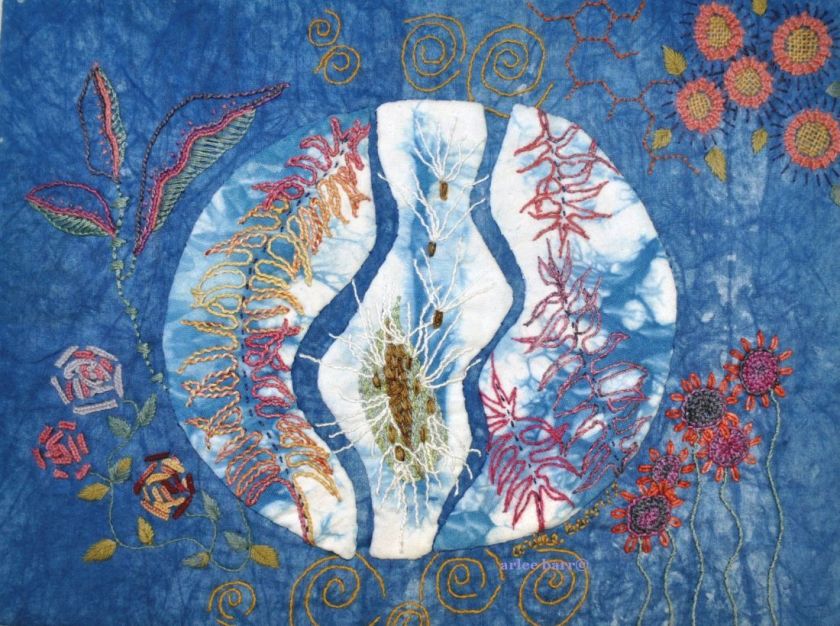
a natural moon

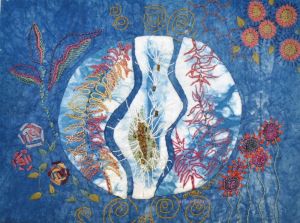
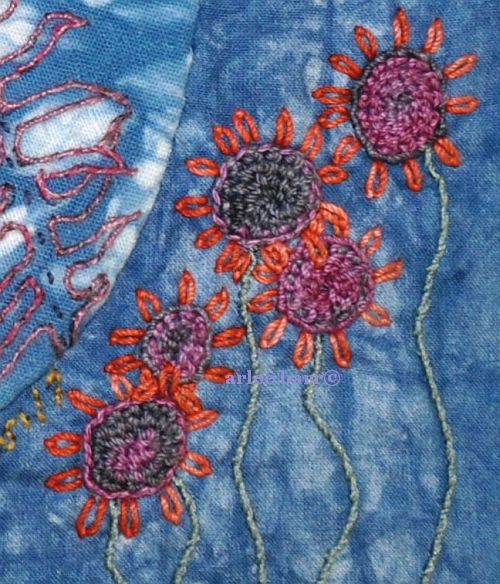
I’ve been slowly (and not so diligently, as other pursuits in the studio have “interfered”) working on this indigo moon, using my newly dyed naturally dyed threads. This is a lesson in itself, as the indigo i’m working on is strong enough to overshadow certain colours, necessitating some more neutral backgrounds for future plans/use.


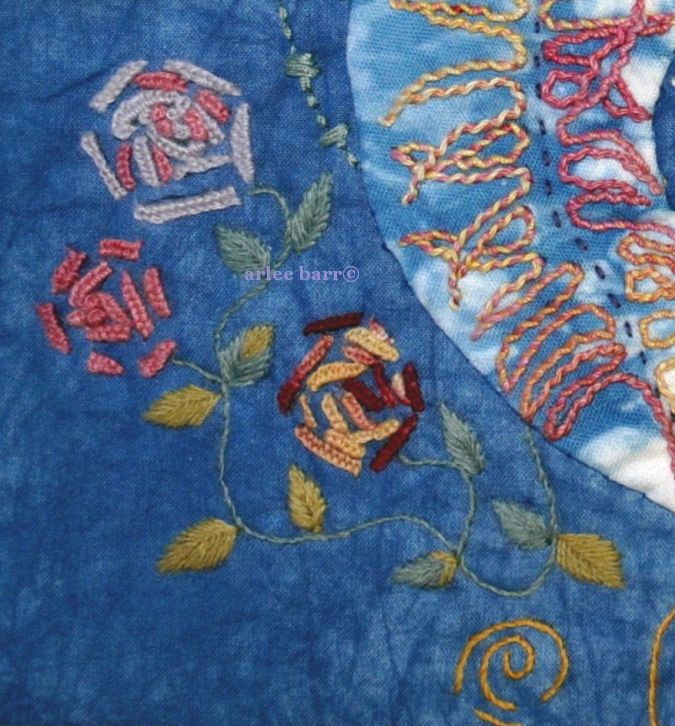
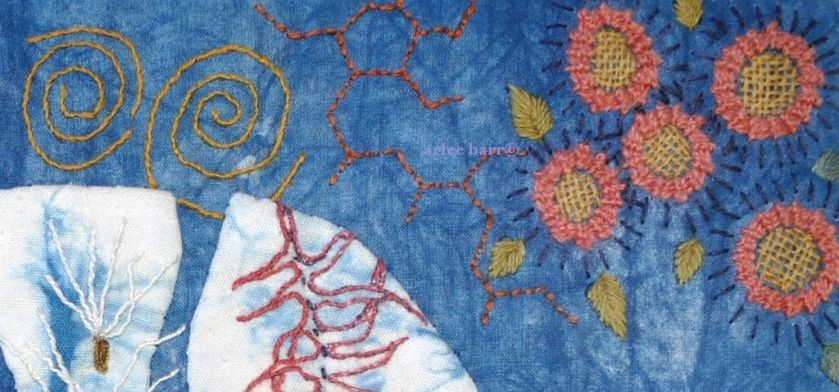
The moon is worked with cotton, silk, silk/wool blend and wool threads in cochineal, osage, logwood, and privet berries, with the brown of the seeds coming from potassium permanganate (actually an inorganic compound). I found a walnut bath i had stored several years ago, when i was setting up in the basement, and shall test to see if it’s still “live”, for some of my browns in future, though i do love all the permutations the PP gave on the skein of cotton. On the background surround, in cotton, silk, wool and silk/wool, the colours i used are privet berry, cochineal, brazilwood, rhubarb root, hollyhock (and that’s where the “oh-oh” happened, as some of the colours are so soft, they are barely discernible), osage, logwood, and sandalwood. Using pre-mordanting (VERY important), and post modifying methods, changes the colours to a wide range. (Ha, just realized i used none of the wonderful madder results!)

I have two other moons still in the finishing stages, and hope to get them done soon too! All will be in the shop.