Posted in "OPINIONATION", Book reviews, mordants and modifiers, natural dye research, Natural Dyes

my drawers will never be empty (book review):The Art and Science of Natural Dyes

JUST when i had got all my dye stuff and tools and pots back down to the Dye Dungeon, this arrived in the mail ๐Ÿ™‚ I pre-ordered this last July, the moment i heard it was finished, and have been anxiously waiting for it. I pretty much snatched it out of the postman’s hands!
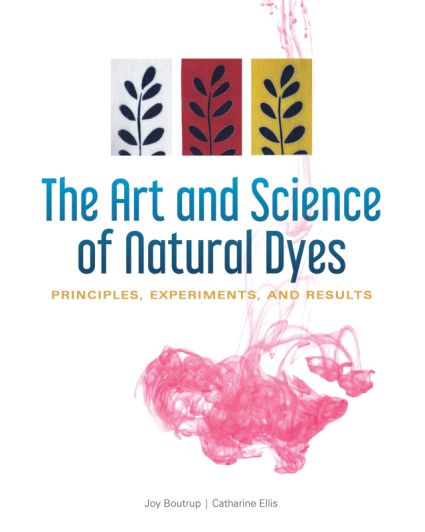
The Art and Science of Natural Dyes: Principles, Experiments and Resultsย  โ€“ Catherine Ellis and Joy Boutrup

I’ve already had 3 “AHA” moments, and i’m only half way through. It’s not a book you read once and then sporadically refer to, so fortunately, it’s also spiral bound so it stays open to the page you want. (Terrific, now i have to dig my book/magazine holder back out of the “donate” box….)

It’s not so sciencey that it can’t be understood, but it’s also not a skim it and do it manual. It covers the “classic” dyes, none of the usual beets, beans and berries nonsense, so don’t bother if you’re interested only in sauteing up some food waste, throwing in a cute baby onesie and staging artful photos for IG. If you’re serious about natural dyeing, and i don’t mean Total Scientist Mode but are a dedicated hobbyist/artist/small business owner, this is the book to explain WHY things work/don’t/happen. I still recommend Jenny Dean for basic, accurate dye recipes and processes, but this one will give you insights into the many variations that can and are encouraged to happen with skillful, knowledgeable hands.

There’s a small section on testing the dye potential of local foraged plants, minimal though helpful, but not the focus of the book. That being said, those tests could lead to work with those plants, following the advice for the classics. It’s all grist for the colour mill!

I’m not about to dissect any “recipe” in this reference manual: A.ย  buy the book, i don’t like spreading out the photos of pages i find interesting, as i’d rather you support the authors, and their research and B. the recipes are classic anyways, BUT with much new information that can be digested fully with the book in front of you ๐Ÿ™‚

There’s a LOT of excitement about this book in the natural dye groups, and rightly so: it also supports all the things i, and others, have said about what constitutes solid, legitimate dyes and the techniques used to create these wondrous rainbows. I have to laugh though in one sense, because i just know that the new catchphrase is going to be “Welllll, Boutrup Ellis says……..” This book should be MANDATORY reading for anyone who goes near a natural dye pot.

It’s not a cheap book, but then it’s not a cheap book, like so many of the Popular girls are publishing right now. I’m about to settle in with another cup of coffee and a pack of stickit thingies to mark pages, and do a little dreaming and planning.

Edit: After 1000’s of hits to this blog post, it occurred to me that there really should be a link here to the book! Beware though–already some are claiming it in their “used but good condition” racks at two and three times the price!!!!!!!!!!!!!!!!!!!!!!!!!!!!!!!!!!!!!

EDIT: Feb 9/18WHOA! “#1 best seller” in dyes at Amazon, sold out of a lot of places, and the bloodsuckers have moved in with their jacked up prices because they bought several copies deliberately to re-sell. Good for the authors, not so much for the buyers!
Posted in "OPINIONATION", natural dye research, Natural Dyes

transparency in natural dyeing


#Plantdyes. #Naturaldyes. #Botanicaldyes. #Vegetabledyes (????????????????????)

These hashtags drive me up the wall. Use them, sure, but QUALIFY them.

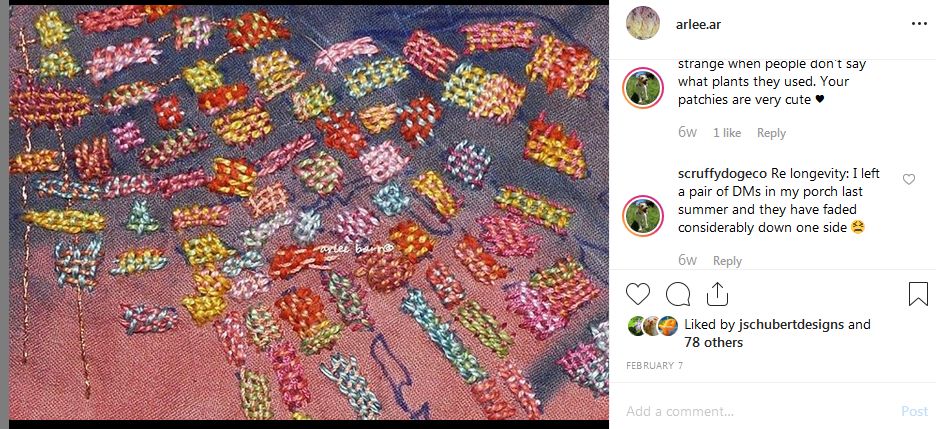
Natural dyes patchies, work in progress. You may have noticed that when I post, I hashtagย  (edit:or ID) ALL of the dyes i use: when people say “plant dyes”, it doesn’t always mean it’s light or wash fast; in fact it could be fugitive. I pride myself on doing these colours and the subsequent art work made from them correctly, from the start. I make sure my efforts are going to last! The “Beets, Beans and Berries Brigade” can go suck on a turnip ๐Ÿ˜œ #naturaldyes #plantdyes #cochineal #sandalwood #indigo #logwood #osage #madder #quebrachorojo #naturaldyersofinstagram #yycartist #calgaryarts

I’ve asked people what “natural dye” they used. They don’t answer. I’ve asked to see their lightfast tests. They don’t answer. Or they do answer,ย  huffy because “it’s not going to be washed anyways”. I’ve asked what mordant they’ve used. “What’s a mordant?” or “Vinegar.” Sigh………… I ask precisely because i DO want to know–there are dyes out there that are not Old World, European, Asian, that we know nothing or little about at present. Maybe i could learn something new, but not with these attitudes.

Raspberries, grapes, beets, strawberries, black beans, mint, spinach, daylilies, passionfruit, cherries, rose petals, hibiscus and hollyhock blooms: when we start out, we try these. It’s fun, it’s fast, it’s colourful, pretty, sweet.ย  BUT THEY ARE NOT DYES. I admit it, i used 2 of these things, but only because they were in a book by a dyer i trust. (That dyer has subsequently revised her opinion on them as NOT true dyes. And i threw in the compost the blooms i’d saved.)

I strongly believe that natural dyeing has become such a burgeoning industry, that anyone who has ever seen beet juice stain a tablecloth, suddenly is a natural dyer, writes a book, and sells the product to increasing numbers of gaga followers. Hell, *i* could write a book, and it would be accurate, but since there are already more than enough GOOD, WELL RESEARCHED, RESPECTED authors and books out there, i wouldn’t presume. I don’t have all the answers (yet ๐Ÿ™‚ ), but someday i will (have all the answers, not write a book), because i DO the research: i don’t trust anyone who doesn’t address or demonstrate anything about lightfastness, i don’t trust “seasonal colours” when half of them are not real dyes, i don’t trust just because something makes a wonderful ink means it also dyes cloth or threads, i don’t trust anyone who won’t be clear about what they are doing if they are selling it, i will never trust someone who advocates the use of kitchen waste without discerning and explaining the difference between a stain and a dye. I’ve *seen* the beet juice dyed yarn on Etsy, the packages of coloured fabrics on Instagram that have no identifiers. How do i know they are “plant dyes” , not food colouring, or watered paint, or procion, ’cause i ain’t never seen THAT green or deep fuschia from plant materials???? Yeah yeah, i know about mordants and modifiers, but some of the colours i’ve seen do not occur in natural dyestuffs! I just wish more buyers too would call out the frauds, identify problems plainly, and stop the “oh but it’s pretty anyways” crap.

No one wants to bake or buy a cake that looks gorgeous, but is really just icing bewitchingly swirled onto a cardboard base……………

I think what i’m asking for is honesty here. If you take pride in your work, and you know that you know what you are doing, share that. Don’t make people guess, don’t defraud them, don’t lie, cheat, obfuscate. If you write a book, aren’t you supposed to be sharing the real true information, or are you just promoting your own agenda with the artfully staged photos, the vague instructions, the “projects” that take up half the book? Holding the information close to your chest is selfish; if you’re doing it wrong, you will be found out i guess, if you’re doing it right, well, so can someone else. And yeah people copy, of course they copy but with natural dyeing, there are so many factors, that their projects are not going to be copies of your projects no matter how hard they try. If you’re hiding that information so you can sell your books, or your fabrics, and you’ve done it wrong, you will be found out, and there goes not only your bank account, but your reputation and the reputation of natural dyers WHO DO IT RIGHT.

I have been asked for instance, “how did you get that colour from madder?” I’ve answered, “by using it correctly, as per a madder recipe”. I can’t be more specific because there are water, mordant, modifier, fibre type, age of dye stuff, original source of dye stuff, length of time, temperature and Magical Fairy Moon Breathless Goddess factors–and that last one is no artsy fartsy obfuscation, because sometimes there is such a confluence of events to create a colour, that it HAS to be magic. Even this pragmatic skeptic has to admit this.

Don’t skimp on the research yourself, personally. Don’t take at face value one blog post that has a colour you like. Don’t EVER take at face value the most popular as the final word on a subject. (Popularity has nothing to do with actual knowledge.) Compare notes with each source, find the original source. Was it all done correctly from the start? Scouring, mordanting, actual dye material, possible post mordanting and/or modifying, light fast and wash fast tests? (These last two are my biggest peeves–i RARELY see any indication these have been done.)

Ah, i could go on and on.

Maybe most people are more interested in popularity and money, than pride of place, of ethics and honesty, of quality work/art. I’d like to sell more too, because i sure as hellย  get frustrated when i see those big numbers of sales on stuff that just isn’t made correctly, done poorly, weak. There’s no “sustainability, eco-consciousness, mindfulness” to any of it. I have however found natural dyers who give a damn, who share the info, who are constantly learning, who are nice or snarky (because they too are frustrated) and know their stuff, who will troubleshoot with you. Those are the ones who have the art of transparency in spades (to mix a metaphor).

As usual, i’m probably just pissing into the wind.

I wrote about this before too, in less polite terms ๐Ÿ™‚
Posted in embrilting, journal: lessons to learn, Moons, Natural Dyes

a year of dyeing moons

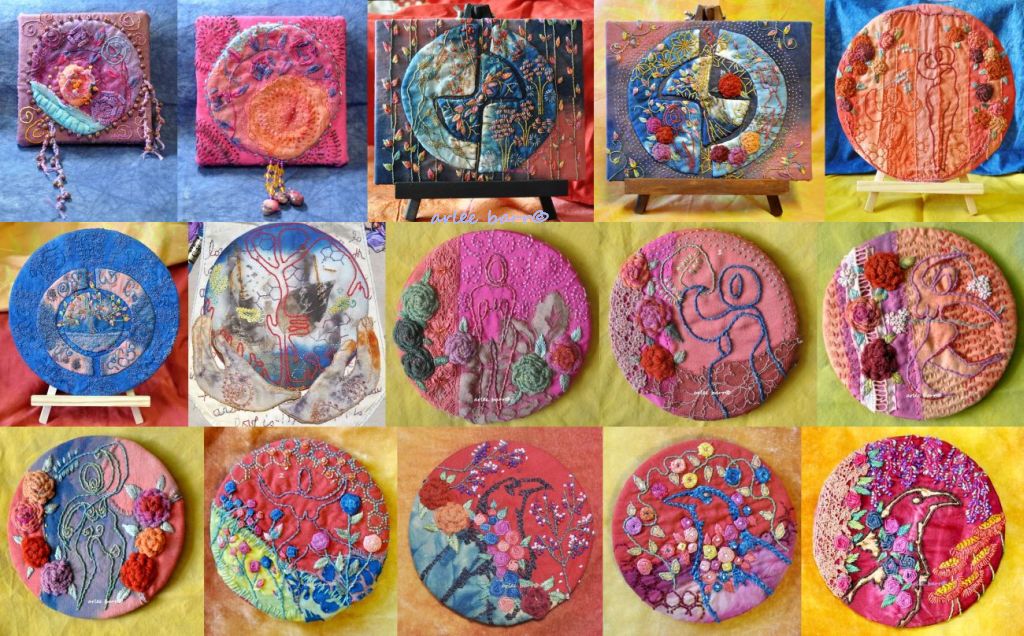
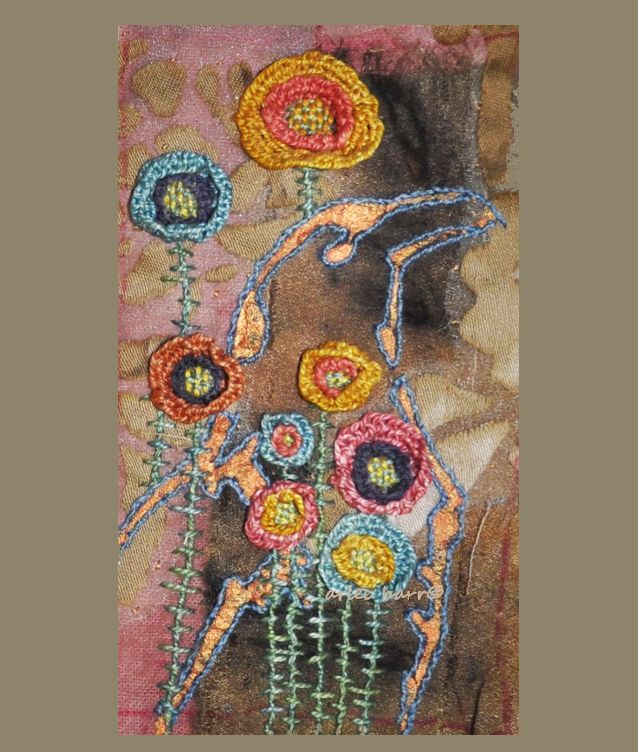
embroidered moons, natural dye, arlee barr, hand embroideryAll natural dyes, cloth and threads ๐Ÿ™‚ (Exception, first two moons top left.)

I think it was 2015 when i bemoaned that i would never have a good assortment of naturally dyed deep rich colours in my threads. HA. Though i had been using natural dyes for a while, something wasn’t working. I kept trying though, sometimes having success, sometimes horrendous fails. What was wrong? So, i diligently re-read the books, taking notes in minutiae, going through each step consciously, and WOWZERS, suddenly things worked. When in doubt, “read the instruction manual”! BUT, read the whole thing, read it in order, don’t just jump to the recipes. I highly recommend any of Jenny Dean’s books, Maiwa’s instructions, J. Liles, Domonique Cardon and the like.

I learned about scouring: just because something is white/new doesn’t mean it’s clean. Most fibres have dirt, dust, wax, pectin, chemicals, oils and who knows what from the initial gathering and processing, the manufacturing whether cloth or thread, the handling, transportation, storage and packaging. (Even PFD fabrics can be suspect.) I was shocked to see the colour of the water from the freshly bought, new, tightly packaged white thread, and how much particulate was in it after a good thrashing with soda ash and soap in boiling (or almost boiling, depending on the fibre type) water! Brown! Yellow!! Pink!!?????

I learned about mordanting, proper mordanting. According to fibre type, according to what was actually a mordant (NO vinegar, salt, soy products), according to correct WOF use, according to historical use and extant samples. (I chortle now when i see the so-called “vivid” colours on soy mordanted fabrics…………the uptake is uneven on most fibres, gives predominantly pale to medium shades and i wonder about the lightfastnessness, especially since no one seems to show actual tests!)

I learned about WOF, the correct amount of dye in ratio to the weight of the fibre being dyed. Dumping a tablespoon of dye and seeing a dark colour in the pot doesn’t mean that’s what you’re going to get on the fibre. And there was clear information being offered about the correct WOF for each type of dye, as they are not all the same.

I learned what an actual natural dye is. The hollyhock blooms, the hibiscus all went into the compost heap, the avocados kept as a tannin only. Lovely colours, but fugitive, no matter how mordanted. Not wasting my efforts, resources, time. (Yes, there are still natural dyes that aren’t as light or wash fast, but most can be coaxed with proper mordanting and/or post modifying.)

I learned about the effects of different mordants and pre or post modifying, about combining dyes and/or overdyeing, giving me an even more extensive array of colours and shades.

I learned about light and wash fastness. Oh boy, did i learn. The compost bin has thanked me on a few occasions.

The biggest thing i realized was TIME. With the exception of indigo, nothing comes out of my pots until it’s been in at least 8 hours, and often a day or two. It’s not instant gratification, nor a case of sitting and watching the pot boil, bemoaning “wasted” hours ๐Ÿ™‚ Like making homemade bread, most of the work is already done, and “waiting” can be either relaxing or productively spent elsewhere!

All of this has taught me patience this year, and while it’s still not a Perfect State for me, i’m getting there. I can turn away from the aggravating, the frustrating, those who “persist in their own stupidity” (as my Dear Mother says), and the willfully ignorant.


Mostly. I’m only human after all. Just trying to get better at it.


Posted in Days of Honey, FybreSpace the shop, Moons, Natural Dyes

on a roll

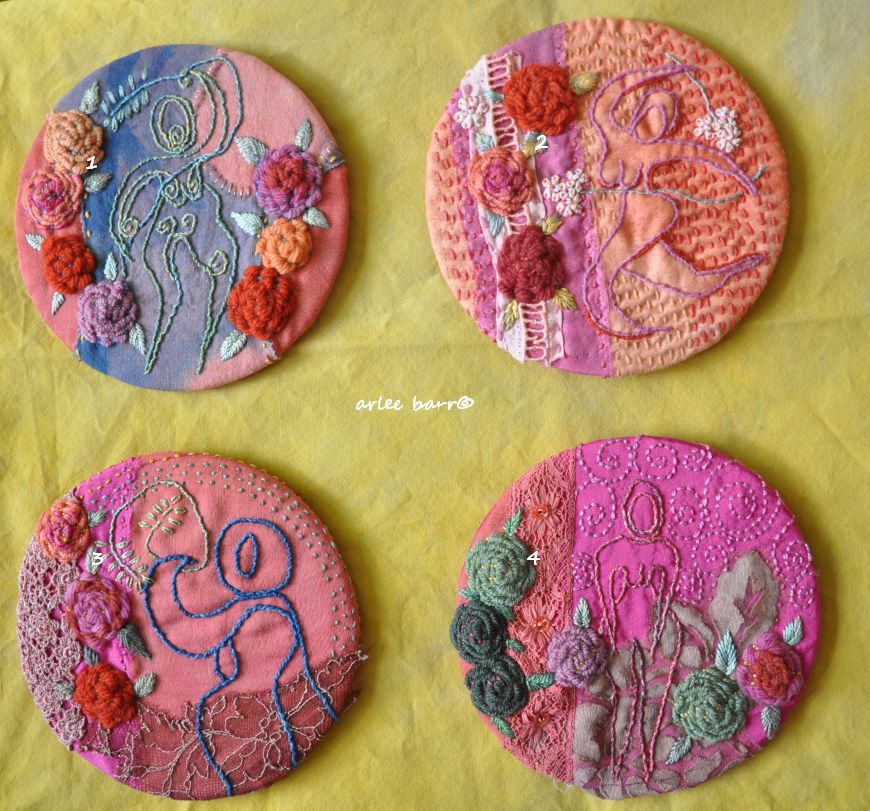
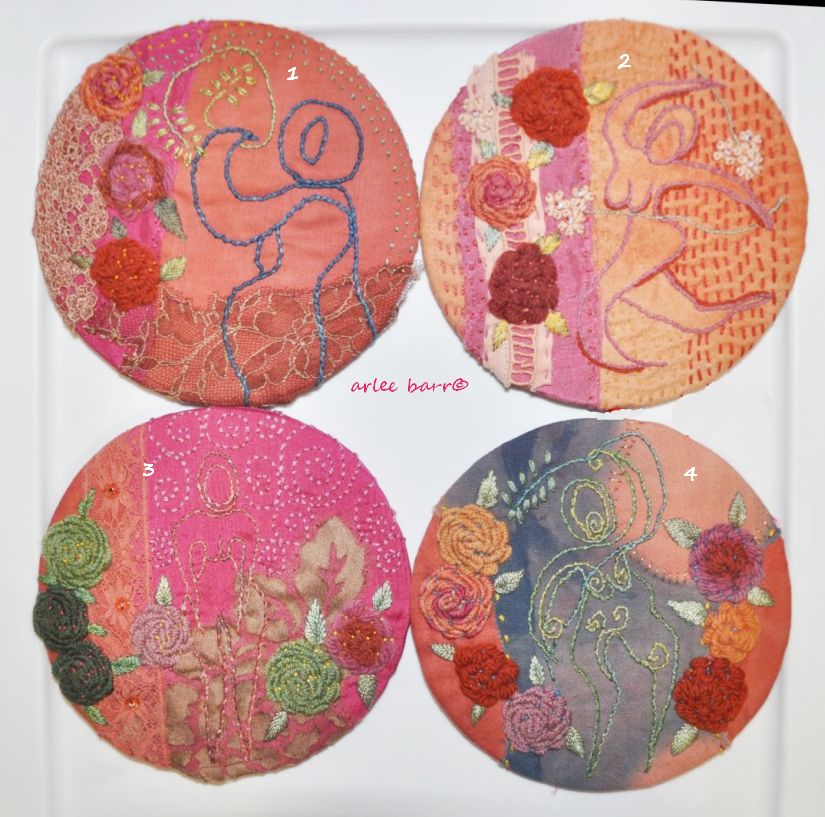
round and round i go, with ideas abundant, colours singing, and natural dyes that sing sing sing

these mini moons are not only an antidote to blue days, SAD and the Black Dog, they are fun to create!


Happy Solstice to you all!


EDIT: PS:

Sad. I’m sad that someone would email me and tell me i’m obsessing about my little moons. Damn right i am–i’m not depressed, i’m not angry, i look forward to getting up in the morning, i’m loving colour, i’m working in my studio EVERY day, i am doing what i need to. We all need to find what makes us happy, productive, engaged and feeling positive!

So, now i am NOT SAD myself

Posted in embrilting, journal: lessons to learn, Moons, Natural Dyes

using again

Stash, i’m using stash! Whadja think i meant? ๐Ÿ™‚

On Sunday when i was (re)organizing the work space, i had a brilliant thought. Why not USE some of the natural dyes? Seriously, wth am i making them for otherwise? Pretty piles are one thing, unused pretty piles are another ๐Ÿ™‚

I am stressed right now though, overly stressed actually, for reasons i won’t go into publicly, but keeping my hands and mind busy are a good antidote. That and long long wintry walks with the DogFaced Girl (Brown Dog), trying to gather my thoughts, and lock the doors against the Black Dog…………..

So. Small projects. Things i can finish if not in a day, maybe two or three. I have a resentment about making “things” that won’t see the light of day, are unappreciated, or that serve no purpose (gone are my days of filling the studio with tchotchkes based on magazine articles…), but these, these i like. Gifts, a thoughtful concentrated mark of time, hopeful colourful little bits that might mean something to someone.

When the light is better later today, i’ll rephotograph these, and list them in the shop (with an addended photo here too, so you can see them as they really are.). Through December, they’ll be on sale. Maybe they will cheer you, or a friend.


Posted in Natural Dyes, Probably talking to just myself, quebracho rojo

the dye that keeps on giving, Quebracho Rojo

My previous results with a fresh pot were in the pink and purple range.

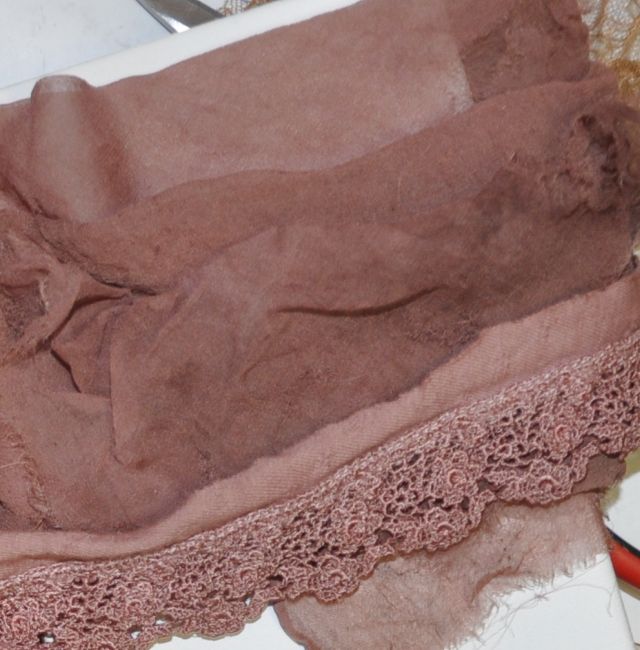
This dye/tannin was definitely worth the expense. I’ve had a pot sitting for two weeks in the back room, where it’s quite cold in the winter. No mold grew, no funny smells, no questionable sludge, so i decided to throw a few odd bits in to see what colours i’d end up with. (I know there’s still a lot of colour in the pot, as an experienced eye can tell when a pot is exhausted and when there’s still dye stuff left.)

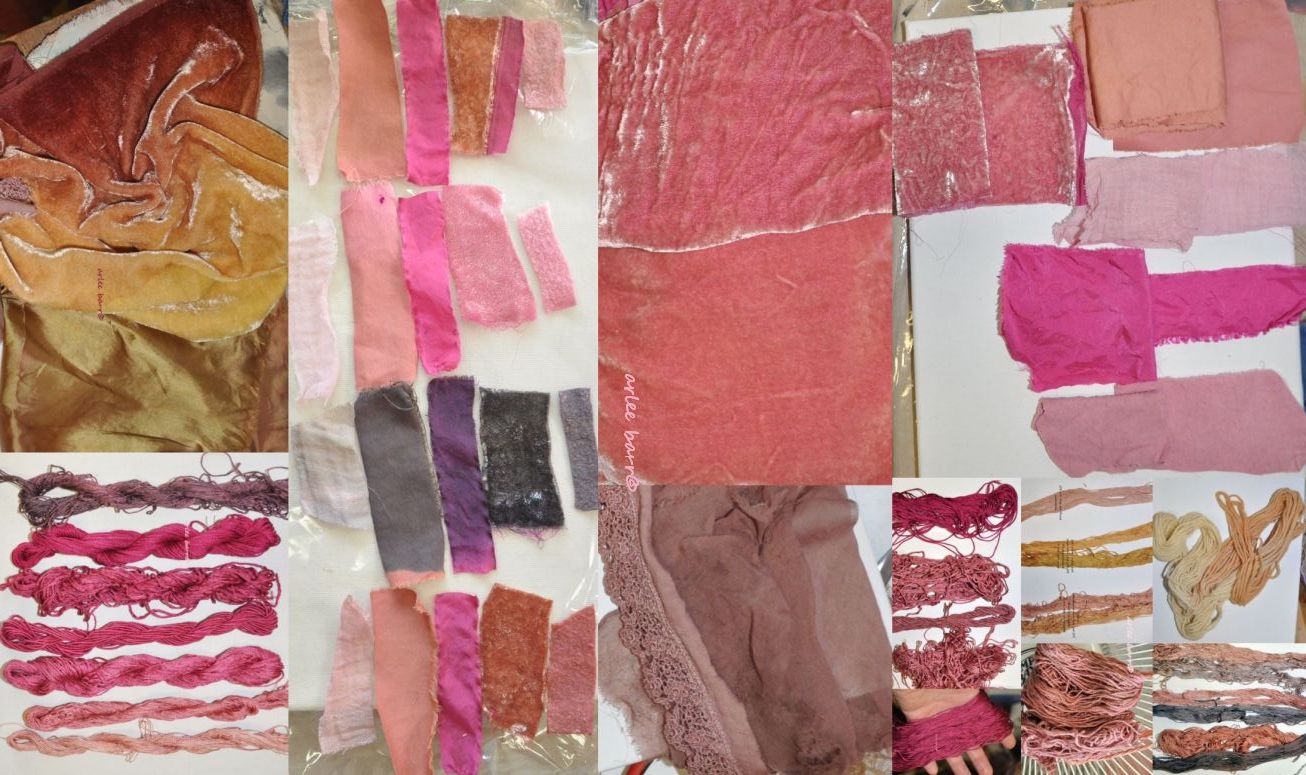
A few scrappy bits of sheer silk chiffon from 8 years ago (the original hollyhock had completely faded: no mordant!), i love the purple/pink cast to this brown. The cotton lace was a surprise as well. (Note none of these were premordanted, in this case because QR is also a tannin, which can be a mordant. Normally i would have premordanted, even old scraps.)

Since most of the cottons i had done before were not terribly exciting with the QR, this bodes well.


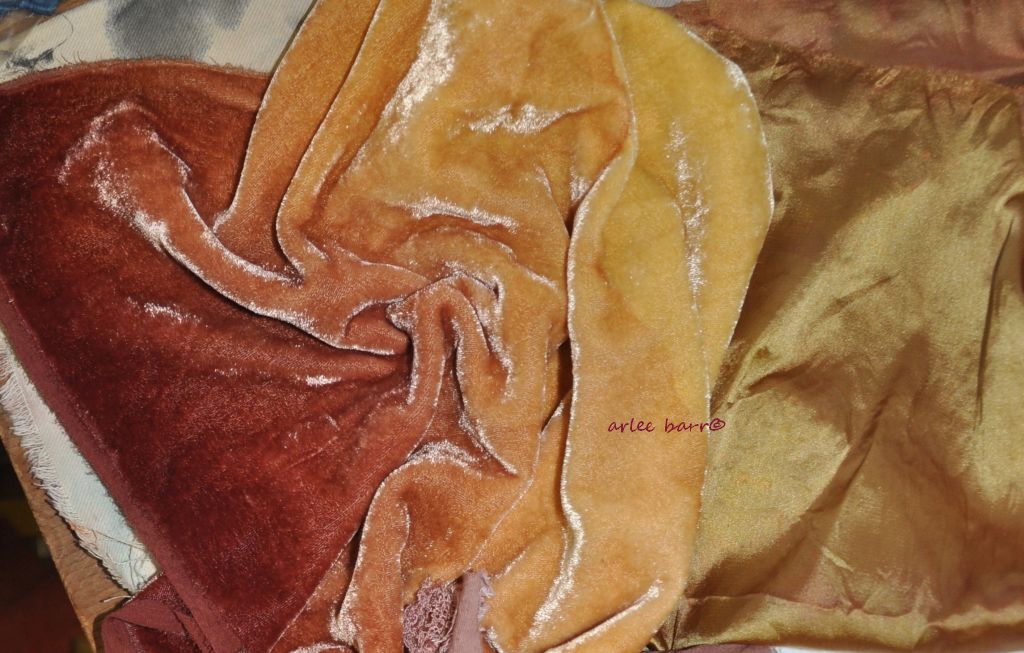
The gold in the photo below, to the right, was an errant piece of previously ecoprinted POLYESTER, that had snuck into the pot long ago. GOLD? All right!

But that deep reddish brown on the osage (yellow) silk velvet–OOOOOOOOOOOOO!

So, the Quebracho Rojo has gone from giving striking pinks and purples to rich warm browns., money well spent.

Posted in "OPINIONATION", Natural Dyes

I’m going to burn in hell

If you don’t give a flying youknowwhat about natural dyeing, move on, friend.

Beets, beans, olives, mint, spinach, blackberries,ย  carrots, cherries, raspberries, red cabbage,. Yum, but not dyes. Really. They are not dyes. Even so called “reputable”, “popular” authors are buggering about now with these. PLEASE please please PLEASE, if you must include these in your book, make sure it is OBVIOUS that these are fugitive/bad/stains only/pointless for using on fabric. Maybe write a book on how to dye Easter eggs instead. Or salt and flour playdough for kids.

However.

I’m not aware of any field of craft anywhere else as “natural dyeing” that advocates the use of bad practice as “play”. Since so many espouse “ecological awareness and sustainability”, how does that balance with the waste of time, resources (water and electricity), materials (cloth and thread) and plant materials? Granted some of these plant materials *are* “waste”, but they’d be better in your compost then, so that you could then grow healthy plants that *do* actually dye. The approach too that “if it fades, it can still be pretty, or dyed again” does no service to the natural dyers who pride themselves on products done well to begin with, that do not need overdyeing after a month, and who have customers who spending their money, expect a little more than “well, i can re-do it when that purple turns to washed out beige”.ย  (Assuming the customer is able to get the product back to them, WANTS to get it back to them, and then can pick it up again….AND are you going to charge them for the re-dye???? Really?) And is that customer going to trust that the product WILL last this time? Even if you are not selling the item, how many times has the family member/friend worn that spinach dyed toque? Or have they “donated” it to the local charity, or tossed it in a garbage bag going to the landfill, saying “oh so sorry, i lost it”? MORE waste.

When learning to play with different mordants and modifiers, why not use an accredited dye that will actually teach you something about natural dyeing? Just because mint/blackberries/beets react with these chemicals, doesn’t mean a real dye is going to act the same way. Just because a plant is “readily available” does not make it a dye plant. Where is the historically relevant data, where are the extant samples, the light and colour fastness tests results? Artfully staged photos are not “proof”.

Because you can bet if i styled a cantaloupe with some coral silk, or an eggplant with artistically draped purple wool gauze, someone would automatically wax rhapsodic about the beauty and depth of colour, and accept it at face value… I’ve seen it too many times on FB, Instagram and on blogs. Liars.

The claim that natural dyes are “expensive” is specious as well. At the very least, many reputable dye houses sell mixed packs that can give even a novice good results. There’s a system of Cost per Wear, that says if i buy a dress for 200 and wear it once, it cost me 200 that is now gone: if i wear that dress 20 times, it cost me 10 per wear, and i didn’t have to buy a dress to replace it. If i use water, electricity, cloth and beets (for $10 for enough to “dye” with), and the colour washes/fades out, i now add the cost of the water, the electricity, the cloth, the time and the damn beets and it probably comes out to more than 10, that is now GONE. AND i have to redye it or the cloth itself is now wasted. This is “sustainable? This is ecologically responsible?

Is this the “if it’s on the internet, it must be true” mentality? Books can be as bad for information, given the spate of vanity/self publishing now, or from publishers/editors who really don’t know the field, and who don’t care as long as the book sells. Even authors with years of experience and actual research will advise that something didn’t work after all, that the information was erroneous to begin with. (Jenny Dean admits hollyhocks do NOT work as a supportable dye.) And if you’re going to teach, or are avid about less waste, and more responsibility in the textile field, why not promote something that does last, that is proven to be viable. The number of books a person publishes, or what position she/he holds has nothing to do with veracity. (Look at Dr Oz……….) Obviously too, “facts” can be tailored for books, not presenting the whole picture.

We have this little Cult of Personality too, where no one is willing to speak up, to give honest opinions, to present true facts. This means the book/blog/website/class/workshop is free to promulgate more disinformation/folklore/slanted views, and now it’s the Bible, and if you disagree, you are a heretic.

Burn baby, burn. Guess that’s me.

And there’s a new post too about this ๐Ÿ™‚