Posted in Deliberation--do something you don't do--or haven't in awhile, Natural Dyes

cut cuttedy cuttedy cuttedy cut

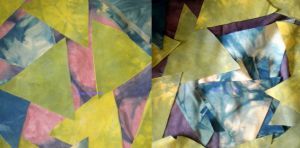
I’m of a mind to make something larger from these latest dye results.

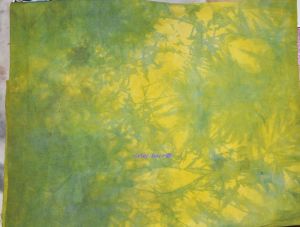
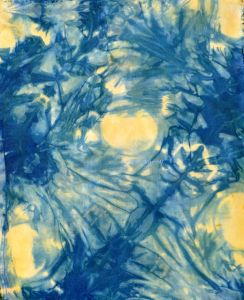
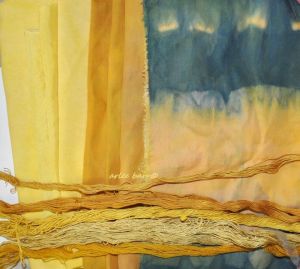
Above osage over indigo, below indigo over tansy.

But i need a third colour–contrast? Co-ordinate? Do i calm it, or dramatize?

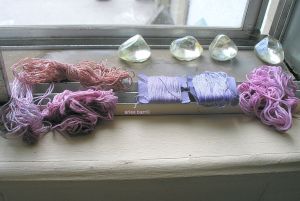
General consensus so far on social media has been the purple.

Anyone who thinks natural dyes are boring browns: HA.

Making a layout is not going to be easy though, with dog hair, grass clippings, loose threads and assorted cosmic debris on the floor, the only place big enough to use. (And that’s *after* vacuuming 🙂

Posted in embrilting, FybreSpace the shop, Indigo Dreams, Naturally dyed threads, osage

a serious love affair

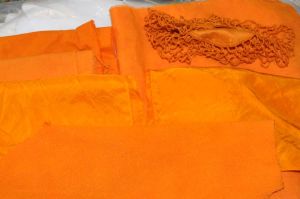
Such sunshine from this one pot of Osage Orange! Bought from Maiwa, a dependable, high wash and light fast dye made from wood chips, it’s such an antidote to the grey smokey skies we’ve had for the last three (?more? seems like it…) weeks. My tansy results were poor again this year, not sure why since i followed the same recipe i always have, one i always got good results from, but not in the last two years. Locally, as i have mentioned before, the soldiago/goldenrod is sadly a stunted, mingy little plant, that i now leave alone, for pollinators. Weld is spendy, though highly rated, but the budget allows for Osage in plenitude.

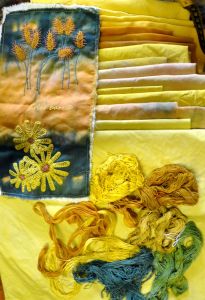
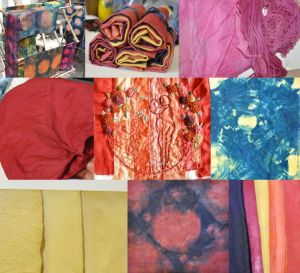
I’m building up a stock of these fabrics, for overdyeing, for playing with post modifiers, for shibori and because i have little yellow in any form in my stash!

And greens too!

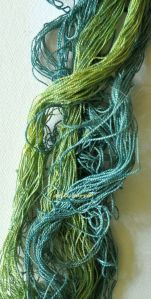
Having fun working on these as well, for little projects! The threads here are osage, sandalwood, walnut and indigo, or blends thereof, on osage over indigo over madder, all cottons 🙂

Just a hint too, there is only today and tomorrow left for my 8th anniversary sale in the shop. Enter 8AFS in the discount box (and make sure you click on the little black circle to add it), to receive 20% off EVERYTHING in the shop, sale items and art included. Someone remarked my shipping prices were too high, BUT i ALWAYS refund any differences in what you paid and what the actual postage is at the post office. One cannot guess at weights and costs to other countries/continents, but one does one’s best to be fair. I’m sure you’re all familiar with packages that you paid 15bucks to have shipped to you, and when it arrives, the post stamp clearly says it only cost 4.95……


I’m just mad about  Osage
Osage’s mad about me
I’m just mad about Osage
She’s just mad about me

They call me mellow yellow
(Quite rightly)
They call me mellow yellow
(Quite rightly)
They call me mellow yellow

Paraphrased 🙂

Posted in Days of Honey, embrilting, in progress, Indigo Dreams, Jam Day, Madder, osage, The Summer of Madder (Study)

just a day

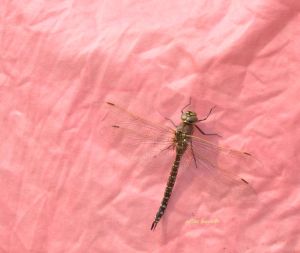
Here’s proof that pink calms dragons as well 🙂 He then flew onto my shoulder to say hello, before he went off on business.

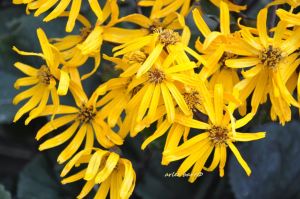
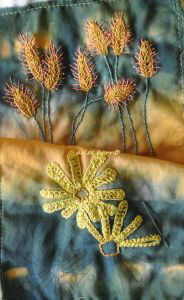
How can one ignore inspiration from one’s own garden? It wasn’t just the yellow shouting of these Ligularia flowers, it was the indigo shadows underneath as well, due in part to the smoke still hanging here.

Posted in "OPINIONATION", Book reviews, Natural Dyes, Probably talking to just myself

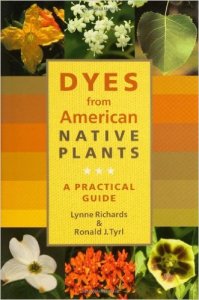
Book review: Dyes from Native American Plants

(I reviewed this on my old blog, but thought it worth repeating here, with a few edits.)

You know what the best thing about this book is? It gives a detailed list of plant materials that give little or no colour!!! That means less wasted time, fabric, heat and gathering 🙂 Though it’s a bit more geocentric than i thought it would be, given the slightly misleading title (covering mostly what grows in south-central US), a lot of the wild plants mentioned are widespread in North America, even up to Alberta. It does miss out on a few plants in the same species, but given again that it is geo-specific, that may be why–one variety in the species grows there, but not others. It’s also decidedly not a “kitchen scrap” book with claims of blue from elecampene, magenta from dandilion roots, green from spinach and lasting effects from turmeric!!!

No vinegar or salt “fixes” either–really, just go, run down to the corner convenience store, buy a bag of potato chips fer jeebly sakes, if you’ve got a hankering for salt and vinegar, and stop mushing on about how they make berries last longer and stops rust from rusting…….

The only true problem with this book, is that it doesn’t give any indication of what is light or wash fast. It does tell you *how* to do that, but there are no notes with plants what is worth the effort, and what is a waste of time, effort and resources. I truly believe too, that testing for these should be an INTEGRAL part of the dyeing process. Maybe then we’d see less of the Beet and Berry Brigade posting their results for the GaGa newbies…………… There’s also no mention of post modifying, an important and often surprising process that brings unexpected colour out.

So what else is in it?

It’s laid out with plant materials grouped by colour results, it has a comprehensive index with the Latin and common name (though the common nomenclature may be regional), there are photos of the plants mentioned. I would also recommend investing in a good geo-centric plant guide, like those published by Lone Pine Publishing, so that you know what you are looking at, and hoping to gather. The author speaks of responsible gathering and safe dye practices and it’s not dumbed down or too technical. My only complaint is the prevalent use of tin as mordant in a lot of the dye baths. Even in 2005 (the date this book was published), we knew this type of mordant was dangerous for the dyer, and best not used in the home. There are no “recipes” per se, for the novice, but the more experienced dyer will already know that as with most plant materials, your plant chunks ratio should be at least of the same weight as your fabrics/threads.

There were a few surprises with some of the flora mentioned. Certain plants abound here, and while i’m not going to get too excited about the possibility of using them, it does give me new hope for local colour. Many of them are also though, while “plentiful”, are in our National Parks–and i am never going to scavenge great quantities, because of that, and because they belong where they belong, period. If i find them in a ditch however and if it’s in my immediate environs, and i know it’s considered invasive or noxious, it’s fair game. I recognized a few varieties i had no idea would give any colour at all, but because of my frequent walks with the DogFaced Girl, i know that locally these are very very small ecosystems, and i would feel incredibly guilty if i denuded the area. I am passionately interested in using what i can find, but not at the expense of the primary reason why i do these walks and that is to appreciate what is there, not what can be taken away! You’ll note i did not mention any of these by name—–i don’t want to be blamed by the Cosmos for encouraging somebody sneaky to go and strip their area!

Of course, the preponderance of colour mentioned is yellows and browns, as few native North American plants have the tinctoria classification 🙂

Posted in Home Cookin' the Cloth, Jam Day, Natural Dyes, osage

“Ain’t no sunshine”

Ain’t no sunshine when she’s gone
It’s not warm when she’s away
Ain’t no sunshine when she’s gone
And she’s always gone too long
Anytime she goes away
Wonder this time where she’s gone
Wonder if she’s gone to stay
Ain’t no sunshine when she’s gone
And this house just ain’t no home
Anytime she goes away
None here, because there’s so much smoke again from BC and California!!!!!!
Normally at this time of year, i’d be using tansy or goldenrod, gathered locally, for base yellows, but for whatever reason, this season again, the tansy gave very poor results, and the goldenrod is so stingy mingy stunted in our climate that i always feel guilty gathering any. I miss the big beautiful bounteous ones from Ontario and the East!
So, since the objective was to make some gold for making green 🙂 , i dug out the Osage and had some sun fun with it.
“You are my sunshine, my only sunshine….”
Posted in FybreSpace the shop, journal: lessons to learn, Natural Dyes, Naturally dyed threads

8th anniversary natural dyes!

To celebrate my loyal customers who have supported me through this adventure, i am offering 20% off EVERYTHING in the shop–that includes sale items, Art and fabrics! As always too, i refund extra postage paid. The discount code is 8AFS, and because the instructions on the form are a bit confusing, after you add the discount code to the little box, make sure you click on the little black circle too!

According to my old blog, i started “messing with potions” in the form of natural dyes, sometime in July of 2010. From threads that faded in days, kvetching that most dye books mentioned only wool, smelly jars that resulted in copious ick and mold, and wondering how you knew what to mordant with what, i’ve come a long way to piles of naturally dyed fabrics in strong colours that last, a rainbow of threads and a library that is dependable and exciting. Along the way came knowledge about the history, economics, science, geography, arts and culture, and folklore and fact, so much more fascinating that any synthesized dye! (I won’t say “chemical” dye, as it’s ALL chemistry, even/especially the naturals! 🙂 )

Lovely lovely hollyhock colours–that faded in a week

I had hard lessons about the value of mordanting, above (i didn’t at all…), and of learning about fugitive dyes, below:

Hibiscus Ha Ha

I learned about the quality of dyes:

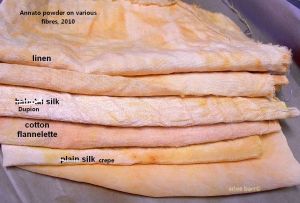
Annato powder used on several fibre types
Annatto powder sold for food colouring used on several fibre types, no scouring, no mordant

And the correct WOF use:

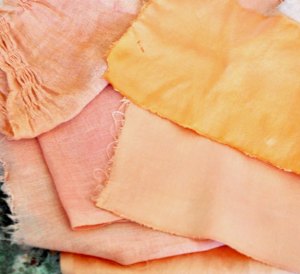
Actual annatto, correct WOF, pre-mordanted

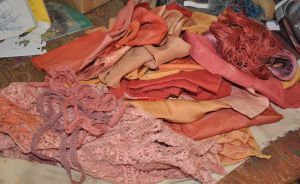
I learned that cheaping out does not give good results–if i bought the dyestuff, obviously i should be using it correctly, but these were scoured improperly, poorly mordanted, and low WOF, madder:

And done correctly below:

Yes, it *was* fun, playing with whatever was handy, experimenting and mucking about, and it *is* a way to learn about natural colour, BUT all those poor results, fugitive dyes and improper procedures become expensive wastes of time and materials in the end run. “If it’s worth doing, do it right.” “When in doubt, read the instructions.” Because as my mother always says “You buttered your bread: now you have to lay in it.”

Posted in Indigo Dreams, Jam Day, Natural Dyes, tansy

cooking with noxious weed control

Just doing my bit to keep invasives from taking over 🙂 Tansy, oh Tansy, i love you, but you’re considered “noxious” here in Alberta. And YES, i get that invasive/non-native weeds plants can be a serious problem. I’m a Nature Girl, but the best Nature is, well, Natural, not “introduced”.

Okay, really, to me, a weed is something that grows in my garden that isn’t edible and/or pretty. I let the purslane and amaranthus go crazy, the millet seeded from the bird feeder, the bindweed in the lawn, the dandilions even. Control is maintained by mowing the Back40 often enough, but not MEGA SHORT (cause A  that’s ugly and B bad practice), so our little nasties there are never taller than 3″. We have a milkweed growing by the side fence where no other garden is, and guard it jealously, as the bees love it, as do other pollinators, and hope and pray that one day, some day we have visits from Monarch butterflies. I don’t think i’ve seen one since i was a child in mid-western Ontario, many many moons ago.
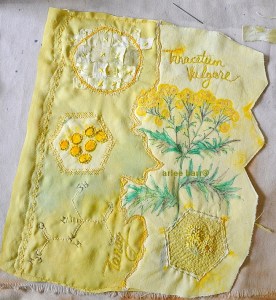
(I should finish this, from 2012…)

BUT, Tansy is really really prevalent here, so i’m ambivalent about the growth, and the destruction of it, as the city and the province would like us to do. On the fence actually, because i cut their pretty little yellow heads off so they can’t set anymore seed, BUT they also reproduce easily from a rhizomatous root. However, because they are so ubiquitous here, i feel no compunction in bringing home bags and bags and bags of decapitated Tanacetum vulgare, to throw in the dyepot fresh, and to dry for future use. The colourfastness is classified as “good””, and with proper mordanting, i don’t worry about its longevity. (Note though, the longest lasting natural yellow is Weld, an ancient–and spendy–dye. Can’t grow my own because it too is a No No here in Alberta.)

Too, yellow is the most scopic of all natural dye plants, from a multitude of sources, some light and wash fast, some not so much. It is however, if you remember your primary mixing of colour, a good base for oranges (think corals and peaches, not pumpkins 🙂 ), greens (teal! emerald!) and browns (chocolate chocolate chocolate!). The photo i showed here is the reason i picked much of this, and plan on stockpiling fibres as bases for overdyeing. I didn’t get *quite* the greens i wanted, but will keep trying.
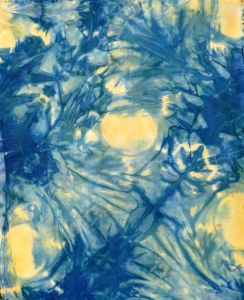
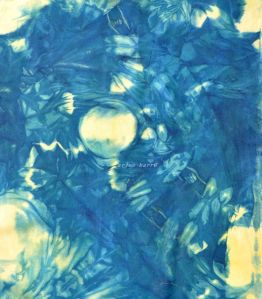
Tansy on bamboo above overdyed (obviously) with indigo.  I’m going to try again with cotton (because i’m out of the bamboo) that took up a load of oxidized tannin, as the yellow uptake was quite strong.

There were more greens in the shibori samples below, but the indigo is now weak, and needs reviving. Ah, to find that happy balance. The tansy dyed cotton was post modifed in, top to bottom soda ash, iron and copper before the indigo dip.
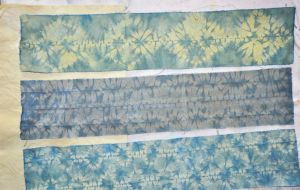
I need to find a disappearing type of marker as well. Even after the “finishing” of these pieces, the pencil i used is still visible, okay for samples, but not for actual work.


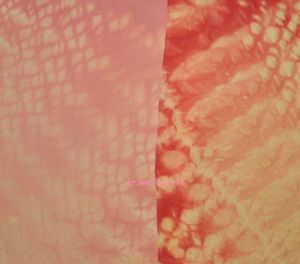
And i also want to do this again!
 

Posted in Madder, mordants and modifiers, natural dye research, Natural Dyes, tansy, The Summer of Madder (Study)

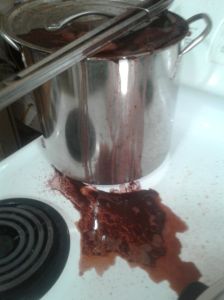
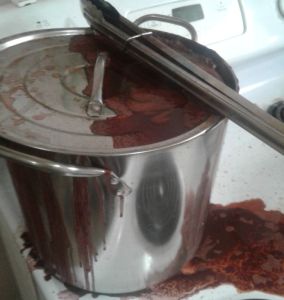
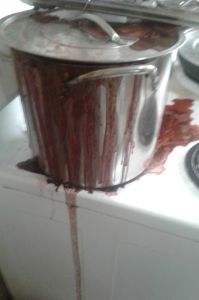
gimme the ticket, i’m guilty as hell

This morning’s madder mess was easily cleaned up with a bit of a bleachy scrub, something that was still out, as earlier in the week i also had an exploding indigo stock solution on the kitchen counter……… Yes, my kitchen could have been red and blue, naturally 🙂

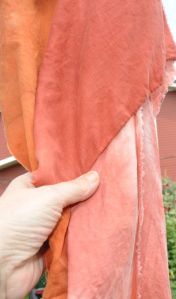
I quickly scurried the pot out to the patio, and with temps being in the high 20C’s and set on concrete, it stayed hot all day. I hucked some cloth in there, just to see what was left, and am glad i did.

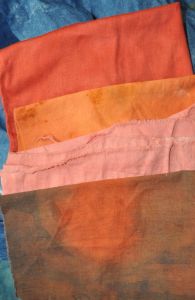
Top, tansy dyed first, then a rusted piece that had been treated with titanium oxalate, an undyed piece, and an indigo over tansy and madder, all previously mordanted with tannin and alum, all cottons:

Below, left to right, the TO/rust, the tansy, the undyed:

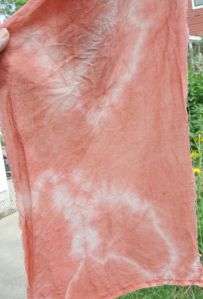
I’d loosely scrunched the undyed–LOVE it.

Waste not, want not!


Posted in Deliberation--do something you don't do--or haven't in awhile, Madder

distracted dyeing ticket…..

good thing the dye police weren’t here……

i’m off in another room, and i smell the sweetest thing, then realize i accidentally hit the stove knob when moving the madder……….

well, it *was* due for a heat up to prevent mold, but.

wonder what colour i’ll get now? (madder isn’t supposed to go above 72C/160F,  but this definitely boiled……)