Posted in Ecoprints and Natural Dyes, FybreSpace the shop, Indigo Dreams, Moons, Natural Dyes, Probably talking to just myself, Work 2018

dot dot matrix (shop update), and the use of poisonous (gasp) plants in the dyepot

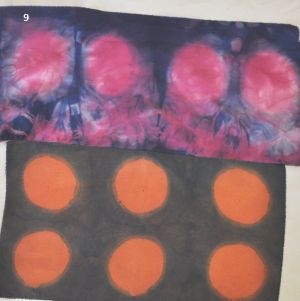
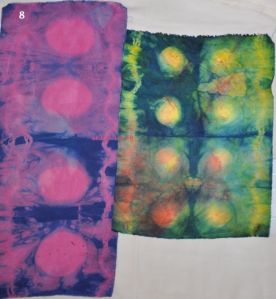
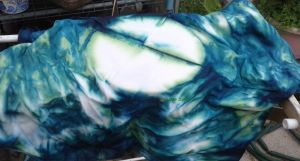
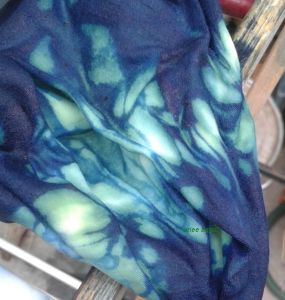
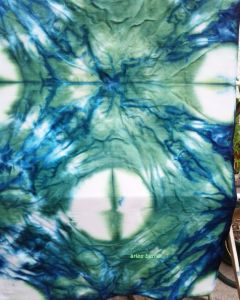
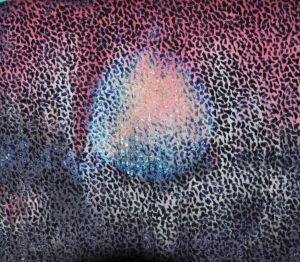
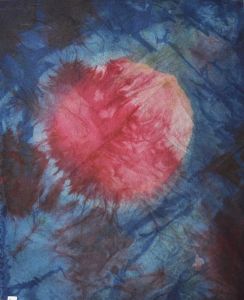
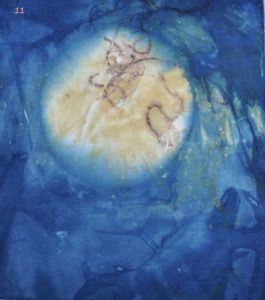
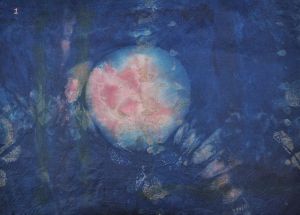
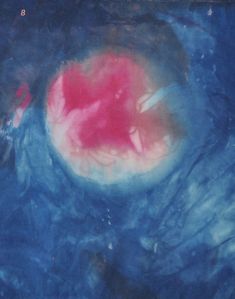
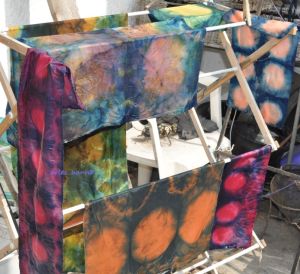
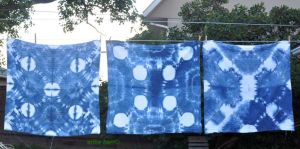
It’s hot, it’s sunny, it’s dry in Calgary, so while that lasts, i’m running a lot of indigo! Some of these babies will be kept for the stash, as i’d like to do an adjunct project with natural dyes this summer, not just the Summer Madder Study! Some will go in the shop***. I have listed only a few to start with, as it takes time to “match up” pieces, so they’re interesting :), and more time to photograph! There are MANY more to list, BUT once the ones in there now are gone, they are GONE, as these are impossible to replicate.


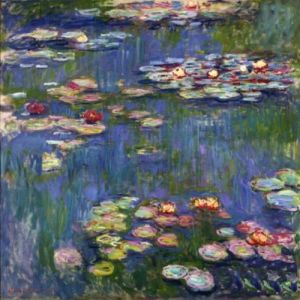
Indigo over madder:
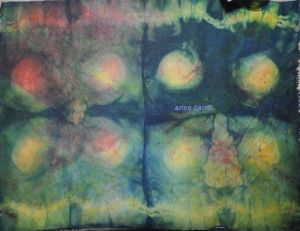
Like a Monet painting!

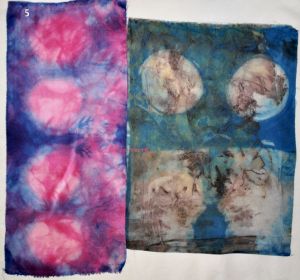
Indigo over tansy and madder:
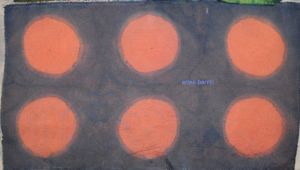
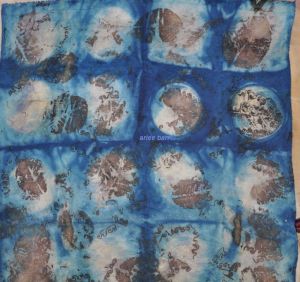
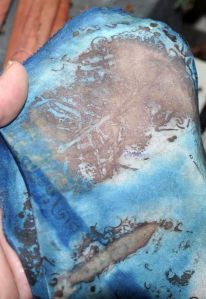
Indigo over ecoprint:

This one above i really love, as the indigo turned the ecoprint almost metallic!
 

~~~~~~~~~~~~~~~~~~~

I’m still in need of green threads for projects, and remembered i still had some dried privet berries stored away from last February. CRAP, this points up why some materials should be used fresh, rather than dried or frozen……
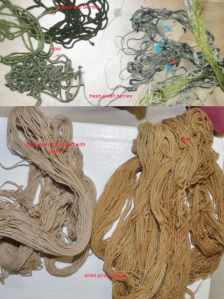
And OMG did the dyepot STINK. A deep dark brown, it immediately got poured out in a spot where nobody goes in the back alley! I want to point out too, that privet (Ligustrum vulgare), while an attractive garden shrub, is also TOXIC. (It’s also invasive, so you might be doing the neighbourhood a favour by grabbing the berries so they don’t turn into baby privets…) One wears gloves, and one does not go all airyfairy breathy goddess and hang one’s head over the pot, inhaling deeply and exclaiming about Mother Nature’s wonderful gifts.

I’ll have to modify those to get greens, or dip in some indigo….

If you forage locally, know what you are gathering, and any potential toxicities.  Also, check to see if *your* country has a Biodiversity databank. Canada has an excellent one. They do also mention other areas, in the US. http://www.cbif.gc.ca/…/canadian-poisonous-plants…/…

~~~~~~~~~~~~~~~~~~~~~~~~~~~~

***Please bear with me as i update shop offerings. I know it may be annoying to continually see posts of “GO TO MY SHOP AND BUY BUY BUY”, but as an artist, and a small business owner, this is the way i help keep the groceries on the table, animal food in the pantry for the assorted beasties, and the occasional “luxury” like new socks and underwear 🙂 My hardworking Greyman  is very supportive of me, but i still have to pull my own weight, as an even partner in our marriage! I have only 3 avenues to promote my business: here, on my FB “biz” page, and on Instagram, so i have to take advantage of that. I don’t do craft fairs, though i may do the Contextural one this year, haven’t decided yet, so online is where my business is. Yes, it may seem pushy in a way to keep seeing these “ads”, but a Woman Has to Do What a Woman Has to Do, and the Gawdz know i ramble, rant and rite write about other stuff often enough in other posts, that i hope you will understand.


Posted in "OPINIONATION", Book reviews, natural dye research, Natural Dyes

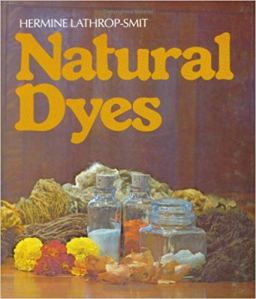
Book review: Natural Dyes (1978)

One doesn’t really need another dye book for the library, but i couldn’t resist, as this one was written by an Albertan, Hermine Lathrop-Smit, and is touted as “specific” to Canada.

Actually, it’s pretty much North American–most of the plants are available throughout a number of climes, and are not particularly geo-centric. It’s a funny little book, given when it was written, and some of the plant materials are specious in one way or another–beets don’t give red (i was QUITE shocked to see that entry, though she does mention that it’s not colourfast….), berries used are rarely light or washfast,  and no mention that lily of the valley and bloodroot are poisonous.

Illustrated with black and white drawings, i would recommend referencing an actual plant guide with colour photographs and full descriptors of leaf, stem, flower and seed, and growth habit (is it a bush, a vine, a flowering plant, field, mountain or water sited? These guides always mention toxicity as well, very important in the wild. Wouldn’t want a bear to eat Poisoned Forager (sub-species, varietal) 🙂 .  I use field guides for Alberta, and the Rocky Mountains, from Lone Pine Publishing which can be found in most garden centres, Walmart (!) and sometimes National Park gift shops. Some entries in these books will mention whether or not the plant has been used “historically” as a dye material, but don’t take that as a rule of thumb, as some of that is based only on hearsay and old wives tales! Lone Pine has a number of geo-specific books, so look for your area. You can also order online, if you can’t find them locally.

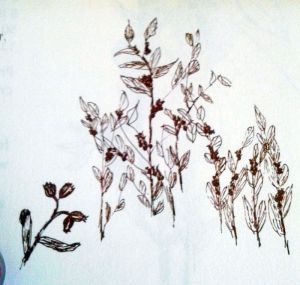
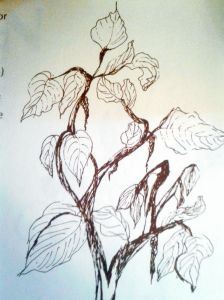
These drawings are rather vague, though she does give Latin names. I wouldn’t however have been able to determine WHAT these were from the drawing.

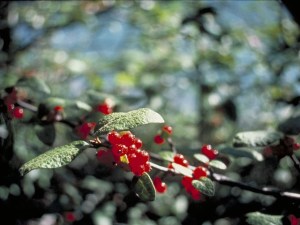
Buffalo berry/Shepherdia canadensis

actual photo:

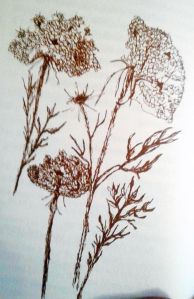
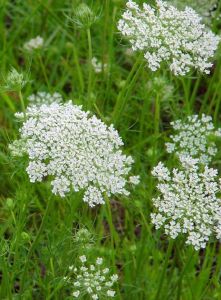
Queen Anne’s Lace:

This plant is particular is dangerous to identify from a drawing only, as there are many similar plants that are HIGHLY toxic. *I* know what QA is but that’s because i grew up with it. (Even it can bother some people, though NOT as much as the others!)

Birch. Seriously? While some know that birch is “peelable” bark wise (DON’T, unless it’s a dead tree or a broken branch!), most don’t know the difference between birch and aspen. And no one is really going to be able to positively identify this:

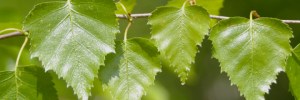
Heck, you might even think it’s alder. Below, the real thing:

You also need to watch out for common/colloquial/local names–one person’s bluebell is another’s Polemonium. Latin is the same EVERYWHERE.

I realize too, the cost of colour photographs was probably rather spendy as all was film in those days, but don’t depend on these for proper identification! The drawings especially of Queen Anne’s Lace can be very misleading, as there are a number of very similar plants, in the same family and in others, and some are extremely dangerous to human and animal. (I can’t reiterate that enough. Too many associate natural with “safe”– arsenic is natural too….

The use of alum is rather heavy-handed as well: 50gr to 200gr of wool, since most modern recipes recommend 12-20% WOF for “regular” alum (aluminum potassium sulfate ), and 5-8% WOF for aluminum acetate (THE recommended alum for cellulose fibres). Mention is also made of mordants we now try to avoid, like tin, chrome and copper sulphate. Note though, that some dyers with caution, expertise and experience still use these. Rarely do we use Glauber’s salt either–though maybe we should!

This book could also be confusing for the novice! There’s a chapter on mordanting that precedes the actual dye plants, but in many of the recipes, she adds the mordant to the dye bath, or no mordant at all, giving the impression that some don’t need it. Since none of the plants mentioned, except for walnut, are substantive (meaning needing no mordant), this gives the impression that these plants will give colour that stays, and that will be strong from the “get go”. Honestly, i mordant EVERYTHING, even for indigo, madder and walnut, not because they need it, but because having a stash of premordanted fabrics on hand means i can dye with anything, when i feel like it, and have it take the colour. Mordanting doesn’t hurt substantive dyes, so rather than take the chance of accidentally getting something unmordanted and going in a dye material that needs it, i figure it’s best to be prepared.  I do keep bags labelled with each type of mordant however, as mordants react differently to dye materials. Post mordanting *is* possible, but in my experience, the colour is not as strong. Overdyeing of substantive colours is also possible, but then they must be mordanted for the dye type being added over the substantive dye.

There’s a list of suppliers in the back too–when i searched, most of them are of course gone. Funny that one of them was Wide World of Herbs Ltd, in Montreal, the place where my 33 year old madder came from! Also included in a ONE page appendice of dyeing with lichens, very uninformative and vague.

So, in the end, this one stays in my library anyways, as a bit of history, a bit of useful information and a bit of a laugh.


PS DO NOT click on ANY of the “free PDF downloads” if you search for Ms Lathrop-Smit, as they are probably toxic malware sites!!!!!!!!!! I could find NO actual information about her, or any mention by anyone in article, blog, research site or history of the area.

Posted in FybreSpace the shop, Indigo Dreams, journal: lessons to learn, Natural Dyes

“shopfull” indigo revival

I had to make a new indigo vat, as the old one while having been successfully revived last year (after going through 3 frozen outside Calgary winters!), is now defunct, kaput, gone to the Great Blue in the Sky Vat. The 123 vat, well, we just won’t go there again…….i took the lid off and i’m sure the neighbours three doors down heard my horrified gasp. It’s definitely a note to throw out when it’s GREY, molded and has a suspicious pancake of solid yellow schmutz in the bottom that won’t break up……

As i was going through drawers and boxes, looking not only for dyes and chemicals, but fabrics as well, i realized too that it’s almost an anniversary, 8 years of natural dye, sometime around the beginning of August, and wow have i come a long way! In the beginning, i played and got lovely colours that didn’t last (no mordants!), used things that didn’t really qualify as a dye (lilac flowers, anyone?), but i learned from this what would give colour, a bit about post modifying, and got quite excited about indulging a childhood passion for “potions” and finally that actual RESEARCH means you can do it right, right from the start. I really knew nothing about natural dyeing, in respect to process, though i did know the basic history. Along the way, i also learned to ecoprint/contact print/botanical print, whatever you want to call it 🙂

Subsequently, in the shop are some wonderful combinations of natural dye, ecoprint and indigo. The prices are low, considering the processes, and the size, so please, do indulge yourself:) As always, any extra postage you paid will be refunded!


Posted in a collusion of ideas, Ecoprints and Natural Dyes, embrilting, in progress, Redux projects, The Summer of Madder (Study)

mining the past again

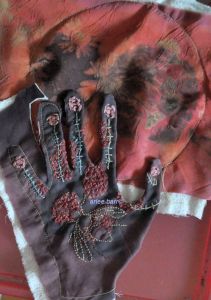
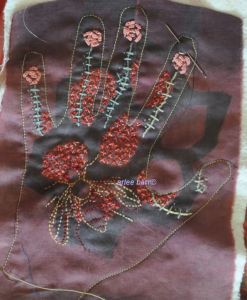
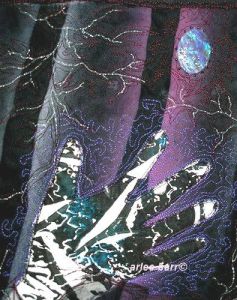
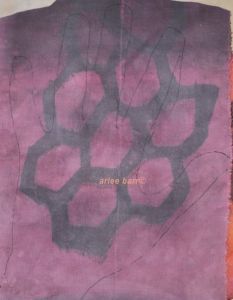
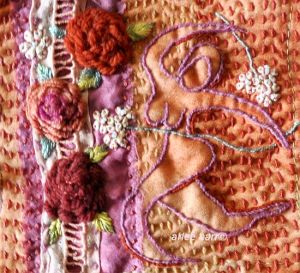
That’s a page from a 2007 “fabric art journal”, a time for me of experimenting and heavy machine embroidery. “Kirlian Hand” is a portrayal of the so-called phenomena of a person’s “aura”. Named after Semyon Kirlian’s accidentally discovered observation in 1939, that if an object on a photographic plate is connected to a high-voltage source, an image is produced on the photographic plate—- and touted in the 70’s as captures of the human spirit! (My ex was heavily into this, Hollow Earth theory, pyramid power, Chariots of the Gods alien conspiracy, and the whole “new age” crapola of the time….used to drive me nuts…but then *he* was/is.)

Anyhoo, i did like the design possibilities of this, so wth. The hand was cut from screen printed fabric, all of the embroidery is by free motion and the abalone shell piece was attached with glue and beads (i think..the page is somewhere in a box with other relics of the time, in a little room at the back of the house so stuffed i can’t get into it. Note to self: do something about that this weekend, there’s some Good Stuff in there too…)

It’s interesting to look at old work and not only remember how and why it was done, but to go forward with it as well, in a new direction. Yeah, some of the results from the way back machine are either embarrassing or weak, but some of it is still valid, good, intriguing, and touches a chord. Let’s roll with it!

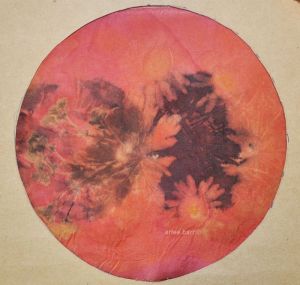
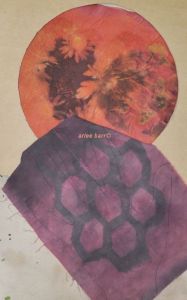
As i mentioned in a previous post, i’m working on improving my ecoprinting skills, and while my little tests are very quite promising, i’m not completely satisfied yet, BUT, i can still use some of the bits in the Summer of Madder Study project 🙂 I’m going to “condense” the above layout a bit, due to the size of the moon i want to use, because the original layout would make too big a section to work on comfortably, considering the scale.

I’ll have to be tender with the moon too: a silk, i always have problems with stitching on this fabric, by hand or machine, as the threads of the fabric tend to “pull” when the needle goes through. I’ve tried finer threads, and smaller eye bulbed needles, but haven’t solved the mystery yet, so minimal stitching on the moon. Given though that the details are so fine and so delicious, less is more anyways: not everything has to be encrusted!

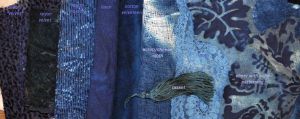
And the potential layout–just pretend/imagine the fingers are separate so the moon shines through 🙂

It’s now time then to set up the outside stitching corner!