Posted in Collision: the work begins, embrilting, The Summer of Madder (Study)

gonna rock some pockets

Most women’s garments just don’t have pockets, or real, decent pockets. I’m tired of jeans with fake ones (a cop-out “detail” at its worst–who’s looking at me that cares if it looks like a pocket if it isn’t????????), tired of ones that are too small, or so small and deep that you can’t get anything in, but if you do, you can’t get it back out, ones that don’t lie flat, ones that twist, ones that are placed too high, too low or impossible to find behind your back, and pockets that quickly develop holes.

I have SO many ideas for this Summer Madder Project garment, too many maybe, or maybe enough that there could be a couple of pieces! As things go in, (some delicate vintage lace now! and more threads!) and things come out of the madder pot (hopefully, an even deeper red), i thought one best start somewhere, so pockets, pockets it is. I want capacious, generous baggy pockets, suitable for gathering leaves, stuffing monies in and snacks, carrying lost journals, lost kittens, injured birds, rocks, whatever: pockets should be able to comfortably CARRY things. That’s their function, truly. And if these don’t work as pockets, then they become small bags!
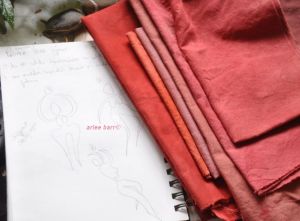
I’ve used similar little figures before, but since i plan on using them scattered around, the above are newly “designed” ones, along with 4 others not shown. Previous incarnation of the originals is here. (There will be other motifs as well, but these are a good start.)

Since this project when done will have to be washed by hand (due to natural dye Ph considerations), i’m not hesitating to mix silk/wool, wool, silk, and cotton threads, and fabrics in silk and cotton. The range of colours is more enticing on all the different fibres than using just cellulose or just protein fabrics and threads. The original plan was to create a “top” from a Tina Givens pattern, and i’m still going to use that (minus the ruffle, and lengthened a bit), but given that most of my embroidery is done with a flannel backing, this is going to have to be lined somehow, to hide the flannel and protect the reverse of the stitches. That means it’s a bit “heavier” than normal summer wear, but given that our nights here in the summer are a lot cooler than elsewhere, due to our altitude, that’s perfectly acceptable. I will however be using a thinner flannel than normal. I *could* use a finer cotton as a backing, but then the effect that stitching on a backing like flannel is lost–and that’s what my work is about, that added little dimension and depth. That’s why, for years, i’ve called it “embrilting” 🙂

As i’ve thought of the stitching itself, i’ve also come to the decision that more dimension will be “needed” as well, to personalize this to me. I might be going overboard, but time and effort will tell!
 

Posted in Madder, mordants and modifiers, Natural Dyes, The Summer of Madder (Study)

seeing red

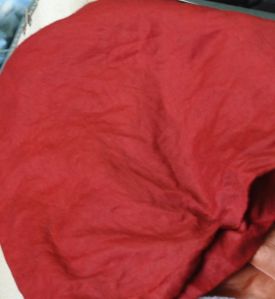
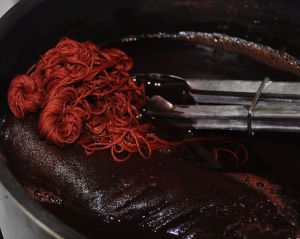
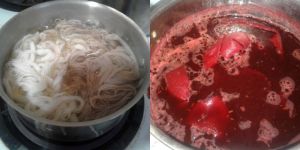
Oh so close to disaster! My brain must have done a fancy flip of some sort, because on Saturday i was bemoaning to Greyman, that i couldn’t seem to get the madder pot to 140C. He most emphatically with gestures and other well chosen words reminded me that boiling point of water is 120C, and WHY WOULD I WANT IT THAT HOT????? Oh BUGGER…that’s the Fahrenheit temp, the Celsius should be 60!!!!!!!!!!!! I whipped the pot off the burner just as it reached 70C, and fortunately the short time at that temp doesn’t seem to have hurt the results too much. (Too high a temp with madder, and you destroy the reds, and get browns only.)

On a side note,  the Greyman puts up with a lot in the dye department–after all, he *almost* accepts when he comes home at suppertime that this is spaghetti and sauce……   🙂

I greatly increased the WOF this time, reasoning that hoarding the darn stuff is pointless–ya bought it for using: USE IT!!!!! Recommended WOF for madder is 35-100% after all. It’s not worth cheaping out: you can’t add another egg to a cake after it’s already baked. (Yeah yeah, one can overdye, but why add another step and more dye material?)

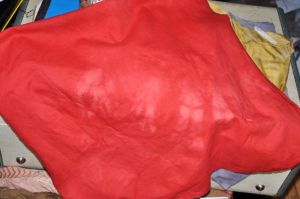
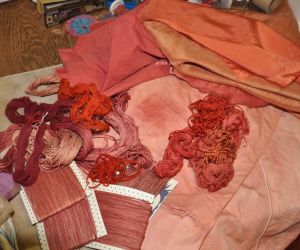
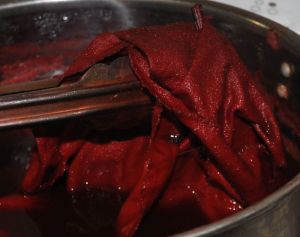
And of course, while the above photo makes it look EXACTLY like what i desire most in madder, fabrics always dry lighter, whether a synthetic dye or a natural.

Wet:

Dry:

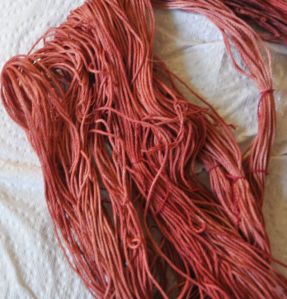
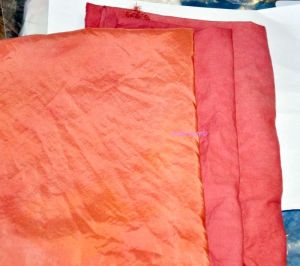
The resultant colour is much better, though still not quite as deep as i’d like–and note too, while it’s almost impossible to get even results on large pieces(above, actually folded in half, and around  20×34″), i obviously need a much larger pot for movement so i don’t have such conspicuous squish marks 🙂 Still, i kind of like the effect! I’m pretty much sticking to cotton too, as getting madder red on silk is a LOT of different steps and chemicals, some of which i’m not sure i’d like to do/use at this time. Getting this depth of red though on cellulose is rather special too so, though i want the red that Kate Bowles got on hers, and have informed her via Instagram that from now on that coveted shade is “Kate Bowles Red”, i’m quite sure i’m on the way to what i want!

I’ll try some post mordanting/modifying on small bits of this to see if i can get closer to that wet-in-the-pot shade.


I’ll be throwing some threads and lace in there next, as additions to the Summer Madder Project garment. They’re stewing in the first part of the mordanting process, so won’t be in until tomorrow night at the earliest.


~~~~~~~~~~~~~~~~~

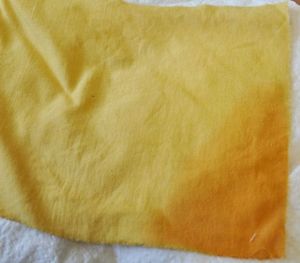
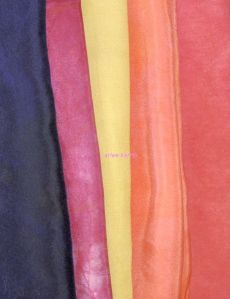
I’ve also been playing with a “new” mordant, something is becoming quite popular with ecoprinting, a fine powder called Titanium Oxalate. I was abbreviating it to Titox, but Greyman thought that was hilarious, so have gone to the accredited TO appellation 🙂 On weaker madder shades however, it seems to strip out the colour.

Won’t be using it as a madder adderitive then!

BUT, i also found another use for it besides it’s usual for creating orange-r yellows:

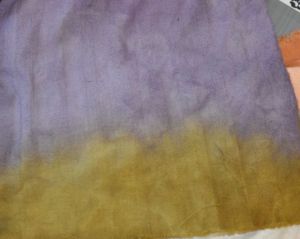
and strange colour/chemical reactions like this green on logwood purple:

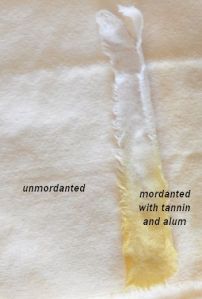
A funny little tip for you, if you A. properly mordant your fabrics (but forget if they’re finished when you pack them away) and B. keep a wee tiny jar of Titanium oxalate, then you’ve got a handy dandy little tester for mordants. Tear off a tiny strip of the fabric, dip the end in the TO, and if it turns bright yellow, it’s mordanted with alum (silk) or alum and tannin (cotton). If it’s pale pale cream, it’s unmordanted!

~~~~~~~~~~~~~~~~

And now i REALLY need to start actual STITCHING on this Summer Madder Project. I’ve decided to start with pockets–cause i’m tired of not having any! I had to revise my plan a wee bit due to the way i do my “embrilting”, so instead of a “top”, it’s going to be more of a jacket/wrap/coatlet of some sort.


Posted in "OPINIONATION", garden dye plants, Garden Hard, Natural Dyes

dandilion delight

We had a long long hot hot summer last year, and it looks like it’s going to be another one, so what better way to mark it than by celebrating the dandilion?

Our back 40 is rather lush (in the spring, but dried out by August’s end!), and the dandilions are plentiful, bee feeders and happydays harbingers, but a bone of contention with the neighbours.

I figured though that beheading them (the dandilions, not the neighbours), would keep the snarking at bay for awhile, and threw some in a dyepot.

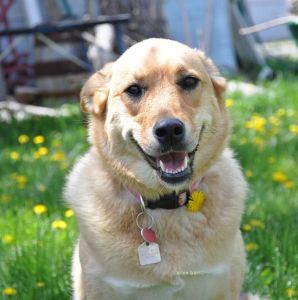
The first look was Meh. Yeah, it’s yellow, but barely worth the effort. (Though using dandilions is one of the EASIEST ways to get colour. But no, the roots will NOT give you any GD magenta, ever, ever. EVER.) Then i threw in a pinch of soda ash–BOOM. YELLOW. DANDILION YELLOW. Wowzers, it’s neon, electric, it’s definitely a Spring colour. (Paler yellow wool yarn at top is without the soda ash.)

So, do i add yet another yellow dyed silk to the stash and wonder why i do so much yellow and never use it? Nah. Let’s use it. I’m betting it would make wonderful dandilions 🙂

~~~~~~~~~~~~~~~~~~~~~~~~

A side note to my fellow natural dyers and ecoprinters: apparently some person in the US has made it her mission to prevent teachers from other countries coming to the US to share their skills and techniques with students, reporting “potentially un-work-visa’d travellers” to immigration and customs! Can you imagine any other art field professional doing this?  And while there *are* divided camps about the “purity” of the technique with those who decry the use of ANY “chemical” or any use of plastic, and those who use anything they can experiment with, and a fiercely competitive attitude amongst some on both sides, this is going too far! It deprives students of learning, workshops and their facilitators of making money to bring other teachers in, no matter what technique or field, and is so narrow minded and malicious, that it just blows me away. Just goes to show you, that not all earthgoddessy-natural-eco-mothers are altruistic sharing sweethearts…………


Posted in a collusion of ideas, Deliberation--do something you don't do--or haven't in awhile, Madder, mordants and modifiers, The Summer of Madder (Study)

summer madder project Project

For a couple of years now, i’ve had an idea in my head for a special garment, after seeing something in a trendy boutique window that fired some desire for a similar “Objay Dart” (aka Objet d’art). It was in reds, all patchy and flowing, bohemian though unadorned with any embellishments, simply cut and extremely Spendy. I filed the idea away, as i haven’t made even a pair of pyjama pants in the last 7 years.

But what’s this? There seems to be a plethora of chunks of fabric, all dyed recently, in the madder summer experiment pot. And threads in various shades as well. EUREKA.

I do have more fabrics, but have to dig through some serious piles first! I’m picking up a package from Maiwa today too, which includes more madder, because even though i intend to use up the 33 year old madder currently in the pot, and the tons still left in that bag, i think the best red was from Maiwa. Two madder pots then!

I used to make wearable art, even had a moderately successful small business for 6 years, selling through local boutiques and “Craft fairs”, so i’m experienced enough a designer and construction-ist (i hate the word seamstress…), that i know the cut of this is going to be important. Cotton, at least most of the cotton i have, is not terribly drapey. They’re not stiff slices either, but with not a lot of movement in them, the design has to accommodate that fact and the silk additions, which are drapey. I might go on the bias with some of them though, as that helps a bit with flow.

I could of course just draft my own design, but i pulled out my only Tina Givens pattern, and had a look at that.

Hmm, slip “too” biasy, pants too much fabric. The crop top however might work, but i may forgo the ruffled detail at the bottom, and just lengthen it a bit. Actually, there could be enough silk to do the slip too! OOOOO, wouldn’t that be decandenty-bohemianish-artful-artistry-Artist-y? I tend to live in either leggings and a shirt for work and out-and-about, and a tank and pyjama pants at home! My body has settled into a 60 year old shape (though a “few” pounds could be lost) and i really don’t care to “dress to impress” anyone anymore, but it’s always nice to have something for “good” 🙂

So, though i may have chunks of fabric, and hanks of thread to share in the shop, depending on amounts and time, i will also have something to really show what i’ve been up to. It’s not a daunting project either, as i have no deadline, no rules to follow, and no one to account to. I can do whatever treatment i like to the “patches”, take my time with those as well, enjoy the process (and maybe make learn new skills or at least, new applications of older skills), and go easier on myself in my studio. Perhaps the Muse will return somewhere along the line here, and if not, well, i’ll have some new duds at the least.

***EDIT: For those of us with that 60 year old body, you might want to read this review, with its tips. (Please be aware though that the writer of the post, Lorraine from Calgary, has passed on since…i sure would have liked to have met her in person.)


Posted in Madder, mordants and modifiers, Natural Dyes, The Summer of Madder (Study)

33 year old madder

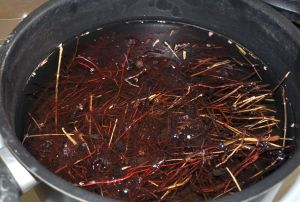
This madder *could* be older actually. I’m going by the date of dissolution of the company that sold it, so who knows when this was actually packaged??!!! I doubt that it has “expired”, though i’m sure at some point, even madder roots lose their potency. From yesterday’s start, things looked mighty promising.

All skeins were premordanted with tannin (gallnut) and alum acetate, as is recommended for cellulose fibres. The thread is a 4 stranded embroidery floss Galler product, “Parisian cotton”, sadly no longer in production. The company is still in business, but doesn’t manufacture this particular commodity anymore. I didn’t do a bran bath however as the last step, a better way of “dunging” than actual dung….  That will happen on the next batch of threads to see if it really does make a difference–i know people who swear by this, and it is emphasized with the use of alum acetate, but haven’t tried it myself yet.

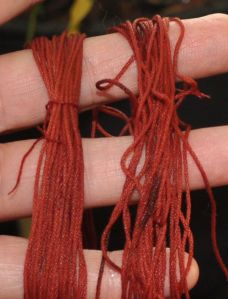
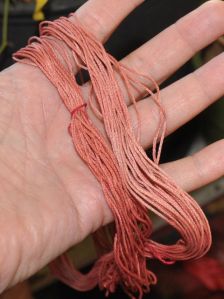
The first skein was in the dyebath for 8 hours. Wet:

And dry. I was quite surprised to see how much the first skein lightened when dry, though i know that dyed items, whether chemical or natural dyes, always dry lighter. Well, nothing wrong with “terracotta rose” 🙂

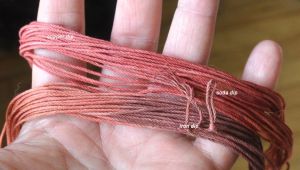
An iron dip on one section of the 16 hour second skein browned it, copper sort of pinked it, some soda ash made it slightly redder.

I still had 4 skeins in the pot at this point and left each for a day longer, progressively, though there’s not much difference in absorption. From now on though, i’ll be leaving the threads (or fabrics if used) in the pot for at least 2-3 days for maximum absorption and depth of colour.

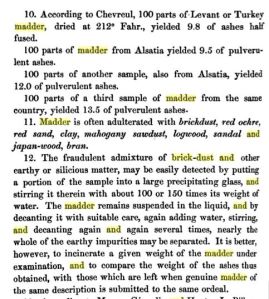
Not knowing the provenance of this bag of ground madder root, i’m not even sure it hasn’t been doctored with red brick-dust or gawdz-know-what, a common practice to pad the bill in the old days! For the amount i put in the stocking, it swelled a LOT, from filling a good two inches to puffing up and making itself look big at 6 so round so firm so fully packed inches.

Though not “true” TURKEY RED, this range of shades are wonderful, because each time i do the dye pots, i get something unique to me. Madder is also more work on cellulose fibres though, with those deep rich radical raunchy reds best showing on wool (a protein fibre). BUT, that’s still a good thing for the personal stash and usage. *And* i can say now with some truth, that i have some “vintage” threads. And yes, i know the terminology: 25+ years is “classic”, 50-100 is “vintage” and 100+ is “antique”. “Vintage” also refers to a specific YEAR, so my threads are done with vintage madder 🙂 I do love this range of shades i got, and look forward to incorporating them into my work, should the Muse return……

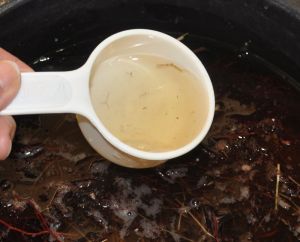
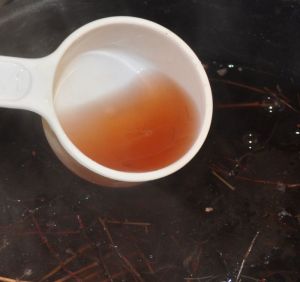
I’ve poured off the first extraction, saving it, and will now see what colours result from a second soaking.

Posted in journal: lessons to learn, madder, Natural Dyes, Naturally dyed threads

summer study

I’ve decided since i am much a gadfly these past few months with everything but dyeing, that the summer is going to be devoted to studying madder.

Previous to October of last year, my results were weak, embarrassing forays into pale pinks and peaches, ordinary orange, and unenthusiastic brawny beiges when the pot gave out . (HA, that was supposed to be “browny” not “brawny, but some of them were rather beefy! 😉 ) Somehow the magic clicked on October 3 and i finally got RED, red in all its permutations. Though i previously kept notes, i’m not sure why it hadn’t worked until that magic day–heat? Amount/WOF? Improper mordanting? Dunno, don’t care, because whatever it is i’m doing now is working.

I’ve run out of my Maiwa kilo of madder, but managed to scrounge around the Dye Dungeon and found this:

An extremely fine powder, probably due to its age, i encased it in a nylon pantyhose foot. It’s not only a pain in the bazotski shaking powder out of threads and yarns, but it wastes the bits as well, which may still have some colour left.

Alas,  Wide World of Herbs Ltd was dissolved in 1985, long before the web was prevalent, so there’s NOTHING about them, their products or where this madder actually came from. I would like to have supported them, as they were based in Montreal, Quebec (yes, that is SO in Canada 🙂 ). Next best thing, THE best thing now is to buy from Maiwa. (Ordered this morning!)

(In one or two years, i can harvest roots from my own “home grown”.)

I do love red. Before i got into using natural dyes, ecoprinting and rust, which resulted in a lot of earthy neutrals and vintage-y colours, i used a LOT of red in my work. It was unconscious (subconscious?), because i always thought i loved orange. I still do, but in smaller slices and dibs! Red evokes so much to so many, everywhere in the world, politically, spiritually, emotionally, artistically.

Now this isn’t meaning that *i* am going to discover a New madder colour. Look at all of them! There are many more experienced dyers, researchers, scientists and hobbyists who get these results, than this one little personal Dye Dungeon. I however want to know what *i* will get, in my “conditions”–water, heat, the madder i use, the methods i use.

I’d rather be doing something, than the whole lot of nothing that has been going on!

Posted in Ecoprints and Natural Dyes, gallium, garden dye plants, Garden Hard, mordants and modifiers, Natural Dyes

Galium results

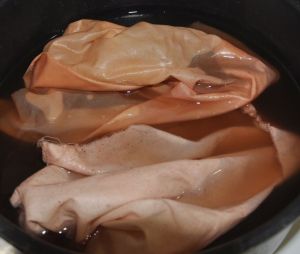
Well, there *is* colour, but it’s weak, probably because of the amount of root i had, maybe 40 scant grams, dirt included. I used Jenny Dean’s method of soaking the roots overnight, pouring off the first water, then slow simmering with a Tums tablet (calcium carbonate) for two subsequent baths that were saved and combined. (A third simmer had no colour at all, and was discarded with the roots, in the garden as no adjunct chemicals were added.) Both fibre types were properly scoured and pre-mordanted also, according to their requirements.

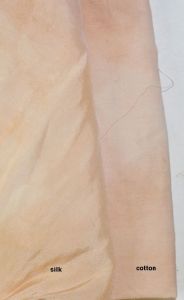
Wet, silk top, cotton bottom, after 24 hour soak in dyepot:

Technically, i should have decanted into two pots, and dyed separately, as cotton (cellulose) and silk (protein) have different uptakes.

Dry:

Soft, but not terribly exciting, again most likely due to the amount of root gathered.

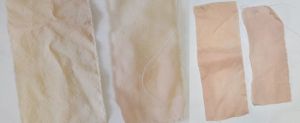
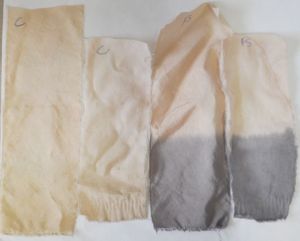
Some modifying/post mordanting on small strips:

Pretty much insignificant changes with (L to R) above, vinegar no change/possible “bleaching effect”, soda ash marginal pink activation

and above (L to R) copper minimal change and possible miniscule yellowing, ferrous sulphate the most dramatic change (might just do this to the remaining pieces and use that way!). (This could also be due to any residual tannins. I used an incredibly SMALL amount of ferrous sulphate, as the stuff is quite strong, maybe a few grains.)

I’m also thinking that because there is so little colour on these, that they are NOT going to be terribly light OR wash fast……BIG sigh of “WhatEVER” 🙂 Still goes in the dye annals though 🙂 I’m sticking to actual madder from now on.


So, was it worth the effort? Yes, in a way, because i learned it is possible to grow, harvest and use a plant material that can and does grow here. And no, because i learned the amount of time to grow (3 years to wait to harvest), time to harvest (ridiculously small amount for the work it took) and use (weak, because time and harvest took too much and amount gathered was too small) was not worth the experiment. Then again, maybe ***this variety of Galium has very little dye material in it. BUT, obviously someone with patience, a larger pot/plot might want to try this so they could say they use “local”, if that’s their Thing.

I’m rather sure too, that if i had just ecoprinted with these, instead of using as a dye material, the results would have been negligible, as there’s little alizarin/purpurin in these roots, probably due more to their size, than the quantity gathered. (Again, or the variety is pathetic in the dye substance department.) I highly doubt that the roots get very big at all, even after years, as that’s not their nature. It would also take masses and masses of them to get a decent quantity, a problematic exercise, also due to the way they grow.

So, have on, some brave soul: i’ve lived and learned, and the lesson is filed! (If you are interested in how i got to this point, this will take you to all of the Galium posts previous.) (And yes, i misspelled it in the archives–gallium with 2 l’s is actually a chemical element.)

Erratum: The Galium species most prevalent here is Galium boreale, which is what i used, not Galium verum as previously stated. There are ***6oo species of Galium, and some have no alizarin at all, but do have pur purin and pseudopurpurin. I’m also certain that some have little to no use whatsoever as a dye plant. I found this article, and they do mention that some of these plants have little to no madder-like characteristics.

Posted in gallium, garden dye plants, journal: lessons to learn, Natural Dyes

galium, part two

Sad, very  very sad.

Granted, i had a really small amount of roots, but i’m not sure (yet) that this was worth it! This “red” has a quite brown tone to it, but of course, the proof will be in using it. I’m still waiting for pre-mordanted fabrics to be finished 🙂

I’m thinking however, that whatever results i get, this was a valuable experiment in growing my own dye, processing it, and using it. You don’t know if you don’t try!

Posted in gallium, garden dye plants

red from bedstraw (Galium species)

Welllll, maybe…..

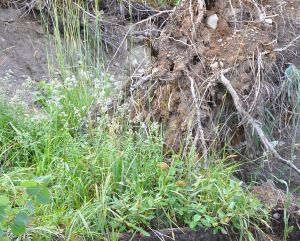
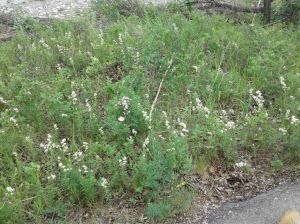
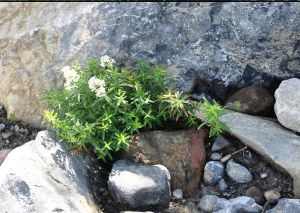
Mine is Galium boreale, a type that grows wild here, though i bought my seeds locally, as i was unable to either gather seeds, or dig up roots. Also known as Cleavers, Northern Bedstraw and a host of other nastier names because it’s invasive, and because the tiny seed burs and clutchy hooky barbed stems (also a characteristic of madder) stick to everything, including skin.

As per Jenny Dean’s advice, i soaked it overnight.

You can certainly see the red in the root above. (Go ahead, click on it to enlarge.) Didn’t look promising to begin with. My little pile of skinny weeny roots was full of dirt i couldn’t rinse off, so i filtered the mess through some haremcloth (cheesecloth is too porous for dirt), and got what i could off the roots. I had MAYBE a scant 40 grams, counting the dirt that wouldn’t let go 🙂 I’m working on a rather laissez-faire attitude here with that–perhaps the minerals in the dirt will leach out and help the colour somehow, though i doubt it……. (I don’t subscribe to the “pot as mordant” theory–unless it’s a really rusty iron pot, or a pure copper one that things have been sitting in for weeks………MORDANT PROPERLY TO BEGIN WITH. Save yourself the grief.)

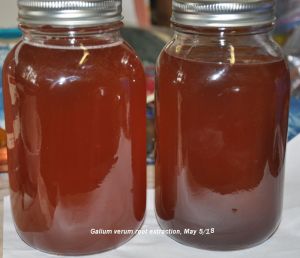
First soaking poured off–possibly the browns and yellows inherent with red dye roots, possibly the dirt factor:

I refilled the dye pot using our tap water, which is hard, being from the Alberta Rockies, but did throw in a Tums as well, as that has really helped my madder along.

So, there is *definitely* colour in these pathetic sorry little excuses for roots, but as to whether there will be any good results ON cloth or threads will be the real test.

But, i have to do some more pre-mordanting of fabrics and threads, as i seem to be out! Stay tuned!