Posted in Contextural Fibre Arts Co-operative, Dyeing, Ecoprints and Natural Dyes, Residency 2017

residency plans again

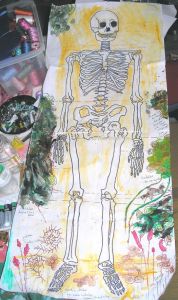
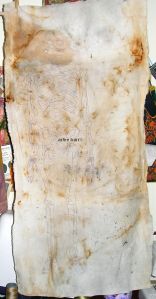
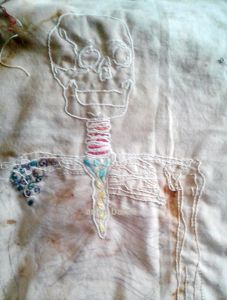
This year, i decided to take the 3 month slot at ACAD for Contextural’s summer residency. It usually takes me a week or two while there to really get into the swing of it anyways (and i always regret not having more time), but i figure for the extra money it will cost (minimal in comparison to a one month slot), i might as well be really serious this year, develop some new skills, brush up on old ones, and truly enjoy myself —*and* expand the cloth arsenal.
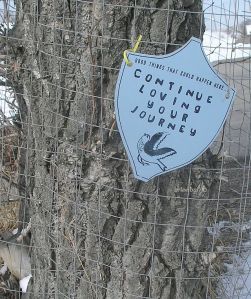
a telling sign
Continue your journey

(This also means there will be LOTS of fabrics available in the shop, for my faithful followers and customers! Note: there are a few listings going in there within the week, from cloth made last year.)

I’m re-reading my faithful dye Bibles (all of Jenny Dean‘s books), and using highlighters, post-its and scribbled side notes to brush up, and focus on new things–and old things tried and tested that i haven’t done before. I’m collecting fabrics, prepping fabrics with mordants and stitch, making my lists, assembling the suitcase of necessaries, and getting more and more excited!

This year again, i’ll be working with my old faves of indigo, rust and potassium permanganate, along with dyes i haven’t had much success with, like madder. Madder has always fought me, giving only oranges and peaches, and the occasional oink pink (though i kinda like that fingerslip “oink” descriptor! 😉 ). The only time i ever got red was from the cotton bag used to hold the dye stuff, a tiny 4″ square, way way back. I do love the corals and oranges though so am also going to work with annato, tansy and rhubarb again. This year i also want THREADS as part of the stash! I’ve done a few along the way, but except for the indigo, never really dyed enough to be worthwhile.

I’ll be doing a “regular” indigo vat at home, and hoping to start a 1-2-3 vat at the school with henna–i like the more green tone of this one. (Or maybe it was just greener because of so many using it and dipping strange things in it…….Yoshiko Wada workshop in August of 2014)
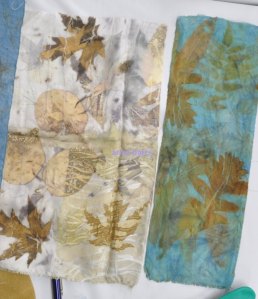
indigo-overdyed-ecoprint

I’m planning on doing some ecoprinting again, something i haven’t done much of in the last 2 years, as it A. started to bore me, and B. everyone else is doing so much more beauty than i could. Of course, all those workshops that some can take do help, and yes i am SUPREMELY jealous. I think i’ve found some ground to stand on though, and will try some new things. If you learn something new every day, you know you’re not dead!

I want to try more shibori, and pole wrapping, more combinations of things, and more deliberate placements of dye and adjuncts like rust and leaf.

I shall be donning my goggles, rubber apron and tin foil hat, as the Mad Textile Scientist makes a long anticipated re-appearance.

Of course, i always remember words of wisdom imparted at my first res orientation back in 2011: “Make a plan, half it, half it again, and expect to not get even that much done.”
 

Posted in Ecoprints and Natural Dyes, FybreSpace the shop, Rust

Listings soon in the Shop!

As i have mentioned before, FybreSpace no longer exists on BigCartel, but you can buy here. Please do sign up for email notifications of new posts, if you will.

All of these have been washed and pressed, are cotton, and having been stored for almost a year, are nicely cured. Each listing will have its own post, as Blogger and Paypal fight otherwise. I will be listing through this week, and will publish all when ready to go.

The possibilities with these fabrics are infinite. Don’t be afraid to cut up, cut holes, slash, machine stitch, hand stitch, applique or piece into other works. It’s fabric after all, and while i view them as semi-precious, they can be treated as any other fabric!


Posted in Ecoprints and Natural Dyes, garden dye plants, indigo, madder, woad

“dyeing when hell freezes over”

I ordered madder seeds from Salt Spring Island (BC), and casting around, found little info on growing in a colder clime. Fortunately, the natural dye group on FB has some experienced growers, and some of those are in zones similar to mine–or tougher!

I suppose buying these seeds and hoping that in three years i can harvest my own reds might be a bit delusional. Calgary has a shorter growing season, colder nights (even in the summer) and hard winters, but for the price of 6.00 (including shipping), what the hell. Never know until you try. The first step will be to germinate in the Dye Dungeon, under lights, and in sand. Hoofies crossed that the seeds are viable! Though i have yet to get a true red from any commercial madder i’ve used, i keep trying!)

I also have to find my woad seeds–i did grow some the year before the flood, but alas, after the move to the shithole, the pot froze under a roof run off and the poor things didn’t survive. Specifically grown for cold zones by Sarah of Joybilee Farms in BC, i put the darn remaining seeds somewhere “safe” and haven’t found them yet. (I don’t think she sells them anymore either…)

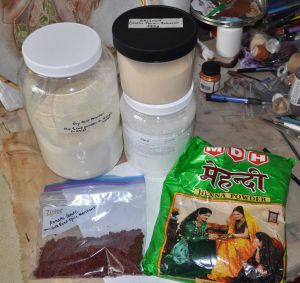
The old indigo pot remains downstairs in the Dye Dungeon also—haven’t used it in a year, but i’m not only hoping to revive it, but to start a more “organic” vat as well. And ordering seeds for these as well…) Picking up a load of calx, henna and other assorted dye goodies tomorrow, including some proper mordants in the form of gallnut and soy!

Hope springs eternal this first day of March!

Posted in Dyeing, Ecoprints and Natural Dyes, privet

winter dye adventures, part 3, weird science

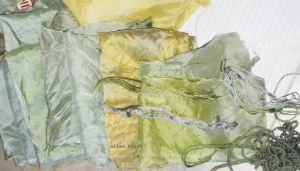
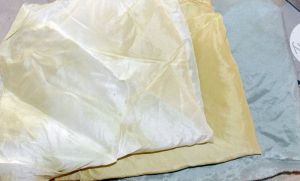
Well, mixed results! Surprising results. Chemistry is very obviously at play here, in the purest sense of the word. Playing with me: blues and purples from the privet berries showing in the pot, dark greys and deep greens when they come out and are still wet, drying to shades of celadon, ghosted sea blue, odd mixes with tansy and madder (all on silk hab), wonderful jades in the threads (silk and wool), brilliant with soda ash modifier. Iron didn’t do much at all, not saddening or shifting shade deeper.

Leaves and stalks(twigs/fine branches) hardly worth it, a really pale yellow on the threads,which surprised me, because they are usually the more reliable dye source.  I threw those into the berry pot too, as they are so wishy-washy as to be pointless.

Berries? Sort of a greeny grey green, like faded Celadon (?). ImPOSSible to photograph, so here, like this:

celadon_thumb


Updated as i write this post: my expensive DSLR camera could not capture the colours, no matter what i did in terms of lighting conditions, but the cheap camera on the cellphone worked. More weird science, go figure.

privet-results-on-silk-and-silk-and-wool-threads

BUT, will they be lightfast?

Regardless of all this, i probably won’t be dyeing with privet again. It’s toxic, it’s expensive and it has to be imported, even if the importing is from BC 🙂 Still, it was a nice little interlude, and learning experience in the wintery season of Calgary! And after a couple of weeks, if they don’t fade, they will be added to the thread and scrap arsenal.

Now back to the monumental stitching.

Posted in Ecoprints and Natural Dyes, privet

winter dye adventures, part 2

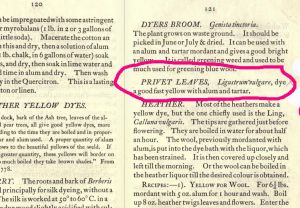
The big question of course is, are these lightfast? Some one said no, but Ethel says yes 🙂 Old dye books sometimes have erroneous recipes and results though. And dandilion roots STILL don’t give magenta, pink or purple 🙂

ethel-mairet-privet

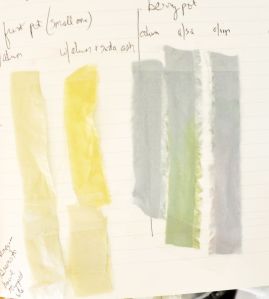
Most of the threads and silk chunks are still in the pot, marinating as long as possible, but i removed a few pieces to test some modifiers. (The only mordant so far has been alum.)

privet-various-mord-modsOn the two yellows left, which were from the first teeny pot, the soda ash (alkali) really brightened it, but vinegar (acid) seems to have stripped out the colour on the bottom!! The berries gave a completely different colour, something that *doesn’t* always happen. The alum mordant alone gave a lovely greyed shade, while soda ash turned it green, and vinegar changed the shade SLIGHTLY more blue (barely worth it.)

privet-various

I’ll test too an iron mordant to see if it darkens, changes hue or can’t be bothered to do anything 🙂

Stay tuned for part 3, sometime at the end of the week.

Posted in Ecoprints and Natural Dyes, privet

winter dye adventures, part 1

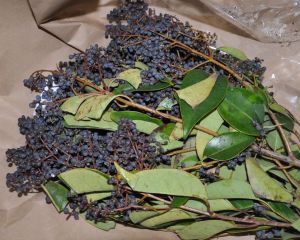
I always forget that i have access to plant materials that are suitable for dyeing with! Though i enjoy my DayJob, i try not to bring it home, except for the occasional orchid bloom, one gerb, some old roses, or the rare exotic specimen, but a few days ago paging through the FB dross and pearls, i chanced upon some of Morgen Bardati’s work, and lo and behold–a gorgeous deep green from privet. And privet just happens to be “seasonal” right now, though an import still, and since it readily falls apart, and one crappy scrappy stem is usually left after arranging with flowers, it behooved me to bring some home and try it.

Had to do a little research first, as i was afraid it was one of those temperamental ineedtobefresh things. Not a lot online but i did discover that it’s TOXIC, to humans AND animals. As with *all* natural dyes, i NEVER EVER NEVER assume—  just because it’s “natural” does NOT mean it’s SAFE. Seriously, some natural dyes are as scarey as synthetics, so don’t fall for the kitchenscrap all encompassing goodness that some sites breathily exclaim is so pure/eco-conscious/earthmagic.

So, the most i could find was boil up the leaves, chopped stems and (bruised) berries, throw in some alum, and see what happens.

Meh. Mind you, my first experiment was with a (gloved!) handful of berries and one chopped up stem/branch, so there wasn’t a lot of colour, but it did colour, and the colour was decidely green. Pale green. Again, small amount of plant material.

More research yielded up using salt–i’m guessing Glauber’s Salt, a chemical used by a lot of wool dyers. Not table salt, as again the Ensorcelled Cauldron Witches would have you believe to  “set” colours, but Sodium Sulphate. Well, i don’t have any, but it *is* a chemical used in making soda ash, and that i have, so i threw a wee bit of that in.

Instant colour change. Yellowy-greeny-yellow. Standard plant colour from a million plants!!!!!!

So, it being the time of year when we are ordering a lot of stuff for Valentine’s Day, i asked for a whole bunch of it for myself to play with.

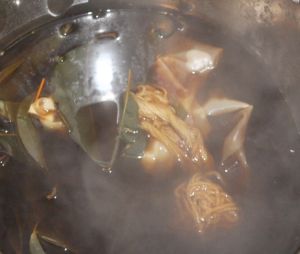
privetI added the chopped stems and leaves to the first pot and the second pot was just the berries.

No greens however, as i saw in Morgen’s photo…………

Because the first pot had soda ash in it, my threads (silk and wool) and silk scraps are yellowy.

privet-leaves-and-branches-dyebath-a

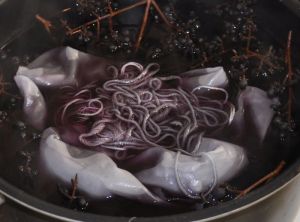
The berry pot *looks* exciting, but i’m betting i’ll get greyed tones with a HINT of lavender, not the purple here.

privet-berries-dyebath-a  These pots will sit for a couple of days at least.

Further tests will be done with different mordants and modifiers later in the week, as will light fastness tests. If i get the colours i think i’m going to end up with, i won’t use privet again. You never know though what results you will get, due to the season, where the material came from, how fresh it is and what your water does. It’s good to experiment, but not all outcomes are worth repeating, even if “successful”—as i have often mentioned, you can get yellow from so many local plants that specialty ordering is not the way to go. (The privet is not cheap, being $45 for FIVE branches–and yes i got a discount as staff so paid half of that, but still……)

~~~~~~~~~~~~~~~~~~~~


There was quite a bitter exchange on one of the natural dye groups i’m in, with one ecoprinter getting all huffy saying that “Are you people mad, eco dyeing causes no harm.Listen lady there are groups that have been doing this eco dyeing for years, I suggest you research that and them and stop pulling yr hair out. ” WHAT THE FUCK???? This is exactly the mind set that reputable, safety conscious, responsible dyers get our panties in knots about. If you want to poison yourself, your dog or kids and husbands, by all means cook up that possibly toxic plant in the same pot you cook the soup in. That would be called Darwinian Karma. However, if you do the research, you’ll know what the possible dangers are.


Posted in a collusion of ideas, Ecoprints and Natural Dyes, in progress, Indigo Dreams, journal: lessons to learn, potassium permanganate, Rust

hexes rising

indigo-hexes-jan-24A few years ago in a Yoshiko Wada workshop, i fortuitously dipped two previously ecoprinted hunks of silk in a henna based indigo pot. In the ensuing years i’ve often dug them out and admired the greeny blue that resulted, though often thought the mud colour induced by chemical reaction over the ecoprints was well, too muddy. Sometimes i’ve wondered about just tossing them or giving them away.

Whew, i didn’t. You never know what will be Useful and Beautiful and Perfect, if you throw it out. The earthiness now of those colours are what was called for in secret by this piece. I listened.

My biggest challenge with this though, is finding a UBP slab of true madder.


I’ve been tuning into certain words and phrases now as i stitch in the evenings, hearing from the strangest sources quotes about memory. A cheesy B movie yielded up “We survive by remembering, but sometimes we survive by forgetting,” and a Cicero quote from an episode of Criminal Minds “The life of the dead is placed in the memory of the living.” Proves one never knows what might be relevant or inspiring, and from the oddest “sources”!!!!!!!!!!!!!!


Posted in a collusion of ideas, Collision: the work begins, in progress, journal: lessons to learn, potassium permanganate, Rust

are you experienced?

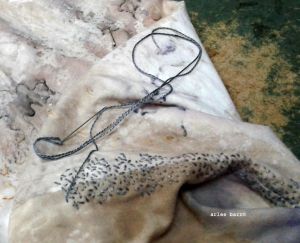
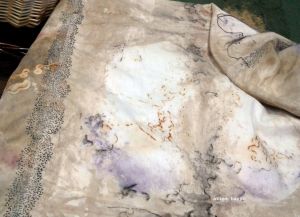
jan-12-bAs i work with this large expanse, i’m better appreciating the nuances of colour created by chemical reactions between rust, potassium permanganate and brazilwood. Pinks, purples, teeny bits of blue and charcoal, russets and washed out reds. Amazing how that works, and really wondering how i managed to get such clean whites too!

jan-12

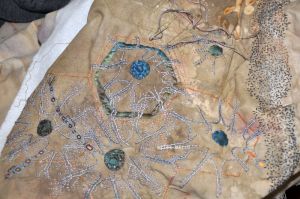
These long lines of seeded backstitch, paths, divisions, separations, they appeal to the memory and sense, for otherness, unpredictable, centering, old consciousness. I’m struggling to express this in words, but words are an important part of this project as well. I’ve been writing a lot of free association exercises on my work blog, and will be condensing them down to make clear what it is i’m making, sharing, experiencing. I think of everything from Jimi Hendrix, to memories of childhood, passed friends and washed away river banks.


Posted in Collision: the work begins, Ecoprints and Natural Dyes, in progress, Residency 2016, Rust

appreciating what you already have

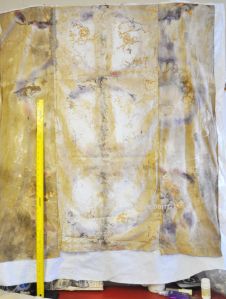
When i created these fabrics during the 2016 Contextural summer residency, i knew i liked them but stashed them away as for use in a Someday project, thinking they would probably just be cut up, and incorporated into other projects.

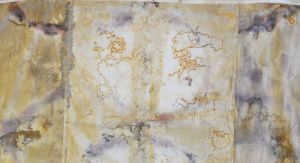
They are beautiful. They can stand on their own. I hadn’t really really Looked at them. The softness of the colours, the strong yet delicate markings of rust, the motifs that occurred during the process are perfect for a background, while having enough interest to accent in some areas as i move through this piece.

background-1-scale

I didn’t want a seam down the middle, so i tore one chunk in half and attached it to either side of the main fabric. This is going to be a large work, as you can see by the yardstick left in there for scale 🙂 (I’ll have to have an appropriately sized stretcher bar set custom built, as i haven’t this size in the stoodio!) The seams aren’t terribly obvious, because of the similar colourings and process, but they are there enough that i wanted to segue them into each other. Immediately, i knew i wanted to use my technique of melding the fabrics into each other with a multitude of seeded back stitch. (I used that technique a lot on “Ebb and Flow” from 2014, on the indigo pieces.)

background-1-stitch-detail-1

On New Year’s Eve, i watched part of “Expendables” and then all of “Expendables 2” (i deliberately choose “Cheesy B”  horror or action films to keep my mind and fingers activated, but not concentrating on the tubage.) and in the space of three hours, managed a section of 12×2″. These seams are 46″ long so i need to update my watch list!!! HA! “You WILL be a-seam-alated!” (I think i’m SO funny….) (Edit: as this post goes live, i have another 13×2″ done—yeah!)

So far, only two variegated colourways have been used there, but a third will pop in as well. One i am going to run out of, hopefully not until the seams are done, because it’s just not available anymore! The other two can be ordered again, and hoofies crossed that the batches aren’t so different as to be noticeable to anyone but Moi. Below, though the differences are not terribly apparent–which is kind of the point of blending—-i’ve used a silk in the centre, edged with a Caron Wildflower Sticks and Stones. Those edges will be edged into also with another Caron Wildflower “Pebbles”.

stitch-detail-1Unintentionally, that “strip” echoes the squiggly lines of dye and rust. The subconscious mind at work i suppose, because watching cars blowing up and manly posturing with bazookas sure didn’t influence it.

On the fun side of things, i pulled this out and have started playing with it. A riff on the original Beautiful Bones from 2009, and conceived in 2010, it’s mindless and silly, and an enjoyable change from Serious Art!

thebonesdecorated1

denbonesonbase1

bb-start-2016