First rabbit moon DONE. With wild roses for his bed, a sky full of stars for wondering, and mountains and clouds for dreaming on. Definitely an Alberta Jack Rabbit 
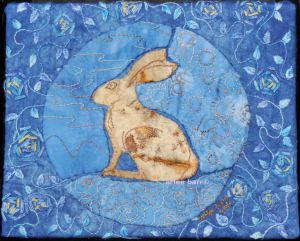
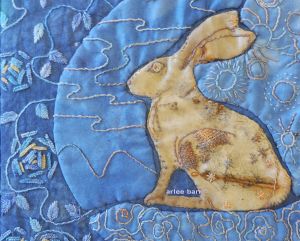
He’d also be very hoppy to live at your home 🙂
First rabbit moon DONE. With wild roses for his bed, a sky full of stars for wondering, and mountains and clouds for dreaming on. Definitely an Alberta Jack Rabbit
He’d also be very hoppy to live at your home 🙂
The couple left to be stitched at the bottom will have to be done after the edges are finished (the back covered). Since, as i mentioned before, that “symbol”/shape has shown up before often in my work, i can see these being a focus for awhile in other pieces.
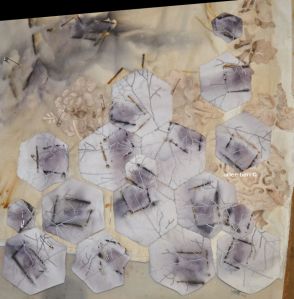 And the results of the Rumex seed stalk dyepots:
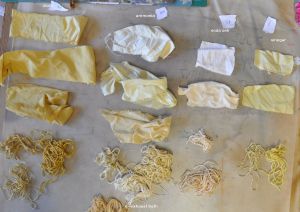 I was quite shocked at how much colour washed out of the soda ash modified one–in the bath, they looked a warm reddish gold, but most of it disappeared. The best was just plain old alum with the dyebath, though i did get a surprise from an immersion of white cotton thread in the exhausted ammonia modified bath, peachy!
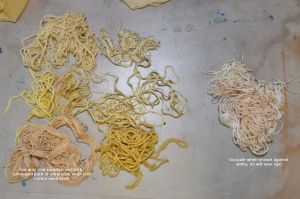
I’m wondering if there was a chemical reaction similar to madder, in that first the yellows are extracted (poured off in madder), and then the redder tones show up? I’ll test that a bit more, as i do like that shade. Other than that, i won’t bother with gathering this plant material again–yellow is basically yellow, after all, and there are a million plants that give that 🙂
Subject to change without notification, but i am betting this will be the most likely configuration.
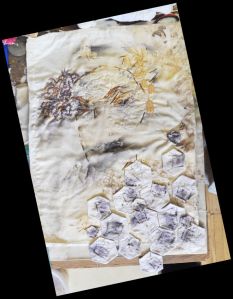 And i’m having a terrible time photographing things this last week–the weather has been strange with dark moody skies and then a burst of blinding sun, and then thundercracks and lightening!
Doing some natural dye experimenting as well. I gathered dock (Rumex) seed stalks, after seeing the results someone else did in a REPUTABLE, SCIENTIFIC, FACT BASED FB group. Currently these are in various vessels with different modifiers and mordants.
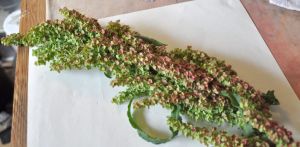 Fresh above, dried and drying below.
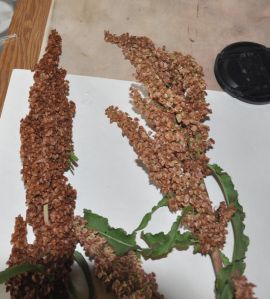 Though someone else with 40 years of natural dye experience got a range of colours from yellow green and brown to red and orange, i’m getting some glorious shades of ————————— ——————— yellow again………..but i like yellow now, and the more threads i have in the arsenal, and to over dye, the better my thread stash looks. Could be the season, could be the weather, could be the soil, could be the stage of growth, everyone gets different results with some things. My rhubarb root dye pot gave me the most luminescent glowing gold threads that i had to try these, and there were good results from burdock as well, but i can find no roots due to recent “herbicide” spraydowns. The bastards.
And why am i harping on PROVEN DYE methods again???? Because this kind of crap is still around:
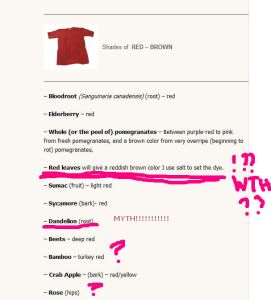 There’s a whole chunk of “dyes” listed for various colours (some are REALLY dumb…), but ANY site that immediately tells me i can use SALT and VINEGAR as a MORDANT or “fixative”, is IMMEDIATELY scoffed at by true natural dyers. Do a little research. (For one thing, vinegar is a MODIFIER, (and a Ph adjuster)not a mordant. Go look up the definition of mordant, you idiots.) Just because this is “Pioneer Thinking” doesn’t mean it’s true. “Pioneer thinking” also includes a hell of a lot of old wives’ tales. There are SO many good books, fantastic teachers and methodology sites, there’s no excuse for this ignorance. Stop perpetuating it, UNexperts……………
Back to regularly scheduled stitching again while things stew and rest.
I should keep my big mouth shut. Realistically, there is not enough time for me to create an entirely new piece for an exhibit that starts in 23 days, at least not with what i want to do to it….. Plans are wonderful, necessary to keep going and growing, but i don’t need to make myself any crazier than i already am, and decidedly do not need to frustrate my need to make with rushing and forcefulness. On that note too, what the hell is “concept” but construct?
So back to maybe not square one, but square 37? 🙂
Some of the ideas i had for the piece mentioned in the last post are valid for this, so i picked it up again last night, whacked a few more stitchings in, and can see where it’s going now.
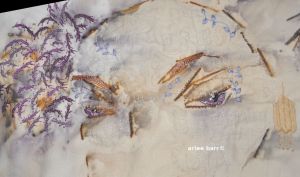
Still means a lot of work has to be done, but just keep going. I created the faces during residency for a reason. Read any trope or import into that.
Can’t make up my mind!
Did some tests yesterday with some of the tansy and solidago in a leftover madder pot. Meh. Top is cotton, bottom silk, and the thread is cotton—though i do like the thread.
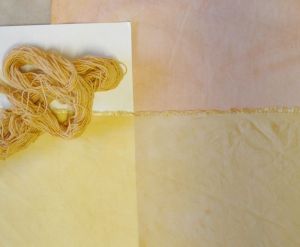
My old method did not work well with the ecoprint though:
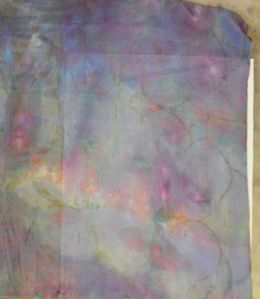
The cotinus barely made an impression on the previously ice dyed (Procion) silk.
The cottons were a bit better in the baths (tansy/solidago/madder bath):
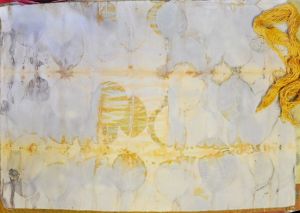 and the other side:
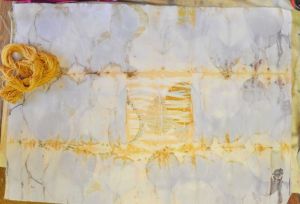
Just tansy:
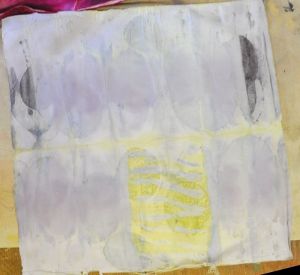
Perhaps if i used the method i developed on my own, i might have got better results. (No, i am not sharing that because as a friend says “every dyer has her own secrets.”)
I’m getting to the point with ecoprinting of giving up, quite frankly. There honestly are many who are doing a much better pushing of the technique (witness Irit Dulman’s incredible work and teaching), and i can’t afford to take a class with her, mostly because of the distances away. I’ll keep the process in the arsenal, as there are certain results i can predict, and use in my own work, but the days are gone of pots bubbling for weeks on end with reams and yards of fabric coming out. I also do still love the natural dye colours, so will continue with that: any colour addition, whether natural or “synthetic” pleases me, as it returns me to the days of “making potions” as a child. As my mother says “fabric is fabric”, no matter whether it came new or from old curtains, so colour is colour!
I’m still in a rut with the making though. Lots of ideas, little inclination to spend the time bringing them to fruition, too much thinking “it’s been done before”, and little desire to keep doing the same thing over and over. The rest of the summer will be spent just f*****g around in the stoodio, with no real plan. I need to give myself a break, overly ambitious overachiever that i am.
I’m not getting miles of yardage done this year, but i’m quite happy with the results.
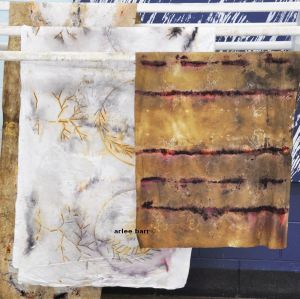
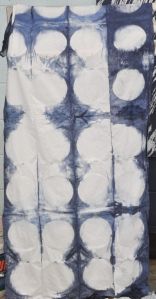
Indigo, of course. Only one clamp resist effort, as my overheated body could manage only that at the end of my day there yesterday………..And not clamped tight enough obviously, but WTH, i’ll add something else to it.
Quite frankly, i’ve grown bored of ecoprinting BUT, FB pulled a reminder up in my feed yesterday, and seeing this again, it does inspire. A detail from “padded Cell: Boro’d Time” (2011), it is quite lovely.
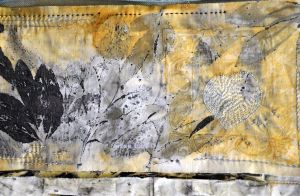 And i just happen to have been given a pile of peony leaves the boss saved for me at the fffFlower Mines.
(I’m also quite jealous of some of the results by others :), but haven’t had the wherewithal yet to try the addition of natural dyes during the process. Maybe i’ll have a self-directed workshop sometime this summer with that technique. I did last week buy a metal colander for use in steaming, so best use it to justify spending the coin!)
Day 7 of the residency won’t be until Monday. The Day Job looms for the next three days, today included, and we have plans to escape to the mountains on the weekend for “de-compression” time. Maybe i can collect some interesting leaves 🙂
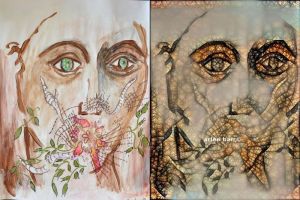
I had this bright, ambitious idea while playing with Dreamscope, to build some fabrics reflecting the different effects a photo editing application can have on a particular design. Since i make specific designs anyways whether i ecoprint or rust, it’s a natural progression in my mind. My hand drawn sketches are at best thumbnails and notes, (my handwriting is very difficult to read after 39+ years of taking orders over the phone that had to be done fast so as not to piss off the sender….) but sometimes they’re so obscure even to me, that developing some 21st century skills felt right.
I initially had plans first for this one.
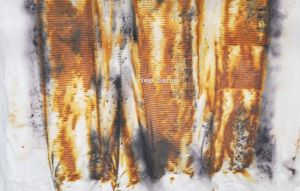
Still going to try it, as i envisioned it in piecing, and the photo of the fabric directly above this paragraph will come into play there,but i thought i’d best start with an easier task in designing the “base”.
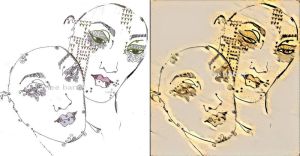 My first try sucked. I gave up half way through and this is the miserable result:
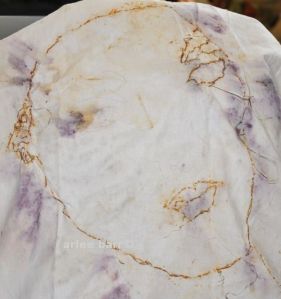
Trying to get the wire on to begin with was a bitch, trying to get it off is even worse!!!!!!!!!
The second experiment with the addition of a circle/moon. Kind of wishy-washy, but a start.
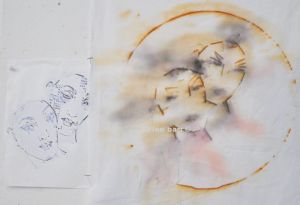 Then i i knew what i wanted to do and how.
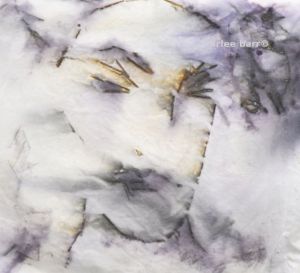
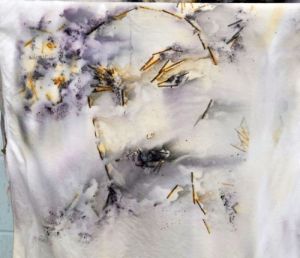
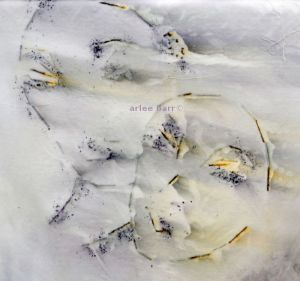
It’s quite satisfying to take old work and put a new spin on it, in a style that has developed over the years since first creating this one. It was made 10 years ago, in my “burning, machine-stitch-only- ’cause-handwork-is-tedious-and-not-artistic, use lots of glitz” phase. I pooh-poohed digital manipulation a long time too as it seemed like “cheating”, but hey, it’s just another tool. The original designs are mine after all, and if i had the skill to paint them by hand, would it have been any more “pure”? The initial work took a long time, the manipulation a very short instant gratification app online, the natural processes took overnight to react, and then the stitching will take a lot of time, so how can this not be hand-made, hand created, mindful, deliberate, satisfying? Working this way to me is like prepping a canvas: lay the base layer of primer, the first jots of colour and then interpret and extrapolate your subject.
Today is Contextural’s residency orientation, a procedure we all do, no matter how many times we’ve done residency. It reminds us of where everything is, proper studio procedures and safety, and introduces us to each other. I don’t count it as “Day One” though—household matters aren’t going to let me start today with actual work there! And because i do have that pesky Day Job, the first day may not be until later in the week.
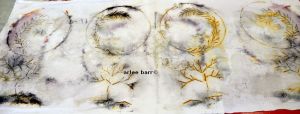
This year, amongst the glorious free-form do-what-they-want-to-will-do natural process fabrics i’ll be making, i set myself a challenge.
In a previous post, i showed you these, the original painting sketch and the Dreamscoped “amber fractal” result:
I could take an easy way out, and simply dye paint the fabric and do the usual “crackle stitch” to delineate the lines and fractures, but i want more than a flat surface.
From previous experience, i know that each type of cotton weave or finish has a different effect on rust marks. Cotton sateen lets the rust have crisp, almost floating marks, broadcloth lets small details be clear, twill and anything with a distinct “motif” (stripes or florals woven in, think damasks) “interrupts” itself, flanellette is, well, fuzzy, haremcloth makes the sheer aspect visible, and pima can do all of the above, except for the fuzzies! I also know how any dyes will “spread” or separate on the surface. This year, because of my participation in a recent Susan Purney Mark ice dyeing class, i may try to exploit the effect in combination with natural processes. I’m going to work with specific colours–if i can find them in ACAD’s student supply shop! This all being said, rust does what it wants to, as it wants to, so we’ll see how much control i really do have 🙂
First i’ll have to draw up a basic pattern for placement. There’s going to be a fair amount of piecing, and i’m thinking by hand, simply because the seam line is softer, and because there are so many “directions” the small marks are making on the “fabric’ in the drawing photo edit.
But first, i must “pack” for it! Greyman has to chauffeur me there, as i can’t carry all my supplies on the bus and train. Fortunately, we have a home studio there while in residency, and everything can stay put. And i’m looking forward too, to the student cast off box–always interesting to see what ends up as hopeless in someone else’s eyes, in this box. Reminds me of the old “free boxes” in the 70’s and 80’s!
Edited: Some of my previous fabrics done during residency are here, here and here.
She’s ready for attaching to her background.
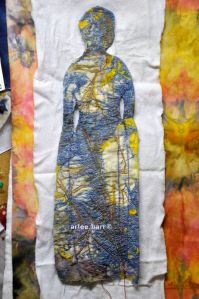 I have still to audition the fabric that will hold her–and that woogle in her arm on the right side of the photo will be straightened in the stitching.
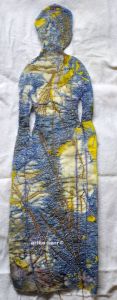 There will be more roots as everything comes together as well. She rises from river and earth as my Mother.
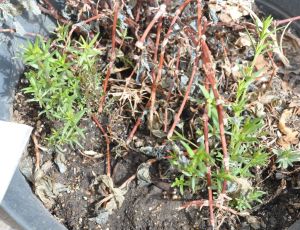 I haven’t given up on that, in fact have been keeping a close eye on what’s up already. The Gallium boreale planted last year in those damn cheap Chinese peat pots grew all of 2″ total last summer. I’m guessing the stoopid pots have finally broken down and this year already, those dinky little babies are 6″ tall. They’re being contained in one pot because they spread like crazy, but finding the roots is near impossible, due to the hairlike consistency of them., so maybe corralling the wild beasts will help! I plan on using these for ecoprinting, rather than as a dyestuff–pretty sure i’d have to harvest ACRES to extract enough dye. I have seen some marvellous bundling results with madder root, so it’s worth a shot with these as well.
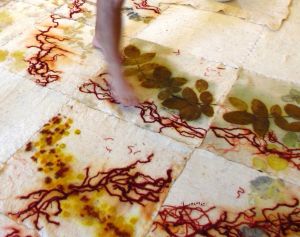 For the record, the photo above is work by Michela Pasini, and the link to her blog is highlighted in the paragraph above. I can HOPE to get results, probably paled in comparison, but you never know until you try. And obviously, it’s not going to be until the end of the summer, so that i have enough.
 albedo too
You must be logged in to post a comment.