Posted in mordants and modifiers, natural dye research, Natural Dyes, Naturally dyed threads, Probably talking to just myself, quebracho rojo

feeling in the pink….and purple

Now that i have a good stock of green threads from the osage and indigo work, it’s time to add some pinks and purples! Not talking about wishy washy, not talking about raspberries, beets, beans or any other silliness i see on too many blogs who haven’t the sense of a sack of potatoes πŸ™‚

I did get a wonderful hot pink from madder by accidentally boiling over a pot of madder (considered a VERY VERY BAD BAD as madder shouldn’t go above a certain temp or you just get browns), some useful colour variations from cochineal in the pink to purple range, and a very deep purple with logwood. Cochineal however kind of puts me off now because i worry about Ph shifts–and some Ph shifts WASH OUT with an ordinary tap water rinse!!!!!!!!!!!– and i fret too about the lightfastness of logwood, because unless it’s got a lot of iron in the mix (which can damage fibres…), i’ve seen a noticeable change in the depth of colour within months of dyeing. (I do wonder too about the current craze for it in ecoprinting: are these people going to have a shock somewhere in the next few months/year with dramatic colour shifting or fade??) So………………. my next experiments/tests/results are from a type of tannin in the “catechic” range, more red-browns that the clear “gallic” or yellow “elegic” types. Tannins are an important part of premordanting fibres, especially cellulose which doesn’t work well with just alum, but very well with a tannin first, then the alum. Some tannins are also used as dyes by themselves, notably in the elegic and catechic types.

This tannin/dye IS more expensive, but i now am comfortable spending the money to get the best results. There’s no point in cheaping out with some things: it’s a waste of time, effort and resources, from water to electricity to containers and materials used, something i am very conscious off, having been raised quite frugally and with much common sense πŸ™‚

When i threw the Quebracho Rojo in the pot, i first screamed (silently, as Greyman was napping). The colour was PHENOMENAL. However, that silent scream was from my excitable take it at face value 9 year old child self: my rational XX+ self reminded me that what you see in a dye pot is NOT necessarily what you get from a dye pot, asΒ  i swear they deliberately skull xxxk with you. Ahem.

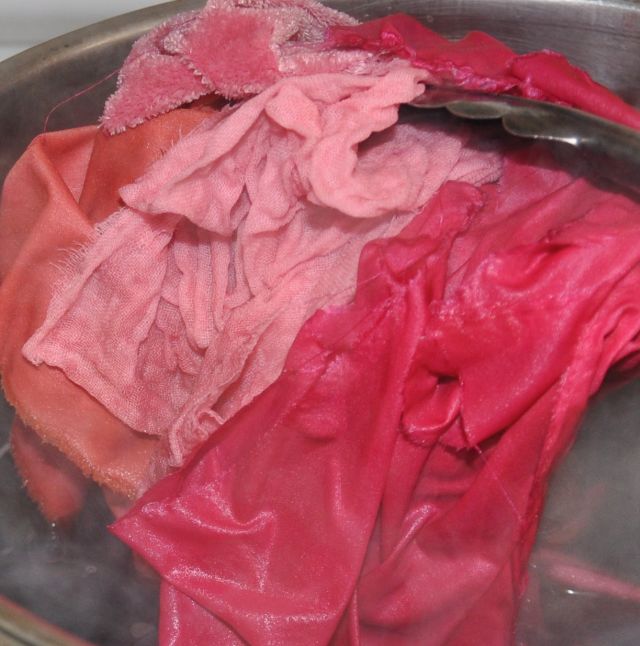
Looks fab, ay?

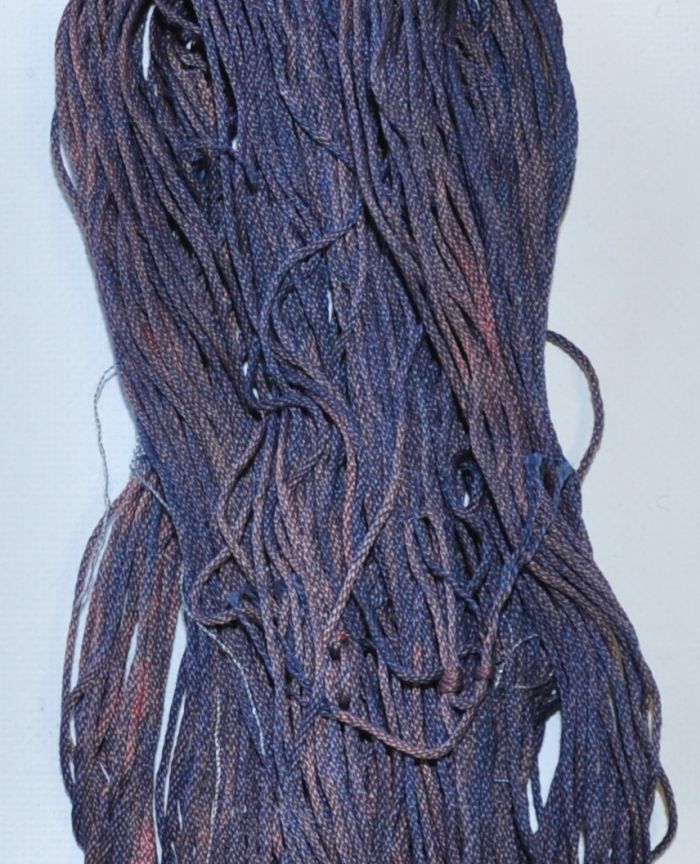
Wet, ooo ooo oooo:

Above, rinsed, barely any wash out!

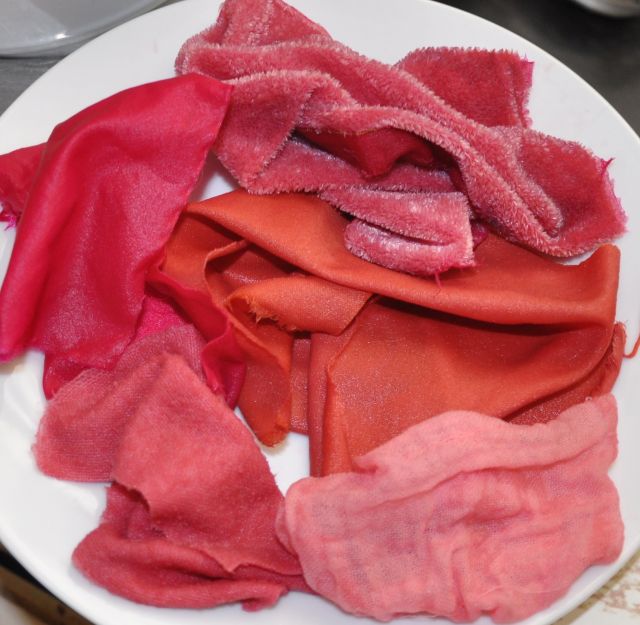
Dry, bearing in mind that colours can dry 20-70% lighter with ANY colourant, natural OR synthetic:
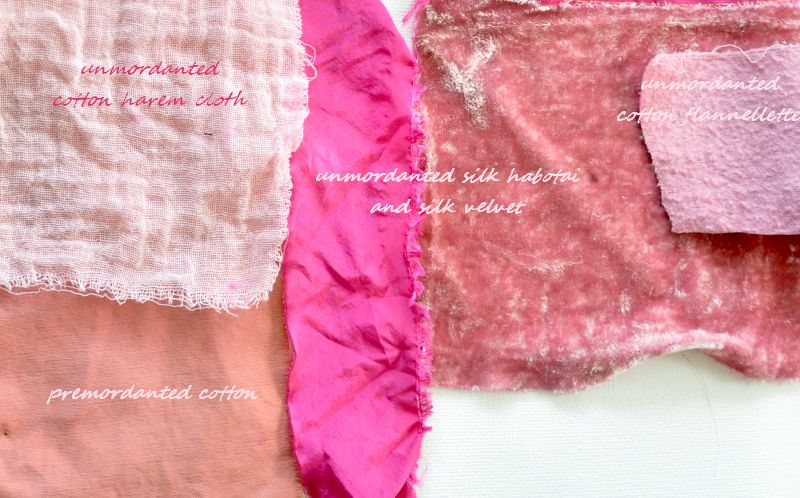
See what i mean by dye pot deception? Respectable colour, but not terribly excitingly scream worthy. Now mind you, the cottons that are paler pink were unmordanted, the darker cotton premordanted with tannin and alum. The silk habotai and silk velvet were also unmordanted, but because QR is a tannin as i mentioned, i figured “let’s try it as a tannin first”. Interesting too that most sources says it’s best on cellulose, “but performs well on silk and wool”, since obviously both silks did better……………………

The next phase of natural dye colour work is post mordant/post modify (though you can do these first, i don’t because i don’t want that active stew in the mix all in one pot.) Now this a is a nice range of colours!!!

Guess what though? I forgot to put any threads in, so now i have to go wind some skeins, scour ’em, then premordant some…………..

OlΓ©!

PS you can still click on the photos for enlargement, but you can no longer comment on them–i had to shut that off due to the number of STOOPID ASSHAT SPAMMERS.
Posted in cochineal, embrilting, FybreSpace the shop, Indigo Dreams, Madder, Moons, Natural Dyes, Naturally dyed threads, osage, sandalwood

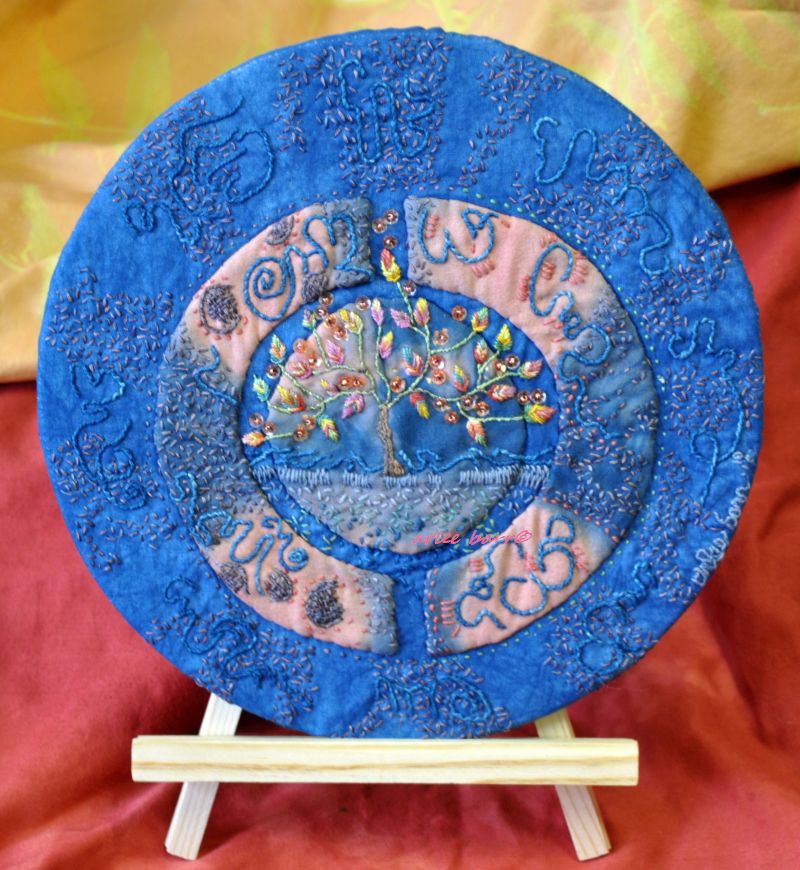
River’s Edge

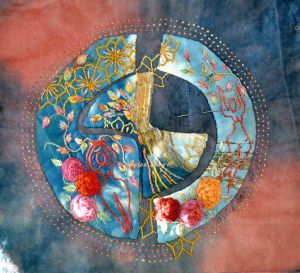
#15 in the indigo moon series, i may have lost some “serious art” readers “because apparently all i’m doing is “crafting” this year” (get on yer high horse, you know who, and ride off far away), but ya know what? I NEEDED this year to be easy, to be Small, to be, well, just mooning the world–ha!

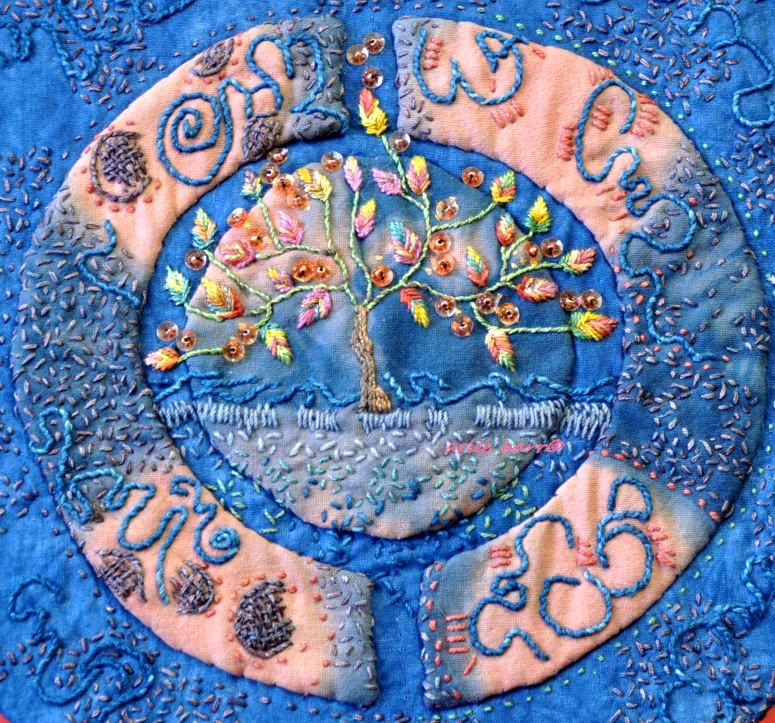
The texture on this one is amazing, even if i do say so myself πŸ™‚


Since it’s grey and cold and blowy here, i added a little bling from the embellishment stash that hasn’t seen the light of day for a looonnng while! These moons are getting bigger with this one measuring at 10″ across. (Still thinking of a HUGE indigo moon!!) And some are getting smaller, as i have a few planned in a 5″ size.

See the shop for details.


Posted in Natural Dyes, Naturally dyed threads, Probably talking to just myself

“each stitch an entrance”

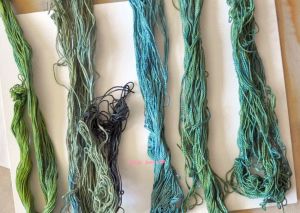
Not all threads are created equally, especially when it comes to dyeing them with natural colourants!

I’ve had a few flubs along the way, as i build my stash for stitching with, but in the end, each has it’s own qualities that are useful. The major fail i had was a thread i thought was 100% cotton, but since the label had been long lost, and i generally haven’t collected any synthetics for a few years now, i threw it in a madder pot and expected good results automatically. HA! There must have been some acrylic in this one, as it barely took any colour:

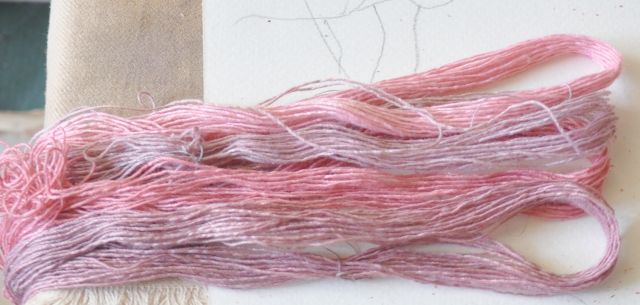
Pink from madder, pale lilac from madder with post mod iron dip, but this thread was just too soft and lovely on its own to throw out, so i then dipped them in indigo, because indigo dyes *everything*, it being SO substantive!

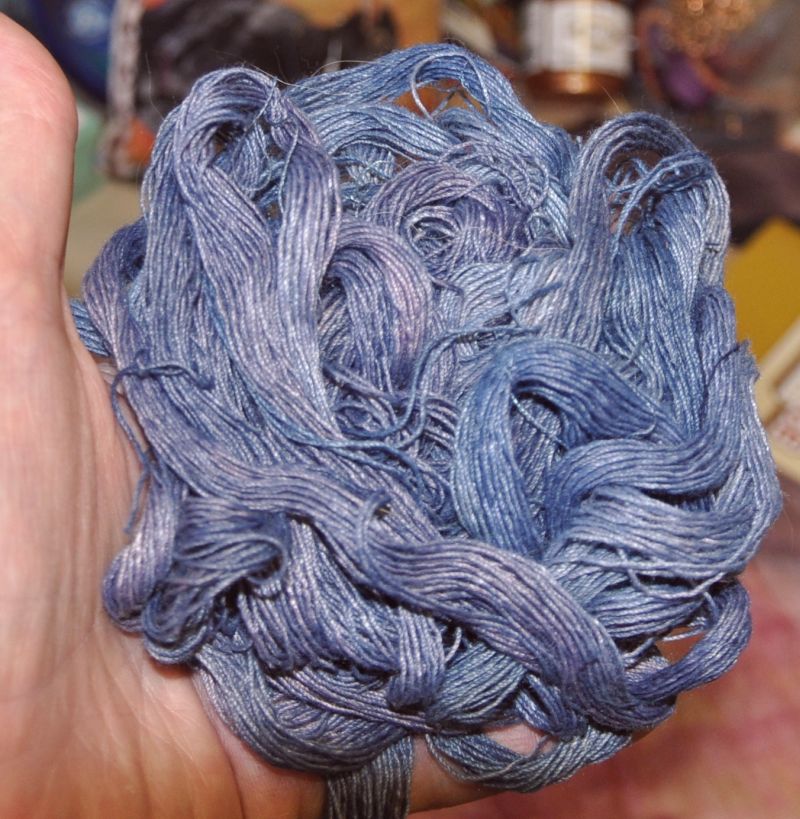
And there’s still some lilac-y hints! These give a lovely soft ethereal appearance when used, subtle gradations and shadings quite effective depending on the stitch used.


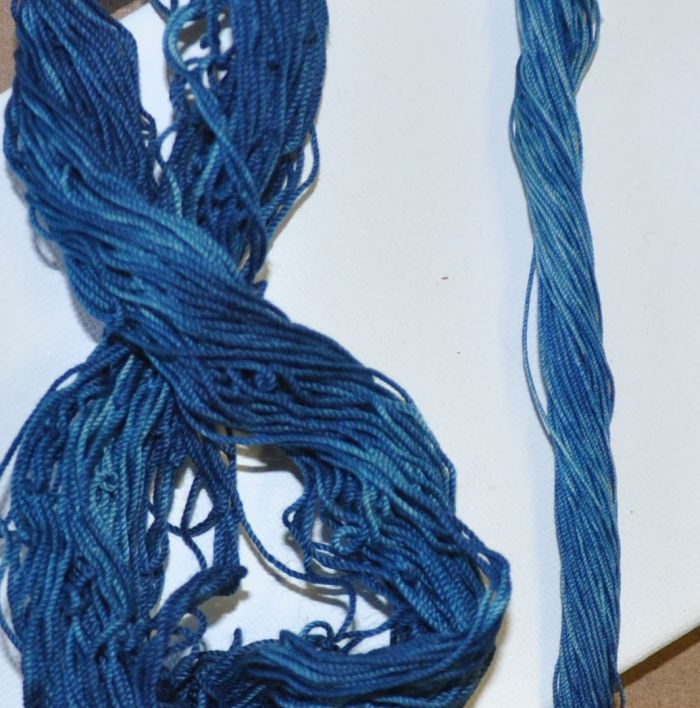
This one REALLY bothered me at first, a heavily twisted 4 strand embroidery thread, it just wouldn’t dye evenly due to the tightness of the wind, no matter how long i let it sit in the madder! Popped it in the indigo again and whoa! Look at that tweedy heather effect!

I use this one separated into two strands and love the way the colour shifts along each length. Because of the stiffness of the thread too, it tends to stand more proud of the surface. The way the colour took, and the spin of the thread, give it the appearance of disappearance visually when used on darker backgrounds! Fantastic for texture!

And these were a lesson also in the “weight” of a thread, the left being a crochet cotton, the right a stray spool of fine upholstery thread:

Due to my inexperience at the time, the indigo didn’t grab every spot, because of the way the threads were wound, tied and handled. Both are heavier, thicker threads that really lie loudly on the surface, or build a heavy tactile line, again with different stitch types.

It may look as if i’m using indigo to “fix” problems in incorrect procedures, but it’s co-incidence i swear πŸ™‚ I do pride myself on proper scouring, premordanting according to fibre type, and using dyes that are actually dyes, not stains or food waste nonsense. (Again, no beets, beans or berries here….) These “fails” were inexperience, haste, and not testing unlabeled fibres. Lessons learned!

While every stitcher needs a substrate to stitch on, whether it’s conventional fabrics, plastic, metal, paper or toast, it’s the threads that get me excited. I’m continually building the inventory, and am thrilled to say that now i can depend on my own skills to add so much colour, without using commercially dyed threads, or having to worry about matching dyelots! There *can* be subtle differences in dye baths due to the inherent nature of these dyes, but at least the reds are still reds, the greens are greens, the blues are blues, etc etc etc, but never like this debacle with synthetic dye……..


And i wanted to share a very evocative piece of poetry that my friend Dana sent me.

The Many Ways the Light Gets In

​​​​​​​
It was easy to judge those Jane Austen ladies
languishing all afternoon over embroidery
pulling thread in and out of hooped linen
as the world spun round without them.

The bone stays in the starched bodice of their dresses
forced an upright position,
the way nuns in a cloister sit
all spine and neck erect
to better access the β€œno thought”
they need to taste
the honey of meditation

centering their minds
to a pinpoint
of light

I’ve envied the discipline of those mystics
tossing off thought like an extra blanket
but not so much the ladies
sealed in their parlors

then today
I found myself
deep in silence
pulling a rainbow of silken threads
through a hooped grid
the rhythmic in and out
of the steel needle flashing its tail of color
dissolving all thoughts in whorls of amber
sapphire, magentaβ€”
falling upward
each stitch an entrance.

Marion Goldstein

Posted in cochineal, Ecoprints and Natural Dyes, FybreSpace the shop, Indigo Dreams, Madder, Moons, Natural Dyes, oak, osage, pomegranate (as dye and as mordant), privet, sandalwood

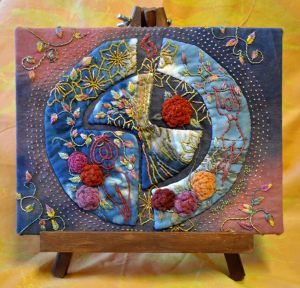
Autumn Goddess Moon done!

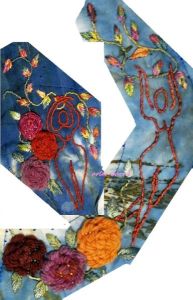
A celebration of fecundity and the feminine, this indigo moon bears the rune “Jera”, a symbol of harvest, and meaning “Peace on the land, peace in the heart”.

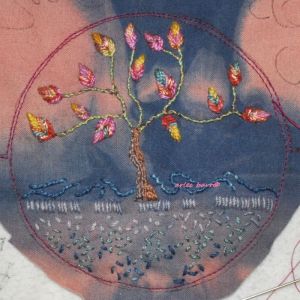
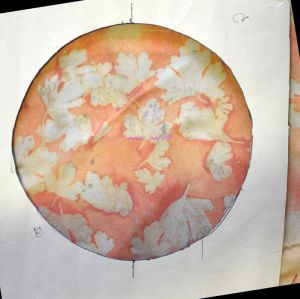
Hand embroidered in cotton, silk and wool threads, naturally dyed with oak, osage, privet, walnut, madder, pomegranate, cochineal, indigo and sandalwood, on an ecoprinted and indigo dipped cotton, background madder and indigo on cotton. Some metallic threads are also featured, because even natural likes a bit of bling once in awhile!

Available in the shop!Β Β  SOLD

Posted in cochineal, Ecoprints and Natural Dyes, Indigo Dreams, Madder, Moons, Naturally dyed threads, oak, osage, pomegranate (as dye and as mordant), privet, sandalwood, tansy

Moon number 12, almost done!

(Although, if i count the two Rabbit Moons, this one is number 14!)

Again, all natural dyes, threads and fabric, except for that teeeeeny bit of coppery glitz on the “stars”, a gift from Karin. Even naturals like a bit of bling once in awhile πŸ™‚

I figure about another 4-6 hours, and “Harvest Goddess Moon” will be done.

Posted in Natural Dyes, Naturally dyed threads, oak

foraging

As much as i love the “Grand Teint” dyes, the historically accurate tried and true, there *are* other geo-centric plants that are still considered dependable methods of colouring fibre. I’d like to use more of these in my studio, with the proper applications and methods used. (No beets, beans or berries in this Dye Dungeon!) You could call this one “loakal” πŸ™‚

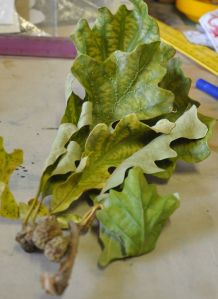
The only oak that is indigenous to, and survives the hard winters of Alberta, is the Bur Oak.Β  When i first started ecoprinting in 2010, i couldn’t find any, though i figured someone had ONE in their area somewhere, since i saw one of the leaves floating in the river πŸ™‚Β  In the last three years however, they are aplenty, due to the city’s replanting along boulevards and green spaces. My neighbourhood now probably has at least 20 of them, but none on my street!

Recovering from ‘Snowtember’ 2014, Recovery and restoration of Calgary’s urban forest

In September 2014, a late-summer snow storm affected Calgary’s urban forest. Trees that had not yet lost their leaves were heavily weighed down by snow, causing trunks and branches to break. Of the 227 communities in Calgary, 148 with mature canopies were particularly impacted by the snow.

It is estimated that 50 per cent of the 500,000 public trees and 1.5 million private trees have been impacted. This means there are three times as many damaged trees on private property as there are on City land. Recovering from this storm will require us as a city and a community to look after our trees.

Out of this disaster, The City created the ReTree YYC program to work on the recovery and restoration of the urban forest. This recovery work started immediately after the storm and will continue over the next three years. This work will ensure we have a strong and resilient canopy for generations to come.

This is the snowstorm took half of our 90 year old apple tree!

I know that oaks give colours from beige, to yellows, to various greens and browns, depending on what part it is (leaf, bark or gall/”oak apple”), and what mordant or modifier is used, and that those can be base colours for overdyeing, or warm earthy shades to be used on their own. I don’t have a lot of these shades in my naturally dyed thread box bin yet, as i’ve been concentrating on brights, deep rich rainbows and exciting greens, all of which is kind of funny now, since when i started on the “natural” kick, i had to use commercially dyed browns….

Oak is also rich in tannins, from any part of the tree. I collected a few galls as well this fall, something i’ve never seen before here. At the very least, my fabrics will be pre-mordanted correctly!

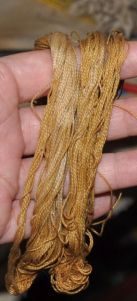
Yesterday, the DogFaced Girl helped me stuff a large grocery bag with fallen oak leaves (faded to brown, not like the green above from several weeks ago). That girl is such a help on these walks πŸ™‚ I didn’t weigh the amount, just stuffed a 16L pot, with about 12 litres of hard tap water, simmered them for 2 hours, threw in a skein of thread and left it overnight to stew and cool. (I just realized too the thread had already been premordanted, so will have to try one that hasn’t been…)

Because the pot is so full of leaves, the thread was somewhat constricted, so the dye job is a bit patchy in uptake, which is okay because i love variegated threads πŸ™‚ This is still wet in the photo, but isn’t it a pretty gold?

Yeah, yeah, i know, the number of plants that give this range of colours is humungous. The point is though, that it IS an actual dye (and tannin), and as i noted, a good base. And i did it.

I threw the skein back in the pot, wanting to see if i could get an even deeper shade with longer soaking, and will add more premordanted and unmordanted threads, and a couple of hunks of fabric as well. Tests at the end of the week will be overdyes, post mordanting and post modifying.

And Nessie and will be going on another long walk with more bags, as the leaves can be dried and stored for later use, during out long cold hard Calgary winter.