Posted in a collusion of ideas, in progress, journal: lessons to learn, Rust, Samara

bravely, eyes squeezed wide shut

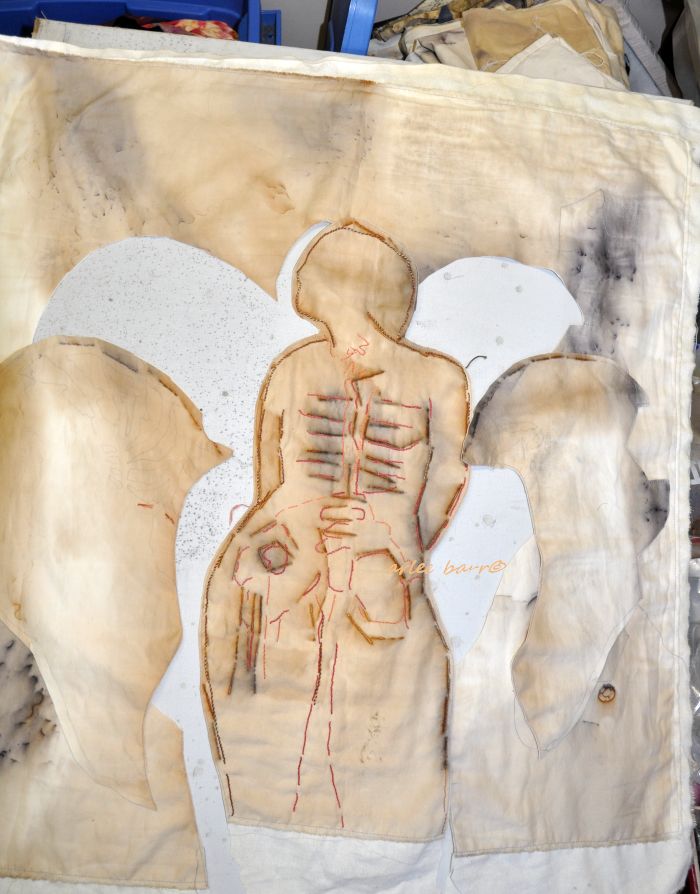
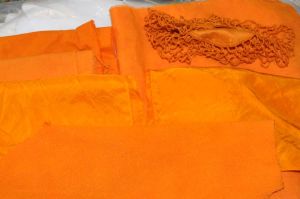
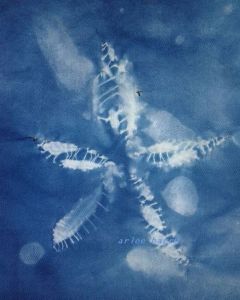
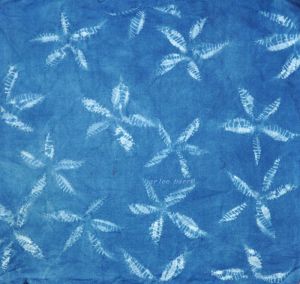
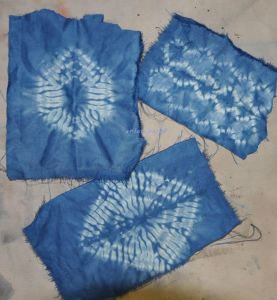
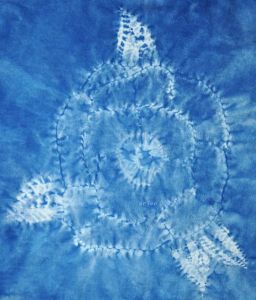
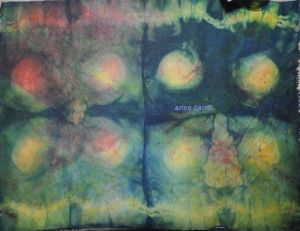
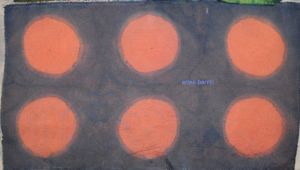
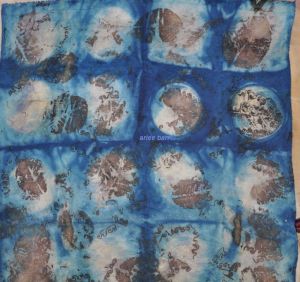
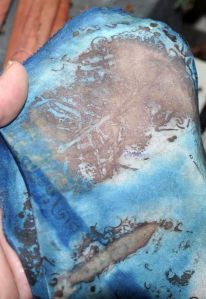
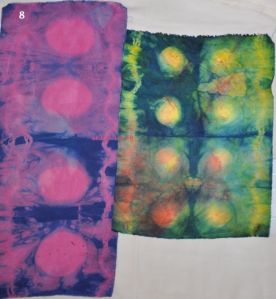
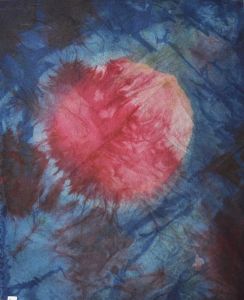
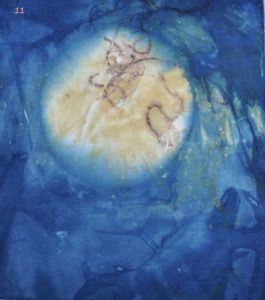
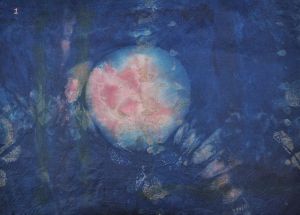
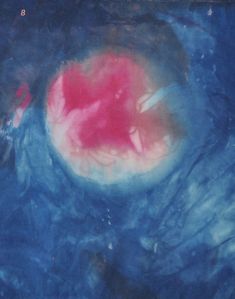
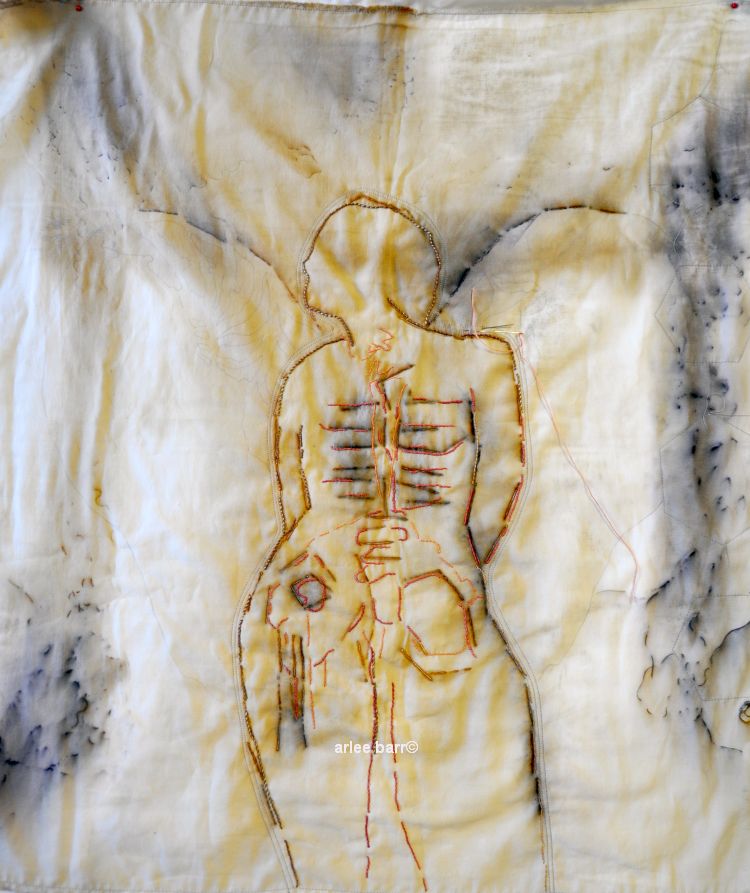
Samara has been stalled for a long while. The fabric was created in a residency in 2016, has had a wee bit of stitching on the body, and a hell of a lot of staring at on the design wall.

Every once in awhile i’ve trotted her out on the blog, wondering what i’m going to do with her and how. *I’m* tired of her as she is, so i imagine you’re pretty bored by now too πŸ™‚

I know i probably had some grand vision when i first laid her out at ACAD, and at that time it was enough to be able to deliberately create a design like this with natural processes. I do love her, but for reasons unknown, she just hasn’t fired up my imagination enough to do any more to.Β  I’ve started feathers of various sorts for her wings, pulled naturally dyed threads, fussy cut naturally dyed fabrics for some areas, but nope, no feeling of commitment.

Time for extreme measures then.

Well, at least if i *still* don’t do anything with her, she’ll be easier to store………………………………..


Posted in journal: lessons to learn, mordants and modifiers, natural dye research, oak

foraging, part 2

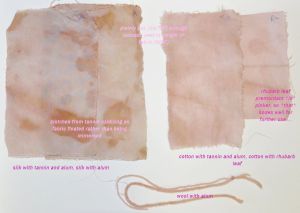
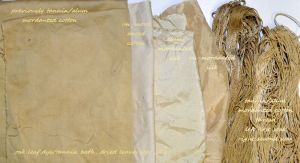
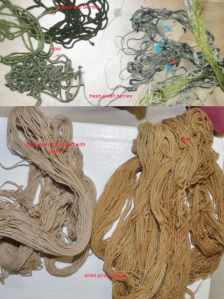
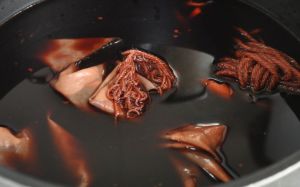
Mysterious chemistry πŸ™‚ These are the oak leaf results.

Quite chocolate coloured on its own!!! I’m sure the first extraction, the first thread in the photo below, proves that more WOF is needed, as i’d love to get that ON fabric or threads! Even though the pot was positively solid with the leaves, i’ll do extraction by soaking/simmering for two days, then remove and add new/more leaves and repeat the process.

Oddly the UNmordanted silk took the colour better, whereas the uptake on previously mordanted cotton was expected.

I have also discovered that my thread skeins from this batch were looped too tightly to either be scoured properly, or mordanted thoroughly, hence the “variegation”–even though i loop quite loosely, it still had an effect. (lesson learned there: DON’T loop)

The colours are softly pretty but not terribly exciting, however they are good base colours for overdyeing, and are obviously *all* mordanted now, as that’s what oak does πŸ™‚ I still have to do post mods to see what colour changes i can get (nothing earth shattering expected), but it *is* good to see what colours one can forage locally.

I’ll still collect more of the oak leaves as they are plentiful and falling anyways. And no one else uses them, just bags them up and sends them to the city compost facility! Also on the list is Cottonwood (a poplar species), very prevalent in my neighbourhood.

Posted in "OPINIONATION", FybreSpace the shop, Probably talking to just myself

reality check

Okay, time to be blunt. FB is doing me no good as a business. No one sees the posts. If you pay for an ad, no one sees the post. If no one sees a post, no one goes to the shop, and no one buys. No support=no business. No business=no products being made. No-one goes to the shop from here either, honestly, though for one last time, i am adding the link here–>shop


All products that are in the shop will remain until sold, but no new ones will be added either. The shop will remain as it is, until a. everything/most is sold or b. i fucking give up. If you see it, want it, please buy it. As a small business owner, i cannot afford to keep paying for a shop or a passion, that does not pay for itself. This is not a whine, or a rant, this is a reality check. I could probably make more money standing on a damned corner, as raddled and old as this body and personality is. If no one supports small businesses, artists, entrepreneurs, why should we keep on going? I’m not going to discount anything except to the faithful few (you know who you are and already have that discount) because the prices are more than reasonable for the amount of work and effort i have put into them. And as always i refund any extra postage paid.

I see people going all ga-ga over mindfulness, slowness, natural and eco, but few who actually put their money on those products. I see badly dyed or overpriced products fly out of some shops. Should i raise my prices? Should i slap things on cloth and call it wabi-sabi? I pride myself on well done, properly done, reasonably priced.

You think i’m whining? Nope. Honestly, i am DISGUSTED. I’m not even going to bother with the “Buy my art before i’m dead” route, because too many think that’s funny. I have never cheaped out on the quality of my work. I’ve put every lesson learned, into producing cloth that should be valued. I don’t whack things out in multiples using the crummiest method that will impart a modicum of colour.

I’m not just disgusted either, i’m fucking furious. At myself. Wasted time, wasted effort, wasted resources, wasted money. Screw it, head is now out of ass.

To the customers who have supported me over the years, i do thank you for the support and faith you have put in me. You are truly a lovely bunch of people.

If you disagree, well, ’nuff said. Over it and out of it.

Posted in "OPINIONATION", Book reviews, Natural Dyes, Probably talking to just myself

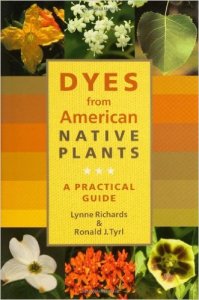
Book review: Dyes from Native American Plants

(I reviewed this on my old blog, but thought it worth repeating here, with a few edits.)

You know what the best thing about this book is? It gives a detailed list of plant materials that give little or no colour!!! That means less wasted time, fabric, heat and gathering πŸ™‚ Though it’s a bit more geocentric than i thought it would be, given the slightly misleading title (covering mostly what grows in south-central US), a lot of the wild plants mentioned are widespread in North America, even up to Alberta. It does miss out on a few plants in the same species, but given again that it is geo-specific, that may be why–one variety in the species grows there, but not others. It’s also decidedly not a “kitchen scrap” book with claims of blue from elecampene, magenta from dandilion roots, green from spinach and lasting effects from turmeric!!!

No vinegar or salt “fixes” either–really, just go, run down to the corner convenience store, buy a bag of potato chips fer jeebly sakes, if you’ve got a hankering for salt and vinegar, and stop mushing on about how they make berries last longer and stops rust from rusting…….

The only true problem with this book, is that it doesn’t give any indication of what is light or wash fast. It does tell you *how* to do that, but there are no notes with plants what is worth the effort, and what is a waste of time, effort and resources. I truly believe too, that testing for these should be an INTEGRAL part of the dyeing process. Maybe then we’d see less of the Beet and Berry Brigade posting their results for the GaGa newbies…………… There’s also no mention of post modifying, an important and often surprising process that brings unexpected colour out.

So what else is in it?

It’s laid out with plant materials grouped by colour results, it has a comprehensive index with the Latin and common name (though the common nomenclature may be regional), there are photos of the plants mentioned. I would also recommend investing in a good geo-centric plant guide, like those published by Lone Pine Publishing, so that you know what you are looking at, and hoping to gather. The author speaks of responsible gathering and safe dye practices and it’s not dumbed down or too technical. My only complaint is the prevalent use of tin as mordant in a lot of the dye baths. Even in 2005 (the date this book was published), we knew this type of mordant was dangerous for the dyer, and best not used in the home. There are no “recipes” per se, for the novice, but the more experienced dyer will already know that as with most plant materials, your plant chunks ratio should be at least of the same weight as your fabrics/threads.

There were a few surprises with some of the flora mentioned. Certain plants abound here, and while i’m not going to get too excited about the possibility of using them, it does give me new hope for local colour. Many of them are also though, while “plentiful”, are in our National Parks–and i am never going to scavenge great quantities, because of that, and because they belong where they belong, period. If i find them in a ditch however and if it’s in my immediate environs, and i know it’s considered invasive or noxious, it’s fair game. I recognized a few varieties i had no idea would give any colour at all, but because of my frequent walks with the DogFaced Girl, i know that locally these are very very small ecosystems, and i would feel incredibly guilty if i denuded the area. I am passionately interested in using what i can find, but not at the expense of the primary reason why i do these walks and that is to appreciate what is there, not what can be taken away! You’ll note i did not mention any of these by name—–i don’t want to be blamed by the Cosmos for encouraging somebody sneaky to go and strip their area!

Of course, the preponderance of colour mentioned is yellows and browns, as few native North American plants have the tinctoria classification πŸ™‚

Posted in FybreSpace the shop, journal: lessons to learn, Natural Dyes, Naturally dyed threads

8th anniversary natural dyes!

To celebrate my loyal customers who have supported me through this adventure, i am offering 20% off EVERYTHING in the shop–that includes sale items, Art and fabrics! As always too, i refund extra postage paid. The discount code is 8AFS, and because the instructions on the form are a bit confusing, after you add the discount code to the little box, make sure you click on the little black circle too!

According to my old blog, i started “messing with potions” in the form of natural dyes, sometime in July of 2010. From threads that faded in days, kvetching that most dye books mentioned only wool, smelly jars that resulted in copious ick and mold, and wondering how you knew what to mordant with what, i’ve come a long way to piles of naturally dyed fabrics in strong colours that last, a rainbow of threads and a library that is dependable and exciting. Along the way came knowledge about the history, economics, science, geography, arts and culture, and folklore and fact, so much more fascinating that any synthesized dye! (I won’t say “chemical” dye, as it’s ALL chemistry, even/especially the naturals! πŸ™‚ )

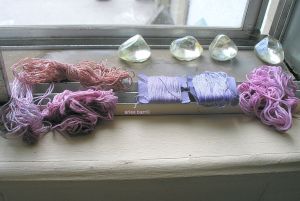
Lovely lovely hollyhock colours–that faded in a week

I had hard lessons about the value of mordanting, above (i didn’t at all…), and of learning about fugitive dyes, below:

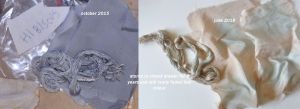
Hibiscus Ha Ha

I learned about the quality of dyes:

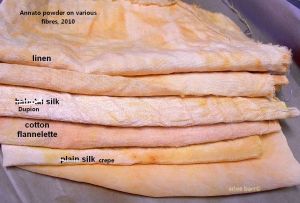
Annato powder used on several fibre types
Annatto powder sold for food colouring used on several fibre types, no scouring, no mordant

And the correct WOF use:

Actual annatto, correct WOF, pre-mordanted

I learned that cheaping out does not give good results–if i bought the dyestuff, obviously i should be using it correctly, but these were scoured improperly, poorly mordanted, and low WOF, madder:

And done correctly below:

Yes, it *was* fun, playing with whatever was handy, experimenting and mucking about, and it *is* a way to learn about natural colour, BUT all those poor results, fugitive dyes and improper procedures become expensive wastes of time and materials in the end run. “If it’s worth doing, do it right.” “When in doubt, read the instructions.” Because as my mother always says “You buttered your bread: now you have to lay in it.”

Posted in Deliberation--do something you don't do--or haven't in awhile, Indigo Dreams, Probably talking to just myself

learning curve, shibori

Actually, i could say “re-learning”: i did a bit of shibori during my 2012 residency, and certainly in the 90’s at Capilano College!

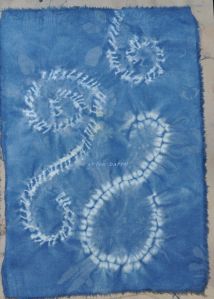
This was my first attempt, a bit of “guntai” stitching:

A small piece, i was a bit impatient and didn’t get it far enough into the indigo.

So then i did this one, same design but many more on one piece:

It took me 2 hours to do all the stitching on this–and almost as long to pick it out after dyeing! Note to self: good light, sharp seam ripper, lighter coloured thread, patience.

Then i thought “Hey, why not get the actual shibori BOOK out and try some samples?” *And* the good light, sharp seam ripper and lighter coloured thread. Patience was found, as i realized i was quite enjoying the process.

Above, trying out different conformations of line.

Below, 2 types of stitch, one motif.

Below, shapes, alone and combined.

And this rose, which i thought would be wonderful, but could still be, done properly πŸ™‚ Three types of stitch, several of which were not pulled tightly enough, and too square as i learnt to handle the fabric as it stitch. The larger the piece, the more awkward, but it was getting easier!

Rose approximately 10×12″.


Posted in Ecoprints and Natural Dyes, FybreSpace the shop, Indigo Dreams, Moons, Natural Dyes, Probably talking to just myself, Work 2018

dot dot matrix (shop update), and the use of poisonous (gasp) plants in the dyepot

It’s hot, it’s sunny, it’s dry in Calgary, so while that lasts, i’m running a lot of indigo! Some of these babies will be kept for the stash, as i’d like to do an adjunct project with natural dyes this summer, not just the Summer Madder Study! Some will go in the shop***. I have listed only a few to start with, as it takes time to “match up” pieces, so they’re interesting :), and more time to photograph! There are MANY more to list, BUT once the ones in there now are gone, they are GONE, as these are impossible to replicate.


Indigo over madder:

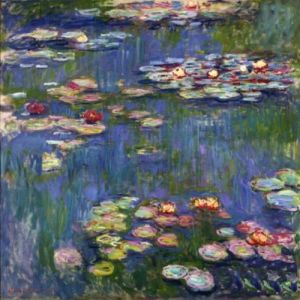
Like a Monet painting!

Indigo over tansy and madder:

Indigo over ecoprint:

This one above i really love, as the indigo turned the ecoprint almost metallic!


~~~~~~~~~~~~~~~~~~~

I’m still in need of green threads for projects, and remembered i still had some dried privet berries stored away from last February. CRAP, this points up why some materials should be used fresh, rather than dried or frozen……

And OMG did the dyepot STINK. A deep dark brown, it immediately got poured out in a spot where nobody goes in the back alley! I want to point out too, that privet (Ligustrum vulgare), while an attractive garden shrub, is also TOXIC. (It’s also invasive, so you might be doing the neighbourhood a favour by grabbing the berries so they don’t turn into baby privets…) One wears gloves, and one does not go all airyfairy breathy goddess and hang one’s head over the pot, inhaling deeply and exclaiming about Mother Nature’s wonderful gifts.

I’ll have to modify those to get greens, or dip in some indigo….

If you forage locally, know what you are gathering, and any potential toxicities.Β  Also, check to see if *your* country has a Biodiversity databank. Canada has an excellent one. They do also mention other areas, in the US. http://www.cbif.gc.ca/…/canadian-poisonous-plants…/…

~~~~~~~~~~~~~~~~~~~~~~~~~~~~

***Please bear with me as i update shop offerings. I know it may be annoying to continually see posts of “GO TO MY SHOP AND BUY BUY BUY”, but as an artist, and a small business owner, this is the way i help keep the groceries on the table, animal food in the pantry for the assorted beasties, and the occasional “luxury” like new socks and underwear πŸ™‚ My hardworking GreymanΒ  is very supportive of me, but i still have to pull my own weight, as an even partner in our marriage! I have only 3 avenues to promote my business: here, on my FB “biz” page, and on Instagram, so i have to take advantage of that. I don’t do craft fairs, though i may do the Contextural one this year, haven’t decided yet, so online is where my business is. Yes, it may seem pushy in a way to keep seeing these “ads”, but a Woman Has to Do What a Woman Has to Do, and the Gawdz know i ramble, rant and rite write about other stuff often enough in other posts, that i hope you will understand.


Posted in FybreSpace the shop, Indigo Dreams, journal: lessons to learn, Natural Dyes

“shopfull” indigo revival

I had to make a new indigo vat, as the old one while having been successfully revived last year (after going through 3 frozen outside Calgary winters!), is now defunct, kaput, gone to the Great Blue in the Sky Vat. The 123 vat, well, we just won’t go there again…….i took the lid off and i’m sure the neighbours three doors down heard my horrified gasp. It’s definitely a note to throw out when it’s GREY, molded and has a suspicious pancake of solid yellow schmutz in the bottom that won’t break up……

As i was going through drawers and boxes, looking not only for dyes and chemicals, but fabrics as well, i realized too that it’s almost an anniversary, 8 years of natural dye, sometime around the beginning of August, and wow have i come a long way! In the beginning, i played and got lovely colours that didn’t last (no mordants!), used things that didn’t really qualify as a dye (lilac flowers, anyone?), but i learned from this what would give colour, a bit about post modifying, and got quite excited about indulging a childhood passion for “potions” and finally that actual RESEARCH means you can do it right, right from the start. I really knew nothing about natural dyeing, in respect to process, though i did know the basic history. Along the way, i also learned to ecoprint/contact print/botanical print, whatever you want to call it πŸ™‚

Subsequently, in the shop are some wonderful combinations of natural dye, ecoprint and indigo. The prices are low, considering the processes, and the size, so please, do indulge yourself:) As always, any extra postage you paid will be refunded!


Posted in avocado, journal: lessons to learn, mordants and modifiers, natural dye research, Natural Dyes

deception/disappointment/disavowal in the avocado pot

Though i was intending to leave much of the test fabrics and threads in the dyepot longer, i couldn’t resist cutting a few pieces from them, and pulling them out. You’d think with the appearance of that pot above, that the colours would be a HELL of a lot deeper. I could have totally conveniently “forgotten” to post all this, lessening the chance of public embarrassment, but hey, it doesn’t work all the time, and usually because we don’t follow the instructions, so live, learn, laugh and take the lumps πŸ™‚

CRAP, these are undeniably CRAP. Definitely not enough plant material in comparison to the fabics (WOF in other words)!Β  Admittedly, i had maybe a scant 50 grams of the peels………. I’ve been told the best ratio here is 2:1, so i was waaaaaaaaaay off base with that, duh duh duh. Strangely, the cottons seem to have better uptake than the silk and the wool this time.Β  The blotches are because they floated up during the night, and were exposed to air, the tannin then oxidizing. I think too, my pot is a bit too alkaline though, and that’s why i have browner tones. HOWEVER, there IS colour uptake, but undoubtedly, irrevocably, clearly, not enough peels.

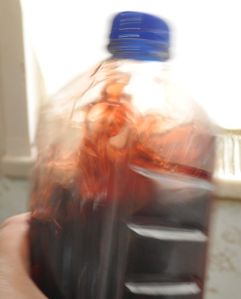
The remaining stewing peels had a glug of ammonia added yesterday, and holy crap, there’s more colour left! I shook the bottle to show the colour splash πŸ™‚

I’m assuming these then are Hass avocados, reputedly the best for colouring. So, i’ll combine the two extractions, and the first dyed pieces, trusting that the strange chemical mix will give me something πŸ™‚Β  (If i don’t blow up the house.) I’m calling this experiment not quite a failure, but a learning experience: DON’T CHEAP OUT ON THE DYE MATERIALS. If it’s worth doing, do it right, otherwise all i can chalk this up to is a waste of water, time and effort.

The pits that are soaking are more weightwise, but need to stew longer.

Note: buy more avocados for lunch.

EDIT APRIL 30/19: subsequent discussions in a natural textile dye group, and my own lightfast tests, have concluded that avocado’s lovely pinks will gradually oxidize to browns, because they are more a tannin, than a dye.


As a side note about the importance of scouring, i thought i had done enough on a new thread, but when i put them in tannin, this happened:
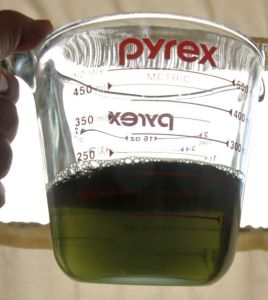
GREEN?????? I contacted Maiwa, my trusted supplier, and asked if perhaps it had been the soda ash in the initial scouring that had reacted (maybe not rinsed enough), as gallnut is a clear tannin, and stays to the “browner” tones after being used and stored. Nope.

Hi Arlee,

This is rare but it does happen, but it is not from the soda ash. Fabrics are often pretreated and contain substances which can leach out or react with the mordant. When used on it’s own Maiwa’s gallnut extract is usually a clear/colourless tannin. I would suggest trying other cotton fibres from different sources and comparing the results.

Best,
Danielle

So, obviously, i did NOT scour as well as i should have, and am thinking this could also be the problem with some fabrics i’ve had problems with, particularly new ones (not second hand, recycled, etc). I don’t generally use new fabrics, but maybe some of the stuff i’ve purchased second hand were new enough that these chemicals were still in them. Something to think about! I had noticed there was more “colour”/precipitate in the wash pot after, but thought all had been removed from the threads. I’ll be doing all the scouring from now on with fabrics/threads that appear in better condition then (ie “newer”) for 2-4 hours, as per J. Liles recommendation. (I scour PFD fabrics as well, as i don’t trust that everything has been removed!)

The green didn’t rinse out of the threads either!
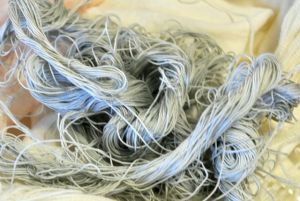

EDIT: i decided NOT to mix the two extractions of the avocado peels. I’ve dumped the first “batch”, rinsed the fabric and threads, and put together in cleaned pot with the second extraction.
 

Posted in Deliberation--do something you don't do--or haven't in awhile, Probably talking to just myself

working with space

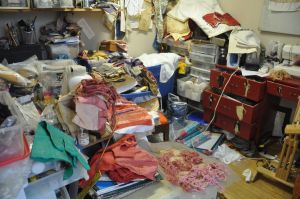
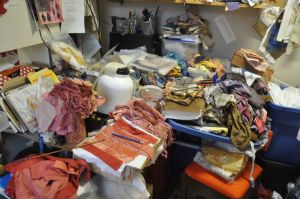
IF you count that corner of the table where the pocket lies with a pencil on top of it…….

I’m HYPER neat and organized at the Day Job, but it never seems to carry over to the home studio.

I categorized this post as “Deliberation–do something you don’t do–or haven’t in awhile”, because obviously, cleaning this up hasn’t happened “in awhile”…….