Posted in Natural Dyes, Probably talking to just myself, quebracho rojo, Samara

sometimes a week has a lot of days to deal with


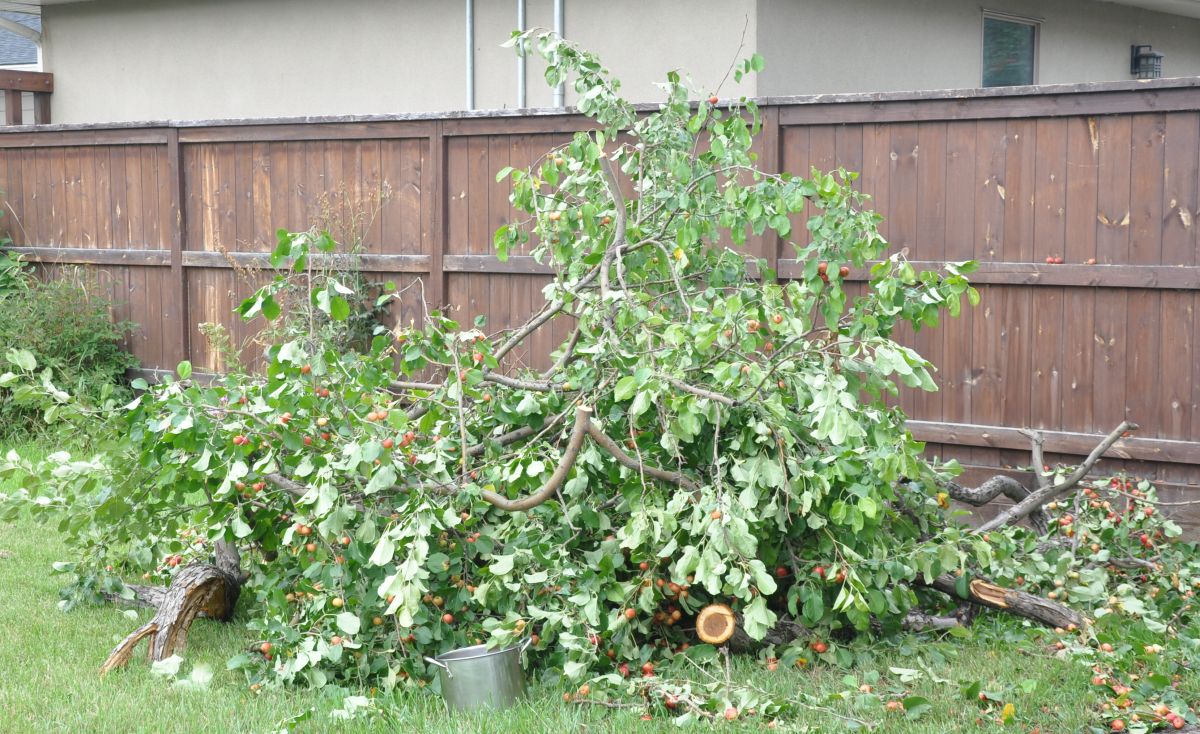
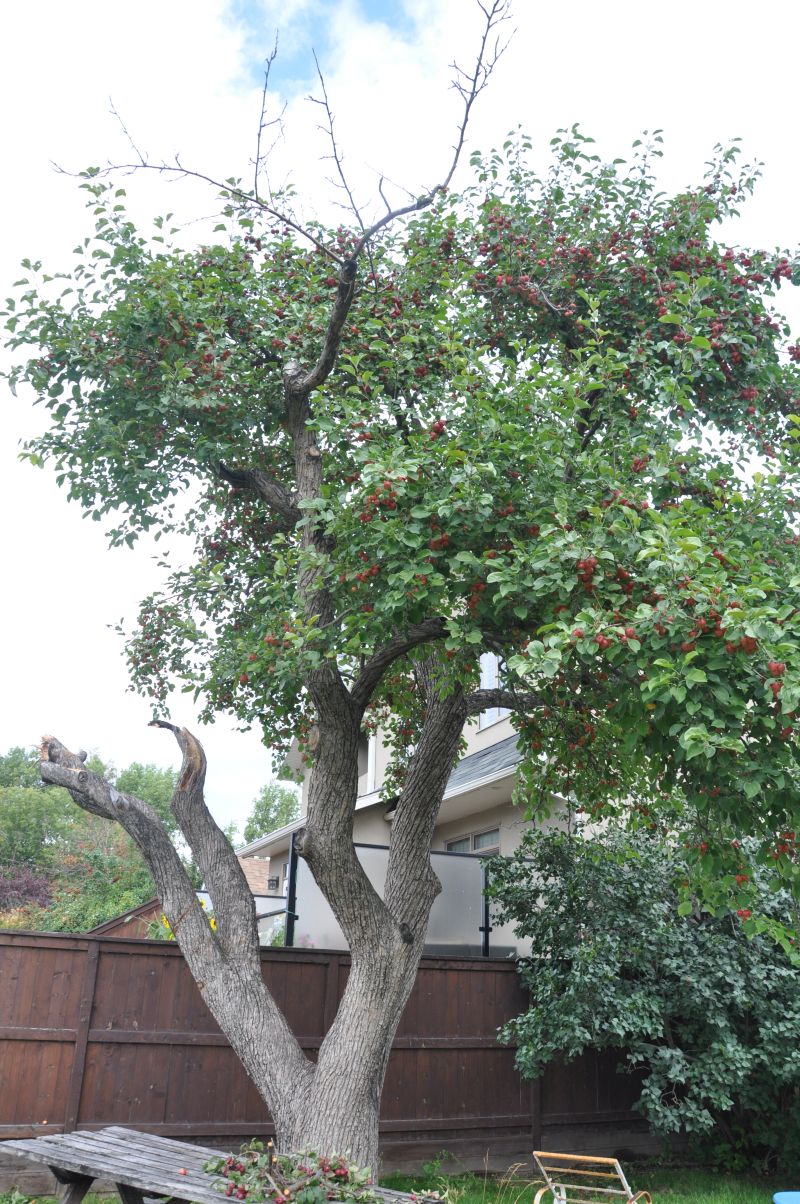
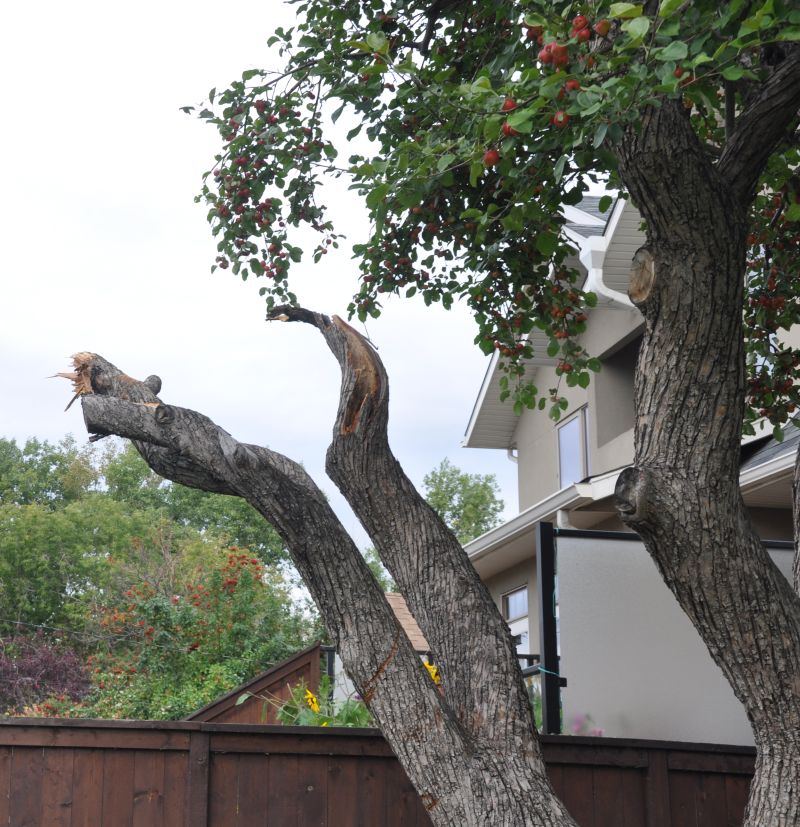
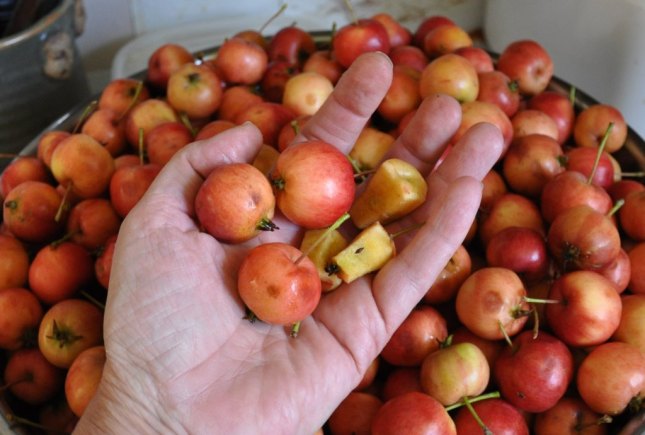
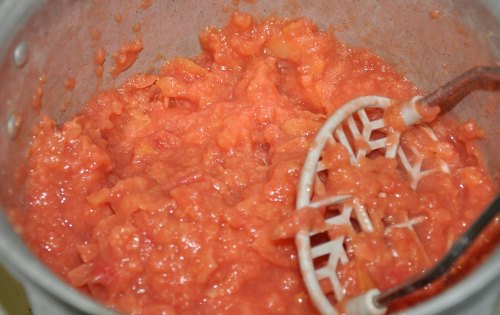
The weight of the apples this year was too much. Picking before this happened would sadly have not prevented this: the big branches are thoroughly rotten inside where they “attached” to the tree…… And of course, this was the best year yet for the fruit. Golfball sized and rosy, they make an astonishingly deep pinkycoral sauce that needs no sweetener–but does necessitate hours of cutting up hundreds of them for a score of 3 litres of sauce.
The whole thing may have to come down, a very sad heartbreak. It’s 90 years old we bet, and if/when it’s gone, there will be no shade, no explosive mass of blossoms and bees, no woodpeckers or porcupines or deer visiting, and another part of this house’s history gone…..

There’s a new “baby” who has joined the family.
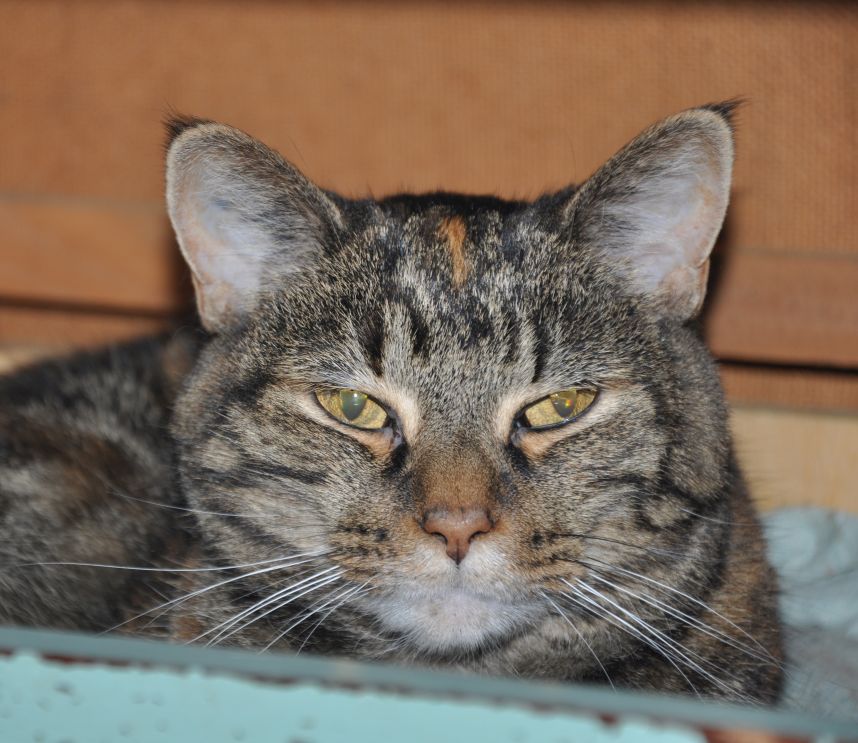
This is Sally, as sweet as her name. From the face, you’d think she was a grey tabby, but stretched out full, she’s a “torty” with tab markings. Sally belonged to my departed MIL, and it’s a good thing we rescued her when we did, the night before MIL passed away (Aug 30), because apparently after a death, only the executor of the estate is allowed to enter the home until everything has been inventoried. (We know they would have fed her, BUT they are still in a foreign country far away, and not back until Sunday night of this coming weekend! Try changing a whole family’s tickets for an early return–3times the price of the original airfare return!!!!!!!!!! She’s have been one very hungry and dehydrated kitty!)

We have wanted this girl for a long time. She lived under MIL’s bed for the most part as she was petrified anytime someone came in the house. We figured cleaning staff may be responsible for this and are so pleased, that while still skittish, she makes herself at home every night on my bed, with plenty of purrs, head butts and long luxurious stretches. She is HOME. Slapshot and Nessie are really not interested, except for the extra “Fud” being doled out 🙂 The family will blend well once again.

I am still trying to decide which natural dye i will use to transform the white swiss dotted cotton to the body of a dress.
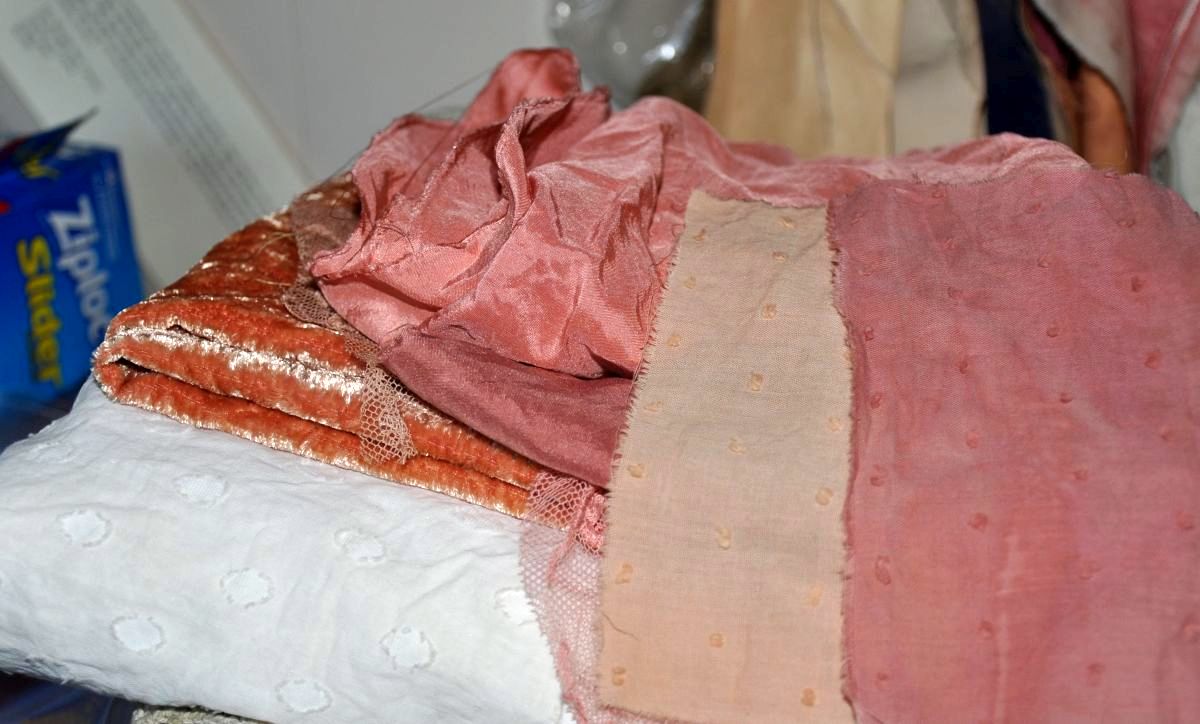
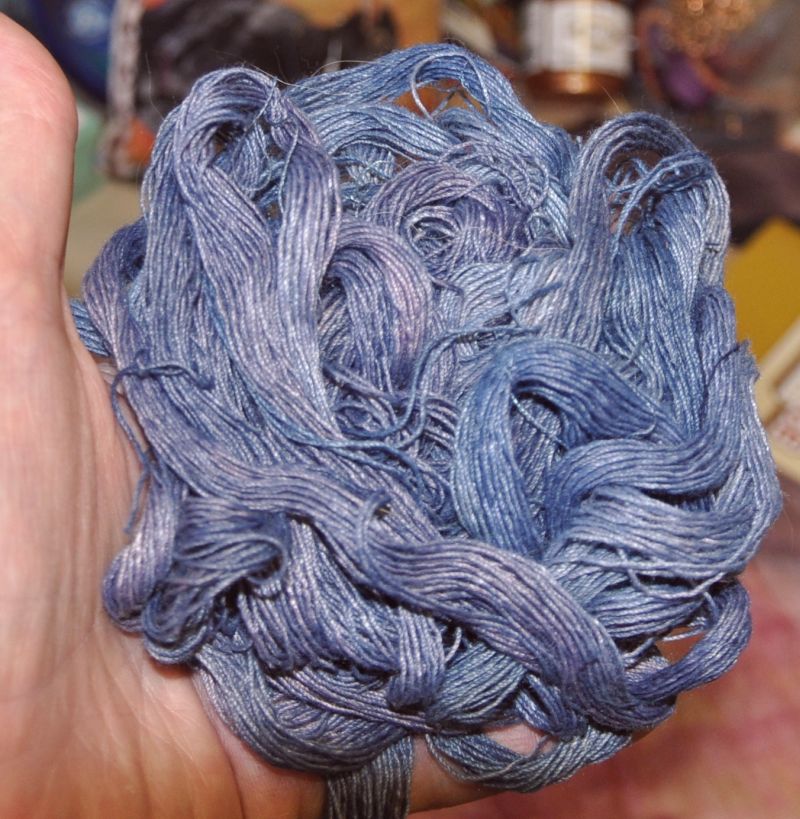
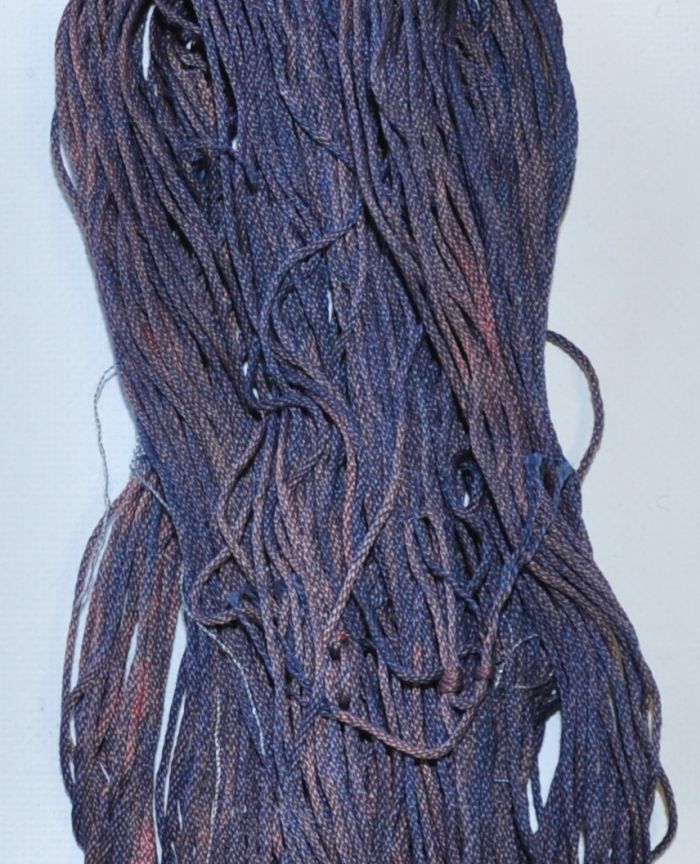
I did two little tests (to the right) with quebracho rojo “leftovers”, the paler almost brown an exhausted bath, the pinker an alcohol extraction, less used. I’m leaning towards them with an overdye of tansy, to get the coral i want, but may slip some madder dips on some areas for a slight ombre effect.

I’ve also been working when i can on the new hexes for Samara.
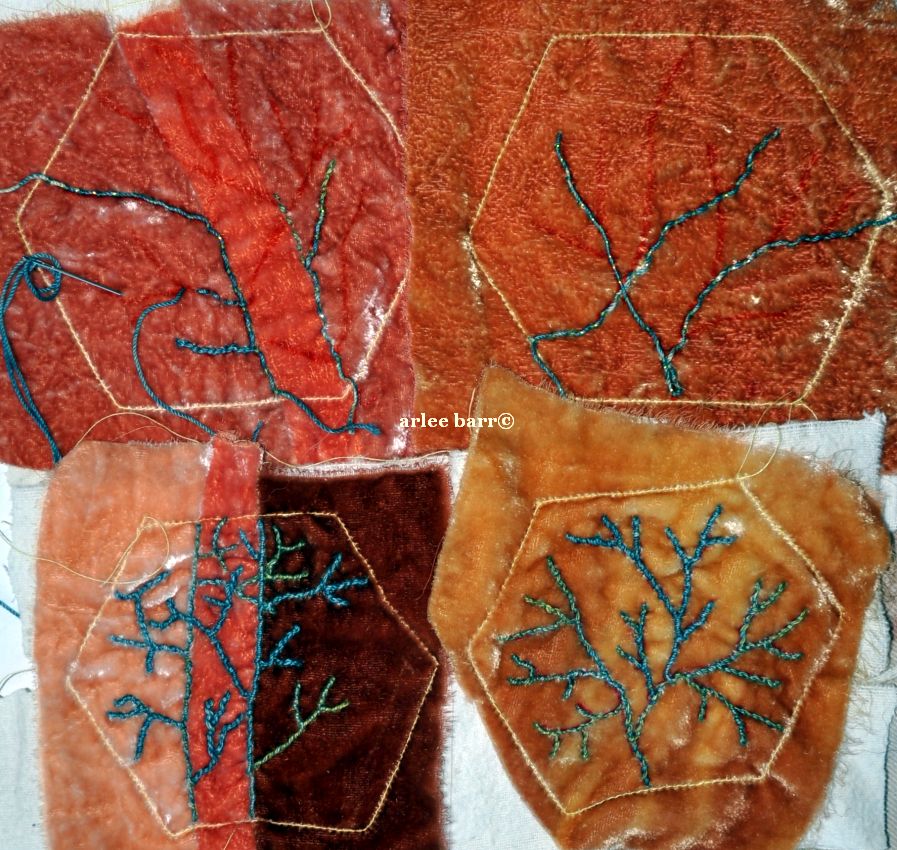
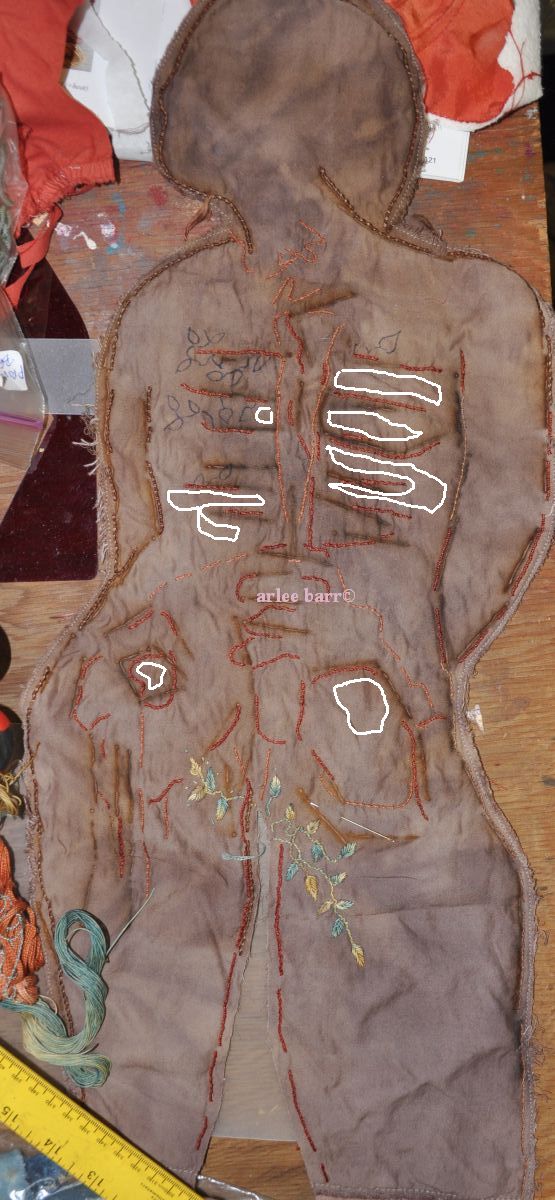
They’ll replace the original ones cut from the background, which will also be embroidered this way and re-attached.

We’re just taking each day as it comes, slow, doing what we can as we can.


Posted in Indigo Dreams, Natural Dyes, Probably talking to just myself, tansy

the greens of summer

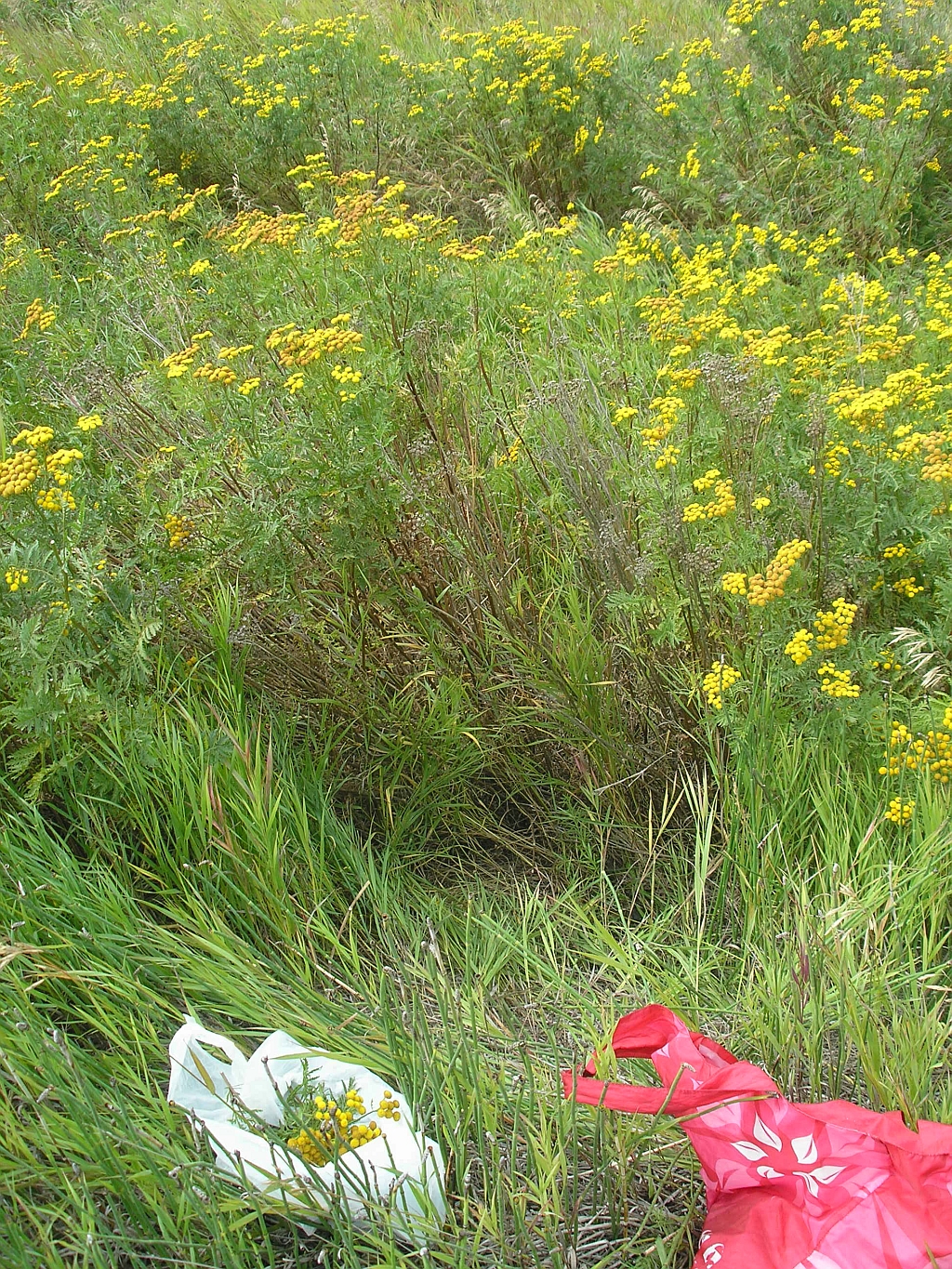
Above, that’s actually a photo from 2010. “There was a gigormous patch of it by the tracks so i headed there eagerly. Just as i got to the edge of the embankment, i heard a train and caught out of the corner of my eye one of the machines they use to keep track (narf) of the rails and trespassers, coming around the corner. Guess who was trespassing actually? Guess who fortunately (?) was so startled that she fell down the embankment into a tansy forest????? They never saw me, even backing up and looking while i flattened myself out on the ground down the edge. I felt guilty and silly at the same time, elated too 🙂 I snuck the camera out of my bag in case one tromped over and asked what the hell this middle aged frazzle haired freakwoman was doing lying on her face on CPR property in the weeds. Umm, taking pictures because i’m a botany specialist? HA! Got a BIG bag of tansy after they toodled back the way they came.”

As much as i love the results i’ve got with “traditional” natural dyes (ie the ones i have to buy, like madder–still waiting till the fall to harvest mine, indigo, cutch, osage, logwood etc), i love a good walk, with the DogFaced Girl of course :), to forage what i know are proven dye plants in my area.

My last big excursion with local plants for natural dye was a couple of years ago, and the results weren’t great. I was never sure if it was because the tansy was picked from a site that had previously been a (probably) highly contaminated ground for a gas station, or if it was just a bad year for colour. This year though there’s ACRES of the darn stuff, a highly invasive plant in the neighbourhood. I decided to try again, and my first excursion yielded the picking of 3.2 kilos (7.05lbs), barely a drop in the bucket even in my immediate area! I’ll be picking more, as there’s probably 1000 times that, no exaggeration, within the 3 block radius i pick in! It can be dried, but sometimes the shades are browner or weaker. That being said, it’s a good base to overdye with other colours: indigo for the most spectacular greens, madders for warmer yellow tones, or oranges and corals, and who knows what with quebracho rojo or cutch? I’ll be testing those as well.

When the flowers are gone, picked or naturally drying/dying on the plant, i can collect the leaves for greener yellows too.

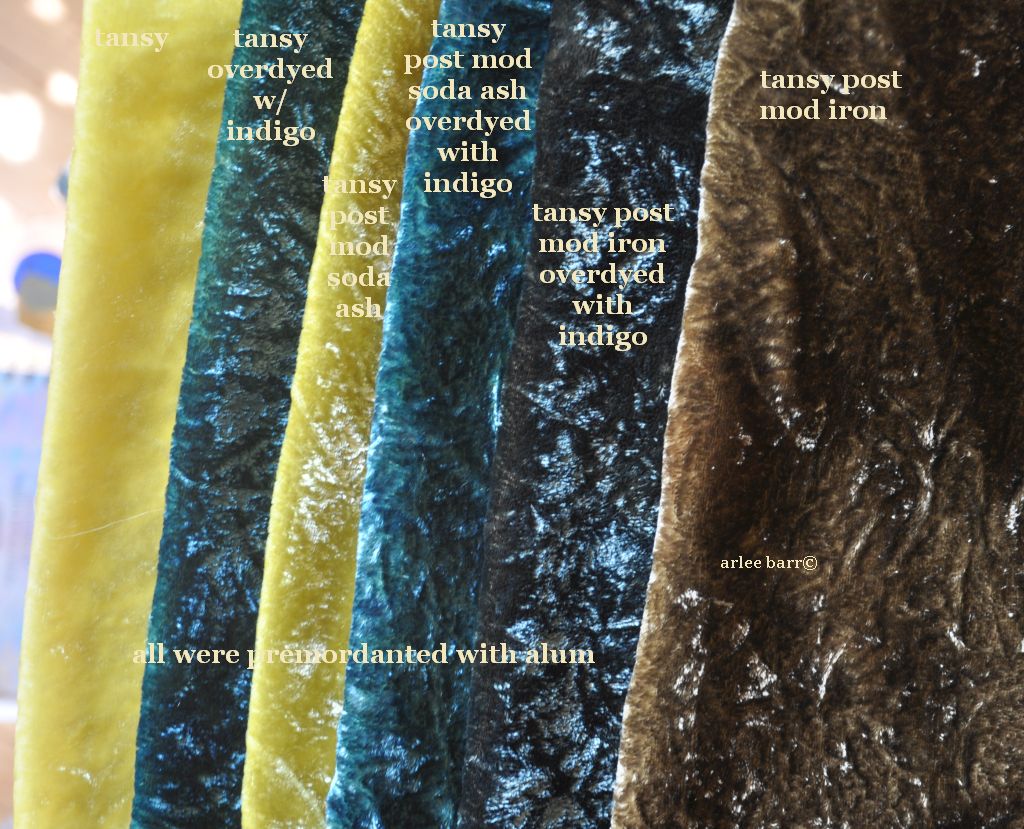
I seriously upped the WOF this year as well, using twice the amount of plant matter per weight of cloth. YUM. This is YELLOW, a cool one, unlike the warmth of osage, but i do love the various shades with different yellow plants. When foraging locally too, the likelihood is that most plants are going to give yellows or greens, but post mods and other dyes can really extend the colour range. I can’t gather enough Solidago (Goldenrod), as the varieties that grow here are really mingy stunted little varieties. Ah, i miss the Ontario ones for colour, and beauty! (Not that i knew that when i lived there, oh so many many years ago…..)

So,

Amazing what one plant, some pre and post mods, and 1 overdye colour can do. Note: these are all silk velvet, with tests to come on cotton and silk habotai.


Posted in a collusion of ideas, Probably talking to just myself

Combination plate #1 please

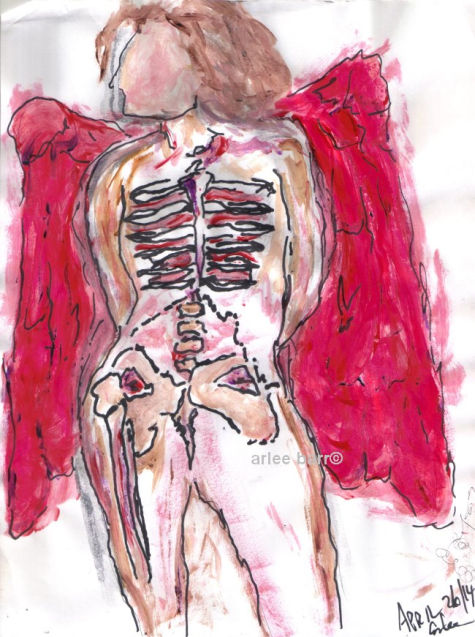
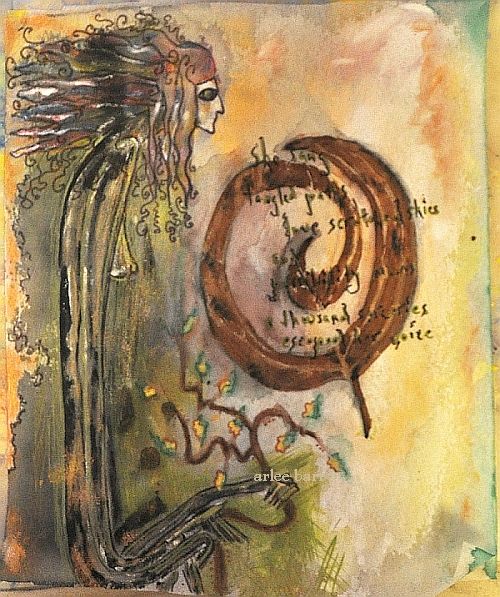
This crone has often travelled through my sketchbooks. (The one above is from 2012.) Originating in the 90’s, and in different incarnations, colourways and “moods”, she became machine applique on vests and jackets, and was quite popular. (I think there’s one version wandering around Hong Kong and another in San Francisco…)

Now i’d like to see her become a bit more tribal as she was intended. I’ll be working out ways to make that happen with the current “ethnic” studies and samplings i’ve been doing. Combining seemingly disparate elements has always been one of my favourite ways to work.

Posted in Natural Dyes, Probably talking to just myself, quebracho rojo

the dye that keeps on giving, Quebracho Rojo

My previous results with a fresh pot were in the pink and purple range.

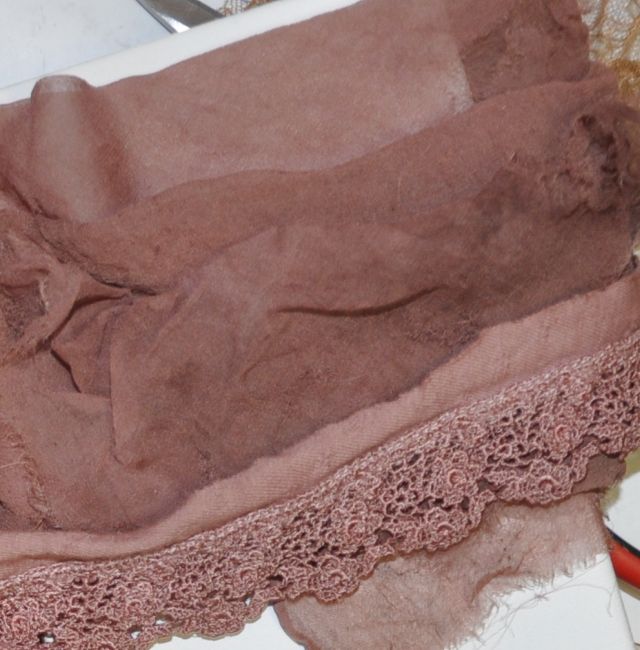
This dye/tannin was definitely worth the expense. I’ve had a pot sitting for two weeks in the back room, where it’s quite cold in the winter. No mold grew, no funny smells, no questionable sludge, so i decided to throw a few odd bits in to see what colours i’d end up with. (I know there’s still a lot of colour in the pot, as an experienced eye can tell when a pot is exhausted and when there’s still dye stuff left.)

A few scrappy bits of sheer silk chiffon from 8 years ago (the original hollyhock had completely faded: no mordant!), i love the purple/pink cast to this brown. The cotton lace was a surprise as well. (Note none of these were premordanted, in this case because QR is also a tannin, which can be a mordant. Normally i would have premordanted, even old scraps.)

Since most of the cottons i had done before were not terribly exciting with the QR, this bodes well.


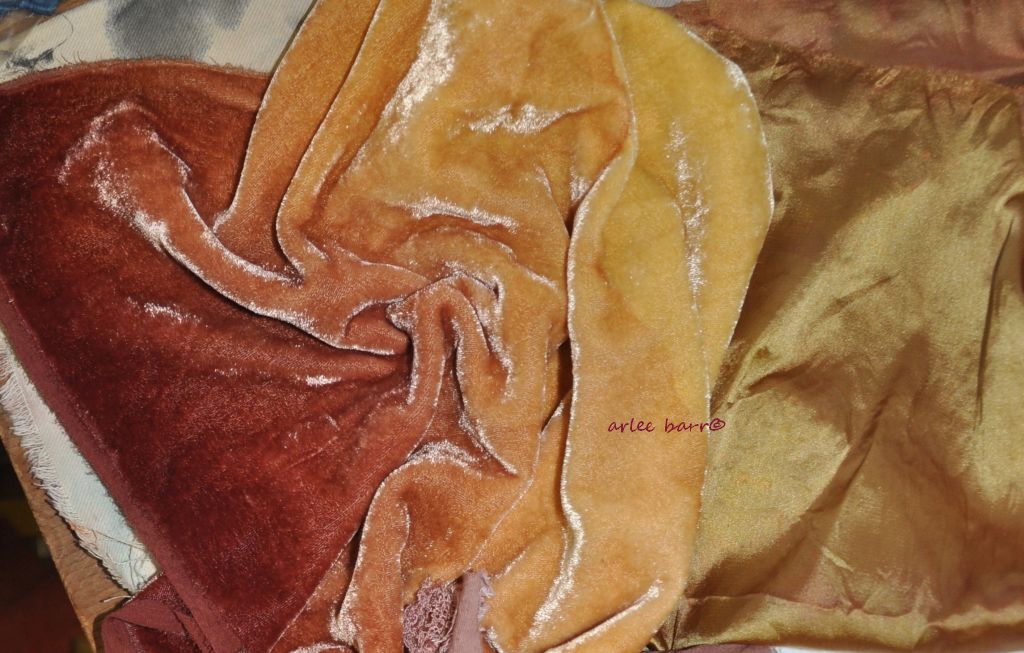
The gold in the photo below, to the right, was an errant piece of previously ecoprinted POLYESTER, that had snuck into the pot long ago. GOLD? All right!

But that deep reddish brown on the osage (yellow) silk velvet–OOOOOOOOOOOOO!

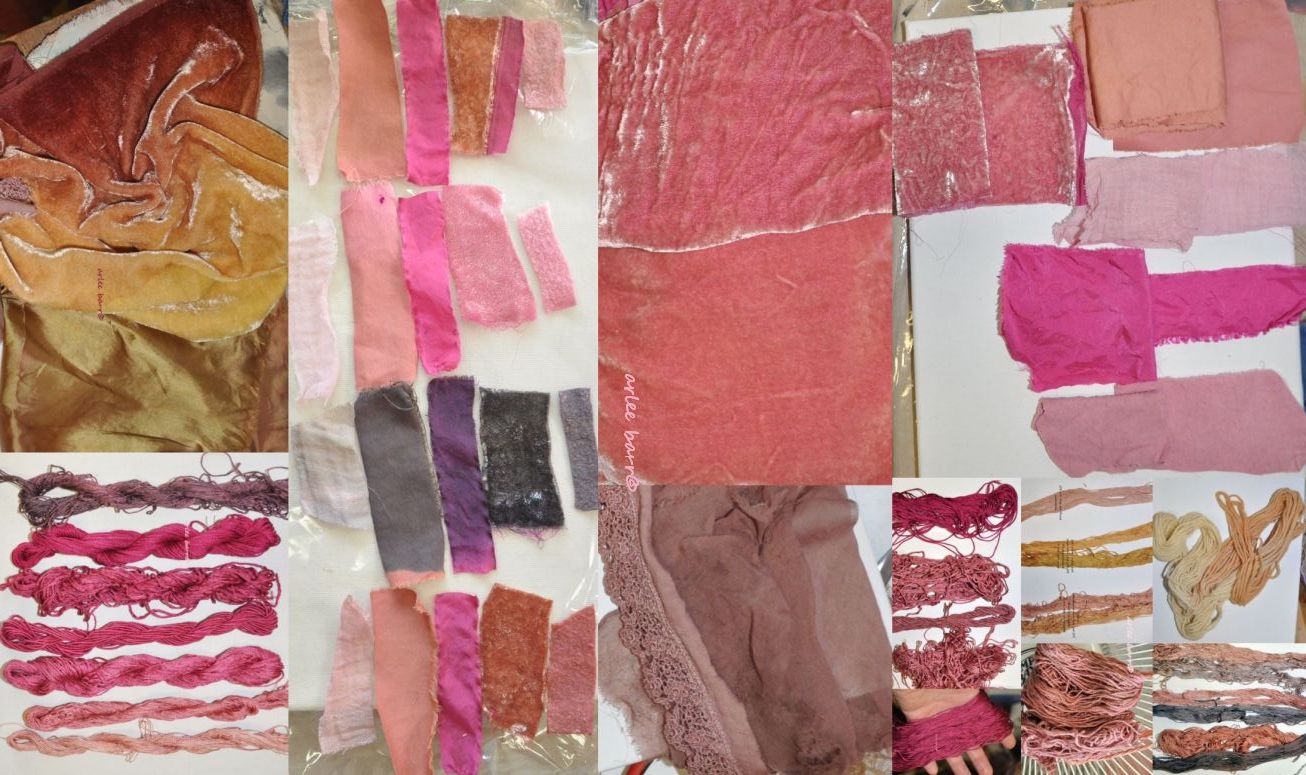
So, the Quebracho Rojo has gone from giving striking pinks and purples to rich warm browns., money well spent.

Posted in mordants and modifiers, natural dye research, Natural Dyes, Naturally dyed threads, Probably talking to just myself, quebracho rojo

feeling in the pink….and purple

Now that i have a good stock of green threads from the osage and indigo work, it’s time to add some pinks and purples! Not talking about wishy washy, not talking about raspberries, beets, beans or any other silliness i see on too many blogs who haven’t the sense of a sack of potatoes 🙂

I did get a wonderful hot pink from madder by accidentally boiling over a pot of madder (considered a VERY VERY BAD BAD as madder shouldn’t go above a certain temp or you just get browns), some useful colour variations from cochineal in the pink to purple range, and a very deep purple with logwood. Cochineal however kind of puts me off now because i worry about Ph shifts–and some Ph shifts WASH OUT with an ordinary tap water rinse!!!!!!!!!!!– and i fret too about the lightfastness of logwood, because unless it’s got a lot of iron in the mix (which can damage fibres…), i’ve seen a noticeable change in the depth of colour within months of dyeing. (I do wonder too about the current craze for it in ecoprinting: are these people going to have a shock somewhere in the next few months/year with dramatic colour shifting or fade??) So………………. my next experiments/tests/results are from a type of tannin in the “catechic” range, more red-browns that the clear “gallic” or yellow “elegic” types. Tannins are an important part of premordanting fibres, especially cellulose which doesn’t work well with just alum, but very well with a tannin first, then the alum. Some tannins are also used as dyes by themselves, notably in the elegic and catechic types.

This tannin/dye IS more expensive, but i now am comfortable spending the money to get the best results. There’s no point in cheaping out with some things: it’s a waste of time, effort and resources, from water to electricity to containers and materials used, something i am very conscious off, having been raised quite frugally and with much common sense 🙂

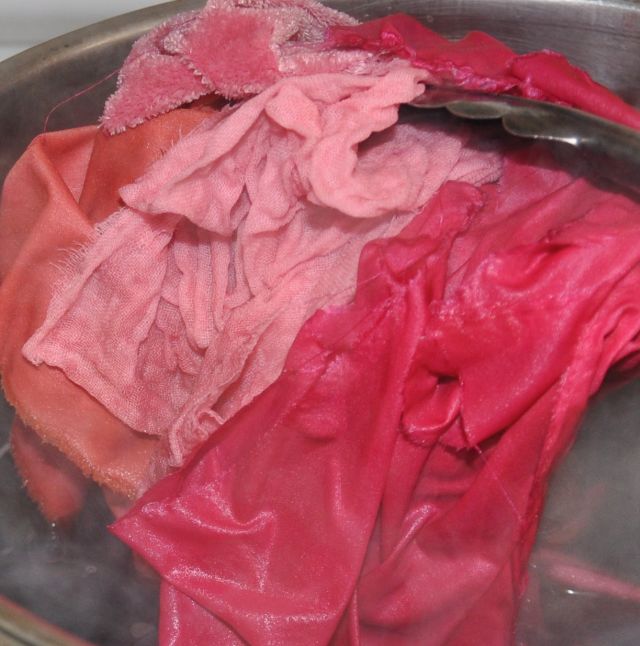
When i threw the Quebracho Rojo in the pot, i first screamed (silently, as Greyman was napping). The colour was PHENOMENAL. However, that silent scream was from my excitable take it at face value 9 year old child self: my rational XX+ self reminded me that what you see in a dye pot is NOT necessarily what you get from a dye pot, as  i swear they deliberately skull xxxk with you. Ahem.

Looks fab, ay?

Wet, ooo ooo oooo:

Above, rinsed, barely any wash out!

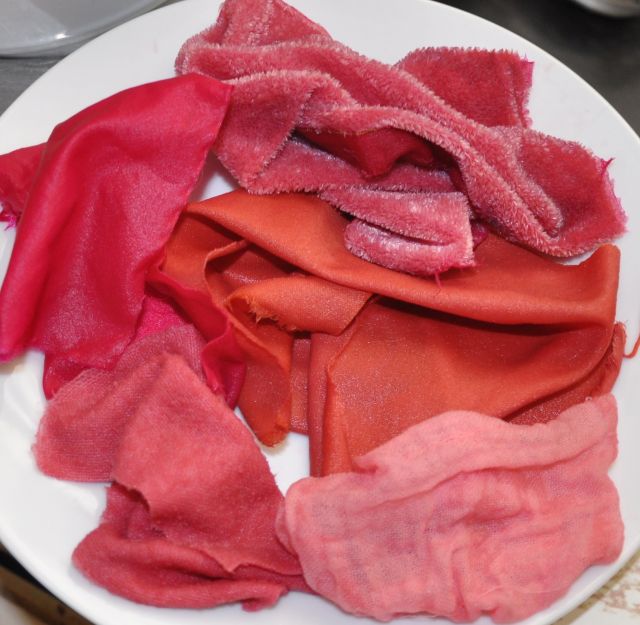
Dry, bearing in mind that colours can dry 20-70% lighter with ANY colourant, natural OR synthetic:

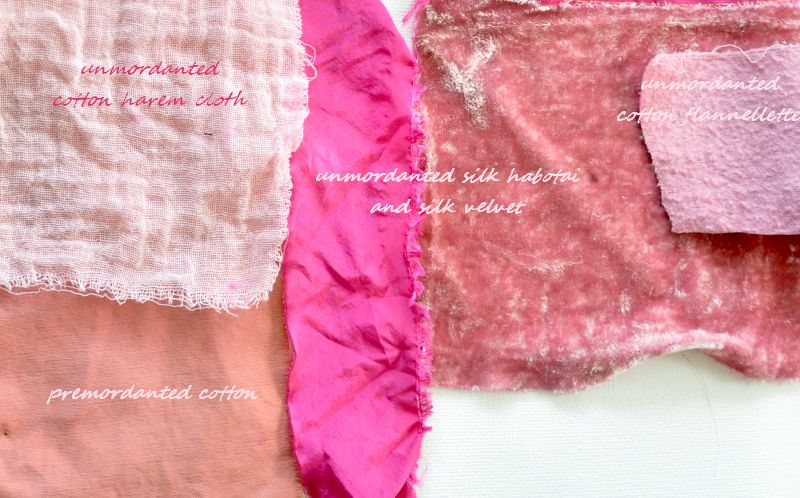
See what i mean by dye pot deception? Respectable colour, but not terribly excitingly scream worthy. Now mind you, the cottons that are paler pink were unmordanted, the darker cotton premordanted with tannin and alum. The silk habotai and silk velvet were also unmordanted, but because QR is a tannin as i mentioned, i figured “let’s try it as a tannin first”. Interesting too that most sources says it’s best on cellulose, “but performs well on silk and wool”, since obviously both silks did better……………………

The next phase of natural dye colour work is post mordant/post modify (though you can do these first, i don’t because i don’t want that active stew in the mix all in one pot.) Now this a is a nice range of colours!!!

Guess what though? I forgot to put any threads in, so now i have to go wind some skeins, scour ’em, then premordant some…………..

Olé!

PS you can still click on the photos for enlargement, but you can no longer comment on them–i had to shut that off due to the number of STOOPID ASSHAT SPAMMERS.

Posted in Natural Dyes, Naturally dyed threads, Probably talking to just myself

“each stitch an entrance”

Not all threads are created equally, especially when it comes to dyeing them with natural colourants!

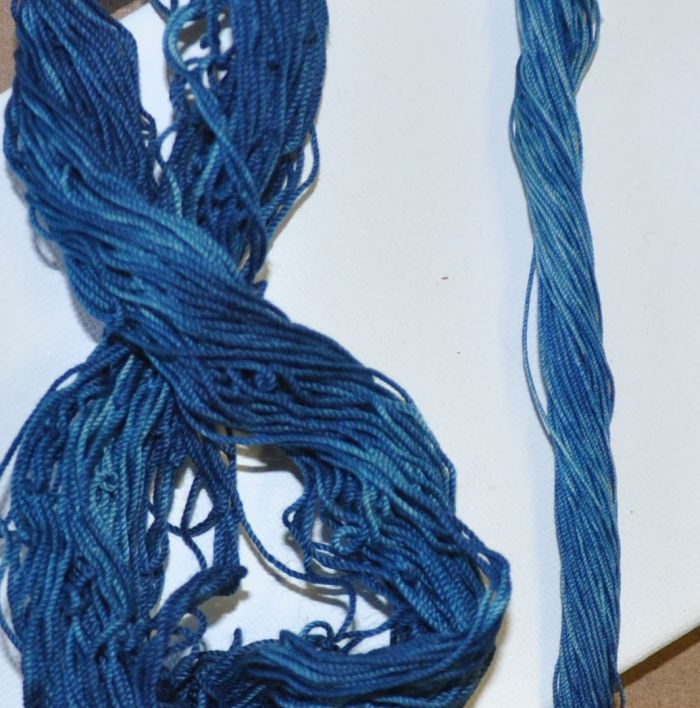
I’ve had a few flubs along the way, as i build my stash for stitching with, but in the end, each has it’s own qualities that are useful. The major fail i had was a thread i thought was 100% cotton, but since the label had been long lost, and i generally haven’t collected any synthetics for a few years now, i threw it in a madder pot and expected good results automatically. HA! There must have been some acrylic in this one, as it barely took any colour:

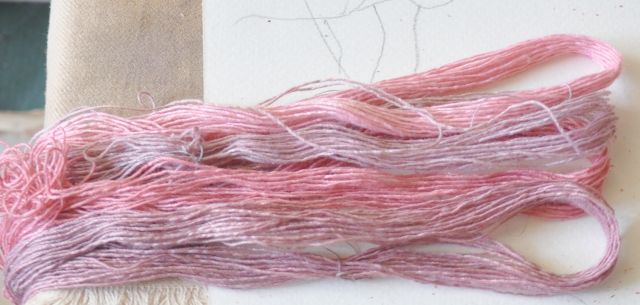
Pink from madder, pale lilac from madder with post mod iron dip, but this thread was just too soft and lovely on its own to throw out, so i then dipped them in indigo, because indigo dyes *everything*, it being SO substantive!

And there’s still some lilac-y hints! These give a lovely soft ethereal appearance when used, subtle gradations and shadings quite effective depending on the stitch used.


This one REALLY bothered me at first, a heavily twisted 4 strand embroidery thread, it just wouldn’t dye evenly due to the tightness of the wind, no matter how long i let it sit in the madder! Popped it in the indigo again and whoa! Look at that tweedy heather effect!

I use this one separated into two strands and love the way the colour shifts along each length. Because of the stiffness of the thread too, it tends to stand more proud of the surface. The way the colour took, and the spin of the thread, give it the appearance of disappearance visually when used on darker backgrounds! Fantastic for texture!

And these were a lesson also in the “weight” of a thread, the left being a crochet cotton, the right a stray spool of fine upholstery thread:

Due to my inexperience at the time, the indigo didn’t grab every spot, because of the way the threads were wound, tied and handled. Both are heavier, thicker threads that really lie loudly on the surface, or build a heavy tactile line, again with different stitch types.

It may look as if i’m using indigo to “fix” problems in incorrect procedures, but it’s co-incidence i swear 🙂 I do pride myself on proper scouring, premordanting according to fibre type, and using dyes that are actually dyes, not stains or food waste nonsense. (Again, no beets, beans or berries here….) These “fails” were inexperience, haste, and not testing unlabeled fibres. Lessons learned!

While every stitcher needs a substrate to stitch on, whether it’s conventional fabrics, plastic, metal, paper or toast, it’s the threads that get me excited. I’m continually building the inventory, and am thrilled to say that now i can depend on my own skills to add so much colour, without using commercially dyed threads, or having to worry about matching dyelots! There *can* be subtle differences in dye baths due to the inherent nature of these dyes, but at least the reds are still reds, the greens are greens, the blues are blues, etc etc etc, but never like this debacle with synthetic dye……..


And i wanted to share a very evocative piece of poetry that my friend Dana sent me.

The Many Ways the Light Gets In

​​​​​​​
It was easy to judge those Jane Austen ladies
languishing all afternoon over embroidery
pulling thread in and out of hooped linen
as the world spun round without them.

The bone stays in the starched bodice of their dresses
forced an upright position,
the way nuns in a cloister sit
all spine and neck erect
to better access the “no thought”
they need to taste
the honey of meditation

centering their minds
to a pinpoint
of light

I’ve envied the discipline of those mystics
tossing off thought like an extra blanket
but not so much the ladies
sealed in their parlors

then today
I found myself
deep in silence
pulling a rainbow of silken threads
through a hooped grid
the rhythmic in and out
of the steel needle flashing its tail of color
dissolving all thoughts in whorls of amber
sapphire, magenta—
falling upward
each stitch an entrance.

Marion Goldstein

Posted in "OPINIONATION", FybreSpace the shop, Probably talking to just myself

reality check

Okay, time to be blunt. FB is doing me no good as a business. No one sees the posts. If you pay for an ad, no one sees the post. If no one sees a post, no one goes to the shop, and no one buys. No support=no business. No business=no products being made. No-one goes to the shop from here either, honestly, though for one last time, i am adding the link here–>shop


All products that are in the shop will remain until sold, but no new ones will be added either. The shop will remain as it is, until a. everything/most is sold or b. i fucking give up. If you see it, want it, please buy it. As a small business owner, i cannot afford to keep paying for a shop or a passion, that does not pay for itself. This is not a whine, or a rant, this is a reality check. I could probably make more money standing on a damned corner, as raddled and old as this body and personality is. If no one supports small businesses, artists, entrepreneurs, why should we keep on going? I’m not going to discount anything except to the faithful few (you know who you are and already have that discount) because the prices are more than reasonable for the amount of work and effort i have put into them. And as always i refund any extra postage paid.

I see people going all ga-ga over mindfulness, slowness, natural and eco, but few who actually put their money on those products. I see badly dyed or overpriced products fly out of some shops. Should i raise my prices? Should i slap things on cloth and call it wabi-sabi? I pride myself on well done, properly done, reasonably priced.

You think i’m whining? Nope. Honestly, i am DISGUSTED. I’m not even going to bother with the “Buy my art before i’m dead” route, because too many think that’s funny. I have never cheaped out on the quality of my work. I’ve put every lesson learned, into producing cloth that should be valued. I don’t whack things out in multiples using the crummiest method that will impart a modicum of colour.

I’m not just disgusted either, i’m fucking furious. At myself. Wasted time, wasted effort, wasted resources, wasted money. Screw it, head is now out of ass.

To the customers who have supported me over the years, i do thank you for the support and faith you have put in me. You are truly a lovely bunch of people.

If you disagree, well, ’nuff said. Over it and out of it.

Posted in "OPINIONATION", Book reviews, Natural Dyes, Probably talking to just myself

Book review: Dyes from Native American Plants

(I reviewed this on my old blog, but thought it worth repeating here, with a few edits.)

You know what the best thing about this book is? It gives a detailed list of plant materials that give little or no colour!!! That means less wasted time, fabric, heat and gathering 🙂 Though it’s a bit more geocentric than i thought it would be, given the slightly misleading title (covering mostly what grows in south-central US), a lot of the wild plants mentioned are widespread in North America, even up to Alberta. It does miss out on a few plants in the same species, but given again that it is geo-specific, that may be why–one variety in the species grows there, but not others. It’s also decidedly not a “kitchen scrap” book with claims of blue from elecampene, magenta from dandilion roots, green from spinach and lasting effects from turmeric!!!

No vinegar or salt “fixes” either–really, just go, run down to the corner convenience store, buy a bag of potato chips fer jeebly sakes, if you’ve got a hankering for salt and vinegar, and stop mushing on about how they make berries last longer and stops rust from rusting…….

The only true problem with this book, is that it doesn’t give any indication of what is light or wash fast. It does tell you *how* to do that, but there are no notes with plants what is worth the effort, and what is a waste of time, effort and resources. I truly believe too, that testing for these should be an INTEGRAL part of the dyeing process. Maybe then we’d see less of the Beet and Berry Brigade posting their results for the GaGa newbies…………… There’s also no mention of post modifying, an important and often surprising process that brings unexpected colour out.

So what else is in it?

It’s laid out with plant materials grouped by colour results, it has a comprehensive index with the Latin and common name (though the common nomenclature may be regional), there are photos of the plants mentioned. I would also recommend investing in a good geo-centric plant guide, like those published by Lone Pine Publishing, so that you know what you are looking at, and hoping to gather. The author speaks of responsible gathering and safe dye practices and it’s not dumbed down or too technical. My only complaint is the prevalent use of tin as mordant in a lot of the dye baths. Even in 2005 (the date this book was published), we knew this type of mordant was dangerous for the dyer, and best not used in the home. There are no “recipes” per se, for the novice, but the more experienced dyer will already know that as with most plant materials, your plant chunks ratio should be at least of the same weight as your fabrics/threads.

There were a few surprises with some of the flora mentioned. Certain plants abound here, and while i’m not going to get too excited about the possibility of using them, it does give me new hope for local colour. Many of them are also though, while “plentiful”, are in our National Parks–and i am never going to scavenge great quantities, because of that, and because they belong where they belong, period. If i find them in a ditch however and if it’s in my immediate environs, and i know it’s considered invasive or noxious, it’s fair game. I recognized a few varieties i had no idea would give any colour at all, but because of my frequent walks with the DogFaced Girl, i know that locally these are very very small ecosystems, and i would feel incredibly guilty if i denuded the area. I am passionately interested in using what i can find, but not at the expense of the primary reason why i do these walks and that is to appreciate what is there, not what can be taken away! You’ll note i did not mention any of these by name—–i don’t want to be blamed by the Cosmos for encouraging somebody sneaky to go and strip their area!

Of course, the preponderance of colour mentioned is yellows and browns, as few native North American plants have the tinctoria classification 🙂

Posted in Deliberation--do something you don't do--or haven't in awhile, Indigo Dreams, Probably talking to just myself

learning curve, shibori

Actually, i could say “re-learning”: i did a bit of shibori during my 2012 residency, and certainly in the 90’s at Capilano College!

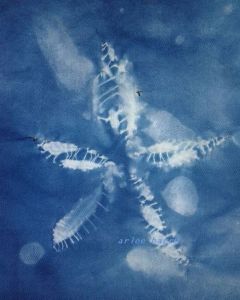
This was my first attempt, a bit of “guntai” stitching:

A small piece, i was a bit impatient and didn’t get it far enough into the indigo.

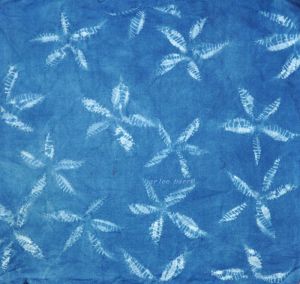
So then i did this one, same design but many more on one piece:

It took me 2 hours to do all the stitching on this–and almost as long to pick it out after dyeing! Note to self: good light, sharp seam ripper, lighter coloured thread, patience.

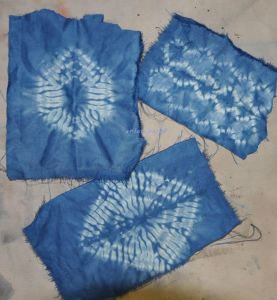
Then i thought “Hey, why not get the actual shibori BOOK out and try some samples?” *And* the good light, sharp seam ripper and lighter coloured thread. Patience was found, as i realized i was quite enjoying the process.

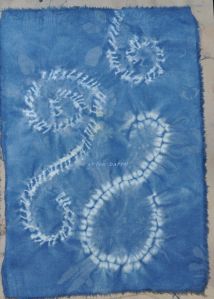
Above, trying out different conformations of line.

Below, 2 types of stitch, one motif.

Below, shapes, alone and combined.

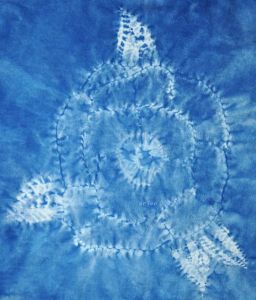
And this rose, which i thought would be wonderful, but could still be, done properly 🙂 Three types of stitch, several of which were not pulled tightly enough, and too square as i learnt to handle the fabric as it stitch. The larger the piece, the more awkward, but it was getting easier!

Rose approximately 10×12″.