Posted in "Love is the Answer" collaborative project, "OPINIONATION", Deliberation--do something you don't do--or haven't in awhile, in progress, Not so ordinaries, Shows/Publications, Work 2018

“Love is the Answer” project, part 1

March 5/18: (I decided not to publish any of these until i had a certain amount of work done on my part of the project , hence the date at the beginning of the post. You might have seen some of the drawings/work though in previous to this project posts 🙂 )

I’ve been a long time follower/reader of Mo Orkizewski (Mo Crow) at her It’s Crow Time blog in Australia. I admire her spirit, her ethics, her art and her outlook on life. In June of 2017, she conceived a project, based on a line from her equally talented partner’s song “I Dream of a World”, that has become a hugely collaborative art installation, slated for display in 2019 at Artsite as part of a show entitled “Braille for the Soul”.

Now, long time readers will know that i “hold no truck” with arty proposed “solutions” to world evils, from folding paper cranes for Paris’s Charlie Hebdo tragedy, to prayer flags for whatever cause, or “craft for peace” days. It’s not that i think groundswell movements can’t change things (because alas, our sad world has so many problems), but that people use these as excuses to pay a moment of goodytwoshoes my piece about peace is more important than your considered opinion and actions about HOW to/that do actually make things better for SOMEONE.

*My* answer usually is go small, be small. Contra-indicative? Nope. Because i/you will never stop any of the depredations that man commits upon man, that man commits on the world, on Mother Nature, on women, on children (and by “man” that’s the generic human species, not specifically the male sex–though given the current climate in the US happening right now with the confirmation hearings, that’s a debate well in fury right now…..), by practicing origami, hanging rags on ropes in a breeze, or blessing fabric in the sea. Going and being small does not mean either that one is selfish–i mean go small, be small, as in sharing what you have with someone who truly needs, in your own part of the world. It is a small thing on a global or universal scale, but it helps someone/something immediately. Prayers don’t fill bellies, warm hands in -40 temps, or show any true kindness.  Be small when you volunteer, donate give ( i don’t like the word donate with all its connotations of old clothes that don’t fit, or that you had enough money to mis-spend and really don’t care, or a 20 dollar bill once a year in the Salvation Army kettles because you feel guilty and seasonally magnanimous at the same time…), help, compliment, show respect, share gloves and scarves, a sandwich and coffee, a five dollar bill to someone scraping for busfare or cans in the trash, hold a door, pick up someone who has fallen on the ice, because small is big for some. If you can make ONE day better for ONE person, doesn’t that say more for your humanity and soul AND theirs, than all the frickin’ paper cranes in the world???????? And maybe THAT person is the one who DOES change the WHOLE world.

Off the soapbox. So WHY then would i contribute gladly to a project like this? Because to me, this one does say something–it’s the joining of a lot of viewpoints from around the world, expressed eloquently, calmly, lovingly and full of hope and concern, with intent, expression and heart that goes beyond slapping some felt letters on a scrap or finding the prettiest paper at great expense to torture into a symbolic shape.

So within the context of the show, what does “Love is the answer” mean? Love, true love***, whether platonic, romantic, pantheistic, or spiritual is, on a broader truer scale, about respect. It does not use apologies as manipulation, is inclusive, does not contrive, never obligates, does not keep a ledger. Love guides and supports, connects and strengthens, complements, enhances and shares. Love is moral, thoughtful, questioning but not aggressive, does not judge, is constant and patient. Love is not guile or a weapon. I re-iterate: Love is Respect.

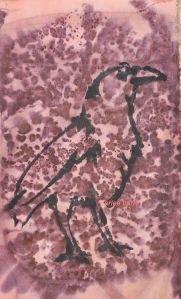
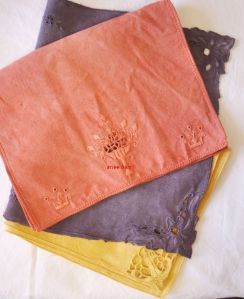
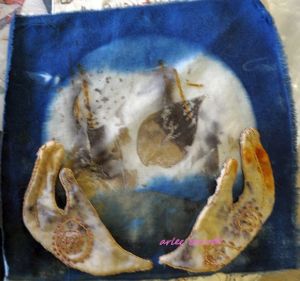
So, anyways, off the box again 🙂 Mo sent me one of the “pennants” to do with as i wish. (The fabric is from a very old wedding dress.) I took it apart first, as the layers can be re-assembled when the work is done.
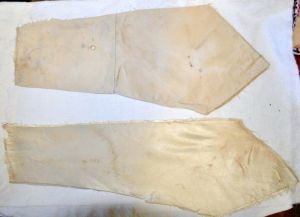
I did an alum pre-mordant, assuming the cloth was silk, but there was no madder dye uptake, then realized it was a synthetic after a burn test spattered some on one of my fingers! Then i spent two weeks dithering about what i was going to do next, staring at it, shuffling bits on and off it, having multiple “Eureka” moments that withered very very very fast, and thinking i was going to completely ruin it —–and Mo was going to politely say “oh that’s interesting” while privately wondering why the hell she had sent the original to me at all…….

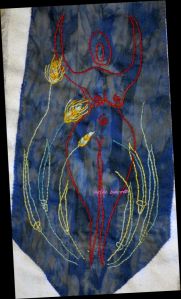
This will be a layered process, something i have done before, but not a lot lately. Building dimension and story this way means the elements won’t be fighting each other. This is the “first” layer, though in the end, it’ll be the background, and not all visible. I deliberately stitched some areas so that they looked as if they were fading, rubbed out. (Unfinished at time of photography.) Not only is negative space important, but it will be more effective once the next layers go on.

Greyman thought i was embroidering him a wide tie 🙂 , but *his* choice of words would have been quite different!
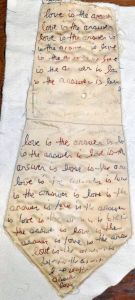
July: A mock up for part of the front, still being worked:
August: and good progress on the back, as of the middle of August:
Stay tuned for “part 2” and maybe one more: one post would be waaaaaay too long!!! And of course, an “Artist Statement” 🙂

“Love, true love”*** does momentarily give me a giggle as i remember a particular scene from “The Princess Bride”…..
 

Posted in "OPINIONATION", FybreSpace the shop, Probably talking to just myself

reality check

Okay, time to be blunt. FB is doing me no good as a business. No one sees the posts. If you pay for an ad, no one sees the post. If no one sees a post, no one goes to the shop, and no one buys. No support=no business. No business=no products being made. No-one goes to the shop from here either, honestly, though for one last time, i am adding the link here–>shop


All products that are in the shop will remain until sold, but no new ones will be added either. The shop will remain as it is, until a. everything/most is sold or b. i fucking give up. If you see it, want it, please buy it. As a small business owner, i cannot afford to keep paying for a shop or a passion, that does not pay for itself. This is not a whine, or a rant, this is a reality check. I could probably make more money standing on a damned corner, as raddled and old as this body and personality is. If no one supports small businesses, artists, entrepreneurs, why should we keep on going? I’m not going to discount anything except to the faithful few (you know who you are and already have that discount) because the prices are more than reasonable for the amount of work and effort i have put into them. And as always i refund any extra postage paid.

I see people going all ga-ga over mindfulness, slowness, natural and eco, but few who actually put their money on those products. I see badly dyed or overpriced products fly out of some shops. Should i raise my prices? Should i slap things on cloth and call it wabi-sabi? I pride myself on well done, properly done, reasonably priced.

You think i’m whining? Nope. Honestly, i am DISGUSTED. I’m not even going to bother with the “Buy my art before i’m dead” route, because too many think that’s funny. I have never cheaped out on the quality of my work. I’ve put every lesson learned, into producing cloth that should be valued. I don’t whack things out in multiples using the crummiest method that will impart a modicum of colour.

I’m not just disgusted either, i’m fucking furious. At myself. Wasted time, wasted effort, wasted resources, wasted money. Screw it, head is now out of ass.

To the customers who have supported me over the years, i do thank you for the support and faith you have put in me. You are truly a lovely bunch of people.

If you disagree, well, ’nuff said. Over it and out of it.

Posted in "OPINIONATION", Book reviews, Natural Dyes, Probably talking to just myself

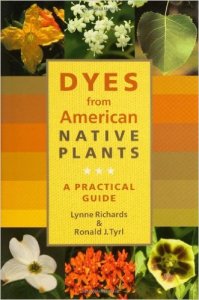
Book review: Dyes from Native American Plants

(I reviewed this on my old blog, but thought it worth repeating here, with a few edits.)

You know what the best thing about this book is? It gives a detailed list of plant materials that give little or no colour!!! That means less wasted time, fabric, heat and gathering 🙂 Though it’s a bit more geocentric than i thought it would be, given the slightly misleading title (covering mostly what grows in south-central US), a lot of the wild plants mentioned are widespread in North America, even up to Alberta. It does miss out on a few plants in the same species, but given again that it is geo-specific, that may be why–one variety in the species grows there, but not others. It’s also decidedly not a “kitchen scrap” book with claims of blue from elecampene, magenta from dandilion roots, green from spinach and lasting effects from turmeric!!!

No vinegar or salt “fixes” either–really, just go, run down to the corner convenience store, buy a bag of potato chips fer jeebly sakes, if you’ve got a hankering for salt and vinegar, and stop mushing on about how they make berries last longer and stops rust from rusting…….

The only true problem with this book, is that it doesn’t give any indication of what is light or wash fast. It does tell you *how* to do that, but there are no notes with plants what is worth the effort, and what is a waste of time, effort and resources. I truly believe too, that testing for these should be an INTEGRAL part of the dyeing process. Maybe then we’d see less of the Beet and Berry Brigade posting their results for the GaGa newbies…………… There’s also no mention of post modifying, an important and often surprising process that brings unexpected colour out.

So what else is in it?

It’s laid out with plant materials grouped by colour results, it has a comprehensive index with the Latin and common name (though the common nomenclature may be regional), there are photos of the plants mentioned. I would also recommend investing in a good geo-centric plant guide, like those published by Lone Pine Publishing, so that you know what you are looking at, and hoping to gather. The author speaks of responsible gathering and safe dye practices and it’s not dumbed down or too technical. My only complaint is the prevalent use of tin as mordant in a lot of the dye baths. Even in 2005 (the date this book was published), we knew this type of mordant was dangerous for the dyer, and best not used in the home. There are no “recipes” per se, for the novice, but the more experienced dyer will already know that as with most plant materials, your plant chunks ratio should be at least of the same weight as your fabrics/threads.

There were a few surprises with some of the flora mentioned. Certain plants abound here, and while i’m not going to get too excited about the possibility of using them, it does give me new hope for local colour. Many of them are also though, while “plentiful”, are in our National Parks–and i am never going to scavenge great quantities, because of that, and because they belong where they belong, period. If i find them in a ditch however and if it’s in my immediate environs, and i know it’s considered invasive or noxious, it’s fair game. I recognized a few varieties i had no idea would give any colour at all, but because of my frequent walks with the DogFaced Girl, i know that locally these are very very small ecosystems, and i would feel incredibly guilty if i denuded the area. I am passionately interested in using what i can find, but not at the expense of the primary reason why i do these walks and that is to appreciate what is there, not what can be taken away! You’ll note i did not mention any of these by name—–i don’t want to be blamed by the Cosmos for encouraging somebody sneaky to go and strip their area!

Of course, the preponderance of colour mentioned is yellows and browns, as few native North American plants have the tinctoria classification 🙂

Posted in "OPINIONATION", Book reviews, natural dye research, Natural Dyes

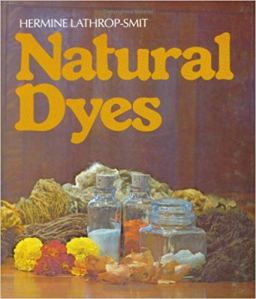
Book review: Natural Dyes (1978)

One doesn’t really need another dye book for the library, but i couldn’t resist, as this one was written by an Albertan, Hermine Lathrop-Smit, and is touted as “specific” to Canada.

Actually, it’s pretty much North American–most of the plants are available throughout a number of climes, and are not particularly geo-centric. It’s a funny little book, given when it was written, and some of the plant materials are specious in one way or another–beets don’t give red (i was QUITE shocked to see that entry, though she does mention that it’s not colourfast….), berries used are rarely light or washfast,  and no mention that lily of the valley and bloodroot are poisonous.

Illustrated with black and white drawings, i would recommend referencing an actual plant guide with colour photographs and full descriptors of leaf, stem, flower and seed, and growth habit (is it a bush, a vine, a flowering plant, field, mountain or water sited? These guides always mention toxicity as well, very important in the wild. Wouldn’t want a bear to eat Poisoned Forager (sub-species, varietal) 🙂 .  I use field guides for Alberta, and the Rocky Mountains, from Lone Pine Publishing which can be found in most garden centres, Walmart (!) and sometimes National Park gift shops. Some entries in these books will mention whether or not the plant has been used “historically” as a dye material, but don’t take that as a rule of thumb, as some of that is based only on hearsay and old wives tales! Lone Pine has a number of geo-specific books, so look for your area. You can also order online, if you can’t find them locally.

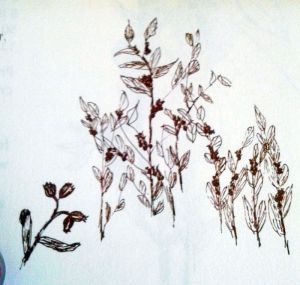
These drawings are rather vague, though she does give Latin names. I wouldn’t however have been able to determine WHAT these were from the drawing.

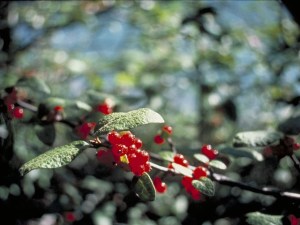
Buffalo berry/Shepherdia canadensis

actual photo:

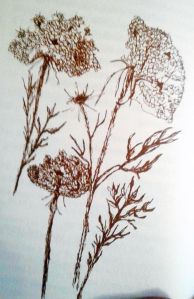
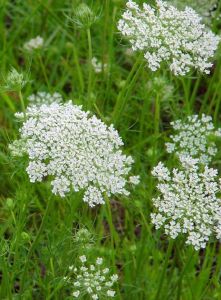
Queen Anne’s Lace:

This plant is particular is dangerous to identify from a drawing only, as there are many similar plants that are HIGHLY toxic. *I* know what QA is but that’s because i grew up with it. (Even it can bother some people, though NOT as much as the others!)

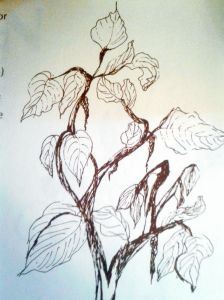
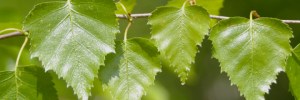
Birch. Seriously? While some know that birch is “peelable” bark wise (DON’T, unless it’s a dead tree or a broken branch!), most don’t know the difference between birch and aspen. And no one is really going to be able to positively identify this:

Heck, you might even think it’s alder. Below, the real thing:

You also need to watch out for common/colloquial/local names–one person’s bluebell is another’s Polemonium. Latin is the same EVERYWHERE.

I realize too, the cost of colour photographs was probably rather spendy as all was film in those days, but don’t depend on these for proper identification! The drawings especially of Queen Anne’s Lace can be very misleading, as there are a number of very similar plants, in the same family and in others, and some are extremely dangerous to human and animal. (I can’t reiterate that enough. Too many associate natural with “safe”– arsenic is natural too….

The use of alum is rather heavy-handed as well: 50gr to 200gr of wool, since most modern recipes recommend 12-20% WOF for “regular” alum (aluminum potassium sulfate ), and 5-8% WOF for aluminum acetate (THE recommended alum for cellulose fibres). Mention is also made of mordants we now try to avoid, like tin, chrome and copper sulphate. Note though, that some dyers with caution, expertise and experience still use these. Rarely do we use Glauber’s salt either–though maybe we should!

This book could also be confusing for the novice! There’s a chapter on mordanting that precedes the actual dye plants, but in many of the recipes, she adds the mordant to the dye bath, or no mordant at all, giving the impression that some don’t need it. Since none of the plants mentioned, except for walnut, are substantive (meaning needing no mordant), this gives the impression that these plants will give colour that stays, and that will be strong from the “get go”. Honestly, i mordant EVERYTHING, even for indigo, madder and walnut, not because they need it, but because having a stash of premordanted fabrics on hand means i can dye with anything, when i feel like it, and have it take the colour. Mordanting doesn’t hurt substantive dyes, so rather than take the chance of accidentally getting something unmordanted and going in a dye material that needs it, i figure it’s best to be prepared.  I do keep bags labelled with each type of mordant however, as mordants react differently to dye materials. Post mordanting *is* possible, but in my experience, the colour is not as strong. Overdyeing of substantive colours is also possible, but then they must be mordanted for the dye type being added over the substantive dye.

There’s a list of suppliers in the back too–when i searched, most of them are of course gone. Funny that one of them was Wide World of Herbs Ltd, in Montreal, the place where my 33 year old madder came from! Also included in a ONE page appendice of dyeing with lichens, very uninformative and vague.

So, in the end, this one stays in my library anyways, as a bit of history, a bit of useful information and a bit of a laugh.


PS DO NOT click on ANY of the “free PDF downloads” if you search for Ms Lathrop-Smit, as they are probably toxic malware sites!!!!!!!!!! I could find NO actual information about her, or any mention by anyone in article, blog, research site or history of the area.

Posted in "OPINIONATION", Ecoprints and Natural Dyes, Home Cookin' the Cloth, natural dye research

going deep, back to ecoprints

I stopped doing ecoprints a few years back. Honestly, it had started to bore me, as i *did* get “predictable” results, knowing what local plants did print, and the effects i could get. Then i was quite frankly, COWED by all the splendid, wonderful experimenting and marvellous, amazing results that others were getting! I couldn’t figure out how people were doing what they were doing, and at the time, it seemed to me that only people with a lot of discretionary cash could afford the goods, dye materials, travelling to classes and workshops, and free time, perhaps a sour grape reflection, but “valid” at the time, for me…

Methods and materials were being closely guarded–and i DO understand the point that teachers make a living from teaching these with their years of experience and skill level, and should be recompensed, so don’t think i’m kvetching because the process was only being taught in paid for classes. (I would KILL, i WOULD kill,  to take a class with premier ecoprint teacher Irit Dulman.) I too have been in that position, as a student, and as a teacher. I never asked anyone who had done the classes to break the chain by giving me for free what the teacher had been paid for, so tried to puzzle it out.

I tried a few things that i thought were the process, but didn’t have a lot of success. It wasn’t that i was stupid, or unwilling to experiment: things just didn’t WORK. But i was “sloppy” in a sense. Now that i’ve learned properly how to prepare fabrics and threads and then dye with natural materials, that knowledge, based on historically accurate, well researched and proven methods, can be applied to ecoprints. (I’m still not a perfect dyer/mad textile scientist, but i’m improving every day 🙂 ) If however, i see ONE more post about vinegar or soymilk as “MORDANT”, i will puke a twice iron dipped catalpa leaf, with a nice frothy TO chaser…………….

Recently i joined a group that is big on sharing method, without spilling teacher secrets, or fighting about who “owns” the process, something that was nastily prevalent in the beginning. (I’ve never seen such an insidiously/assiduously “policed”–sometimes quite maliciously– practice before, as ecoprinting, contact printing, leaf printing, whatever term makes your boat float without “offending” anyone…) The people in this group share generously, indeed that is the POINT of the group, to SHARE the knowledge, the experimenting, processes, thoughts, ethics etc. Oh sure, there are still divisors between the purists, and the “anything that works” camps, but it’s reasonably civil, as the admins do a fantastic job. (It also helps that you can turn off commenting as an admin, or on your own posts 🙂 ) (I tend to do that when people go waaay off topic, or give me the same answer over and over, or just didn’t read the actual post and are tossing in two cents that makes no sense…)

I have a few ideas i explored before and want to return to them with the ecoprinting. They were successes at the time, and nope, i didn’t share the process at the time, and won’t now either 🙂 because as a talented friend once said when i asked something specific about her work : “Every dyer has her secrets”. THAT is valid too.

I have bags of premordanted fabrics ready, from the basic tannin/alum, to rhubarb leaf, titanium oxalate, iron, soda ash, alum alone, combinations thereof of whatever, all suited to the type of fibre (cellulose vs protein) and on the stove is a batch of pomegranate readying for use.  I’m still doing the Summer of Madder (Study) and its adjunct project, but the ecoprinting will be incorporated into that as well.

And since DogFaced Girl and i have got so lazy and so fat over the last year, it’s a perfect time for walks to gather materials, relish the summer, and enjoy the short Calgary summer as best we can. Exercise, fresh air, science and joy at their finest!

And here’s a funny little one, tossed into the current almost exhausted madder pot:

Iron turned the colours pink and purple!


Posted in "OPINIONATION", FybreSpace the shop, Madder, Natural Dyes, Naturally dyed threads, The Summer of Madder (Study)

sharing the bounty

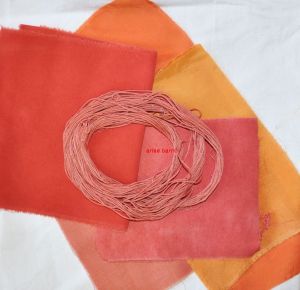
Though i could probably make several garments from the fabrics and threads created so far, during the Summer Madder Project, i’ve decided to add some to the shop.

All of these have been properly prepped, premordanted and dyed according to well researched practices, and historically accurate methods. NO BEETS< NO BLACK BEANS<NO FUGITIVE “DYES!!!!!!!!!!! I haven’t cut any corners just so i can make some coin, as i intend to use bits in my own work–and why short myself?! All of course, are natural fibres, in various weights of silk and cotton, as are the threads. All have been well rinsed after, and because they are done correctly to begin with, there should be no bleeding. Your methods of care may influence the colour, but not out of the ordinary. (Even synthetics can fade…) All natural dyes should be treated with care ie, minimal sun exposure (you can wear it once in awhile at a sunny festival, but not everyday), proper wash handling, which means hand washed with a NEUTRAL soap (Dawn Original dish soap, believe it or not, is perfect, and is what i use), and storage in a closed drawer, closet or box. This all being said, if you are adding it to your stash to use in art textiles, rather than wearables, well, most of that doesn’t apply, except for the sun exposure. Nobody hangs a painting where sun will hit it, and neither will you with your art, will you? 🙂

Posted in "OPINIONATION", garden dye plants, Garden Hard, Natural Dyes

dandilion delight

We had a long long hot hot summer last year, and it looks like it’s going to be another one, so what better way to mark it than by celebrating the dandilion?

Our back 40 is rather lush (in the spring, but dried out by August’s end!), and the dandilions are plentiful, bee feeders and happydays harbingers, but a bone of contention with the neighbours.

I figured though that beheading them (the dandilions, not the neighbours), would keep the snarking at bay for awhile, and threw some in a dyepot.

The first look was Meh. Yeah, it’s yellow, but barely worth the effort. (Though using dandilions is one of the EASIEST ways to get colour. But no, the roots will NOT give you any GD magenta, ever, ever. EVER.) Then i threw in a pinch of soda ash–BOOM. YELLOW. DANDILION YELLOW. Wowzers, it’s neon, electric, it’s definitely a Spring colour. (Paler yellow wool yarn at top is without the soda ash.)

So, do i add yet another yellow dyed silk to the stash and wonder why i do so much yellow and never use it? Nah. Let’s use it. I’m betting it would make wonderful dandilions 🙂

~~~~~~~~~~~~~~~~~~~~~~~~

A side note to my fellow natural dyers and ecoprinters: apparently some person in the US has made it her mission to prevent teachers from other countries coming to the US to share their skills and techniques with students, reporting “potentially un-work-visa’d travellers” to immigration and customs! Can you imagine any other art field professional doing this?  And while there *are* divided camps about the “purity” of the technique with those who decry the use of ANY “chemical” or any use of plastic, and those who use anything they can experiment with, and a fiercely competitive attitude amongst some on both sides, this is going too far! It deprives students of learning, workshops and their facilitators of making money to bring other teachers in, no matter what technique or field, and is so narrow minded and malicious, that it just blows me away. Just goes to show you, that not all earthgoddessy-natural-eco-mothers are altruistic sharing sweethearts…………


Posted in "OPINIONATION", FybreSpace the shop, journal: lessons to learn, Probably talking to just myself

about “shop updates”

It seems every time i do this, i lose a few followers, at least on FB! Please remember that small businesses/artists need support too–especially since i myself am temporarily no longer a “floral arranger”/”employee” by day.  Some/most of us do not work for conventional employers, whether by choice, or because of need for childcare that necessitates someone staying home, or living in a place where jobs are few and far between, or that geography says it’s too far to commute to! You get one of a kind items this way, made with skill and care, unique viewpoints and representations, often created with original to the maker supplies too, and passion and intent. We can’t just show you what we’re doing: it has to pay for itself, pull its own weight, fly out into the world. Some of us are not just artists, but WORKING artists–and working artists make art/things for sale, not just to pretty up a blog or Instagram.

An artist/maker spends time not only making the product, but developing the skills sometimes for years, doing the initial sketches or design work,  gathering the supplies, setting up a work space, photography and editing after, listing the product, packaging when sales are made, schlepping them to the post office, buying special envelopes for some work, and has to pay fees as well to keep the business going, from shop fees, to financing charges, more supply buying and a host of little things that are peculiar to each artist. I don’t mean any of this to offend anyone, am not begging, and certainly am grateful when someone appreciates what i do by opening their wallet. BUT things, “products”, Art, stuff, never spring magically from “a sweated brow”on to a for sale page with no thought or effort beforehand 🙂 It doesn’t just get THUNK into existence: there’s WORK first. I keep my prices low, given the amount of effort/skill/vision that goes into them, and having seen some sell smaller less involved bits for more coin,  it sometimes really depresses me, when they’re shocked that i would have the Audacity to actually want good coin, not a token of “faith” in my pocket. There are times when i just want to give up, quite honestly.

On the other hand, i’ve had well meaning friends and family say some of my prices are too “low”, and yes, i’ve always subscribed to the “some bucks is better’n no bucks” theory, but i know what has gone into those particular efforts, and am comfortable with what i asked for 🙂

I’ve had queries about specific pieces that i have shown in my galleries here, things i *might* like to sell to a good home, but have not actively pursued a sale, or even a hint of one, and after a few back and forth emails, when they find out the price–because my bigger pieces, my more involved pieces are more expensive because they were a hell of a lot more work, not only in size, but in execution and skill — *cricket noises*, no further communication, not even a “thanks for answering, but regretfully, no thanks” response. I get that you thought because you bought a piece 6 years ago for $75, that you might figure one of my massive works is only double that now, but that’s not how it works. I know too that active, dedicated, supporters of textile art don’t always have money, and that too, some figure because they have supported someone before, that they should get a deal. I’m happy to work out a payment plan for something already produced, and have on occasion happily done commissioned work on a payment plan as well.

Do you want something that lasts? Are you the kind of shopper that only buys things that *immediately* gratify you? Are you making an investment in your own happiness, or just to fill your belly, impress someone else, keep up with a trend? I’m constantly remembering customers at the flower mines who would decry that “flowers are so expensive for something that doesn’t last”–well, honey, how’s that steak you had last night, keepin’ on? Those flowers that lasted “only” a week made someone happy every *single* day of that week. That’s a lasting impression.

So is art, Art. Big statement piece, small joy as a present for you or a friend, something to make something else with, it’s all in the shop. Thank you for listening to the end of the commercial, not muting it while you go for a pee and a snack 🙂

>

Posted in "OPINIONATION", Book reviews, Natural Dyes

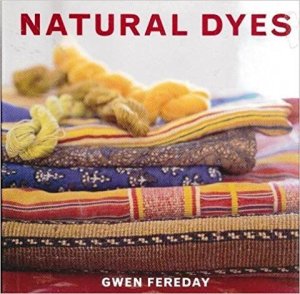
Book Review: Natural Dyes by Gwen Fereday

Note to self: this is the last natural dye book that will be bought for the Stately Barr Manor Studio!

On the advice of someone on the FB Natural Textile Dyeing group (someone i trust 🙂 ),  i ordered a copy of Gwen Fereday’s “Natural Dyes”.

It’s available through used book sellers, but i bypassed Amazon as it was rather expensive ($55-158!!!!!) , just in case it was garbage. I bought mine from Abe books, from the  seller Broad Street Book Centre (an actual bricks and mortar store in NJ Hereford, an actual real live book store!!!),  and was happy to pay slightly less than 30US including the shipping from the US. EDIT: This seller is in the UK! And them sending on the 18th of December, to arrive here on the 27th was impressive also.

And it IS worth the money. Very clear, as the author is also a well respected teacher at the Surrey Institute of Art and Design at University College in the UK, it explains everything from proper pre-treatment of fabrics, both protein and cellulose, to specific dye types, and through to the most wonderful colour plates with “recipes” for achieving the colours. Best of all, as much information is presented for the cellulose as for proteins–while i like wool, and am happy with my results, i prefer to work with cellulose, specifically cotton, and let’s face it, most natural dye books barely give a passing mention to anything but wool!

For the longest time, my cotton results were frankly, lousy, because there was little clear information. I did hunt around and eventually found the tannin/alum method for cellulose (Turkey Red Journal), and that made a world of difference. I still felt there had to be more out there–let’s face it, the average dyer of yore would have been working with linen, cotton or local indigenous fibres, not silk, and possibly not even wool, depending on the geographics.

Even more specifically, and exciting, is that decent mention is made of Turkey Red Oil, a type of sulphated Castor oil, often used historically to deepen reds from madder, hence the “Turkey Red” (not the bird, the locale!) I found a near by supplier–REALLY near by, as in 20 blocks away!!!! It can be used with other colours/dye materials, so i want to play with it, and buying a SMALL bottle of it will mean that effort/expense/extra steps are not wasted or being committed to.

But i digress 🙂 The only point i don’t like about the book is the extremely heavy WOF of cochineal used: 60%!!!!!! as opposed to the usual 3-10%WOF!!!!!!!!!!! (EDIT: JAN 10/17 Actually a lot of her recipes are really heavy WOF’s (500% madder????)—i’d say overkill in some respects, as fibres can still only uptake so much before it’s wasted effort, materials and EXPENSE. And if it crocks after, well, big problems.) And yes, a lot of the info contained is also in other respected books in my library, but the extras i needed are what’s made it worth adding to the shelf. If i *didn’t have any of the others, it would be a fantastic start to the library too. And best of all, no wasted pages on “projects”: really, i’ve said it before, if you didn’t know you could actually MAKE things out of what you dyed, WTF are you doing it for then?

Anyhoo. The next step is to figure some time management so i am not obsessing about one thing, as i am wont to do :), but dividing my efforts between this, and some serious stiching again, so that both are “sustainable”, i.e. they get DONE, not just blethered about.

Posted in "OPINIONATION", journal: lessons to learn

how much does a year?

I used to judge myself on how many things were finished in a year . In the last six years, i’ve let myself slow down, with technique, thinking process, research and results. It’s much more satisfying for me to view work that i am connected to *because* i have taken “more time”. It seems very much to me that quantity over quality, fast fix over real depth has become the way for some to feel they are Artists. I don’t believe any of the masters in any other medium keep a ledger on how many paintings/sculptures/plates/widgets, whatever they have produced each month. It actually makes me laugh too when i see articles about the newest stitching SuperStar “who takes up to 35 hours to do each piece!!!!!!!!! OMG!!!!” Some of us count into the several 100’s, even 1000’s………… No, it doesn’t make us better/more involved/more enlightened, but please, it doesn’t mean we are not conscious of what we are doing just because we count them either. (All creativity is mindful)

Time also has the advantage of your voice and style being added to the work. When you slow down (and i’m not talking about just hand stitching or embroidery here, as that is *not* what “slow” means or what the Slow Cloth movement is about), you actually have the luxury of really looking at what you are doing, can ask yourself if design elements or techniques actually fit with what you are doing, if what you are doing is truly important enough to you to actually/factually do, and really get personal with the cloth. You also learn to fix mistakes, not just cover them up–though as we all know, the occasional mistake can be serendipitous. That can apply to machine work, or any of the fancy “buy more product” mixed media projects as well. It often seems also that speed kills creativity in the competition to try everything, new under the sun or not.

I don’t want to be prolific anymore, i want to be profound. (Even if that is only in *my* head, not recognized by my “peers”…) Of course, the last paragraph of this post aside–because time is precious, does not last forever,  and who might die tomorrow?—- time is also needed to play, to experiment, to simply fart around, but time also must be used wisely and judiciously so that millisecond of Profundity is recognized and acted upon.

Over the last five months of this year, having finished a really large intensive commission, i have found myself at an impasse with my work. I pull out things: sketches, fabrics, notes and get all excited, then realize the momentary WhatIf is not a sustainable mood or strong enough desire to actually do it. I’m an Idea Gadbee right now i guess, too many flowers to visit, not enough time to get back to the inner Hive. There are an awful lot of posts here in the time since “Tabula Memoria” that will just have to sit and seed. I don’t like being one of those people who posts over and over about what they are GOING to do, instead of just doing it. Or not 🙂 Admittedly, my work blog has a hell of a number of those, but that’s good for future mining.

These last few weeks of the year 2017 are being spent with noodling around, and returning to, if not finishing, a few old old old projects that *do* want to be worked on OR finished (still not counting with those), and so, whatever happens, happens.

It’s not so much about the hand, as it is the involved mind. Originality doesn’t arrive at lightening speed, nor does Becoming an Artist. In the words of The Old English Poets “Ti-i-i-ime is on my side, yes it is, yes it is.”