Because you just can’t let them sit around doing nothing.
Even Lalage, my nasty sewing machine got excited. Then the little boogers stuffed themselves, so they could sit upright.
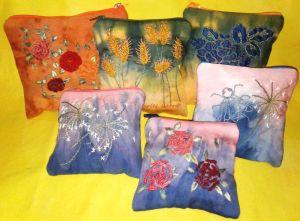
 All lined with indigo.
YUM.
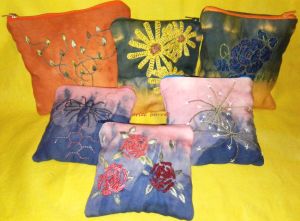
Because you just can’t let them sit around doing nothing.
Even Lalage, my nasty sewing machine got excited. Then the little boogers stuffed themselves, so they could sit upright.
All lined with indigo.
YUM.
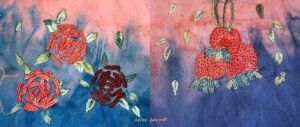
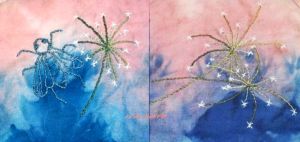
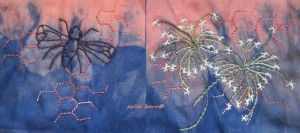
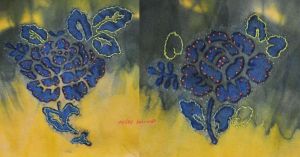
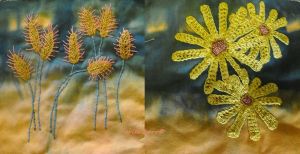
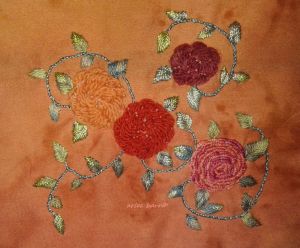
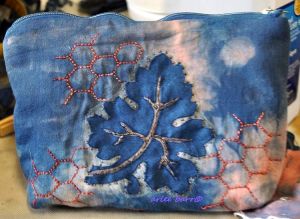
Because sometimes, small can be big.
Okay, time to be blunt. FB is doing me no good as a business. No one sees the posts. If you pay for an ad, no one sees the post. If no one sees a post, no one goes to the shop, and no one buys. No support=no business. No business=no products being made. No-one goes to the shop from here either, honestly, though for one last time, i am adding the link here–>shop
All products that are in the shop will remain until sold, but no new ones will be added either. The shop will remain as it is, until a. everything/most is sold or b. i fucking give up. If you see it, want it, please buy it. As a small business owner, i cannot afford to keep paying for a shop or a passion, that does not pay for itself. This is not a whine, or a rant, this is a reality check. I could probably make more money standing on a damned corner, as raddled and old as this body and personality is. If no one supports small businesses, artists, entrepreneurs, why should we keep on going? I’m not going to discount anything except to the faithful few (you know who you are and already have that discount) because the prices are more than reasonable for the amount of work and effort i have put into them. And as always i refund any extra postage paid.
I see people going all ga-ga over mindfulness, slowness, natural and eco, but few who actually put their money on those products. I see badly dyed or overpriced products fly out of some shops. Should i raise my prices? Should i slap things on cloth and call it wabi-sabi? I pride myself on well done, properly done, reasonably priced.
You think i’m whining? Nope. Honestly, i am DISGUSTED. I’m not even going to bother with the “Buy my art before i’m dead” route, because too many think that’s funny. I have never cheaped out on the quality of my work. I’ve put every lesson learned, into producing cloth that should be valued. I don’t whack things out in multiples using the crummiest method that will impart a modicum of colour.
I’m not just disgusted either, i’m fucking furious. At myself. Wasted time, wasted effort, wasted resources, wasted money. Screw it, head is now out of ass.
To the customers who have supported me over the years, i do thank you for the support and faith you have put in me. You are truly a lovely bunch of people.
If you disagree, well, ’nuff said. Over it and out of it.
I’m of a mind to make something larger from these latest dye results.
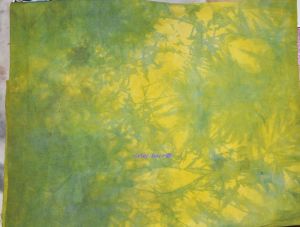 Above osage over indigo, below indigo over tansy.
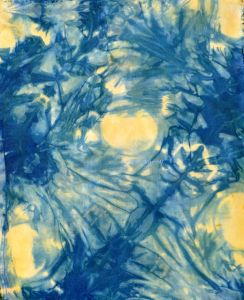

But i need a third colour–contrast? Co-ordinate? Do i calm it, or dramatize?
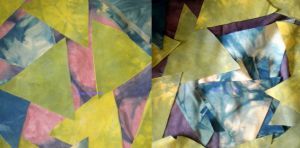
General consensus so far on social media has been the purple.
Anyone who thinks natural dyes are boring browns: HA.
Making a layout is not going to be easy though, with dog hair, grass clippings, loose threads and assorted cosmic debris on the floor, the only place big enough to use. (And that’s *after* vacuuming 🙂
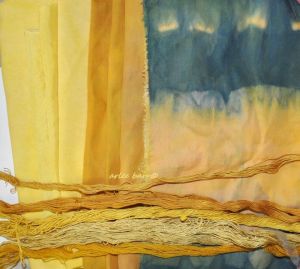
Such sunshine from this one pot of Osage Orange! Bought from Maiwa, a dependable, high wash and light fast dye made from wood chips, it’s such an antidote to the grey smokey skies we’ve had for the last three (?more? seems like it…) weeks. My tansy results were poor again this year, not sure why since i followed the same recipe i always have, one i always got good results from, but not in the last two years. Locally, as i have mentioned before, the soldiago/goldenrod is sadly a stunted, mingy little plant, that i now leave alone, for pollinators. Weld is spendy, though highly rated, but the budget allows for Osage in plenitude.
I’m building up a stock of these fabrics, for overdyeing, for playing with post modifiers, for shibori and because i have little yellow in any form in my stash!
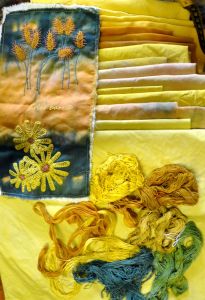 And greens too!
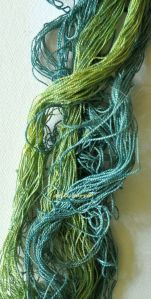
Having fun working on these as well, for little projects! The threads here are osage, sandalwood, walnut and indigo, or blends thereof, on osage over indigo over madder, all cottons 🙂

Just a hint too, there is only today and tomorrow left for my 8th anniversary sale in the shop. Enter 8AFS in the discount box (and make sure you click on the little black circle to add it), to receive 20% off EVERYTHING in the shop, sale items and art included. Someone remarked my shipping prices were too high, BUT i ALWAYS refund any differences in what you paid and what the actual postage is at the post office. One cannot guess at weights and costs to other countries/continents, but one does one’s best to be fair. I’m sure you’re all familiar with packages that you paid 15bucks to have shipped to you, and when it arrives, the post stamp clearly says it only cost 4.95……
I’m just mad about Osage
Osage’s mad about me
I’m just mad about Osage
She’s just mad about meThey call me mellow yellow
(Quite rightly)
They call me mellow yellow
(Quite rightly)
They call me mellow yellow
Paraphrased 🙂
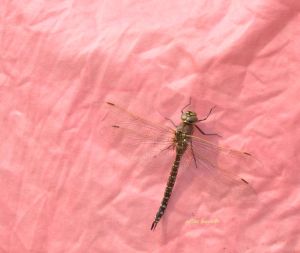 Here’s proof that pink calms dragons as well 🙂 He then flew onto my shoulder to say hello, before he went off on business.
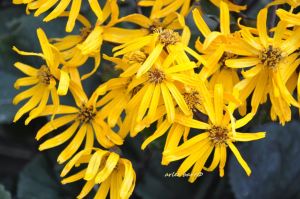
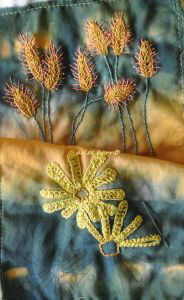
How can one ignore inspiration from one’s own garden? It wasn’t just the yellow shouting of these Ligularia flowers, it was the indigo shadows underneath as well, due in part to the smoke still hanging here.
(I reviewed this on my old blog, but thought it worth repeating here, with a few edits.)
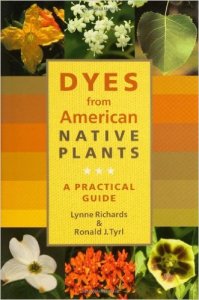
You know what the best thing about this book is? It gives a detailed list of plant materials that give little or no colour!!! That means less wasted time, fabric, heat and gathering 🙂 Though it’s a bit more geocentric than i thought it would be, given the slightly misleading title (covering mostly what grows in south-central US), a lot of the wild plants mentioned are widespread in North America, even up to Alberta. It does miss out on a few plants in the same species, but given again that it is geo-specific, that may be why–one variety in the species grows there, but not others. It’s also decidedly not a “kitchen scrap” book with claims of blue from elecampene, magenta from dandilion roots, green from spinach and lasting effects from turmeric!!!
No vinegar or salt “fixes” either–really, just go, run down to the corner convenience store, buy a bag of potato chips fer jeebly sakes, if you’ve got a hankering for salt and vinegar, and stop mushing on about how they make berries last longer and stops rust from rusting…….
The only true problem with this book, is that it doesn’t give any indication of what is light or wash fast. It does tell you *how* to do that, but there are no notes with plants what is worth the effort, and what is a waste of time, effort and resources. I truly believe too, that testing for these should be an INTEGRAL part of the dyeing process. Maybe then we’d see less of the Beet and Berry Brigade posting their results for the GaGa newbies…………… There’s also no mention of post modifying, an important and often surprising process that brings unexpected colour out.
So what else is in it?
It’s laid out with plant materials grouped by colour results, it has a comprehensive index with the Latin and common name (though the common nomenclature may be regional), there are photos of the plants mentioned. I would also recommend investing in a good geo-centric plant guide, like those published by Lone Pine Publishing, so that you know what you are looking at, and hoping to gather. The author speaks of responsible gathering and safe dye practices and it’s not dumbed down or too technical. My only complaint is the prevalent use of tin as mordant in a lot of the dye baths. Even in 2005 (the date this book was published), we knew this type of mordant was dangerous for the dyer, and best not used in the home. There are no “recipes” per se, for the novice, but the more experienced dyer will already know that as with most plant materials, your plant chunks ratio should be at least of the same weight as your fabrics/threads.
There were a few surprises with some of the flora mentioned. Certain plants abound here, and while i’m not going to get too excited about the possibility of using them, it does give me new hope for local colour. Many of them are also though, while “plentiful”, are in our National Parks–and i am never going to scavenge great quantities, because of that, and because they belong where they belong, period. If i find them in a ditch however and if it’s in my immediate environs, and i know it’s considered invasive or noxious, it’s fair game. I recognized a few varieties i had no idea would give any colour at all, but because of my frequent walks with the DogFaced Girl, i know that locally these are very very small ecosystems, and i would feel incredibly guilty if i denuded the area. I am passionately interested in using what i can find, but not at the expense of the primary reason why i do these walks and that is to appreciate what is there, not what can be taken away! You’ll note i did not mention any of these by name—–i don’t want to be blamed by the Cosmos for encouraging somebody sneaky to go and strip their area!
Of course, the preponderance of colour mentioned is yellows and browns, as few native North American plants have the tinctoria classification 🙂
Ain’t no sunshine when she’s gone
It’s not warm when she’s away
Ain’t no sunshine when she’s gone
And she’s always gone too long
Anytime she goes awayWonder this time where she’s gone
Wonder if she’s gone to stay
Ain’t no sunshine when she’s gone
And this house just ain’t no home
Anytime she goes away
 “You are my sunshine, my only sunshine….”
Like a fancy gerbera, and  i can’t wait to stitch this one!
To celebrate my loyal customers who have supported me through this adventure, i am offering 20% off EVERYTHING in the shop–that includes sale items, Art and fabrics! As always too, i refund extra postage paid. The discount code is 8AFS, and because the instructions on the form are a bit confusing, after you add the discount code to the little box, make sure you click on the little black circle too!
According to my old blog, i started “messing with potions” in the form of natural dyes, sometime in July of 2010. From threads that faded in days, kvetching that most dye books mentioned only wool, smelly jars that resulted in copious ick and mold, and wondering how you knew what to mordant with what, i’ve come a long way to piles of naturally dyed fabrics in strong colours that last, a rainbow of threads and a library that is dependable and exciting. Along the way came knowledge about the history, economics, science, geography, arts and culture, and folklore and fact, so much more fascinating that any synthesized dye! (I won’t say “chemical” dye, as it’s ALL chemistry, even/especially the naturals! 🙂 )
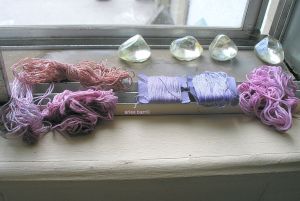
I had hard lessons about the value of mordanting, above (i didn’t at all…), and of learning about fugitive dyes, below:
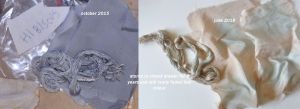
I learned about the quality of dyes:
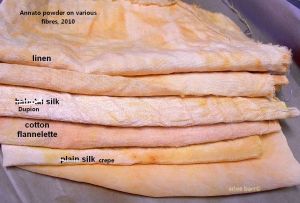
And the correct WOF use:
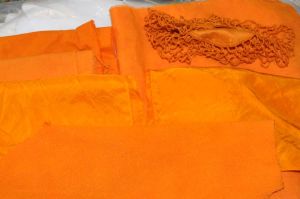
I learned that cheaping out does not give good results–if i bought the dyestuff, obviously i should be using it correctly, but these were scoured improperly, poorly mordanted, and low WOF, madder:
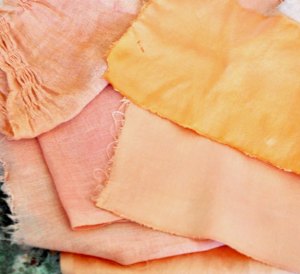
And done correctly below:
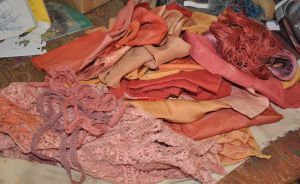
Yes, it *was* fun, playing with whatever was handy, experimenting and mucking about, and it *is* a way to learn about natural colour, BUT all those poor results, fugitive dyes and improper procedures become expensive wastes of time and materials in the end run. “If it’s worth doing, do it right.” “When in doubt, read the instructions.” Because as my mother always says “You buttered your bread: now you have to lay in it.”
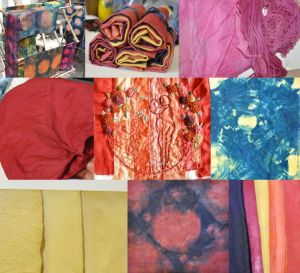
 albedo too
You must be logged in to post a comment.