Posted in "OPINIONATION", Ecoprints and Natural Dyes, Home Cookin' the Cloth, natural dye research

going deep, back to ecoprints

I stopped doing ecoprints a few years back. Honestly, it had started to bore me, as i *did* get “predictable” results, knowing what local plants did print, and the effects i could get. Then i was quite frankly, COWED by all the splendid, wonderful experimenting and marvellous, amazing results that others were getting! I couldn’t figure out how people were doing what they were doing, and at the time, it seemed to me that only people with a lot of discretionary cash could afford the goods, dye materials, travelling to classes and workshops, and free time, perhaps a sour grape reflection, but “valid” at the time, for me…

Methods and materials were being closely guarded–and i DO understand the point that teachers make a living from teaching these with their years of experience and skill level, and should be recompensed, so don’t think i’m kvetching because the process was only being taught in paid for classes. (I would KILL, i WOULD kill,  to take a class with premier ecoprint teacher Irit Dulman.) I too have been in that position, as a student, and as a teacher. I never asked anyone who had done the classes to break the chain by giving me for free what the teacher had been paid for, so tried to puzzle it out.

I tried a few things that i thought were the process, but didn’t have a lot of success. It wasn’t that i was stupid, or unwilling to experiment: things just didn’t WORK. But i was “sloppy” in a sense. Now that i’ve learned properly how to prepare fabrics and threads and then dye with natural materials, that knowledge, based on historically accurate, well researched and proven methods, can be applied to ecoprints. (I’m still not a perfect dyer/mad textile scientist, but i’m improving every day 🙂 ) If however, i see ONE more post about vinegar or soymilk as “MORDANT”, i will puke a twice iron dipped catalpa leaf, with a nice frothy TO chaser…………….

Recently i joined a group that is big on sharing method, without spilling teacher secrets, or fighting about who “owns” the process, something that was nastily prevalent in the beginning. (I’ve never seen such an insidiously/assiduously “policed”–sometimes quite maliciously– practice before, as ecoprinting, contact printing, leaf printing, whatever term makes your boat float without “offending” anyone…) The people in this group share generously, indeed that is the POINT of the group, to SHARE the knowledge, the experimenting, processes, thoughts, ethics etc. Oh sure, there are still divisors between the purists, and the “anything that works” camps, but it’s reasonably civil, as the admins do a fantastic job. (It also helps that you can turn off commenting as an admin, or on your own posts 🙂 ) (I tend to do that when people go waaay off topic, or give me the same answer over and over, or just didn’t read the actual post and are tossing in two cents that makes no sense…)

I have a few ideas i explored before and want to return to them with the ecoprinting. They were successes at the time, and nope, i didn’t share the process at the time, and won’t now either 🙂 because as a talented friend once said when i asked something specific about her work : “Every dyer has her secrets”. THAT is valid too.

I have bags of premordanted fabrics ready, from the basic tannin/alum, to rhubarb leaf, titanium oxalate, iron, soda ash, alum alone, combinations thereof of whatever, all suited to the type of fibre (cellulose vs protein) and on the stove is a batch of pomegranate readying for use.  I’m still doing the Summer of Madder (Study) and its adjunct project, but the ecoprinting will be incorporated into that as well.

And since DogFaced Girl and i have got so lazy and so fat over the last year, it’s a perfect time for walks to gather materials, relish the summer, and enjoy the short Calgary summer as best we can. Exercise, fresh air, science and joy at their finest!

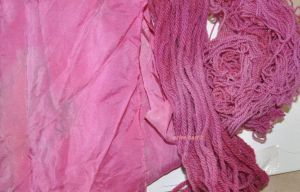
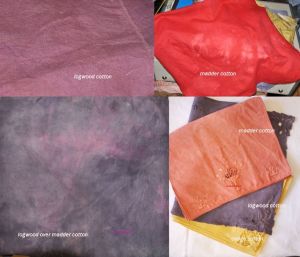
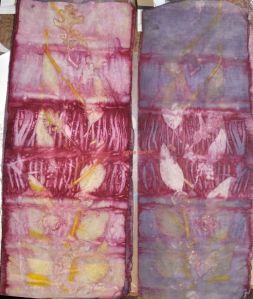
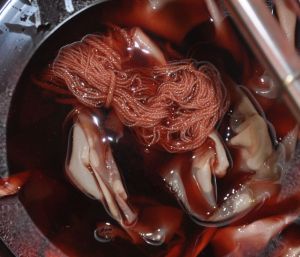
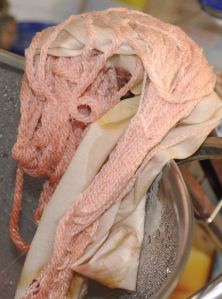
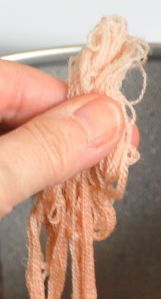
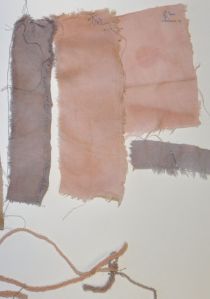
And here’s a funny little one, tossed into the current almost exhausted madder pot:
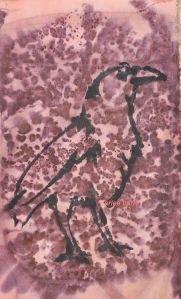
Iron turned the colours pink and purple!


Posted in mordants and modifiers, Natural Dyes, pomegranate (as dye and as mordant)

dyeing with poms

I’ve wanted to try pomegranate for a long time, as it’s both mordant and dye material. I had been saving the peels given to me, until i figured i had enough to make it worthwhile. This isn’t an experiment by the way: it works, and is historically used in India as both a tannin rich mordant, and a greenish-yellow dye. Note: it is the peels that give colour, *not* the arils (the part you eat), not the juice either, just the peels/skin.

I don’t eat pomegranates, as they are expensive, and to my mind a waste of time as an edible 🙂 You can buy an extract from Maiwa, if you don’t have someone saving the skins for you, and can’t be bothered picking out all those seeds for consumption. The price is a bit spendy, BUT at the same time, the WOF because it’s an extract, not just powdered peels, is low, so a little jar goes a long way.

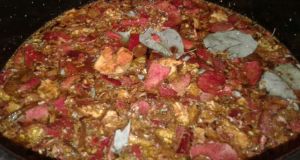
Since the season here for pomegranates in the grocery stores is Autumn, i simply picked off the labels, put in an OPEN plastic bag and set them near a heat vent to dry out, and saved them as i got them, over the month and a half they are available. No mold or ick resulted, just crunchy red bits, that i then stomped to break up more. The weight came to 625 grams, so i just filled my biggest pot with filtered water (not sure what our hard tap water would do), threw the skins in, brought it to a low just starting to boil temp, then immediately turned it off, and let it sit overnight. I threw in 2 skeins of cotton threads on a whim, leaving them overnight also.

Yup, a few errant eucalyptus leaves, nothing to worry about.

Good colour as soon as the heat hit.

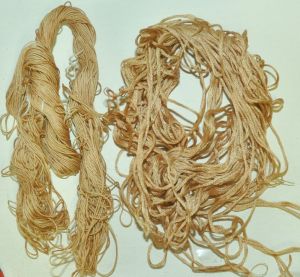
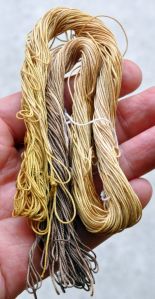
The threads seem a *wee* but stiff, maybe due to the high tannin level, but i can live with that, especially as the cotton embroidery floss is an almost metallic gold! (SO hard to photograph!)  (OOPS, just remembered both threads had been previously tannined in gallnut, but never made it to alum.) I post modified the left cotton thread.


Below on the left skein, colour changes are left copper, middle iron and right ammonia. Biggest surprise was the iron, as i assumed i would get green!

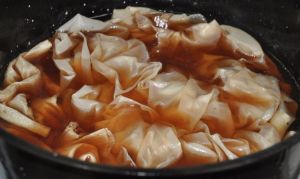
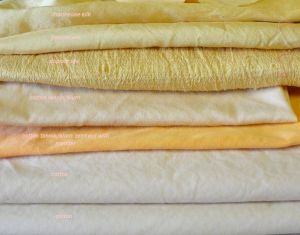
In the morning, i strained out as much of the skins as i could, because leaving them in can result in spotting fabrics, due to contact. The pot is a huge canner, so i tossed in 3 kinds of unmordanted silk (habotai, dupioni and a light charmeuse), several unmordanted cottons, one cotton with a previous tannin/alum mordant  pale madder dyed and one premordanted with tannin/alum no dye, and 2 skeins of wool (a superwash and a lace weight both premordanted with alum), total weight about the same as the peels. Technically, i should have had 2 pots, one for cellulose, one for proteins, as uptake is different, but since i’m more concerned with it as a mordant than a colour, i’m not too fussed about this. The previously mordanted and dyed cotton almost immediately changed colour, a warm goldy yellow. The beauty too of pomegranate is that it’s not fussy with temperature regulation and doesn’t take more than an hour after it’s being used, to get results.

DogFaced Girl and i went for our morning walk, so the whole stew was left a little longer than an hour, probably closer to two and a half 🙂

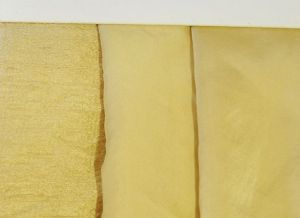
Above, hard to photograph, the cottons are closer to a creamy yellow, with a noticeable difference between the previously unmordanted and the tannin/alum premodanted. The silks are almost metallic as well!

The two skeins of wool are a pale cream, no surprise or big surprise, can’t decide 🙂

I’ll keep sections of the silks and the two darker cottons as they are right now, and play with their other bits in different dyes (and ecoprints) now. The cottons showing little colour will be used for other dyes/ecoprints and more tests.

And i’m pretty sure, i can add the saved used peels back to the pot and get more colour,  after i’ve exhausted this “extraction”. I don’t know either if the use of hard water would have greened the dye more, but i suspect it would have, as we have iron and minerals, especially calcium, in our tap water. Adding an alkali or an acid would change that as well, but doing a few little tests first in smaller decantings.

If the results with dyes and second extractions are deemed worthy, i may buy some of the extract from Maiwa in the future!

Posted in cochineal, Natural Dyes, The Summer of Madder (Study)

FIRE IN THE STUDIO!!!!!!!!!!

Well, hell, i mean *i’m* on fire, at least in the dye department 🙂

Cochineal on silk, and on wool threads:

OOPSIE, i’m not sure why there are areas of gradation in those, as they were all mordanted properly and dyed by swishing around regularly, but it does make the colours more interesting to use.  (I think though that the greyed areas in the silk are oxidization that occurred during the night, when the fabric probably bubbled up.) And i realized with the cotton results–that i won’t show :)–that most of my cellulose results, barring threads, have been rather weak, so need to play a bit with that still. Strange, since cochineal LOVES cotton, as witnessed by Central and South American dyeing……


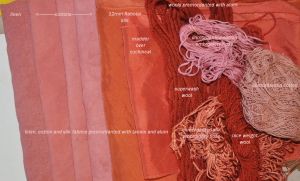
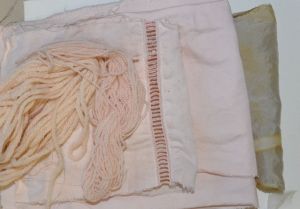
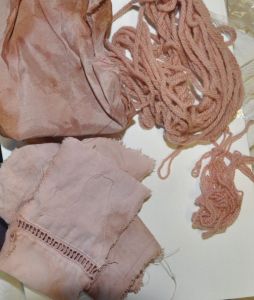
I’ve been doing a lot of exploration with madder this summer, my “study” for the year. This week, i (accidentally!) discovered softer pink toned fabrics and threads by using soft (filtered) water, instead of our regular hard tap water I had still dropped in the ol’ Tum’s tablet, recommended to add that “hardness” of calcium (carbonate) to the bath, but for whatever reason, i used the filtered water this time………… (Too much on my mind lately…)

I’m making green threads today, not something i ever dyed a lot of, deliberately or accidentally. The current project demands them, for leaves and vines. Time to fire up the osage, privet berries and logwood.

And maybe (gasp), the indigo that has been hiding in the Dye Dungeon for 2 years at least…

Posted in a collusion of ideas, embrilting, in progress, Natural Dyes, The Summer of Madder (Study)

wings

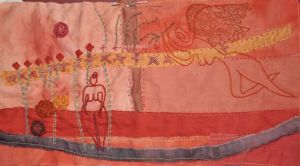
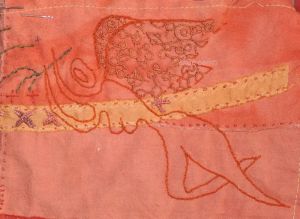
Admittedly, i overthought this section, but i’m happy anyways with the results (still in progress). The idea/execution however is getting a bit *too* “figurative”! It’s time to think of texture and effect as well as the “embrilting”.

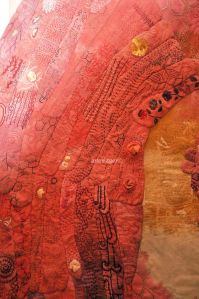
As soon as i finished the wing on the upper right figure, i flashed back to 2014, when i was working on “The Weight She Carries”. At the time, though i wanted redder madders than i was getting, i used synthetic dyes (Procion/Rit/Dylon, whatever was in the drawer) to get a range of reds. (The coral/peach “puffs” in the photo are the madder results i was getting at that time.) The feathers on this wing are a textural smorgasbord, and perhaps i can draw from these, literally, in shape, and figuratively, in feel.

I could see wings on the back of this garment,  but that might be a bit much! I can’t/don’t want to make them smaller to fit in a section either, as they would be too fiddly to work, and would lose the point and effect. Perhaps a few scattered?

Posted in Ecoprints and Natural Dyes, lac, logwood, Madder, Natural Dyes, osage

taken to task….

From the PM i got, someone (some many?) thinks my bad avocado results are because i don’t know what i’m doing………

I beg to differ. Cotton is one of the hardest fibres to get good results on, with natural dyes. I follow Maiwa’s insightful, clear, well researched methods, from scouring to mordanting to dye procedures for each dye. (Don’t lump all together, as each one usually requires a different set of parameters!) My results before this were lousy, but these instructions became my “go to”. (My other trusted source is anything by Jenny Dean.)

You’ve seen these before, but for the person/s who have taken me to task, eat your words please.

My ecoprints on cotton are rather spectacular too, if i do say so myself.

Lac and logwood on cotton, with eucalyptus leaves, oak leaves and osage strips.

So, let’s see *your* results then, Miss/’s.

Posted in avocado, natural dye research, Natural Dyes

pity, ’cause it’s pretty, but pits are the pits

Nope, ain’t gonna bother anymore. I suspect you do have to use the Hass avocados, reputedly the best for natural dyeing, but at 2-4 bucks each, that’s much more expensive than my grocery/natural dye budget allows for! WOF is 2:1, so that’s a LOT of pits that have to be saved…   I buy bags of the smaller whateverthevariety is for 3 bucks on sale, usually getting 4-6, because i do like eating them, but all this effort is a waste of time for me. I envy the deep pinks and russet corals others get, but nope, nope, nope.

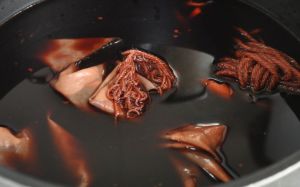
See how beautiful it looks in the pot?

All the fibres were correctly premordanted according to type (cellulose and protein). They were done according to Carol Lee’s clear instructions from“Dyeing with Avocados, Food for my Dyepot”, Fall 2002 Spin-Off Magazine, but they are not Hass avocados, so blah blah blah.

The minute they were lifted to check on uptake, the colour started draining out:

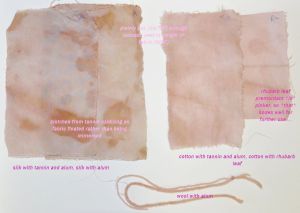
Pathetic, even the silk. EDIT 15 minutes after posting: the cotton is definitely pink, deeper than the wool, and the silk has turned a hideous yellowy piss green……. The cotton has NO uptake (Carol does mention not such good results on cellulose, though Rebecca Desnos seems to make it work, possible because of the hideous soy milk “premordanting… which soy is not …. whatever………… not going there again to explain or to show the results *i* got when i subjected fabrics to it……)

Squeezed:I know what’s going to  happen when they are rinsed and dried: minimal nugatory insipid weak vapid ghost of an insignificant feeble pale negligibly pink colour. Nope.

To all the other intrepid dyers out there, good luck. Your dye bath will look F*&^ing FABulous, but unless it’s a Hass, it’s too much of a HASSle!


Edit June 20/18: how pink it isn’t……….

EDIT APRIL 30/19: subsequent discussions in a natural textile dye group, and my own lightfast tests, have concluded that avocado’s lovely pinks will gradually oxidize to browns, because they are more a tannin, than a dye.

Posted in a collusion of ideas, Natural Dyes, The Summer of Madder (Study)

parts for the whole

It’s time to start other sections of the garment for the Summer Madder Project, so today i pulled the booty out and started laying out areas.

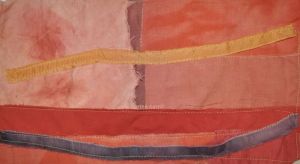
I couldn’t resist adding a slice of the purple, madder overdyed with logwood (and iron). The left top is cochineal over madder, and the right top is sandalwood over madder, because “it all madders”. Ha.

I knew i had better also start using the actual pattern i want for this, a Tina Givens that i’ll have to modify somewhat, due to the construction details and sizing. I don’t want to be trimming too many sections, wasting fabric, or have embroidery in areas that will either be less visible (armpits! and under pockets!), or that will wear faster (armpits and ass 🙂 ). We also don’t want motifs centred on bosom parts either!

I won’t add the ruffle, but will extend the length to below the hip, and will be adding pockets.

I’m going to continue with the small figures, and the roses, but want to add other elements as well. Wings would work on some of these little ladies, but i also don’t want to go overboard with “precious” and airyfairy. Oh no, i will have to dye some more threads in madder! (Such a hardship 🙂 )


Posted in avocado, mordants and modifiers, natural dye research, Natural Dyes

addendum to avocado “failure”

Since these are from a second extraction of the avocado peels, i didn’t expect much, but thought i’d give it a shot anyways. Well, lo and behold, a shorter time in the pot (because after the first batch/reveal i thought “Cut yer losses, Girlie” and pulled them out after 5 hours….) and more colour. Still not terribly exciting and admittedly they were dyed (badly) in the first extraction, so essentially now over dyed, but but but. I think the ammonia worked its magic in the second extraction, while the soda ash from/in the first didn’t. I just about cried though when i poured the bath down the drain, as it looked a rich blood red………..

What i don’t understand is that the cottons had better uptake than the silks, as usually it’s stunningly opposite. The rhubarb leaf mordant did a better job than the usual tannin/alum also.

I still intend on collecting both peels and pits as they are consumed on a regular basis here, but the next experiment with the still soaking pits is perhaps going to prove that conceivably both should be used, as a WOF enhancement (2:1) and for the colour. And when i do it PROPERLY with correct WOF, i ain’t pouring out anything until it’s as exhausted as the DogFaced Girl and i after a loooonnng walk 🙂 The pits will continue soaking for another week or two, unless they start getting jiggy with bacteria.

(Interestingly enough–or stupidly—-my fingers were stained by the avocado bath, as i didn’t put my gloves on to pull things out.)

I did do some post mordanting/modifying with the previous samples though, as that adds to the “library”, at least as research, if not usable samples. No striking differences, except for the iron! These will now be tested for lightfastness, though they may not be entirely indicative because of the low uptake.

Soooooooooooo, i’m just being done with this batch and turning it purple 🙂

Time to return to the Summer Madder Project!

EDIT APRIL 30/19: subsequent discussions in a natural textile dye group, and my own lightfast tests, have concluded that avocado’s lovely pinks will gradually oxidize to browns, because they are more a tannin, than a dye.

Posted in avocado, journal: lessons to learn, mordants and modifiers, natural dye research, Natural Dyes

deception/disappointment/disavowal in the avocado pot

Though i was intending to leave much of the test fabrics and threads in the dyepot longer, i couldn’t resist cutting a few pieces from them, and pulling them out. You’d think with the appearance of that pot above, that the colours would be a HELL of a lot deeper. I could have totally conveniently “forgotten” to post all this, lessening the chance of public embarrassment, but hey, it doesn’t work all the time, and usually because we don’t follow the instructions, so live, learn, laugh and take the lumps 🙂

CRAP, these are undeniably CRAP. Definitely not enough plant material in comparison to the fabics (WOF in other words)!  Admittedly, i had maybe a scant 50 grams of the peels………. I’ve been told the best ratio here is 2:1, so i was waaaaaaaaaay off base with that, duh duh duh. Strangely, the cottons seem to have better uptake than the silk and the wool this time.  The blotches are because they floated up during the night, and were exposed to air, the tannin then oxidizing. I think too, my pot is a bit too alkaline though, and that’s why i have browner tones. HOWEVER, there IS colour uptake, but undoubtedly, irrevocably, clearly, not enough peels.

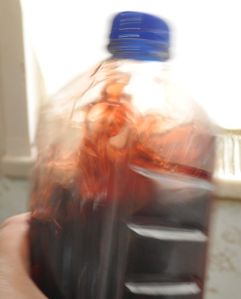
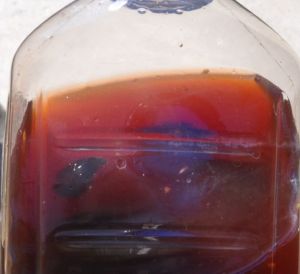
The remaining stewing peels had a glug of ammonia added yesterday, and holy crap, there’s more colour left! I shook the bottle to show the colour splash 🙂

I’m assuming these then are Hass avocados, reputedly the best for colouring. So, i’ll combine the two extractions, and the first dyed pieces, trusting that the strange chemical mix will give me something 🙂  (If i don’t blow up the house.) I’m calling this experiment not quite a failure, but a learning experience: DON’T CHEAP OUT ON THE DYE MATERIALS. If it’s worth doing, do it right, otherwise all i can chalk this up to is a waste of water, time and effort.

The pits that are soaking are more weightwise, but need to stew longer.

Note: buy more avocados for lunch.

EDIT APRIL 30/19: subsequent discussions in a natural textile dye group, and my own lightfast tests, have concluded that avocado’s lovely pinks will gradually oxidize to browns, because they are more a tannin, than a dye.


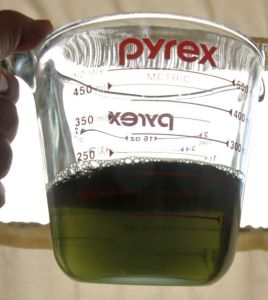
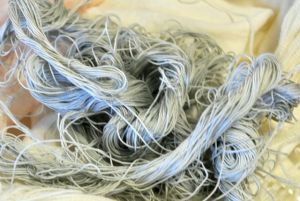
As a side note about the importance of scouring, i thought i had done enough on a new thread, but when i put them in tannin, this happened:

GREEN?????? I contacted Maiwa, my trusted supplier, and asked if perhaps it had been the soda ash in the initial scouring that had reacted (maybe not rinsed enough), as gallnut is a clear tannin, and stays to the “browner” tones after being used and stored. Nope.

Hi Arlee,

This is rare but it does happen, but it is not from the soda ash. Fabrics are often pretreated and contain substances which can leach out or react with the mordant. When used on it’s own Maiwa’s gallnut extract is usually a clear/colourless tannin. I would suggest trying other cotton fibres from different sources and comparing the results.

Best,
Danielle

So, obviously, i did NOT scour as well as i should have, and am thinking this could also be the problem with some fabrics i’ve had problems with, particularly new ones (not second hand, recycled, etc). I don’t generally use new fabrics, but maybe some of the stuff i’ve purchased second hand were new enough that these chemicals were still in them. Something to think about! I had noticed there was more “colour”/precipitate in the wash pot after, but thought all had been removed from the threads. I’ll be doing all the scouring from now on with fabrics/threads that appear in better condition then (ie “newer”) for 2-4 hours, as per J. Liles recommendation. (I scour PFD fabrics as well, as i don’t trust that everything has been removed!)

The green didn’t rinse out of the threads either!


EDIT: i decided NOT to mix the two extractions of the avocado peels. I’ve dumped the first “batch”, rinsed the fabric and threads, and put together in cleaned pot with the second extraction.


Posted in avocado, natural dye research, Natural Dyes

more avocado science

AHA! There is tannin (catchetin, a non water soluble tannin) in the pits: “The seeds could also be used as a source of natural dye. Colour of the extract is supposedly connected to the procyanidins, the oligomeric compounds, formed from catechin and epicatechin molecules . Currently no reported research was performed in dyeing of textiles with avocado seed extract.” Tannins help alum bond tighter/better/stronger/Superman to cellulose fibres. But there are also anthocyanins, which are notoriously UNlightfast )—-remember those damn beets and hibiscus???).

There’s still no definitive evidence though that this tannin is strong enough on its own, though apparently it is used in South America as a tannin. I’ll do my usual prepping then on cellulose using a tannin (gallnut, which imparts little colour) and alum after, just to be sure that things “stick” 🙂

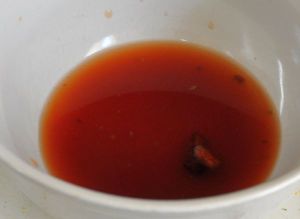
I decided to use the peels first (no tannin as far as i know), as the “extraction” is now turning a wee bit murky, signifying that other life forms could be spontaneously generating in there! There does appear to be a lot of dye colourant, though who knows how much of it is actually viable?

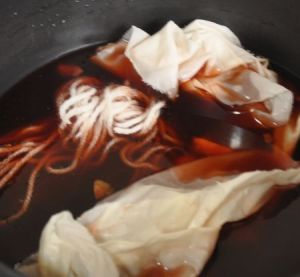
I threw in some wool yarn with alum, cotton with tannin and alum, cotton with rhubarb leaf, silk with alum, and silk with tannin and alum. ( I am aware that silk requires only alum, but adding the tannin may give different colours/shades, depending on the dyestuff.) I gently raised the temperature until it BARELY started to steam, then turned it off. NO boiling as it forces the browns. It will be left in the pot for a number of days, gently reheating once a day to reduce the possibility of mold and other potential ickies.

One thing i didn’t think about initially when i “potted” it in the narrow necked recycled juice bottle: everything swelled, and because i didn’t break into teeny pieces, they are a pain in the bazotski to get out! So, what the hell, filled it up again, threw in a glug of ammonia, and we’ll see if there’s more colour to come.

The pits are still stewing, with no sign of alien activity, so will leave that for a later time.

I’ll leave these in the bath for a couple of days, and see how much it deepens, then the lightfast tests commence. One good thing about summer in Calgary is the intensity of our sun in the summer due to our higher altitude, so tests will be easy–and relatively speedy!

EDIT APRIL 30/19: subsequent discussions in a natural textile dye group, and my own lightfast tests, have concluded that avocado’s lovely pinks will gradually oxidize to browns, because they are more a tannin, than a dye.