Posted in avocado, natural dye research, Natural Dyes

oh, do i want to use the translation of avocados as this post’s title :)

I’ve been trying to find research papers on the use of avocado as a textile dye, and have found little, though i have found a bit. The first link is a badly translated hoot, especially “The word avocado comes from nahuatl ahuacatl, which also siginifica testicles” or probably properly translated as “means testicles”. (Not sure how accurate that is either, as it may have been a joke on the Spanish invaders…)ย  Second linkย  is more “scholarly” though only a photo of the seeds is shown, no actual information on their use, and no actual listing, Latin or otherwise in the tables of plants used. Obviously this is a MesoAmerican dye, as avocados are only found in the “New World”. ( Central and South America).ย  (Somewhere down the rabbithole, i found a brief mention of deep purple blacks also, but i’ll be damned if i can find that again……although i did notice deeper purple splotches on one failed attempt, so who knows. Of course, i can’t find *that* either, but at the time it was the pits only that i had used.) I do wonder too about the popularity of avocado dye having such a bandwagon–who “re-discovered” it, had a “happy accident”, did any research?

The pits are reportedly high in tannins–though i’m not sure how to qualify that. I suspect too that the skins are going to be less permanent, but i could be wrong, as i haven’t any scientific information to back any of this up. The only other research paper i could find mentioned an orange colour from the pit, but no mention as a textile dye, just as a food additive. I’m therefore going to keep the pits and peels separate in dye baths also, when it comes time to use the extractions. I’m allowed to have avocados in my diet luckily (in moderation) , after recent heart issues, diet being one item of speculation, so still plan on saving more bits!

I fortunately have stumbled into a Chilean dyer on a FB group, and she offered to share any historically accurate info she finds in her own search for these geo-centric dyes.

Meantime, the brews deepen in colour, while i work on other parts of the Summer Madder Project!


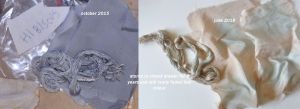
EDIT APRIL 30/19: subsequent discussions in a natural textile dye group, and my own lightfast tests, have concluded that avocado’s lovely pinks will gradually oxidize to browns, because they are more a tannin, than a dye.
Posted in avocado, natural dye research, Natural Dyes

avocado bandwagon

I’m willing to try some dyes that are not in the classic dye histories, at least not in “western” use, but i never assume they are going to work, or last. Avocado peels and pits are the newest trend/fashion it seems, and i admire some of the gorgeous pinks people are getting. I’m not normally a fan of pink, but it *is* in the red family, so why not a little experiment?

I’ve tried avocados before, and the first time, i got NADA, the second time, an insipid languishing Victorian heroine pink. I did the time-tested huck-it-in-a-pot-and-simmer method, and used premordanted fabrics, but. Didn’t bode well for further experimentation!

I decided to really search online for information but take very little on faith, particularly from some sites i’ve visited. When most of them are written by blackbean/turmeric/beetjuice/raspberry aficionados, there’s a large grain of salt attached to the “results”. There is however, Rebecca Desnos, a person who has done research and much experimentation and has had marvellous results. The only problem i personally have is that she only “mordants” with soy milk. (Soy milk is NOT a mordant, it is a binder…. and yes, i know it is a valid method of treating fabrics, as the Japanese have done for millennia for indigo usage, but still not a mordant as indigo does not require one, being substantive.) I will never use soy milk again, as the results i had with it were ABYSMAL, stripping colour from logwood and even wreaking havoc on potassium permanganate (an inorganic compound), though i have friends who swear by it. Also, she never shows or talks about lightfastness!

Further research on my part has found that an alkaline soaking first will result in more colour being pulled from the plant materials, though i have also read that the colour is an anthocyanin, notoriously short on lightfastness. I’m not sure how long to leave it though in the solution, as it seems some are doing a couple of days, and others, several months.

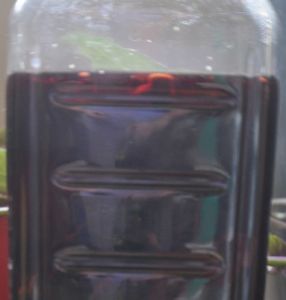
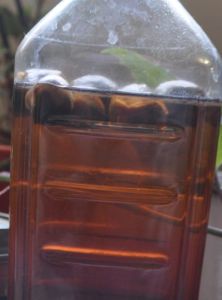
I separated the skins from the pits, and these are the results after 2 days:

Above, peels, below, pits.

I didn’t chop the pits, so obviously it will take longer to extract any colour. The peels practically exploded after an hour, however. I’ll leave them until i think they are ready (how scientific is that? ๐Ÿ™‚ ) , or until it looks like they might just be about to go funky.

And when i do use them, they will be on the correct cellulose/protein appropriately premordanted fibres, and lightfast tests will be conducted.

EDIT APRIL 30/19: subsequent discussions in a natural textile dye group, and my own lightfast tests, have concluded that avocado’s lovely pinks will gradually oxidize to browns, because they are more a tannin, than a dye.
Posted in logwood, Natural Dyes, The Summer of Madder (Study)

something other than red

Admittedly, i have had some ‘fails” with the madder pot, resulting in a plethora of bad browns, pallid oranges and wth-is-thats ๐Ÿ™‚ (Old mold, fridge scum, baby puke, baby shit, dog puke, dog….well, you get the picture.) Part of my problem is that i hesitate to throw away the dye bath, even when the colour left is a ghosty sad mud, with obviously not a lot of actual dyestuff left. Mordants and modifiers can only do so much magic too before it’s pointless with the colour left, and a person can have only so many decanted baths stored that more than likely will not be used again!

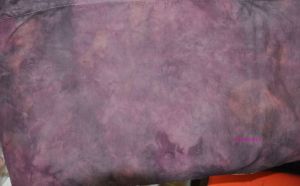
Madder is substantive though, which means most of the colour bonds hard with the fabric, (and requires no mordant really) which also means that even though i’m using the weaker resulting fabrics, any overdye has to be a rather heavy WOF.ย  I don’t need any more oranges, so rather than going with an easy dye like osage, i went with an easy dye like logwood, HA, with a post mordant/modifier dip of iron for lightfastness.

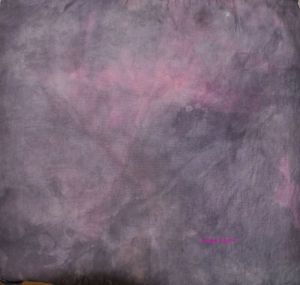
WONDERFUL purples and mottlings!

These may not be “suitable” for the project garment, even though they are part madder, but as narrow splash splices, i might get away with a teeny bit of it.


Posted in Days of Honey, embrilting, in progress, Madder, mordants and modifiers, Natural Dyes, Naturally dyed threads, The Summer of Madder (Study)

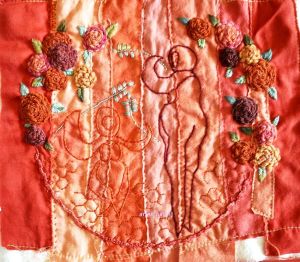
embroidery finished on pocket!

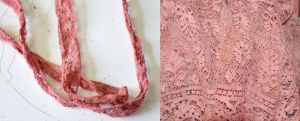
I just have to add some beading, and a bit of vintage lace (also madder dyed ๐Ÿ™‚ ), a top band and then can move on to other parts of the garment.

I think it’s wonderful that all shades on this, except for the greens, are from various mordants and modifiers with madder on cotton (background), and wool, silk and cotton threads.

I *like* getting madder!

Posted in "OPINIONATION", FybreSpace the shop, Madder, Natural Dyes, Naturally dyed threads, The Summer of Madder (Study)

sharing the bounty

Though i could probably make several garments from the fabrics and threads created so far, during the Summer Madder Project, i’ve decided to add some to the shop.

All of these have been properly prepped, premordanted and dyed according to well researched practices, and historically accurate methods. NO BEETS< NO BLACK BEANS<NO FUGITIVE “DYES!!!!!!!!!!! I haven’t cut any corners just so i can make some coin, as i intend to use bits in my own work–and why short myself?! All of course, are natural fibres, in various weights of silk and cotton, as are the threads. All have been well rinsed after, and because they are done correctly to begin with, there should be no bleeding. Your methods of care may influence the colour, but not out of the ordinary. (Even synthetics can fade…) All natural dyes should be treated with care ie, minimal sun exposure (you can wear it once in awhile at a sunny festival, but not everyday), proper wash handling, which means hand washed with a NEUTRAL soap (Dawn Original dish soap, believe it or not, is perfect, and is what i use), and storage in a closed drawer, closet or box. This all being said, if you are adding it to your stash to use in art textiles, rather than wearables, well, most of that doesn’t apply, except for the sun exposure. Nobody hangs a painting where sun will hit it, and neither will you with your art, will you? ๐Ÿ™‚

Posted in mordants and modifiers, Natural Dyes, The Summer of Madder (Study)

madder stash—and more “boring” madder notes :)

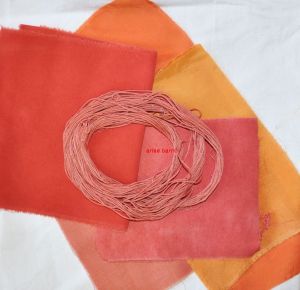
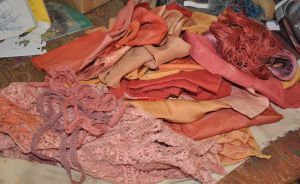
The pile so far for the Summer Madder Project project:

Cottons, silks, threads, and trims in wool, silk and cotton, these are the grist for the garment i am creating from this summer of study.

I’m glad i started with a small “canvas” in choosing one of the pockets to start with, as it has led to a lot of note taking and sketching for other components of the garment. I decided too that some areas can be pieced together first, and then “worked”, and others will be worked independently, with “cross-overs” to integrate the whole. I’m also thinking this could become quite an ornate piece of wearable art, and that it may extend past the summer, because of the amount of handwork. That’s okay though: i didn’t set myself a deadline, just a strategy to both keep myself busy after what i consider to be a long dry spell creatively speaking, and to learn more about natural dyes and all the science and mysteries of them.


Even though madder is a substantive dye, meaning it doesn’t have to have mordants, i’ve been experimenting with different premordants with it: celluloses need tannin and alum, or the dye just doesn’t attach properly, ย  Proteins accept dyes much easier but with other dyes that aren’t substantive, usually they require at least alum. In my experience though, mordants are crucial to getting deeper colours: one can only use so many pale peaches and pinks! I premordant everything now, as it not only influences the colour, it also helps more in lightfastness.

Though we do have hard water from our taps, when i use madder, i always add a Tums (calcium carbonate), and a 1/2 tsp of soda ash to shift it to more reds than yellows/oranges/browns. It doesn’t always work, though my track record says most of the time it does ๐Ÿ™‚ (Madder, weld, logwood and brazilwood need hard water, all other dyes do best in soft.)

Next up is some tests with rhubarb leaf mordant. The one we have in the Back40 is massive this year, so it’s perfectly willing to give up some material. I’ve used rhubarb *root* before as a dye, and had a gorgeous, rich, glowing green gold from it, but haven’t tried it as a mordant, because i have so little of it. Unless some house in the neighbourhood with a patch of it is sold and slated to be torn down, i can’t get more either!

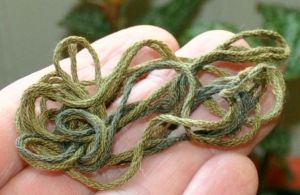
And now i need to make some good greens for leaves and vines! I tested some of the rhubarb root dyed cotton embroidery thread i have, and love the rich greens i got with an iron mordant:

I’m going to try comfrey, also from in my garden, but will have to do some lightfast tests, as i can’t find much info online. It gets a page in Jenny Dean’s “Wild Color” book, but alas, no real mention of lightfastness, so i’d rather be safe than sorry. If it doesn’t work, well, at least it becomes a fab compost/fertilizer for the tomato plants!


~~~~~~~~~~~~~~~

As i was digging through drawers yesterday, i found one labelled “hibiscus”. OMG. I was SO thrilled when i did this waaay back,, but now look at it! I have since learned that most plant materials that are composed chemically with anthocyanins are NOT lightfast, which is why the damn beets, black beans, red cabbage and berries that so many wax ecstatic about DO NOT LAST. (In that link, scroll down to the “Anthocyanins” notes.)

Posted in embrilting, in progress, The Summer of Madder (Study)

looking rosey

I do love this detail.


They were a bit naked without the leaves, so dipping into the stash, i found a bit more of my naturally dyed greens.

Of course, as it so often happens when one falls in love with something, the supplies run out….ย  I have very limited quantities of these wools, because i “never use them”—-HA! Fortunately, i found a small ball undyed, so guess what i’m doing today? (Yes, i hear you groaning “oh fer…more damn madder dyeing….”) AND i have to dye more greens as well, as *that* part of the stash is also very low.

Posted in in progress, Madder, mordants and modifiers, privet, The Summer of Madder (Study)

pocketing the difference

A happy start on the first pocket. To see how it’s progressing, scroll down!!!

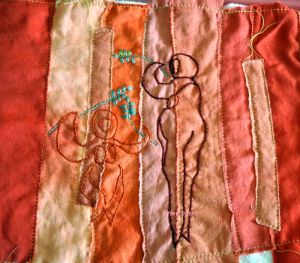
Ahhhh, the different shades of madder! These are all cotton, and reasoning that pockets should be strong and capacious, i chose not to add silk to this, though i suppose with the method of construction, it would have been supported by the interlining. (The yellow “anchoring” machine stitch will be removed.)

The threads are silk, and wool. (The greens are from privet berries, on silk.) Because this, as i mentioned before, will have to be hand washed due to natural dye Ph sensitivity, i’m not being shy about using different fibre types together.

(Colours are truer in first photo–another reason i *usually* shoot in my sunny south facing studio between 2 and 4 PM, rather than the AM, like today ๐Ÿ™‚ )

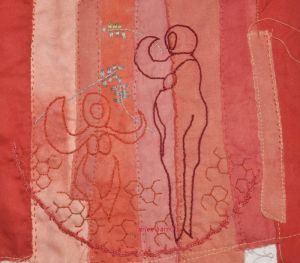
The figures looked kind of floaty, so i added a curve below, a cupping earth if you will, and my favourite hexes/honeycombs/cells. And beads are coming, because, well, beads, and for awhile now i have wanted to add a bit of bling with naturals ๐Ÿ™‚

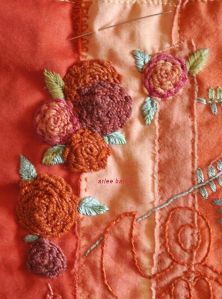
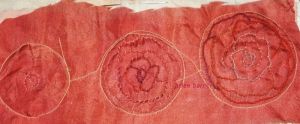
I thought this was still kind of flat looking, so dimensional roses will added at the edges, another motif i can carry across the whole garment.

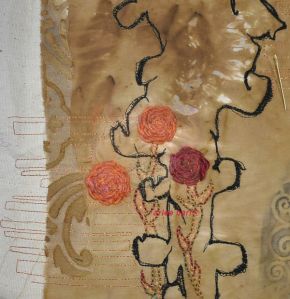
At first i thought i would do my usual embroidered, then appliqued pieces above, (maybe too much dimension for this???) but stumbled across this from 2012:

Never finished, but certainly an inspiration for this project! I do have some chunkier wool to dye, along with some already done, so maybe i will have enough.

There’s a finely worked narrow band of antique laceย  and a chunk of vintage as well, and i’m hoping i can integrate those as well.

I don’t want anything saccharine sweet, but it might work. I’m going to have to add a solid band across the top also, as i forgot that gathering it a bit is going to distort the figures! The second pocket will be similar, but not identical–nothing says they have to match.


Posted in Deliberation--do something you don't do--or haven't in awhile, Probably talking to just myself

working with space

IF you count that corner of the table where the pocket lies with a pencil on top of it…….

I’m HYPER neat and organized at the Day Job, but it never seems to carry over to the home studio.

I categorized this post as “Deliberation–do something you don’t do–or haven’t in awhile”, because obviously, cleaning this up hasn’t happened “in awhile”…….

Posted in Collision: the work begins, embrilting, The Summer of Madder (Study)

gonna rock some pockets

Most women’s garments just don’t have pockets, or real, decent pockets. I’m tired of jeans with fake ones (a cop-out “detail” at its worst–who’s looking at me that cares if it looks like a pocket if it isn’t????????), tired of ones that are too small, or so small and deep that you can’t get anything in, but if you do, you can’t get it back out, ones that don’t lie flat, ones that twist, ones that are placed too high, too low or impossible to find behind your back, and pockets that quickly develop holes.

I have SO many ideas for this Summer Madder Project garment, too many maybe, or maybe enough that there could be a couple of pieces! As things go in, (some delicate vintage lace now! and more threads!) and things come out of the madder pot (hopefully, an even deeper red), i thought one best start somewhere, so pockets, pockets it is. I want capacious, generous baggy pockets, suitable for gathering leaves, stuffing monies in and snacks, carrying lost journals, lost kittens, injured birds, rocks, whatever: pockets should be able to comfortably CARRY things. That’s their function, truly. And if these don’t work as pockets, then they become small bags!

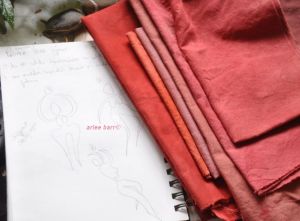
I’ve used similar little figures before, but since i plan on using them scattered around, the above are newly “designed” ones, along with 4 others not shown. Previous incarnation of the originals is here. (There will be other motifs as well, but these are a good start.)

Since this project when done will have to be washed by hand (due to natural dye Ph considerations), i’m not hesitating to mix silk/wool, wool, silk, and cotton threads, and fabrics in silk and cotton. The range of colours is more enticing on all the different fibres than using just cellulose or just protein fabrics and threads. The original plan was to create a “top” from a Tina Givens pattern, and i’m still going to use that (minus the ruffle, and lengthened a bit), but given that most of my embroidery is done with a flannel backing, this is going to have to be lined somehow, to hide the flannel and protect the reverse of the stitches. That means it’s a bit “heavier” than normal summer wear, but given that our nights here in the summer are a lot cooler than elsewhere, due to our altitude, that’s perfectly acceptable. I will however be using a thinner flannel than normal. I *could* use a finer cotton as a backing, but then the effect that stitching on a backing like flannel is lost–and that’s what my work is about, that added little dimension and depth. That’s why, for years, i’ve called it “embrilting” ๐Ÿ™‚

As i’ve thought of the stitching itself, i’ve also come to the decision that more dimension will be “needed” as well, to personalize this to me. I might be going overboard, but time and effort will tell!