But not in my Studio.






 Is it any wonder that i love my job so much?
But not in my Studio.
Is it any wonder that i love my job so much?
This one is particularly satisfying–99% natural dyes!
The first section is osage and cochineal on cotton,
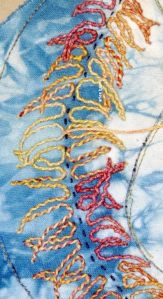
centre section is privet berries on silk and potassium permanganate on cotton (technically an inorganic chemical dye…)
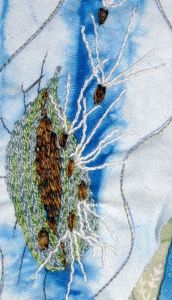
and third section is three flavours of cochineal and logwood on wool, silk, and silk/wool blend, all on a background of indigo on cotton. (And yes, i am fully aware there are natural substances for browns, but i happen to like the permutations of “potperm”, and i have none of the naturals at the moment.)
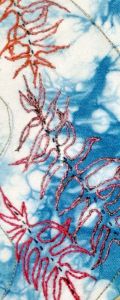
And i just realized, that as usual my photos are mislabelled…….left and right always confuse me………..these are portrayed in the correct order above, but the orientation in the file name is reversed!
I have only to add a few more milkweed seeds to the centre, and then i can finish the whole.
~~~~~~~~~~~~~~~~~~~~~~~~~~~~~~~~
Apparently i have scared a few people with the potassium permanganate. It’s as “safe” as using any other dye, WHEN you follow the protocols! (Would you drink or bathe in Procion??? Or even indigo???????) People also assume that “natural” immediately classifies as safe, and that’s not true either. Yes, PP is corrosive, so wear gloves—-i don’t stick my bare hands in ANY dye pot, mordant or assistant, i wear protective gear when mixing. PP is inert on the fibres: it is not going to explode or spontaneously combust, UNLESS you let ALL the liquid in the bath evaporate and then store it improperly. PP is poisonous–guess what? So are pokeweed, privet berries, rhubarb leaves can be problematic with all the oxalic acid, and logwood is potentially deadly. I also NEVER stick my nose over a pot and inhale deeply while exclaiming how earthgoddessywonderful it is, or blithely swish my unprotected hands through a conventional indigo vat, or even a 123 vat (there’s lime in there, right? and i’m not talking about the fruit.) Common sense people, common sense. We *don’t* know cumulative effects for most of these substances, because when they were in common use, nobody was doing studies about it, were they? Who wants to die from dyeing?
🙂
There ARE plans for stitch coming, ideas developing as i dye the threads and fabrics i want to use.
Last night i tried a wee bit of overdyeing and some modifier experiments:
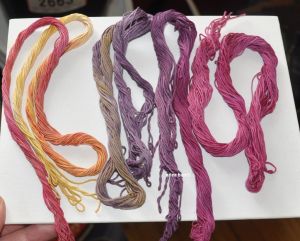 Left, osage dipped in cochineal, logwood dipped in osage–a lovely surprise as i’ve wanted this colour combination for the longest time! , then logwood and cochineal, and cochineal with soda ash, which didn’t deepen as purple as i thought it would. The two logwood overdyes have to have those ends dipped in some iron though to improve the lightfastness, so i wonder how much it will change, and if any will seep into the osage?
BANG. “Shit”, pause, “Sorry!” BANG. “Fuck”, pause, “Sorry!” BANG. “dammit”, pause, “Sorry!” The poor water heater man was in the basement, fixing things, and that’s what i kept hearing. Our basement is low ceilinged after all, being in a 107 year old house. You *can* walk upright (unless you’re 6′ plus, in which case you will be grazing the first floor bracing beams), but there are areas where furnace ducts are low, and both Greyman and i regularly bash our heads on them. When my hair was long and i wore it pinned up, it would be a common part of the experience, catching that full tilt on the top of the head……….I finally had to tell that poor workman to stop apologizing, and just get on with. I’ve heard all those words before, so whatever 🙂
And yes, our basement is slightly creepy. The house is after all Old, and there are parts behind walls down there that are the original stonework and earth dug-outs. It doesn’t smell musty or moldy, just old, no strange growths anywhere or slithering whatthehellisthats, one of the benefits of Calgary’s dry climate, even with us being beside the river and probably not that far above the natural water table. (Actually after the 2013 Calgary flood, we *know* it’s not far above, but we do know we also have the only self draining house on the block!) You can stand up in it, something not said about a lot of 107 year old basements, it’s floored with concrete and mostly painted white. We don’t use it for much beyond storage and it occurred to me yesterday that it was largely being wasted.
It’s divided into 4 strange little rooms, evidence of the original size and shape of the house, documenting add-ons and renovations. There’s actually no basement below the teeny back bedroom, laundry room, kitchen, bathroom and one bedroom, unless you count the old stone and earth part (!), but it’s still big enough for a lot of uses. Dyeing space immediately comes to mind through the winter. The garage is uninsulated and too far from the house in terms of -30c weather, so why not just descend to the depths?
That’s where the Dye Dungeon is again, in the back part near what is the old cistern, long boarded and bricked up, and containing we are sure, a body or two…..There’s a tiny backroom with lots of old wood shelves for all my dye supplies, natural and un-natural chemical/synthetic, plenty of old pull string lights, and a concrete floor. Nothing fancy down there at all, just space where the dog never goes (she’s afraid of the creepy old narrow stairs down), and the cat rarely, as “it’s boring, so boring”. (You know how cats are.) I *did* have it set up 7 years ago, but admittedly didn’t do as much then as i had thought i would. I’m afraid right now if i keep using the studio, that the mess will become a wet one, with pots and jars all over, and inquisitive studio assistants, Slapshot (official studio cat) and Nessie the DogFaced Girl (resident i-go-everywhere-Mom-is dog).
(I’ll post pics in another entry 🙂 )
And the first cochineal results are in, and i am very very quite happy 🙂 These are dry too, so none of that misleading wet photograph stuff–we all know wet is more intense looking than dry!
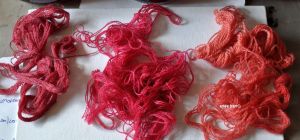
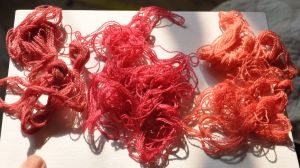 Same threads, different light, to show their beauty, all on wool or a silk/wool blend, different mordants and modifiers.
I have cotton threads as well now, dried after a long soak in the dye bath, and oh i am thrilled with the results!
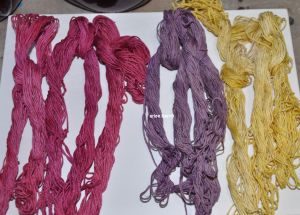
So, in the last two weeks, with experimenting and testing that i am doing things correctly, behold my new stash!!!!!!!!!
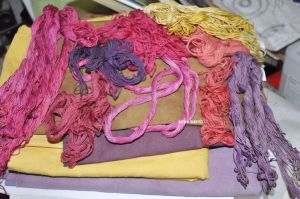
As soon as i can plan for being more productive, quantity wise, i really would like to be offering these in the shop. Stay tuned 🙂
One of THE easiest dyes to use! Yes, it’s expensive, but not with Cost of Wear, known in the dye biz as WOF, the measurement used to calculate how much dyestuff to fabric. Yes, it’s dead bugs, so if your sensitivities include no “animal” products, don’t use it. (And don’t lecture me either.)
Basically, the bugs are scraped off cacti, dried, sold whole, and ground down to a powder with a mortar and pestle for use, cooked, and decanted 3 or 4 times, and pre-mordanted fibres are thrown into the resulting dye bath. Mordants and modifiers can shift the colours from oranges, to fuschias and reds to deepest purples with every flame colour in between. Very versatile but because of these colour variations, in use after, Ph neutral care is important, though wash and lightfastness are excellent.
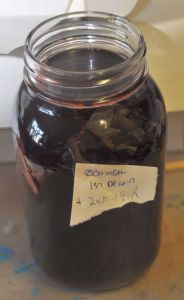
Tip o’ the Day: do not be making grape jelly at the same time: the colour is the same 🙂
Since my practice is to leave things in dyebaths at least overnight, you won’t see the results just yet 🙂 And BEST practice with all natural dyes, is to let the fibres dry, then let “em “cure” for at least a week before rinsing any excess out, so you’re still not going to see them until the 13th earliest. I’m gonna be biting my nails in anticipation.
I intend to do cloth as well as threads, testing all the colour permutations possible, with mordants and modifiers. And overdyes as well–indigo yields another purple over top, and osage would warm it beautifully also, i’m sure.
I threw some of the wool thread in the 2nd extraction logwood bath–yum.
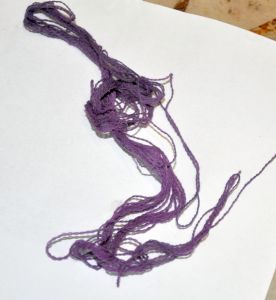
However, i know logwood is not as lightfast as other dyes, so this will be overdyed, or post-mordanted with some iron, which apparently will help with that factor.
OH DEAR GAWDZ. I swear no one in their right mind could possibly have gathered enough of this from the wild, to make any sort of dye pot. There is no way in hell there could conceivably be enough time, patience, gatherers, large areas with dense root that a. could be identified easily after the flowers have gone, because in my experience, the surrounding plants dwarf, hide and smother and b. that it could be dug up easily in the hard soil it usually grows in, or without breaking from the pressure and entwanglement of other plants roots, or c. that there was such a hard-on for red, that anyone, even in groups, would bother…………….Even if it were cultivated deliberately, it’d be a Ass Slapping Hair Pulling Bitch.
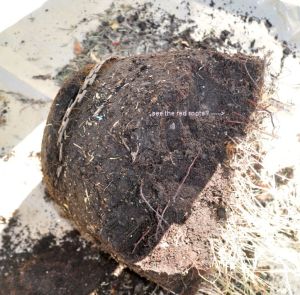
But i had to try it. I nurtured these plants for 3 years, keeping them in a separate pot with nothing else in it, (because i knew the roots would be impossible to detwangle from anything else) and decided today that (since the nurturing apparently ended mid July when i totally forgot about it, and haven’t watered it once after that…), that i might as well just dig up the darn things and separate out those roots.
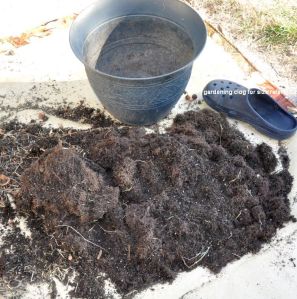
WHAT A JOKE. It took me an hour to pry (GENTLY) the few “large” roots out, as most of it is a mass of finer than spider silk networks. And i say “large” with a very large grain of very salty sarcasm salt, because none of them are any bigger than a skinny pencil lead, and no longer than a generous 3 inches…….ha.
I rinsed them off in a bucket of tepid water, and this munificence, this haul, these absolute treasures, this splendid pile, these riches is the result:
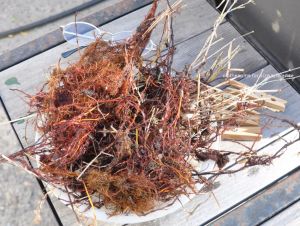
Yes, more very large grains of very salty sarcasm salt here…………i can’t even get all the soil out, so these are gonna be either strange marks, or just plain dirty.
*&^% and *&(^%$# )(#$ ^%#*.
I didn’t plan on using it as a dye however (small mercies in planning *that* ahead), but as an ecoprint material. I’ve seen some stunning examples of madder root used, and one sample with these roots, and thought loftily, why not. Well, that was the plan, and as They say “The best laid plans of dyers and artists often go awry.” Loosely paraphrased, of course.
So…………..these are currently bundled in silk, awaiting a hot bath in the pot, and we will see what we will see. No doubt there will be absolutely stunningly FABulous results.
Very large grains, etc………….
I’ll still plant again next year though, because i do love their pretty little flowers.
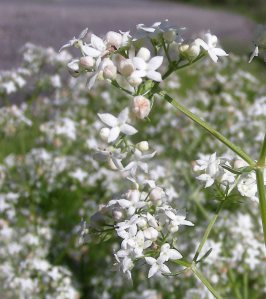 &*^% the roots, i say, *&#@ ’em.
(Galium verum sp)
EDIT MAY 3/18 started the dyepot! —>here
Following a second extraction of dye liquid from the logwood pretty much solidifies my thought that soy mordanting does not work with some dyes. I’m not going to waste perfectly good dye baths! They will be used now with only the tried and trues, the soy cloth will be reserved for the indigo vats–or maybe i’ll just wash the shit out out of them, and be done with it, re-mordanting with something else!
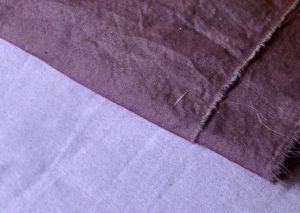 Top is the first extraction, bottom is the second extraction as a new dyebath. Both were pre-mordanted with gallnut and alum, and there is definite colour uptake. Not like this crap from the first pot below!
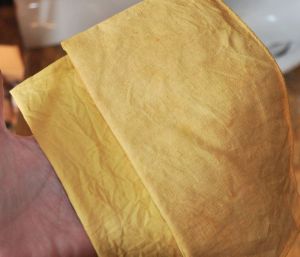
All the osage dyeing is predictable and lovely:
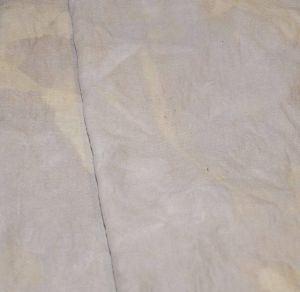
 After the logwood/soy debacle, that soy stuff ain’t going anywhere near my pots! Both above were again with gallnut and alum. See Maiwa’s instructions for mordanting cellulose fabrics(scroll down on the PDF), and also this clear Turkey Red article as well. I’m not going to waste time, effort, money or materials ever again, by not doing it right from the start!
And why am i finally going the proper mordant route? Because these below, done in 2010 with hollyhock and NO mordanting, are now greige and beige…..i was a hurrying novice, excited about the “potions”, and that stash paid for it 🙂
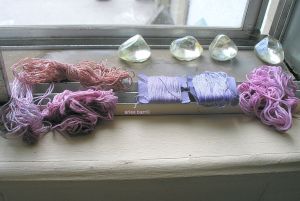
And now it’s time to fire up the cochineal pot, and try some combinations of dye colour as well.
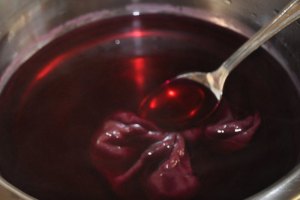
What kind of frosts my cookies though is that when i worked in plant stores many years ago, i remember scraping the damn bug things off cacti–and eeeeuuwing about the gory red gunk i ended up with on fingers and tools–if i had only known!!!!!!!!!!!!!!!!!!!
There’s honestly not much stitch going on right now–i’m busy winding skeins, mordanting fabrics and building a stash for winter work. Lots of ideas going into the sketchbooks though, and maybe i’ll share some of that.
If you are interested in process, rather than project, the journal that accompanies “Tabula Memoria” is available through Blurb now. This was as much a labour of love as the actual work was, and i’m quite proud of it. The print quality is fantastic, and i am liking the response from the few who have seen it “in the flesh”. It’s a bit chatty, but that was part of the point as well!
The actual link is here, because clicking on the photo below takes you to only the preview, with a bit of a counter-intuitive search for the information!
I have yet to figure out the PDF conversion so at the moment, it’s only available as an actual Real Book. I also have not jacked the price very much above the base price, as i’d rather more be able to add it to their libraries! (And remember, the price is in CANADIAN DOLLARS.)
With the timeframe i’d had left to get work done for the end of residency show, i decided instead that since the owner of this work isn’t picking it up until near the end of September, that i could show this instead. Created with fabrics during my 2016 residency, and worked on during the 2017 residency, it suits perfectly in that respect as work done DURING res (because i have seen work in those shows that had nothing to do with res…which kind of defeats the purpose of the exhibition IMHO), and also, as celebrating 10 years of Contextural, it was a perfect opportunity for me to see and show how *i* have evolved in 10 years. (Though i have been a member for only 8!)
To show the scale, i gritted my teeth and had my photo taken with it, hanging at the 371 Gallery at the Alberta College of Art and Design (ACAD). I really don’t like getting my picture taken anymore, because it reminds me i am no longer a sweet young thing (yes, i was, a long time ago, and sometimes still, inside 🙂 ), but it *is* important that people see the Actual Real Artist on occasion!
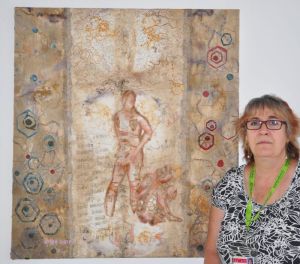
If you are in or near Calgary, Alberta, or are visiting, the exhibition is up, ready for you view it. The Closing Reception is Thursday, September 14th but you can come into ACAD’s public areas and take it in anytime daily until then between 8am – 8pm, weekends too. Remember to check the two areas – the Main Mall and Room 371. I don’t know at this point if i will be at the closing reception, but who knows?
Oh, deer….this morning’s usual let the DogFaced Girl out was interrupted. At 545, in the dark, in my nightgown and bare feet, i am sliding through mushy downed apples and cold wet grass, as i try desperately but calmly to herd two baby deer towards the gate. Momma Deer is on the other side of the fence, glaring at me, the babies are panicking because they’re too little to jump the fence, and now i’m panicking they are going to hurt themselves. Finally, i get them to a point where they can SEE the open gate they came in, and they bolt. *Now* Nessie can go out, and i’ll assess the hoofies everywhere destruction in the garden later. Wouldn’t give up these wildlife experiences for anything though! Oh and wash the applesauce from between my toes!
Sigh, part of loving animals is saying goodbye too…Last week it was our old baby boy, Mo, (right) and today, it’s his brother Cosmo (left). The family plot is sadly filling…………..
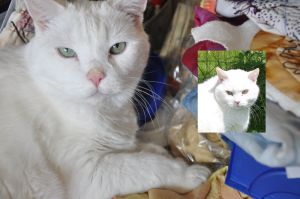
Truly the end of an “era”. I don’t know about other people, but Greyman and i mark this especially, since when we met, we immediately had a “blended family” of 5 cats… now ALL of those babies are gone.
First we lost Slowroll:

Then Doogie:
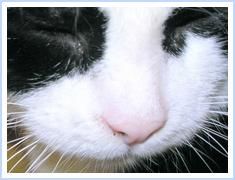
Then, their Momma, Selena:
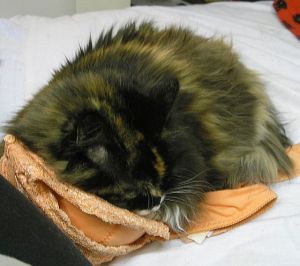
Then, Miss Piggy:

Then Mo:
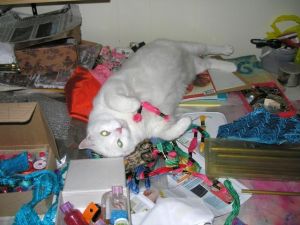
Now, Cosmo:
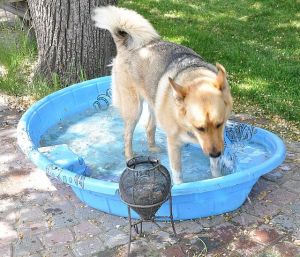
Still loving Nessie, the DogFaced Girl, and Slapshot, the Spastic Elastic:
Well, how about that. Acidity, alkalinity, science, weird science, real science. It was mentioned to me that perhaps the soy pre-mordant was too acid? On the advice of a friend, i hucked in some soda ash, to “blue” it up a bit–after all, nothing to lose at this point! Edit: it did change the colour to a more blue-purple, but the bath had already exhausted, so i got minimal colour— so weak that the poor babies shouldn’t have been taken away from their mommies! (Is logwood supposed to exhaust that fast????)
So, the next pot will be using the reverse osmosis filtered water, and NO soy pre-mordanted fabrics (i’ll save them for the indigo).
I want to use these colours together, in some new work, logwood top, bottom 2 potassium permanganates:
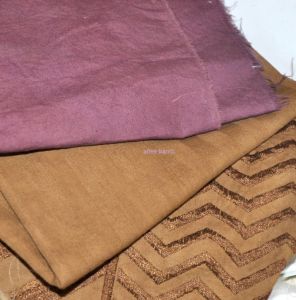 The logwood in proper light is definitely a red-violet, not a blued shade, but i’m starting to like all the variations. I may not get the results that everyone else gets, but that’s kind of the point for my purposes. I want to follow the tried and true METHODS, but i’m happy to get different colours, as long as they are not weak and namby-pamby!
The Osage dyepot was predictable (WHEW), with no surprises there 🙂 Warm yellows with a hint of orange, like a summer sunrise. I might throw some narrow slices of that too in the mix of fabrics in the above photo.
I’ve been collecting the blooms from my “black” Chater’s Double hollyhock all summer, and with only a few more blooms left on the plant, this is the sum total:
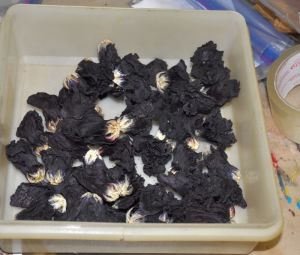
Left below, the Chater’s and right, my single deep red and burgundy–they don’t look that different dried, except for their size, but i’m still hoping the colour will be richer and deeper.
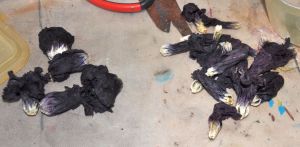
Of course, there’s only enough to do a couple of skeins of thread, but that’s part of the game as well 🙂

 albedo too
You must be logged in to post a comment.