Posted in "OPINIONATION", journal: lessons to learn

coming to terms with the artisan self

I’ve come to the logical conclusion this past week, that i am an artisan type artist now. I say “now” because it’s taken me this long to recognize that all the damn drama i put in and the fighting i’ve done with myself on so many occasions, has been a millstone around my neck. I’m not about to give up the “serious” work, but i know now i will never be considered on a larger scale as “a prophet in my own land”, or anywhere else for that matter. “My land” is still within the scope of textiles, but i won’t ever be a Judy Martin, Penny Berens, or any of a multitude of other Canadian artists who get the gallery shows, the invitations, the international acclaim. I had my spate of “popularity”, exposure, recognition a few years back, in international magazines and on several well-respected online sites, but the days are done.

Please know this is NOT sour grapes.I don’t envy, am not jealous of these artists: i respect and admire them. They have integrity, skill, talent, vision, fortitude and knowledge. In fact, i am in awe of them, love them.

I enjoyed/enjoy (even with the usual accompanying angst that each piece extracts from me 🙂 ), the making of the more reflective pieces, am very proud of them, stand 100% behind them, but in the long run, these do not support me, do not go anywhere, with a very few exceptions, but a wall in my own home. I’ll still create them (Samara, i hear you calling again), but truthfully, it’s the more “crafted” pieces that are going out to the world.

That actually makes me happier. Yes, there’s coin, and who doesn’t like that aspect, but knowing that someone appreciates enough what i have made, to put up their own hard-earned cash, to enjoy the package they open, to take pride of ownership in the purchase, is, THAT is the true validation of what i’m doing. Paying entry fees, shipping costs, filling out paperwork, and rarely if ever being able to attend a show that accepted the work, not so much! Only one of these shows have ever put money in my pocket (and i thank that organizer/buyer/artist from the bottom of my wizened little heart, you know who you are, Darlin’). We all know that “exposure” thing really doesn’t mean much for too many artists…..

Artists can die of exposure……………………

I don’t suffer when i am making the smaller pieces, the stuff that goes in the shop. I don’t have to, shouldn’t have to act like the proverbial starving artist living in a garret. I won’t be shamed or ashamed for not making big political/subversive/feminist trope/anything trope/mindful/revolutionary/label label label Art anymore. I LIKE WHAT I’M DOING NOW. It gets me out of bed in the morning, it helps me sleep at night, it keeps the Black Dog from howling (though he may still growl in unguarded moments). I won’t be an apologist anymore for my Self. BUT, the next person whether in cybrespace or in real who gets all dismissive and condescending to me, gets a mighty slap on the self righteous ass. Make your own damn sandwich then 🙂

So. To that end, i have new plans, though i am smart enough to know that not all always goes according to plan. I need to actually go to the local galleries, participate in the local shows (yeah, still gotta do some, whether artisan market or solo), talk myself up locally. Online has been a great experience, and i will continue there, but i need a more reachable plateau. After all, this is real life.

My tasks this week then are to find those galleries, put some “propaganda” together, figure out tags, prices, presentation and then apply, submit, show.

Oh yeah, and do the artisan thing and make!


Posted in a collusion of ideas, Deliberation--do something you don't do--or haven't in awhile, journal: lessons to learn

tears and tears, accepting the imperfect

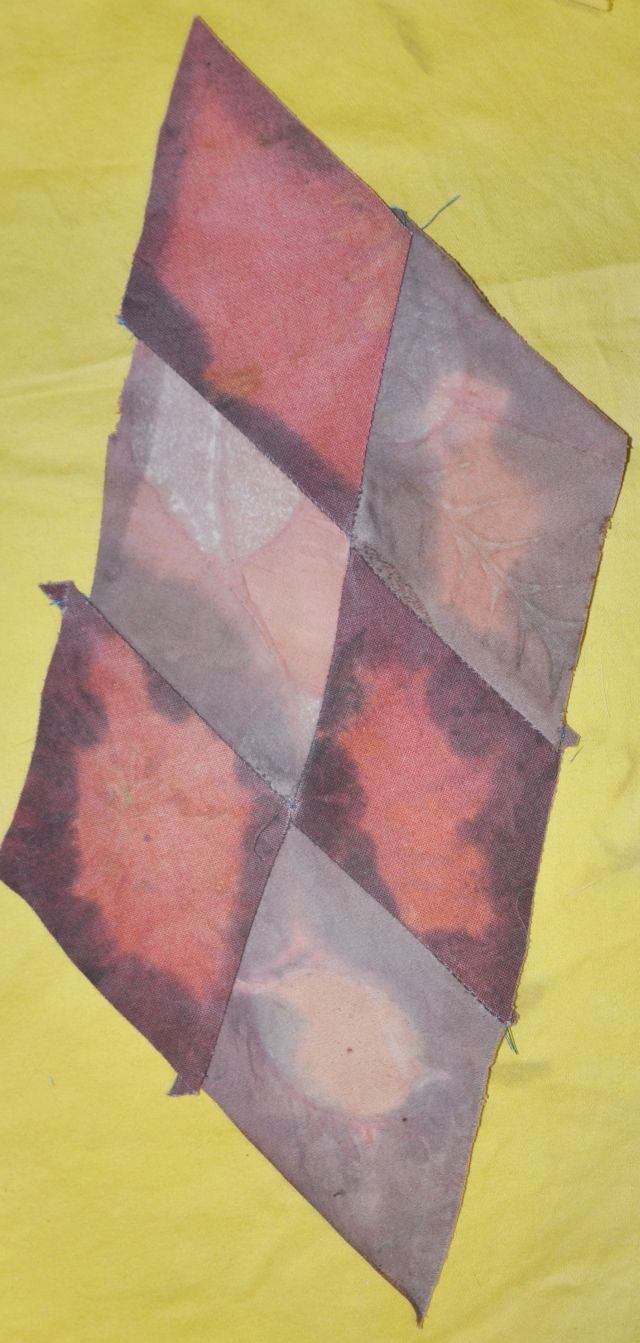
Well, i admit i have never been able to sew or draw a perfectly straight line, but HOW THE HECK DO PEOPLE DO THIS ALL THE TIME????????

I will NEVER be a “Modern Quilter”.

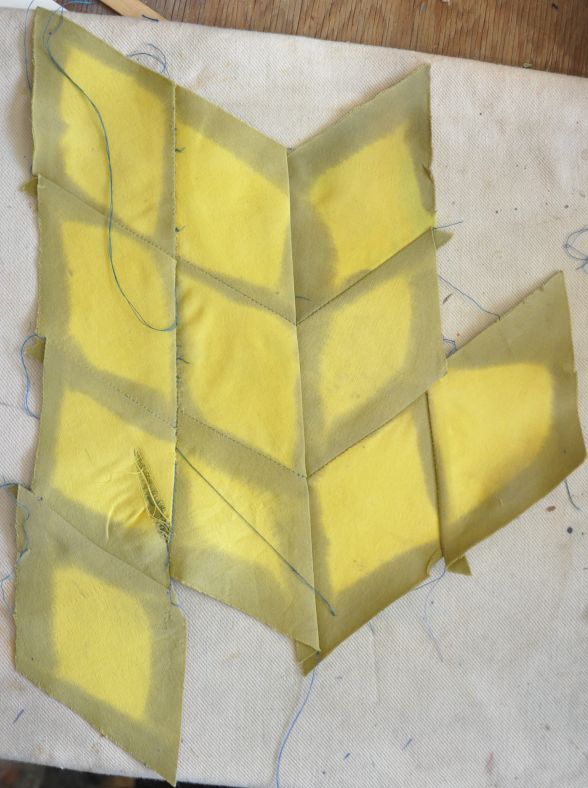
This one sort of worked, except i didn’t cut enough pieces:

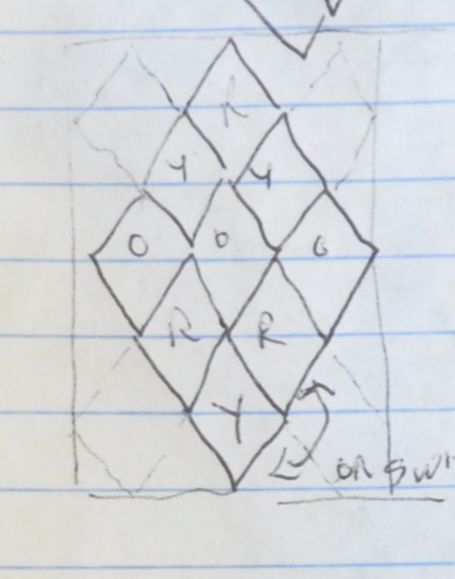
This was the plan:

(Never mind the lettering: i forgot the yellow on the first attempt, and then forgot the red on the second……..) Looks easy. Except when you are seaming. I kept flipping edges to see what it would look like. HA. i didn’t flip correctly on some. Then i just hit a point where i started stitching edges together.

There were angry tears. There were tears (rips 🙂 ) when i pulled on seams to undo. I re-sewed three times. I ended up with an obvious rip, crooked lines, imperfect point matching and the pieces going the wrong way. I cut either too many pieces, or not enough. I blame the template i used 🙂 I swear the marks for the cutting line were off *just* enough on two edges to **** up cutting and seaming. Maybe my blood sugar was low. Maybe i needed another coffee. Perhaps i have too much on my mind. And yes, i used a god-damn blue thread to stitch with because i don’t give a rat’s ass about matching.

Does this even REMOTELY look like the plan??????

Go ahead. Laugh. I can hear you from here.

**** it. I’m not taking it apart again to re-seam it. In fact, i just sewed the *almost” perfect red sample to the left edge of the above.

To hell with the pursuit of perfection. Let’s embrace the organic, the mistakes, the imperfect, the woogles and borgles and blips. Considering i’ve taken mistakes before and made something i’m proud of, i’m just going to let it be what it wants to be. Just wait and see: it WILL be if not “beautiful” when done, it will be defiantly/definitely my work.

Please also refrain from telling me how to do it correctly 🙂

PING!


Posted in journal: lessons to learn

on the other side now

Feels the same, looks the same. (Except for the GI infection i had on New Year’s day and yesterday, mild fortunately!)

It’s also the time of year when i get Butterfly Brain, that state when every idea is good, gets sampled, but doesn’t always go anywhere! You know: “Really have to use more of the beads, wait there’s a lace piece i thought i los– what issue/book was thattechnique inbut look at this velv==, i found a great old sample of manipula—, there’s cotton in here, i know i had some gnatshairsilk why did i buy this where’s the”…………………………………….

Settle down. Add some Method to the Madness.

1. I remembered i have a backlog of Threads issues to dig through. I haven’t bought the magazine in years as it switched to mostly “how to knock off/create couture wear”, but when it was first around, i bought every issue, and was quite bereft when i couldn’t find it: it had a lot of great articles on manipulation, hand techniques, zero waste fashion, historical use and contemporary adaptations, and cutting edge things we now take for granted! I have a backpack i made from one of their pages, that has served well for 24 years (and is still in use!), i learned about “compost dyeing” in 1995, i used a ton of their tips when i had my wearable art business (shoulder pads anyone, hand inserted zippers, princess seams?). And i still have all the index pages for issues 39-104 issues so i can find things 🙂 I did however have to dig up everything near the bookcase, so i could get TO the magazines……. I’ll be doing a couple of posts about the gleaning of these, as i go through them. (You can access their archives of this magazine, to date 188 issues, but it costs 80bucks for the first year.) Then i’ll be donating all of the issues i have to some worthy “cause”.

2. What happened to the Summer of Madder Study? It was very productive, but in November i thought about the end “goal”, the creation of a garment made entirely of hand stitched and embroidered, naturally dyed cloth (predominantly madder, obviously)–which i would not wear, due to my “lifestyle”. Some of those pieces ended up as moons, others will be incorporated into other work, and i have a lovely stash of madder cloth to work with, so it was a good summer in that respect!

3. I MUST get back to Samara. I know i’m headed in the right direction with her, though at this point she has been hanging around the studio, yelling at me.

4. My studio is in a constant state of disruption and chaos. I don’t foresee or want a picture perfect workspace (those books/magazines where obviously more time is spent prettifying the space than working in it…), but i do want territory where i can find things, store things, put things away easily and neatly, and MAKE “things”. It might be a time for a major overhaul/reno. Not the kind that costs money or prettifyin’ time, but honest appraisal of what i do and don’t need/use/want/make.

5. None of these are Resolutions. I do spend that week of limbo, the time from Dec 26 to January 1st, thinking about what i have done, or not done, usually because all of the important projects have ended by the 25th, but i know none of these are silver bullets, cure-alls, or Magickal Thinking that because it’s a new year, all will be well. I expect the constant struggle i am, regardless of the exterior appearance.  🙂

6. Que sera, sera.


Posted in embrilting, journal: lessons to learn, Moons, Natural Dyes

a year of dyeing moons

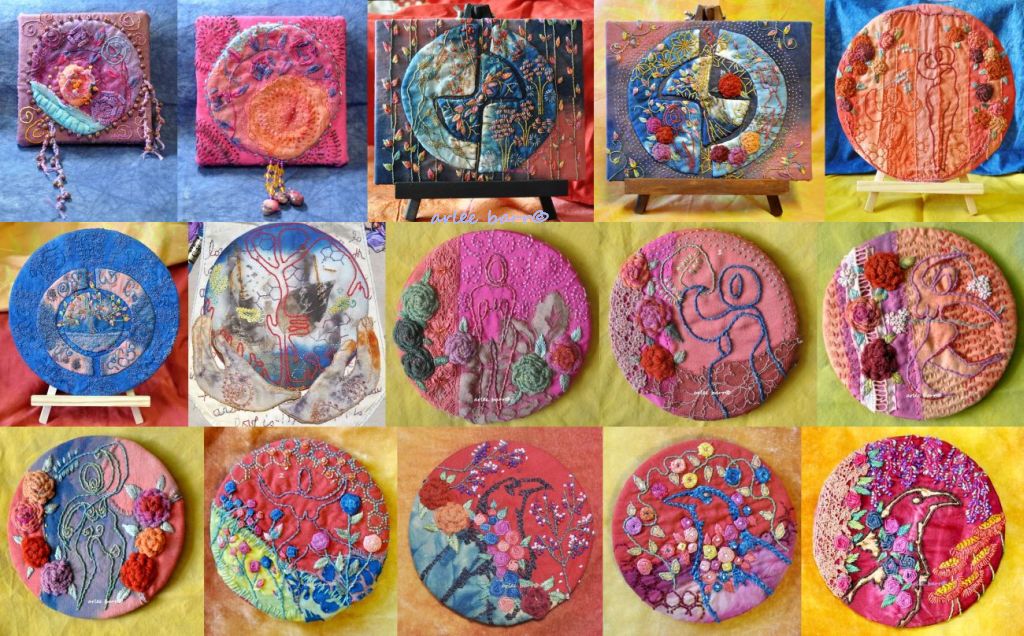
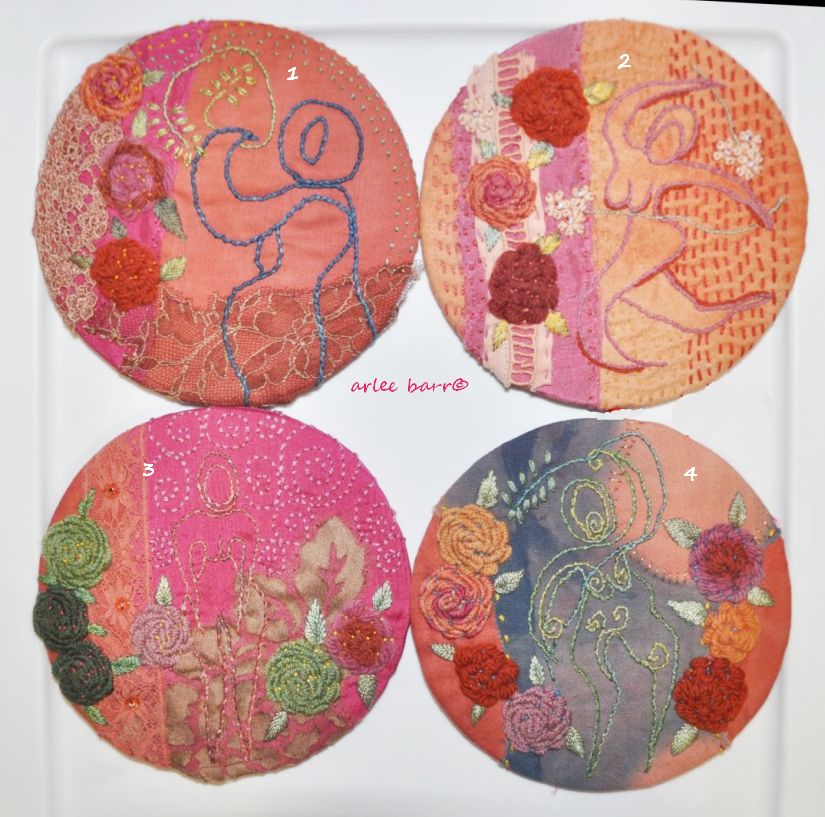
embroidered moons, natural dye, arlee barr, hand embroideryAll natural dyes, cloth and threads 🙂 (Exception, first two moons top left.)

I think it was 2015 when i bemoaned that i would never have a good assortment of naturally dyed deep rich colours in my threads. HA. Though i had been using natural dyes for a while, something wasn’t working. I kept trying though, sometimes having success, sometimes horrendous fails. What was wrong? So, i diligently re-read the books, taking notes in minutiae, going through each step consciously, and WOWZERS, suddenly things worked. When in doubt, “read the instruction manual”! BUT, read the whole thing, read it in order, don’t just jump to the recipes. I highly recommend any of Jenny Dean’s books, Maiwa’s instructions, J. Liles, Domonique Cardon and the like.

I learned about scouring: just because something is white/new doesn’t mean it’s clean. Most fibres have dirt, dust, wax, pectin, chemicals, oils and who knows what from the initial gathering and processing, the manufacturing whether cloth or thread, the handling, transportation, storage and packaging. (Even PFD fabrics can be suspect.) I was shocked to see the colour of the water from the freshly bought, new, tightly packaged white thread, and how much particulate was in it after a good thrashing with soda ash and soap in boiling (or almost boiling, depending on the fibre type) water! Brown! Yellow!! Pink!!?????

I learned about mordanting, proper mordanting. According to fibre type, according to what was actually a mordant (NO vinegar, salt, soy products), according to correct WOF use, according to historical use and extant samples. (I chortle now when i see the so-called “vivid” colours on soy mordanted fabrics…………the uptake is uneven on most fibres, gives predominantly pale to medium shades and i wonder about the lightfastnessness, especially since no one seems to show actual tests!)

I learned about WOF, the correct amount of dye in ratio to the weight of the fibre being dyed. Dumping a tablespoon of dye and seeing a dark colour in the pot doesn’t mean that’s what you’re going to get on the fibre. And there was clear information being offered about the correct WOF for each type of dye, as they are not all the same.

I learned what an actual natural dye is. The hollyhock blooms, the hibiscus all went into the compost heap, the avocados kept as a tannin only. Lovely colours, but fugitive, no matter how mordanted. Not wasting my efforts, resources, time. (Yes, there are still natural dyes that aren’t as light or wash fast, but most can be coaxed with proper mordanting and/or post modifying.)

I learned about the effects of different mordants and pre or post modifying, about combining dyes and/or overdyeing, giving me an even more extensive array of colours and shades.

I learned about light and wash fastness. Oh boy, did i learn. The compost bin has thanked me on a few occasions.

The biggest thing i realized was TIME. With the exception of indigo, nothing comes out of my pots until it’s been in at least 8 hours, and often a day or two. It’s not instant gratification, nor a case of sitting and watching the pot boil, bemoaning “wasted” hours 🙂 Like making homemade bread, most of the work is already done, and “waiting” can be either relaxing or productively spent elsewhere!

All of this has taught me patience this year, and while it’s still not a Perfect State for me, i’m getting there. I can turn away from the aggravating, the frustrating, those who “persist in their own stupidity” (as my Dear Mother says), and the willfully ignorant.


Mostly. I’m only human after all. Just trying to get better at it.


Posted in embrilting, journal: lessons to learn, Moons, Natural Dyes

using again

Stash, i’m using stash! Whadja think i meant? 🙂

On Sunday when i was (re)organizing the work space, i had a brilliant thought. Why not USE some of the natural dyes? Seriously, wth am i making them for otherwise? Pretty piles are one thing, unused pretty piles are another 🙂

I am stressed right now though, overly stressed actually, for reasons i won’t go into publicly, but keeping my hands and mind busy are a good antidote. That and long long wintry walks with the DogFaced Girl (Brown Dog), trying to gather my thoughts, and lock the doors against the Black Dog…………..

So. Small projects. Things i can finish if not in a day, maybe two or three. I have a resentment about making “things” that won’t see the light of day, are unappreciated, or that serve no purpose (gone are my days of filling the studio with tchotchkes based on magazine articles…), but these, these i like. Gifts, a thoughtful concentrated mark of time, hopeful colourful little bits that might mean something to someone.

When the light is better later today, i’ll rephotograph these, and list them in the shop (with an addended photo here too, so you can see them as they really are.). Through December, they’ll be on sale. Maybe they will cheer you, or a friend.


Posted in Natural Dyes, Probably talking to just myself, quebracho rojo

the dye that keeps on giving, Quebracho Rojo

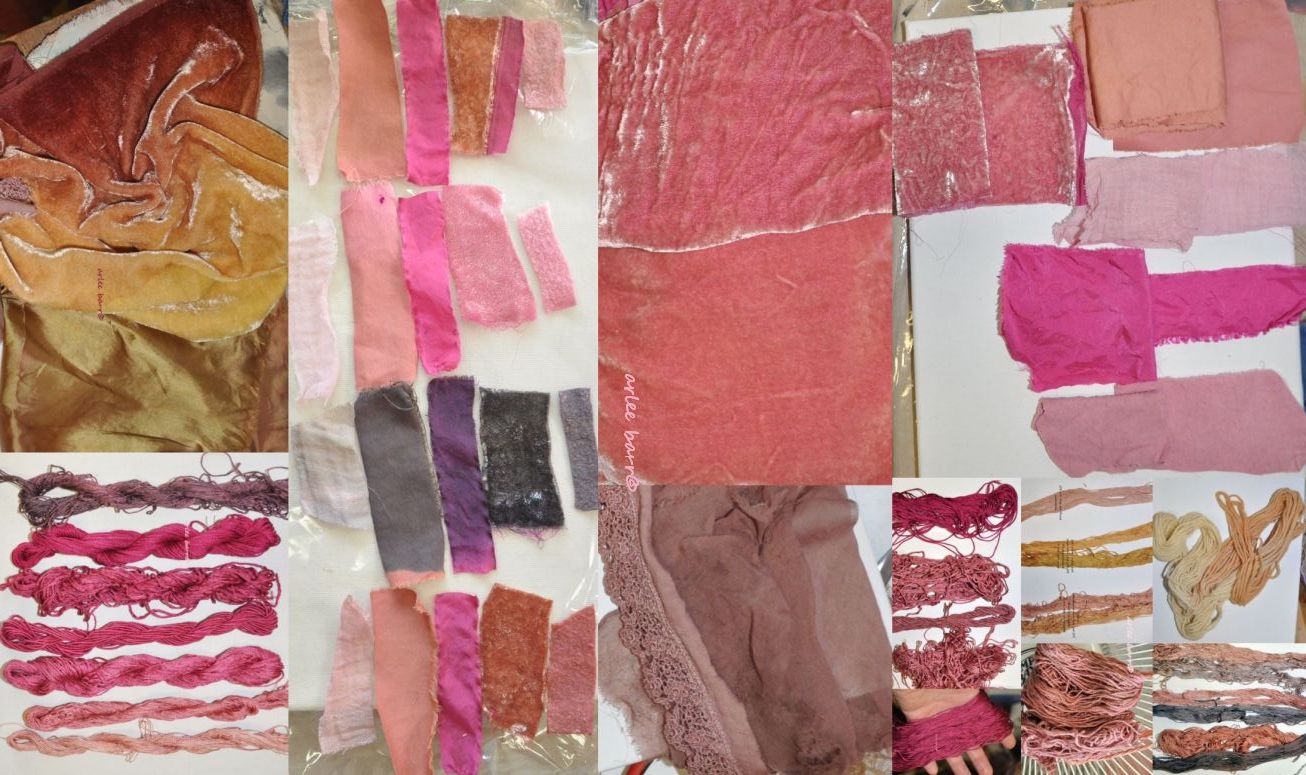
My previous results with a fresh pot were in the pink and purple range.

This dye/tannin was definitely worth the expense. I’ve had a pot sitting for two weeks in the back room, where it’s quite cold in the winter. No mold grew, no funny smells, no questionable sludge, so i decided to throw a few odd bits in to see what colours i’d end up with. (I know there’s still a lot of colour in the pot, as an experienced eye can tell when a pot is exhausted and when there’s still dye stuff left.)

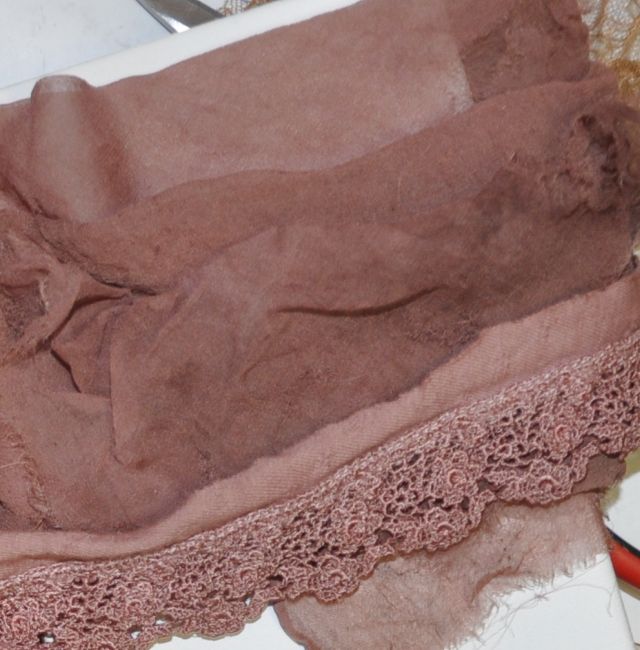
A few scrappy bits of sheer silk chiffon from 8 years ago (the original hollyhock had completely faded: no mordant!), i love the purple/pink cast to this brown. The cotton lace was a surprise as well. (Note none of these were premordanted, in this case because QR is also a tannin, which can be a mordant. Normally i would have premordanted, even old scraps.)

Since most of the cottons i had done before were not terribly exciting with the QR, this bodes well.


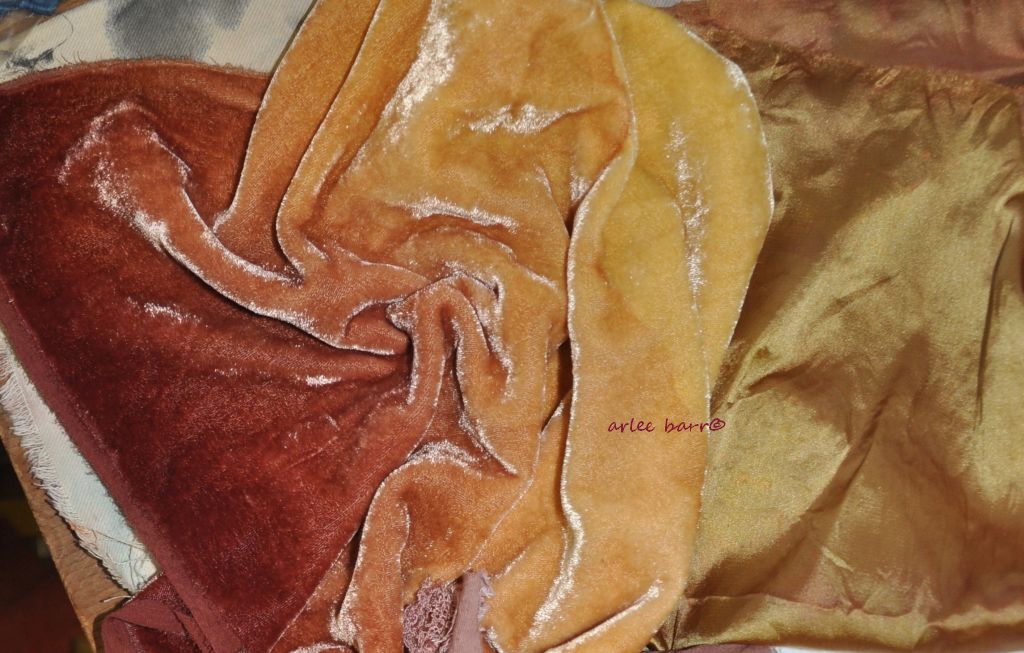
The gold in the photo below, to the right, was an errant piece of previously ecoprinted POLYESTER, that had snuck into the pot long ago. GOLD? All right!

But that deep reddish brown on the osage (yellow) silk velvet–OOOOOOOOOOOOO!

So, the Quebracho Rojo has gone from giving striking pinks and purples to rich warm browns., money well spent.

Posted in mordants and modifiers, natural dye research, Natural Dyes, Naturally dyed threads, Probably talking to just myself, quebracho rojo

feeling in the pink….and purple

Now that i have a good stock of green threads from the osage and indigo work, it’s time to add some pinks and purples! Not talking about wishy washy, not talking about raspberries, beets, beans or any other silliness i see on too many blogs who haven’t the sense of a sack of potatoes 🙂

I did get a wonderful hot pink from madder by accidentally boiling over a pot of madder (considered a VERY VERY BAD BAD as madder shouldn’t go above a certain temp or you just get browns), some useful colour variations from cochineal in the pink to purple range, and a very deep purple with logwood. Cochineal however kind of puts me off now because i worry about Ph shifts–and some Ph shifts WASH OUT with an ordinary tap water rinse!!!!!!!!!!!– and i fret too about the lightfastness of logwood, because unless it’s got a lot of iron in the mix (which can damage fibres…), i’ve seen a noticeable change in the depth of colour within months of dyeing. (I do wonder too about the current craze for it in ecoprinting: are these people going to have a shock somewhere in the next few months/year with dramatic colour shifting or fade??) So………………. my next experiments/tests/results are from a type of tannin in the “catechic” range, more red-browns that the clear “gallic” or yellow “elegic” types. Tannins are an important part of premordanting fibres, especially cellulose which doesn’t work well with just alum, but very well with a tannin first, then the alum. Some tannins are also used as dyes by themselves, notably in the elegic and catechic types.

This tannin/dye IS more expensive, but i now am comfortable spending the money to get the best results. There’s no point in cheaping out with some things: it’s a waste of time, effort and resources, from water to electricity to containers and materials used, something i am very conscious off, having been raised quite frugally and with much common sense 🙂

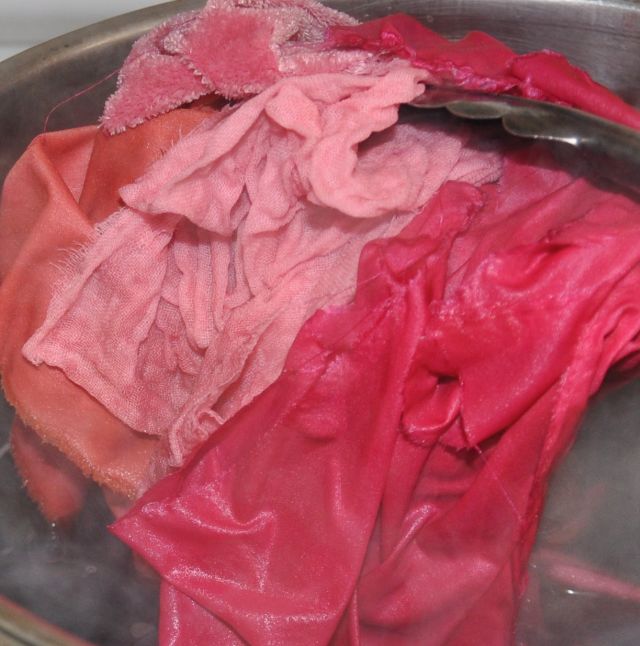
When i threw the Quebracho Rojo in the pot, i first screamed (silently, as Greyman was napping). The colour was PHENOMENAL. However, that silent scream was from my excitable take it at face value 9 year old child self: my rational XX+ self reminded me that what you see in a dye pot is NOT necessarily what you get from a dye pot, as  i swear they deliberately skull xxxk with you. Ahem.

Looks fab, ay?

Wet, ooo ooo oooo:

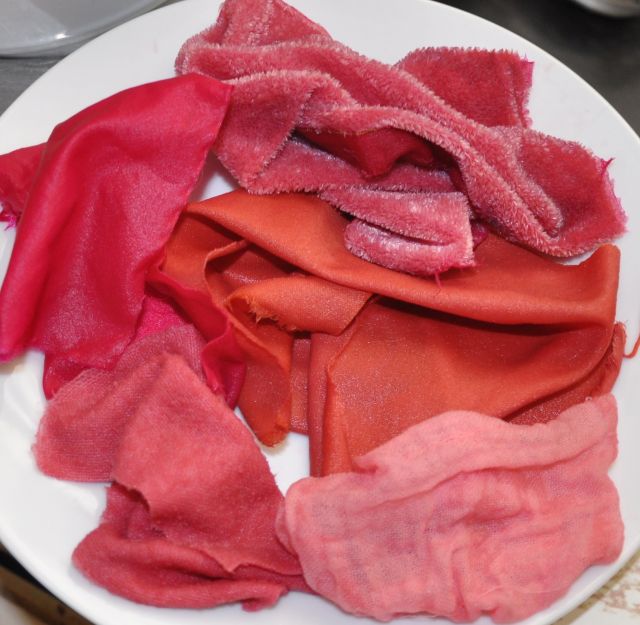
Above, rinsed, barely any wash out!

Dry, bearing in mind that colours can dry 20-70% lighter with ANY colourant, natural OR synthetic:

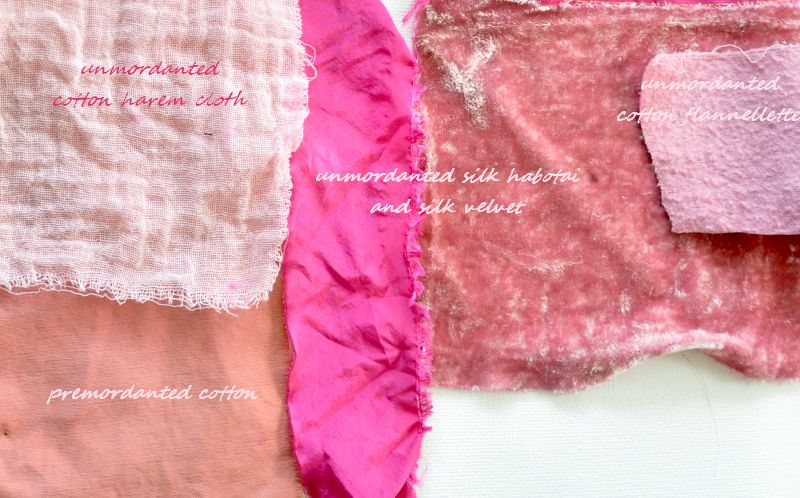
See what i mean by dye pot deception? Respectable colour, but not terribly excitingly scream worthy. Now mind you, the cottons that are paler pink were unmordanted, the darker cotton premordanted with tannin and alum. The silk habotai and silk velvet were also unmordanted, but because QR is a tannin as i mentioned, i figured “let’s try it as a tannin first”. Interesting too that most sources says it’s best on cellulose, “but performs well on silk and wool”, since obviously both silks did better……………………

The next phase of natural dye colour work is post mordant/post modify (though you can do these first, i don’t because i don’t want that active stew in the mix all in one pot.) Now this a is a nice range of colours!!!

Guess what though? I forgot to put any threads in, so now i have to go wind some skeins, scour ’em, then premordant some…………..

Olé!

PS you can still click on the photos for enlargement, but you can no longer comment on them–i had to shut that off due to the number of STOOPID ASSHAT SPAMMERS.

Posted in Natural Dyes, Naturally dyed threads, Probably talking to just myself

“each stitch an entrance”

Not all threads are created equally, especially when it comes to dyeing them with natural colourants!

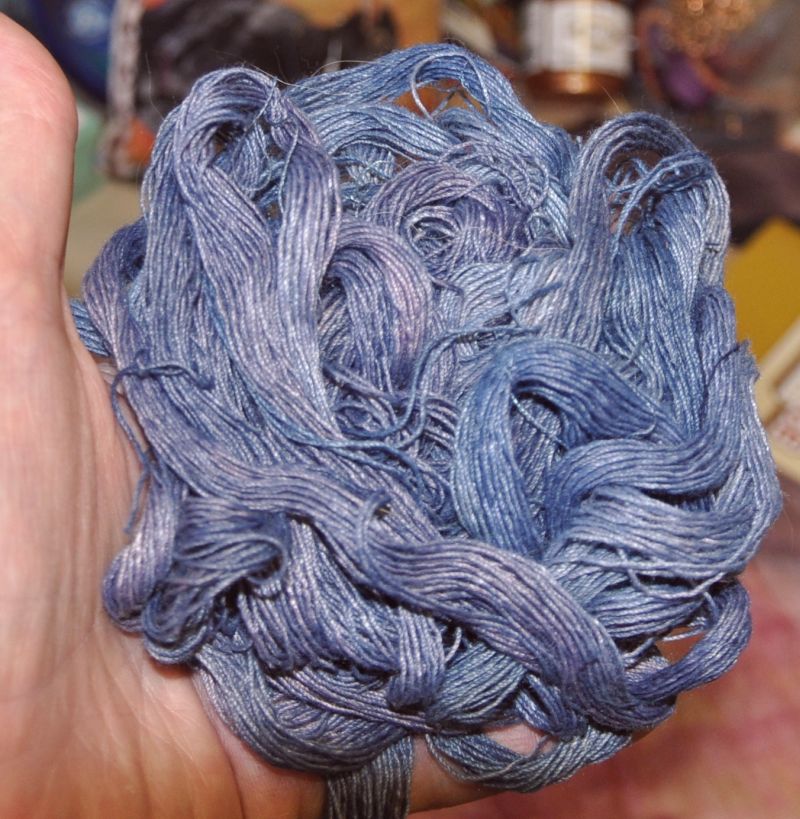
I’ve had a few flubs along the way, as i build my stash for stitching with, but in the end, each has it’s own qualities that are useful. The major fail i had was a thread i thought was 100% cotton, but since the label had been long lost, and i generally haven’t collected any synthetics for a few years now, i threw it in a madder pot and expected good results automatically. HA! There must have been some acrylic in this one, as it barely took any colour:

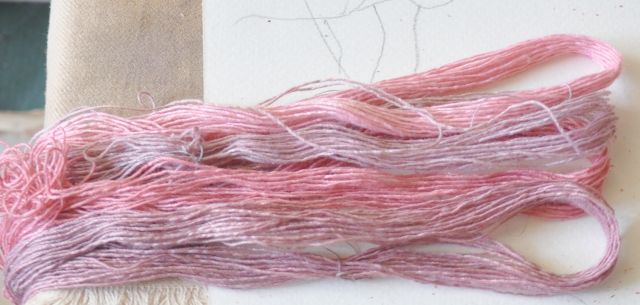
Pink from madder, pale lilac from madder with post mod iron dip, but this thread was just too soft and lovely on its own to throw out, so i then dipped them in indigo, because indigo dyes *everything*, it being SO substantive!

And there’s still some lilac-y hints! These give a lovely soft ethereal appearance when used, subtle gradations and shadings quite effective depending on the stitch used.


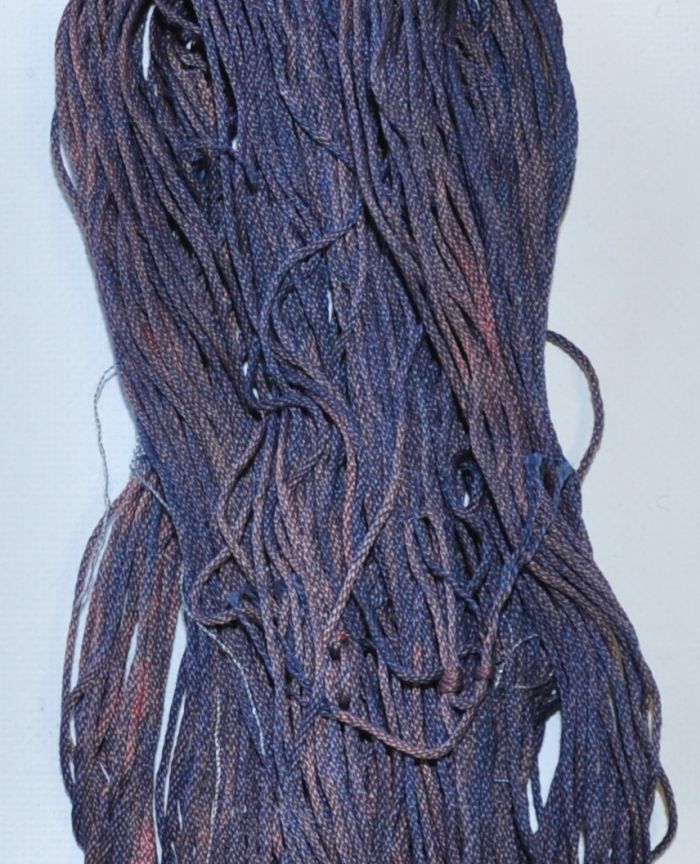
This one REALLY bothered me at first, a heavily twisted 4 strand embroidery thread, it just wouldn’t dye evenly due to the tightness of the wind, no matter how long i let it sit in the madder! Popped it in the indigo again and whoa! Look at that tweedy heather effect!

I use this one separated into two strands and love the way the colour shifts along each length. Because of the stiffness of the thread too, it tends to stand more proud of the surface. The way the colour took, and the spin of the thread, give it the appearance of disappearance visually when used on darker backgrounds! Fantastic for texture!

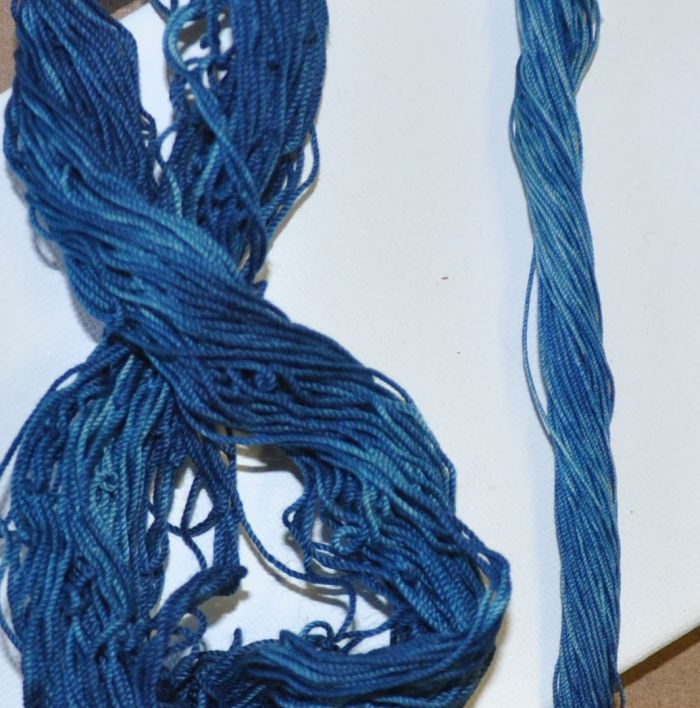
And these were a lesson also in the “weight” of a thread, the left being a crochet cotton, the right a stray spool of fine upholstery thread:

Due to my inexperience at the time, the indigo didn’t grab every spot, because of the way the threads were wound, tied and handled. Both are heavier, thicker threads that really lie loudly on the surface, or build a heavy tactile line, again with different stitch types.

It may look as if i’m using indigo to “fix” problems in incorrect procedures, but it’s co-incidence i swear 🙂 I do pride myself on proper scouring, premordanting according to fibre type, and using dyes that are actually dyes, not stains or food waste nonsense. (Again, no beets, beans or berries here….) These “fails” were inexperience, haste, and not testing unlabeled fibres. Lessons learned!

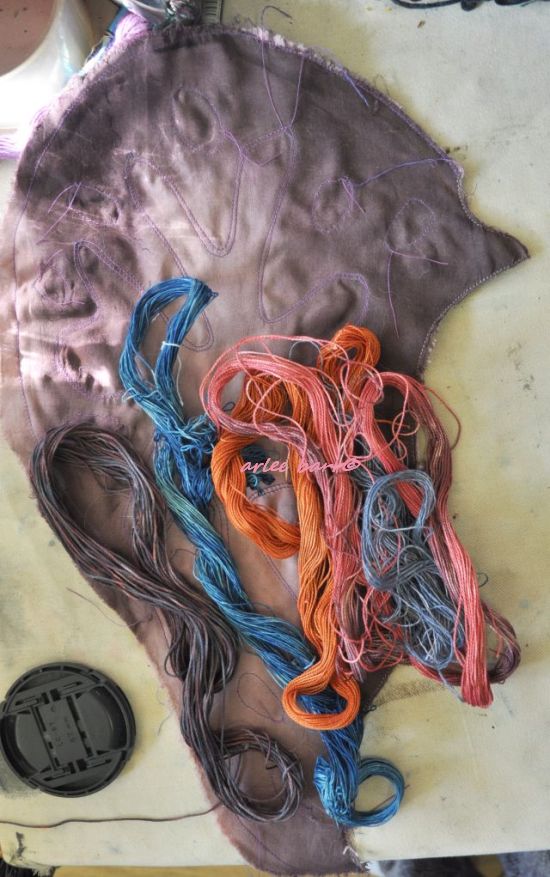
While every stitcher needs a substrate to stitch on, whether it’s conventional fabrics, plastic, metal, paper or toast, it’s the threads that get me excited. I’m continually building the inventory, and am thrilled to say that now i can depend on my own skills to add so much colour, without using commercially dyed threads, or having to worry about matching dyelots! There *can* be subtle differences in dye baths due to the inherent nature of these dyes, but at least the reds are still reds, the greens are greens, the blues are blues, etc etc etc, but never like this debacle with synthetic dye……..


And i wanted to share a very evocative piece of poetry that my friend Dana sent me.

The Many Ways the Light Gets In

​​​​​​​
It was easy to judge those Jane Austen ladies
languishing all afternoon over embroidery
pulling thread in and out of hooped linen
as the world spun round without them.

The bone stays in the starched bodice of their dresses
forced an upright position,
the way nuns in a cloister sit
all spine and neck erect
to better access the “no thought”
they need to taste
the honey of meditation

centering their minds
to a pinpoint
of light

I’ve envied the discipline of those mystics
tossing off thought like an extra blanket
but not so much the ladies
sealed in their parlors

then today
I found myself
deep in silence
pulling a rainbow of silken threads
through a hooped grid
the rhythmic in and out
of the steel needle flashing its tail of color
dissolving all thoughts in whorls of amber
sapphire, magenta—
falling upward
each stitch an entrance.

Marion Goldstein

Posted in Collision: the work begins, in progress, journal: lessons to learn, Natural Dyes, Samara

back in the Land of Myopia

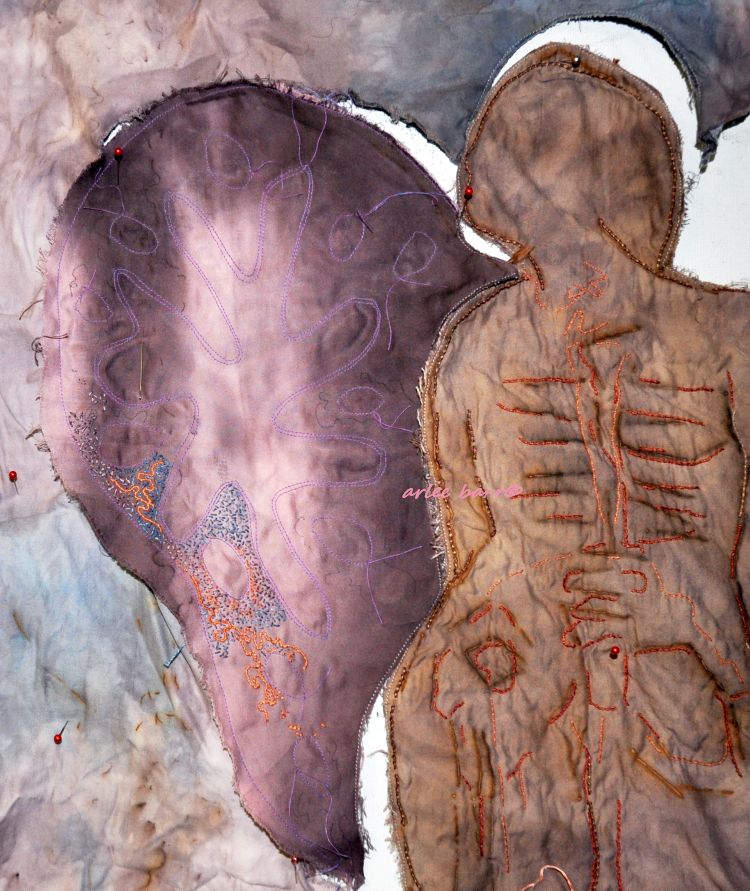
Had a bad moment last night when i suddenly thought the stitching on the wings was too tight, too controlled. Must remember to get out of the small work approach!

But it’s getting bigger, looser and is not too “precious” after all. The “myopia” that develops as i work small areas of a large piece means i have to literally step back to see the whole. And since i can see in my head what will be happening in the wings and in other areas, it will work.

One disappointing (in a sense) thing is that the result is not the same as the work done this way on “A Birth of Silence”. (See previous post.) The rust on that particular piece stiffened the fabric for more dimension, something that is not featured much on any of this piece. I may have to manipulate it more when the time comes to attach to the background, or maybe it will be fine. I think the backing fabric i used this time too is thinner or flatter than the one used in ABOS as well, but c’est la vie!

There’s nothing wrong with it, it’s just different.

Posted in a collusion of ideas, in progress, journal: lessons to learn, Madder, mordants and modifiers, Natural Dyes, osage, Rust, Samara, sandalwood

in a nutshell

So, what do you do with something you’ve stared at for 2+ years, and then cut up?

Throw it in a dyepot. Because if it’s no longer “precious”, you might as well go the full “wtf, why not?” route.

With natural dyes, it’s predictable that if there’s already iron present on the fabric, it’s going to darken and sadden colours. However, with the unmeasurable concentrations of iron used in rusting cloth, there’s no predictability about the shade or depth. Add to the stew, the fact that these pieces were already lined with cotton flannellette, my favourite stabilizer and crunchtexture “additive”, the dyes uptake was even more capricious. And note too: i did not premordant other than using the iron already on the cloth–if i had thought a bit longer, i could have might have done an alum acetate soak to see if the colours grabbed more, but it’s not a big whoopee bad because i didn’t.

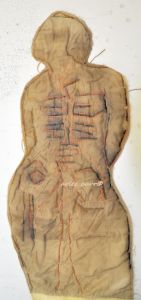
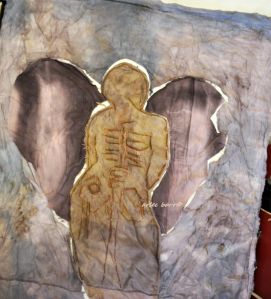
I had thrown the figure itself in an osage bath, and was not happy with the resultant boring tan she became. Admittedly, the osage bath was on its last legs, having been used multiple times, but wow, there was a lot more iron on her than i had suspected. After the fabric had been made during the residency, i immediately washed it in hot water and some synthrapol and baking soda, as i do all of my rusted fabrics, removing stray particles, but this really shows how much the rust/iron had penetrated. Invisible to the eye, but not to chemistry! There are many arguments about how to actually “neutralize” the rust, by many different camps of dyers, but this has been the one that works best for me. AND NO, SALT DOES NOT WORK: does your car STOP rusting in the winter when you get road salt on it????? I dunno where that logic came from….idjits.

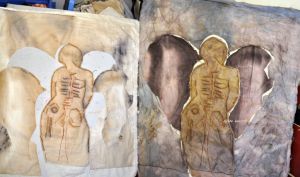
So i threw her in a pot of madder and sandalwood (using up two old dyebaths). I’ll have to work around the stocking appearance of her from the thigh down though! The other chunks were also cooked in the madder/sandalwood: the largest piece had been randomly and quickly dipped into indigo first, with the hope i’d get some purples. The wings apparently had the most iron on them, but i really like the effect it had on the madder, strong. NOW she’s singing!

Here’s the comparison, before and after:

Fortuitously, the indigo features centred and right above her head, a serendipitous effect.

While these are not the best examples of these dyes, and certainly not the best way to do things (no premordants other than the residual iron), i’m actually quite pleased with the results. She looks muddier, dirty, earthy, but given that Fall is all those things, and that her name is “Samara”, implying dried seeds, leaves changing and falling, the end of Summer and the return to the earth, that is more important, and actually there are some “pretty” areas.

Sometimes “wtf, why not?” is worth the effort.

When i see my thread choices (also naturally dyed) with her, i think the results will be perfect.

Now………..i have to figure out how to use those threads appropriately for this. As beautiful as the dimunitive leaves and flowers have been on the recent moons, those tiny motifs are not going to cut it for this. I need stronger, scaled up structures/objects/designs. Perhaps it’s time to resurrect the FrankenStitch approach.