Posted in a collusion of ideas, Deliberation--do something you don't do--or haven't in awhile, Madder, mordants and modifiers, The Summer of Madder (Study)

summer madder project Project

For a couple of years now, i’ve had an idea in my head for a special garment, after seeing something in a trendy boutique window that fired some desire for a similar “Objay Dart” (aka Objet d’art). It was in reds, all patchy and flowing, bohemian though unadorned with any embellishments, simply cut and extremely Spendy. I filed the idea away, as i haven’t made even a pair of pyjama pants in the last 7 years.

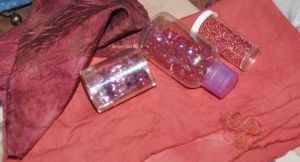
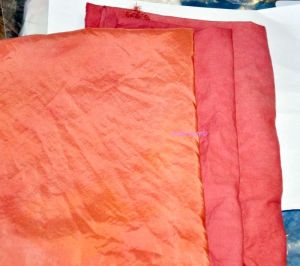
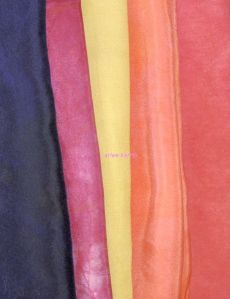
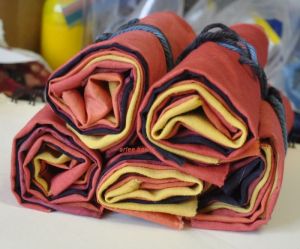
But what’s this? There seems to be a plethora of chunks of fabric, all dyed recently, in the madder summer experiment pot. And threads in various shades as well. EUREKA.
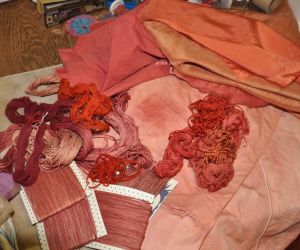
I do have more fabrics, but have to dig through some serious piles first! I’m picking up a package from Maiwa today too, which includes more madder, because even though i intend to use up the 33 year old madder currently in the pot, and the tons still left in that bag, i think the best red was from Maiwa. Two madder pots then!

I used to make wearable art, even had a moderately successful small business for 6 years, selling through local boutiques and “Craft fairs”, so i’m experienced enough a designer and construction-ist (i hate the word seamstress…), that i know the cut of this is going to be important. Cotton, at least most of the cotton i have, is not terribly drapey. They’re not stiff slices either, but with not a lot of movement in them, the design has to accommodate that fact and the silk additions, which are drapey. I might go on the bias with some of them though, as that helps a bit with flow.

I could of course just draft my own design, but i pulled out my only Tina Givens pattern, and had a look at that.

Hmm, slip “too” biasy, pants too much fabric. The crop top however might work, but i may forgo the ruffled detail at the bottom, and just lengthen it a bit. Actually, there could be enough silk to do the slip too! OOOOO, wouldn’t that be decandenty-bohemianish-artful-artistry-Artist-y? I tend to live in either leggings and a shirt for work and out-and-about, and a tank and pyjama pants at home! My body has settled into a 60 year old shape (though a “few” pounds could be lost) and i really don’t care to “dress to impress” anyone anymore, but it’s always nice to have something for “good” πŸ™‚

So, though i may have chunks of fabric, and hanks of thread to share in the shop, depending on amounts and time, i will also have something to really show what i’ve been up to. It’s not a daunting project either, as i have no deadline, no rules to follow, and no one to account to. I can do whatever treatment i like to the “patches”, take my time with those as well, enjoy the process (and maybe make learn new skills or at least, new applications of older skills), and go easier on myself in my studio. Perhaps the Muse will return somewhere along the line here, and if not, well, i’ll have some new duds at the least.

***EDIT: For those of us with that 60 year old body, you might want to read this review, with its tips. (Please be aware though that the writer of the post, Lorraine from Calgary, has passed on since…i sure would have liked to have met her in person.)


Posted in Madder, mordants and modifiers, Natural Dyes, The Summer of Madder (Study)

33 year old madder

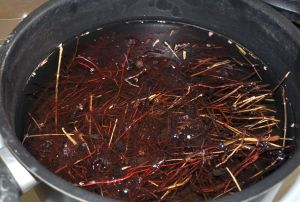
This madder *could* be older actually. I’m going by the date of dissolution of the company that sold it, so who knows when this was actually packaged??!!! I doubt that it has “expired”, though i’m sure at some point, even madder roots lose their potency. From yesterday’s start, things looked mighty promising.

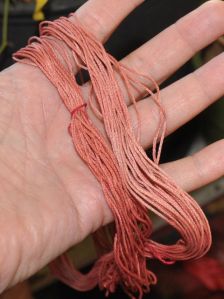
All skeins were premordanted with tannin (gallnut) and alum acetate, as is recommended for cellulose fibres. The thread is a 4 stranded embroidery floss Galler product, “Parisian cotton”, sadly no longer in production. The company is still in business, but doesn’t manufacture this particular commodity anymore. I didn’t do a bran bath however as the last step, a better way of “dunging” than actual dung….Β  That will happen on the next batch of threads to see if it really does make a difference–i know people who swear by this, and it is emphasized with the use of alum acetate, but haven’t tried it myself yet.

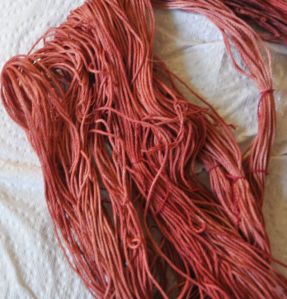
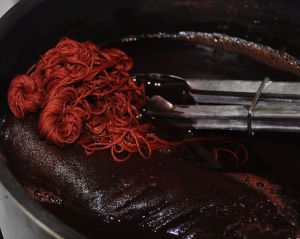
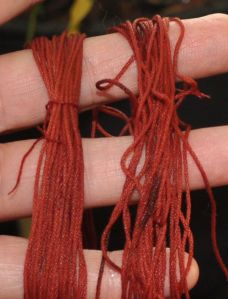
The first skein was in the dyebath for 8 hours. Wet:

And dry. I was quite surprised to see how much the first skein lightened when dry, though i know that dyed items, whether chemical or natural dyes, always dry lighter. Well, nothing wrong with “terracotta rose” πŸ™‚

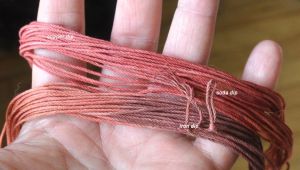
An iron dip on one section of the 16 hour second skein browned it, copper sort of pinked it, some soda ash made it slightly redder.

I still had 4 skeins in the pot at this point and left each for a day longer, progressively, though there’s not much difference in absorption. From now on though, i’ll be leaving the threads (or fabrics if used) in the pot for at least 2-3 days for maximum absorption and depth of colour.

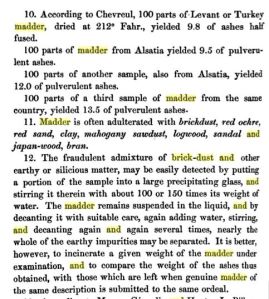
Not knowing the provenance of this bag of ground madder root, i’m not even sure it hasn’t been doctored with red brick-dust or gawdz-know-what, a common practice to pad the bill in the old days! For the amount i put in the stocking, it swelled a LOT, from filling a good two inches to puffing up and making itself look big at 6 so round so firm so fully packed inches.

Though not “true” TURKEY RED, this range of shades are wonderful, because each time i do the dye pots, i get something unique to me. Madder is also more work on cellulose fibres though, with those deep rich radical raunchy reds best showing on wool (a protein fibre). BUT, that’s still a good thing for the personal stash and usage. *And* i can say now with some truth, that i have some “vintage” threads. And yes, i know the terminology: 25+ years is “classic”, 50-100 is “vintage” and 100+ is “antique”. “Vintage” also refers to a specific YEAR, so my threads are done with vintage madder πŸ™‚ I do love this range of shades i got, and look forward to incorporating them into my work, should the Muse return……

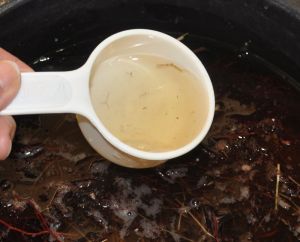
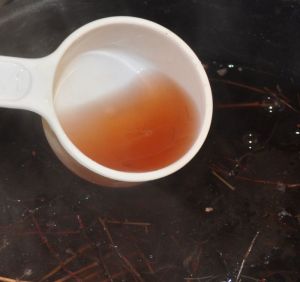
I’ve poured off the first extraction, saving it, and will now see what colours result from a second soaking.

Posted in journal: lessons to learn, madder, Natural Dyes, Naturally dyed threads

summer study

I’ve decided since i am much a gadfly these past few months with everything but dyeing, that the summer is going to be devoted to studying madder.

Previous to October of last year, my results were weak, embarrassing forays into pale pinks and peaches, ordinary orange, and unenthusiastic brawny beiges when the pot gave out . (HA, that was supposed to be “browny” not “brawny, but some of them were rather beefy! πŸ˜‰ ) Somehow the magic clicked on October 3 and i finally got RED, red in all its permutations. Though i previously kept notes, i’m not sure why it hadn’t worked until that magic day–heat? Amount/WOF? Improper mordanting? Dunno, don’t care, because whatever it is i’m doing now is working.

I’ve run out of my Maiwa kilo of madder, but managed to scrounge around the Dye Dungeon and found this:

An extremely fine powder, probably due to its age, i encased it in a nylon pantyhose foot. It’s not only a pain in the bazotski shaking powder out of threads and yarns, but it wastes the bits as well, which may still have some colour left.

Alas,Β  Wide World of Herbs Ltd was dissolved in 1985, long before the web was prevalent, so there’s NOTHING about them, their products or where this madder actually came from. I would like to have supported them, as they were based in Montreal, Quebec (yes, that is SO in Canada πŸ™‚ ). Next best thing, THE best thing now is to buy from Maiwa. (Ordered this morning!)

(In one or two years, i can harvest roots from my own “home grown”.)

I do love red. Before i got into using natural dyes, ecoprinting and rust, which resulted in a lot of earthy neutrals and vintage-y colours, i used a LOT of red in my work. It was unconscious (subconscious?), because i always thought i loved orange. I still do, but in smaller slices and dibs! Red evokes so much to so many, everywhere in the world, politically, spiritually, emotionally, artistically.

Now this isn’t meaning that *i* am going to discover a New madder colour. Look at all of them! There are many more experienced dyers, researchers, scientists and hobbyists who get these results, than this one little personal Dye Dungeon. I however want to know what *i* will get, in my “conditions”–water, heat, the madder i use, the methods i use.

I’d rather be doing something, than the whole lot of nothing that has been going on!

Posted in Redux projects, Sketchwork

when you do a series, and didn’t realize it

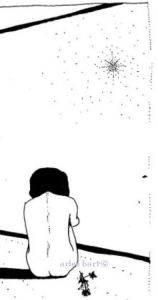
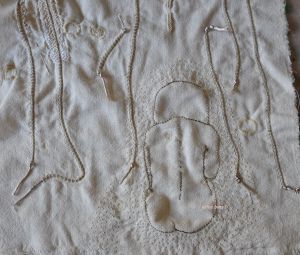
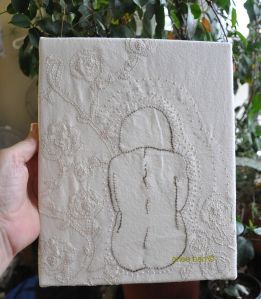
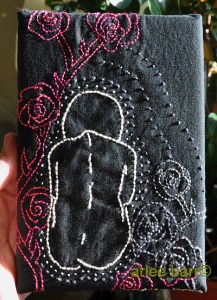
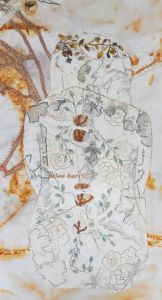
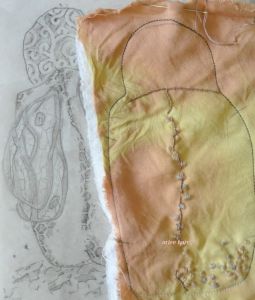
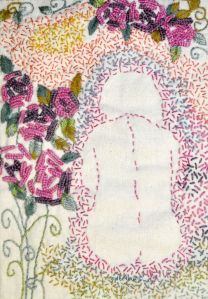
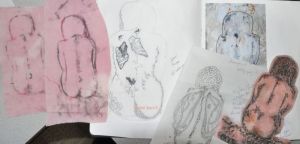
I was looking for something this morning in the studio, and in the photo archives, and realized i have inadvertently done a series of these. Based on my original pen and ink drawing from 1975 (!) (photo cropped because the other side has a drawn-by-an-angsty-18-year-old demon figure πŸ™‚ ), apparently i’ve kept returning to it in my textile work.

2010


2012


2012


2015


2015


2017


2017

This/these are what i’m looking for, as i have some more ideas in mind πŸ™‚

2014

And they involve Lac and Madder dyed fabrics from the recent dyepot adventures, and BLING.

Who says bling doesn’t go with naturals?


Posted in Ecoprints and Natural Dyes, gallium, garden dye plants, Garden Hard, mordants and modifiers, Natural Dyes

Galium results

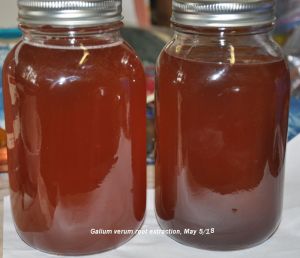
Well, there *is* colour, but it’s weak, probably because of the amount of root i had, maybe 40 scant grams, dirt included. I used Jenny Dean’s method of soaking the roots overnight, pouring off the first water, then slow simmering with a Tums tablet (calcium carbonate) for two subsequent baths that were saved and combined. (A third simmer had no colour at all, and was discarded with the roots, in the garden as no adjunct chemicals were added.) Both fibre types were properly scoured and pre-mordanted also, according to their requirements.

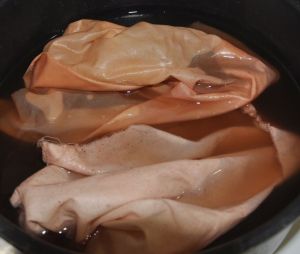
Wet, silk top, cotton bottom, after 24 hour soak in dyepot:

Technically, i should have decanted into two pots, and dyed separately, as cotton (cellulose) and silk (protein) have different uptakes.

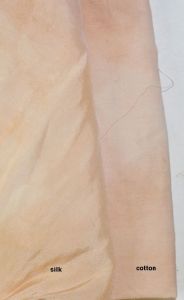
Dry:

Soft, but not terribly exciting, again most likely due to the amount of root gathered.

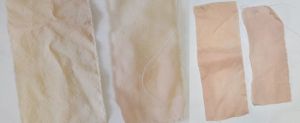
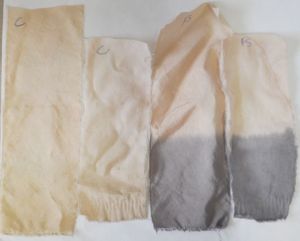
Some modifying/post mordanting on small strips:

Pretty much insignificant changes with (L to R) above, vinegar no change/possible “bleaching effect”, soda ash marginal pink activation

and above (L to R) copper minimal change and possible miniscule yellowing, ferrous sulphate the most dramatic change (might just do this to the remaining pieces and use that way!). (This could also be due to any residual tannins. I used an incredibly SMALL amount of ferrous sulphate, as the stuff is quite strong, maybe a few grains.)

I’m also thinking that because there is so little colour on these, that they are NOT going to be terribly light OR wash fast……BIG sigh of “WhatEVER” πŸ™‚ Still goes in the dye annals though πŸ™‚ I’m sticking to actual madder from now on.


So, was it worth the effort? Yes, in a way, because i learned it is possible to grow, harvest and use a plant material that can and does grow here. And no, because i learned the amount of time to grow (3 years to wait to harvest), time to harvest (ridiculously small amount for the work it took) and use (weak, because time and harvest took too much and amount gathered was too small) was not worth the experiment. Then again, maybe ***this variety of Galium has very little dye material in it. BUT, obviously someone with patience, a larger pot/plot might want to try this so they could say they use “local”, if that’s their Thing.

I’m rather sure too, that if i had just ecoprinted with these, instead of using as a dye material, the results would have been negligible, as there’s little alizarin/purpurin in these roots, probably due more to their size, than the quantity gathered. (Again, or the variety is pathetic in the dye substance department.) I highly doubt that the roots get very big at all, even after years, as that’s not their nature. It would also take masses and masses of them to get a decent quantity, a problematic exercise, also due to the way they grow.

So, have on, some brave soul: i’ve lived and learned, and the lesson is filed! (If you are interested in how i got to this point, this will take you to all of the Galium posts previous.) (And yes, i misspelled it in the archives–gallium with 2 l’s is actually a chemical element.)

Erratum: The Galium species most prevalent here is Galium boreale, which is what i used, not Galium verum as previously stated. There are ***6oo species of Galium, and some have no alizarin at all, but do have pur purin and pseudopurpurin. I’m also certain that some have little to no use whatsoever as a dye plant. I found this article, and they do mention that some of these plants have little to no madder-like characteristics.

Posted in gallium, garden dye plants, journal: lessons to learn, Natural Dyes

galium, part two

Sad, veryΒ  very sad.

Granted, i had a really small amount of roots, but i’m not sure (yet) that this was worth it! This “red” has a quite brown tone to it, but of course, the proof will be in using it. I’m still waiting for pre-mordanted fabrics to be finished πŸ™‚

I’m thinking however, that whatever results i get, this was a valuable experiment in growing my own dye, processing it, and using it. You don’t know if you don’t try!

Posted in gallium, garden dye plants

red from bedstraw (Galium species)

Welllll, maybe…..

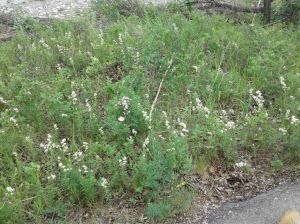
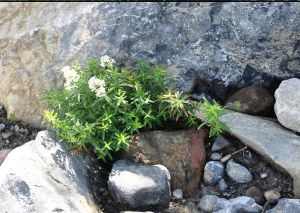
Mine is Galium boreale, a type that grows wild here, though i bought my seeds locally, as i was unable to either gather seeds, or dig up roots. Also known as Cleavers, Northern Bedstraw and a host of other nastier names because it’s invasive, and because the tiny seed burs and clutchy hooky barbed stems (also a characteristic of madder) stick to everything, including skin.

As per Jenny Dean’s advice, i soaked it overnight.

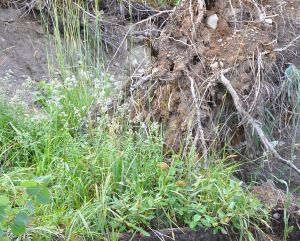
You can certainly see the red in the root above. (Go ahead, click on it to enlarge.) Didn’t look promising to begin with. My little pile of skinny weeny roots was full of dirt i couldn’t rinse off, so i filtered the mess through some haremcloth (cheesecloth is too porous for dirt), and got what i could off the roots. I had MAYBE a scant 40 grams, counting the dirt that wouldn’t let go πŸ™‚ I’m working on a rather laissez-faire attitude here with that–perhaps the minerals in the dirt will leach out and help the colour somehow, though i doubt it……. (I don’t subscribe to the “pot as mordant” theory–unless it’s a really rusty iron pot, or a pure copper one that things have been sitting in for weeks………MORDANT PROPERLY TO BEGIN WITH. Save yourself the grief.)

First soaking poured off–possibly the browns and yellows inherent with red dye roots, possibly the dirt factor:

I refilled the dye pot using our tap water, which is hard, being from the Alberta Rockies, but did throw in a Tums as well, as that has really helped my madder along.

So, there is *definitely* colour in these pathetic sorry little excuses for roots, but as to whether there will be any good results ON cloth or threads will be the real test.

But, i have to do some more pre-mordanting of fabrics and threads, as i seem to be out! Stay tuned!


Posted in gallium, garden dye plants, Garden Hard, madder, Natural Dyes

it might “madder” that i grow my own :)

We gardeners in harder zones have a tough time growing certain things. If you’re a gardener who wants to grow your own dye plants, it’s even tougher! If you’re a Calgary gardener who wants these, it’s even more more tougher! Our growing season is shorter, and while we get intensely sunny days, due to our altitude, we also get much cooler nights–no steamy evenings here (at least, not in the garden πŸ™‚ )

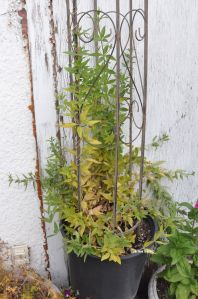
Last spring i planted madder seeds in a big black pot, containing it because madder is notorious for sneaking everywhere with the root system, and this makes it easier to harvest when the time comes (usually after 3 years), but also because my Zone 3 garden is clay based, due to being only a few 100 yards from an old (still quite active) river. I used a mix of “garden soil” i’d had delivered, some actual garden soil from the extant garden, a bit of sand and then amended it weakly with some lime.

It grew to about 3.5 feet last year, and survived the first 3 frosts, before i heeled it into the garden in October. That means, i dug a hole deep enough for the pot, sank it to its rim, then mulched with newspaper, garden debris and it’s own stalks. (I also removed the trellis obelisk, as metal conducts cold and i didn’t want the roots “injected” with -20 to -40 temperatures!)

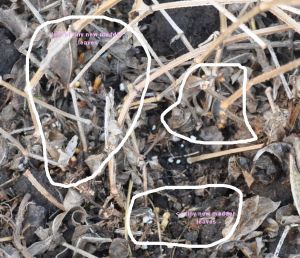
I pulled it out of its hole onΒ  the 27th of April, and was about to PULL all the old growth off, when i realized i didn’t know if it would grow new branches, or start from the old ones. Good thing i stopped and really looked, because the old growth base is precisely where the new growth starts! If you click on the photo below, you can see the new growth.

While it may not look terribly exciting to some, it IS. IT’S VERY VERY VERY EXCITING, because that means at the end of next year, i can be using my own home grown madder for dyeing with! Madder roots are best used in year 3, or 4 if you can wait that long πŸ™‚ The big deal also is the fact that we had one of our harshest winters in a long time, and it still survived being buried under 3 feet of ****ing cold and snow for 5 and a half months. It was also a LONG winter, with snow still happening until mid April…………..

It didn’t flower last year, though that again is not that much of a disappointment, but i’m hoping because it has a much earlier “start” this year IN it’s growing conditions (ie no indoor starting, coddling and having to harden off), that it will—–because it also occurred to me this morning, that if it does flower, seeds from it would already be on their start to being a Zone 3 hardy dye plant!

I’ll continue to use “commercial” madder until then, but i can’t wait to see the results of true “slow dyeing” πŸ™‚

Which reminds me…….last year i harvested the third year roots of gallium, a more “local” dye plant that gives red from the root also. (Gallium grows almost everywhere in the world so i call it “local” because *i* *can* harvest it locally if i had the patience. I grew mine from locally sourced seeds though, as the wild areas are too dense with roots to find any easy to dig out. And Conservation Officers would nail me, if i got caught. And i’m not about to dig in a wild area like that, to that extent, because ya just DON’T!) I did wrap it in silk at the time, ready to throw in a pot and use as an ecoprint material, but never got to it, and just added it back to the pile collected. Today i will try using it!

Posted in "OPINIONATION", FybreSpace the shop, journal: lessons to learn, Probably talking to just myself

about “shop updates”

It seems every time i do this, i lose a few followers, at least on FB! Please remember that small businesses/artists need support too–especially since i myself am temporarily no longer a “floral arranger”/”employee” by day.Β  Some/most of us do not work for conventional employers, whether by choice, or because of need for childcare that necessitates someone staying home, or living in a place where jobs are few and far between, or that geography says it’s too far to commute to! You get one of a kind items this way, made with skill and care, unique viewpoints and representations, often created with original to the maker supplies too, and passion and intent. We can’t just show you what we’re doing: it has to pay for itself, pull its own weight, fly out into the world. Some of us are not just artists, but WORKING artists–and working artists make art/things for sale, not just to pretty up a blog or Instagram.

An artist/maker spends time not only making the product, but developing the skills sometimes for years, doing the initial sketches or design work,Β  gathering the supplies, setting up a work space, photography and editing after, listing the product, packaging when sales are made, schlepping them to the post office, buying special envelopes for some work, and has to pay fees as well to keep the business going, from shop fees, to financing charges, more supply buying and a host of little things that are peculiar to each artist. I don’t mean any of this to offend anyone, am not begging, and certainly am grateful when someone appreciates what i do by opening their wallet. BUT things, “products”, Art, stuff, never spring magically from “a sweated brow”on to a for sale page with no thought or effort beforehand πŸ™‚ It doesn’t just get THUNK into existence: there’s WORK first. I keep my prices low, given the amount of effort/skill/vision that goes into them, and having seen some sell smaller less involved bits for more coin,Β  it sometimes really depresses me, when they’re shocked that i would have the Audacity to actually want good coin, not a token of “faith” in my pocket. There are times when i just want to give up, quite honestly.

On the other hand, i’ve had well meaning friends and family say some of my prices are too “low”, and yes, i’ve always subscribed to the “some bucks is better’n no bucks” theory, but i know what has gone into those particular efforts, and am comfortable with what i asked for πŸ™‚

I’ve had queries about specific pieces that i have shown in my galleries here, things i *might* like to sell to a good home, but have not actively pursued a sale, or even a hint of one, and after a few back and forth emails, when they find out the price–because my bigger pieces, my more involved pieces are more expensive because they were a hell of a lot more work, not only in size, but in execution and skill — *cricket noises*, no further communication, not even a “thanks for answering, but regretfully, no thanks” response. I get that you thought because you bought a piece 6 years ago for $75, that you might figure one of my massive works is only double that now, but that’s not how it works. I know too that active, dedicated, supporters of textile art don’t always have money, and that too, some figure because they have supported someone before, that they should get a deal. I’m happy to work out a payment plan for something already produced, and have on occasion happily done commissioned work on a payment plan as well.

Do you want something that lasts? Are you the kind of shopper that only buys things that *immediately* gratify you? Are you making an investment in your own happiness, or just to fill your belly, impress someone else, keep up with a trend? I’m constantly remembering customers at the flower mines who would decry that “flowers are so expensive for something that doesn’t last”–well, honey, how’s that steak you had last night, keepin’ on? Those flowers that lasted “only” a week made someone happy every *single* day of that week. That’s a lasting impression.

So is art, Art. Big statement piece, small joy as a present for you or a friend, something to make something else with, it’s all in the shop. Thank you for listening to the end of the commercial, not muting it while you go for a pee and a snack πŸ™‚

>